SKU: 12978624830
pineapple plant images

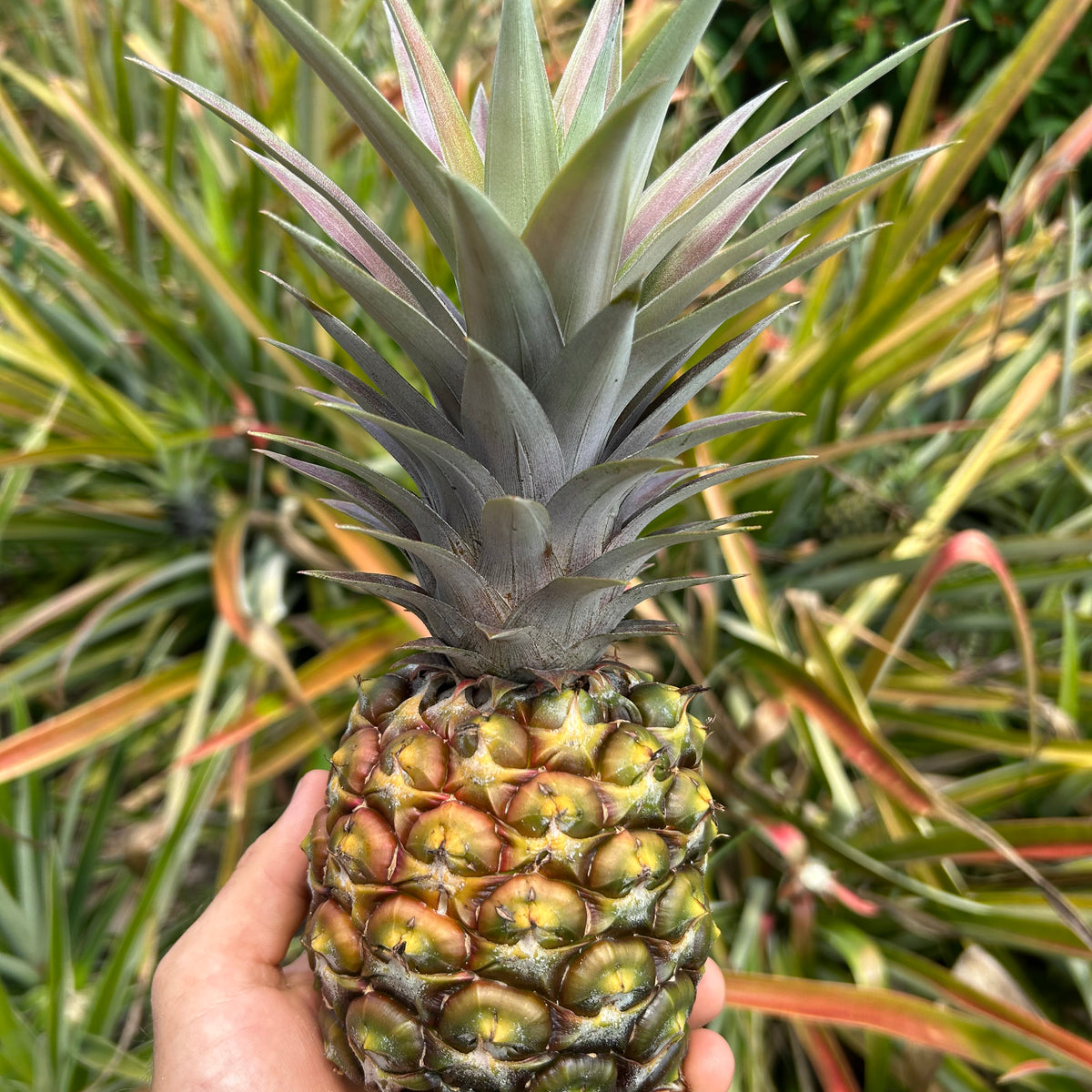
pineapple plant images Pineapple Plant ‘Sugarloaf'

Sale price$18.23 Regular price$20.25
Save 10%

Pay in installments of $5.06 with ShopPay, AfterPay and Klarna

Shipping Estimate
USA
  • USA
  • CAN

Ships within 48 hours · Estimated delivery Jul 31 - Aug 5

Promo Codes Available:

For Your Every Summer RSVP, with Code: SUMMER15

Description

pineapple plant images Pineapple Plant ‘Sugarloaf'A large fruit with white flesh and edible core. Very sweet and a favored variety among growers. Common in Hawaii and sometimes referred to as Kona Sugarloaf. The plant has no spines on its leaves. ________________________________________________________________________________________ Latin name Ananas comosus Pineapple plants are one of the most ubiquitous tropical fruit plants. Surprisingly, these bromeliads are in the same family as tree dwelling

A large  fruit with white flesh and edible core. Very sweet and a favored variety among growers. Common in Hawaii and sometimes referred to as ‘Kona’ Sugarloaf.  The plant has no spines on its leaves.

________________________________________________________________________________________

Latin name - Ananas comosus

Pineapple plants are one of the most ubiquitous tropical fruit plants. Surprisingly, these bromeliads are in the same family as tree-dwelling epiphytes like Spanish moss.

The fruits are familiar, highly-palatable, and fun to grow. Pineapple plants prefer well-draining, sandy/loamy soil as their primary nemesis is root-rot. Container-growing your pineapples is absolutely acceptable and they take quite well to fruiting in a pot.

Pineapple plants, although fairly low-growers, create a wide footprint with their broad leaves. Feel free to cut leaves back out of your walking paths. Commercial growers practice this method regularly with no effect on fruit production.

After about 70-80 leaves have been produced (variety-dependent), a pineapple will begin to produce it’s flowering stem. Pineapples are seedless unless grown closely with other varieties or hand-pollinated for seed production. In the wild, pineapples are primarily pollinated by hummingbirds, but zero pollination is required to yield delicious fruits.

Pineapple fruits are high in water content (86%) and provide a rich source of manganese and Vitamin C. You’re likely well-aware that pineapples are widely used in drinks, confections, fruit salads, and straight up.

A little pineapple history…

Pineapples have been cultivated for centuries in their indigenous region of Central and South America, but were not introduced in Europe until the 17th century. It’s moniker is owed to the tendency of European explorers to name any novel round fruits “apples.” 

Explorer John Smith was one of the first to utter the term “pineapple” to describe this fruit in 1624. By the late 1700’s and early 1800’s, wealthy Europeans installed greenhouses or imported pineapples for display purposes, cycling them through use as centerpieces until they began to rot.

In the 1800’s, commercial production of select cultivars like ‘Smooth Cayenne’ began. The ‘Smooth Cayenne’ cultivar achieved worldwide diaspora as it was favored for commercial growth throughout Europe, Hawaii, Australia, and Africa.

How long until my pineapple fruits?

The time from planting to harvest depends on the part of the plant you are using to propagate the pineapple. Use the guide below to set your expectations regarding harvest timeline:

-Pineapple Crowns (the top of the fruit) can produce a new crop within 12-18 months.

-Pineapple Pups/Suckers (off-shoots from the side of the plant itself) can produce a new crop within 18-24 months.

-Pineapple Slips (baby plants taken from the bottom of a pineapple fruit) can produce a new crop after about 24+ months.

When to pick pineapples…

Pineapples typically mature in the warmest months. In South Florida, harvest season rolls from June through September. You can tell your fruit is ready to pick when color change begins and the fruit begins to emit scent. Some gardeners are able to leave their pineapples on the plant until full yellow coloration; Gardeners with rodent pests should pick their fruits as soon as yellow blush appears to avoid loss of your precious fruits.

Once in a while, you may experience the glory of an off-season pineapple at Thanksgiving or Christmas-time.

_____________________________________________________________________

Size - 4’ Wide x 3’ Tall 

Noteable Characteristics - Fruits year after year, and offers more plants (via slips, pups, and crowns) year over year.

Sunlight requirements - Full or Part Sun

Cold hardy temp - Damaged below 50 F; Killed at freezing temps

Harvest Season - June, July, August (an off-season fruit once in a while)


Shipping Notes
  • Free Standard Shipping on $100+ Orders to the USA.
  • Except Preorder products are shipped in 48 hours.
  • Delivery to the USA:
  1. Standard Shipping : 3-10 business days
  • If time is of the essence, please consider selecting expedited delivery for faster service.
Exchange/Return Notes
  • We offer a 30-day return/exchange service after receiving.
  • Final sale items are not eligible for returns or exchanges.
  • To process your return/exchange, please contact us at [email protected]
  • Please click here for more details>>> Return & Exchange Policy
SKU: 12978624830

Discover Niche Categories That Outsell pineapple plant images

Top-Converting Item to Boost Your Average Order

4.5 ★★★★★
Based on 5 reviews
Sort
Highest Rating
Newest First
Oldest First
Product Reviews
C
Cliente Kindle
Alexandria, US
★★★★★ 5
Broad, detailed and comprehensible book on Linux Kernel Programming
Format: Paperback, Format: Paperback
I got on my desk a copy of "Linux Kernel Programmin (2E)" by Kaiwan N. Billimoria and will shortly mention what this book is about. It is a book that you can read cover-to-cover to have a better understanding of kernel development, but I see also how it can be used as a reference when you are going to throw C code at your compiler and build a linux kernel. There is a number of scenario why you might want to do that: - You are recompiling the kernel for a new machine that needs better support - You are going to implement a kernel module and you need some context - You are going to work on the kernel yourself While all of those use-cases for the book are technically a fit, apart from gaining some higher understanding I see the most out of it if you are going to code on the kernel itself. There you have everything that is needed. You can go back and forth between your code and the book, and still learn by doing. What mostly impressed me is the breath of the topics: the chapter about writing a config file for the kernel enlists a total of seven (7!) different strategies to get started with a configuration file for your kernel. Also a lot of side tools are mentioned to help out with kernel development and debugging. Quite some module development can be in theory done without fully understanding the details of the kernel itself, but the deeper you reach, the more you will need the details that are well discussed in the book. Memory allocation, CPU scheduling algorithms, the book does not try to save words and describe in detail and plain language most things there is to know, not sparing plenty of references to other books and articles. Also, the material is up-to-date with the latest kernel.
WAS THIS REVIEW HELPFUL?YesReportShare
Reviewed in the United States on March 8, 2024
S
Sergio Prado
Lowell, US
★★★★★ 5
For begginers and also experienced kernel developers!
Format: Paperback
There are a few aspects about the book that I really like. One is that every chapter provides a very detailed and immersive look into a specific part of kernel development. Another interesting aspect about the book is that it is based on a very recent kernel version (6.1), which is also an LTS version that will be maintained for a few years. I am not aware of any other book about the Linux kernel based on such a recent version. The first 3 chapters of the book explains how to configure and build the Linux kernel (both natively for x86_64 and cross-compiling for AArch64). After that, chapters 4 and 5 explains all you need to know about how to write kernel modules. And starting from chapter 6, the book introduces different aspects of kernel programming in very detail, from the scheduler to memory management and synchronization. Get ready, because it is indeed a big book, with more than 800+ pages! I really think the book targets both beginners and experts. For beginners, it will be a deep dive into major kernel programming concepts (make sure you follow along the exercises proposed by the author). For experienced kernel developers, the book is really a refresher. Though I work with the Linux kernel for 15+ years, I can still learn a lot by reading the book. An old dog can always learn new tricks, right?
WAS THIS REVIEW HELPFUL?YesReportShare
Reviewed in the United States on May 30, 2024
P
Verified Purchase
princesscoldheart
Phoenix, US
★★★★★ 5
Organized well. You can read it section by section. Fantastic information. Clearly presented.
I like this book better than "what to expect" because this one does a better job of what you'll ACTUALLY expect versus telling you the throngs of horrible things that could happen to you or your baby. I'd rather be informed than mentally prodded with scary information. On one hand, it's good to know what could happen, so the other books you've probably already ordered are good to skim through, but this book I recommend reading all the way through. Easy to read, you'll actually have TIME to read it because you can read the age your baby is instead of a book that's all mixed up and organized by diseases and threats. Clear photos and explanations and tips on how to make your life and baby's life easier and better. I've understood my baby's needs better because of this book. I feel really glad I got it because it was the only book that really helped my daily life with my newborn.
WAS THIS REVIEW HELPFUL?YesReportShare
Reviewed in the United States on November 21, 2013
T
Verified Purchase
thibault rosazza
Carnegie, US
★★★★★ 5
Useful
Format: Hardcover
Comprehensive book from 0 to 1 year. This book provide good tips and tricks on how to raise and take care of your newborn. Well designed, we come back to it time to times to get some help and support.
WAS THIS REVIEW HELPFUL?YesReportShare
Reviewed in the United States on September 18, 2025
J
Verified Purchase
James Henderson
Belleville, US
★★★★★ 5
we loved this well-illustrated book
As first-time parents, we loved this well-illustrated book, recommended it to one couple, and recently ordered another for an expecting couple in our family. Rather than grouping content by topic, the book is ordered chronologically, starting with Day 1 and progressing throughout the first year. Don't expect to read straight through; there are lots of pictures, sidebars, notes, etc. This makes it easier to find and retain relevant information (as opposed to reading a 100-page section on "Diet and Nutrition"). Provides a thorough treatment of most of the common issues, fun discoveries and concerns you encounter as a new parent.
WAS THIS REVIEW HELPFUL?YesReportShare
Reviewed in the United States on January 6, 2015

recommand products