SKU: 13509030836
pacific northwest native flower seeds

pacific northwest native flower seeds Native Pollinator Meadow Seed Mix 1 (For West of the Cascades)

Sale price$23.45 Regular price$26.05
Save 10%

Pay in installments of $6.51 with ShopPay, AfterPay and Klarna

Shipping Estimate
USA
  • USA
  • CAN

Ships within 48 hours · Estimated delivery Aug 23 - Aug 28

Promo Codes Available:

For Your Every Summer RSVP, with Code: SUMMER15

Description

pacific northwest native flower seeds Native Pollinator Meadow Seed Mix 1 (For West of the Cascades)More than 30 species all native to the broader Pacific Northwest Attract bees, butterflies, hummingbirds, and beneficial insects with this dramatic wildflower show. The combination of native annuals and perennials in this seed mix provides an ongoing succession of flowers over multiple years. This seed mix includes native bunch grasses to provide nesting habitat for bees and to reduce weed encroachment. Unlike cheap, mass produced "wildflower seed

More than 30-species -- all native to the broader Pacific Northwest

Attract bees, butterflies, hummingbirds, and beneficial insects with this dramatic wildflower show. The combination of native annuals and perennials in this seed mix provides an ongoing succession of flowers over multiple years. This seed mix includes native bunch grasses to provide nesting habitat for bees and to reduce weed encroachment.

Unlike cheap, mass-produced "wildflower seed mixes," this mix includes true native species, and is formulated at a seeding rate of 60+seeds per square foot. 

This mix was developed following almost two-decades of extensive research and real world field trials, including information gained during our co-founder, Eric Lee-Mäder's tenure at the Xerces Society as a director of pollinator conservation. In fact, earlier Xerces formulations that this improved mix are based upon were evaluated by the USDA's Natural Resources Conservation Service in Corvallis, Oregon where these plant species consistently demonstrated: 1) extremely high attractiveness to native bees, 2) extended bloom time across multiple seasons, 3) good multi-year persistence. To date this mix has been successfully established on hundreds of acres regionally.

Some key notes:

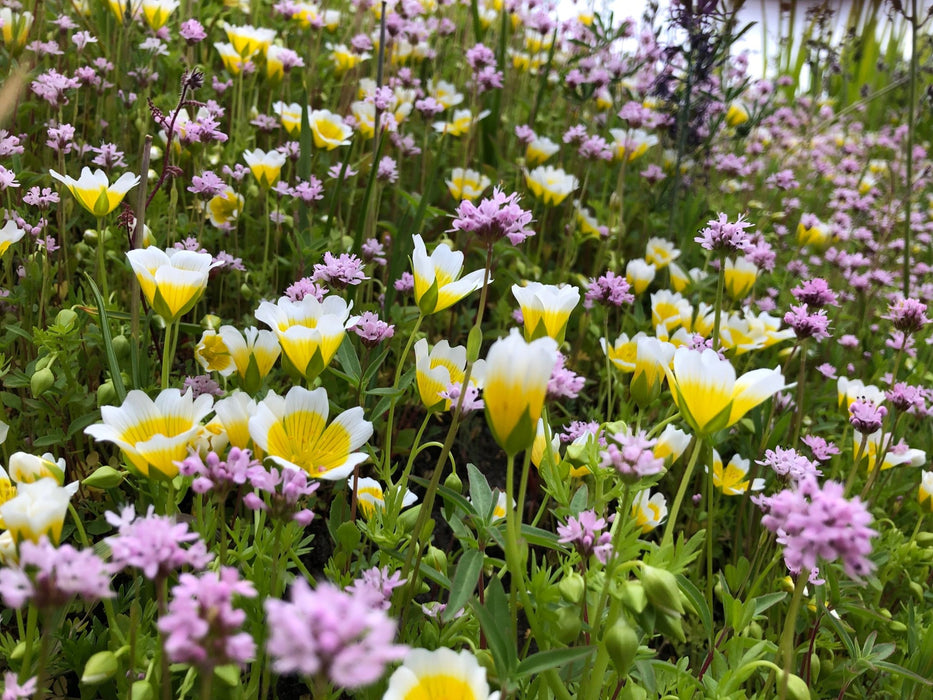
  1. The photos here show the changes in blooming species across the seasons. Because of the diversity of species in the mix, it is a constantly changing spectrum of plants, a spectrum that also changes from year-to-year.
  2. This mix makes good use of native Annual Hairgrass (Deschampshia danthoides), as a fast-growing nurse crop species. This small-statured grass typically establishes early in the first year, filling in spaces between the slower-growing wildflowers (Stabilizing the soil and reducing places for weeds to invade). It does not typically re-seed extensively, nor persist beyond a few years -- so -- if your meadow looks especially "grassy" shortly after planting, please note that much of that grass is likely this beautiful little native species that helps form a bridge between early establishment and the long-term life of the meadow.  

Seed Mix Contents

Annual Wildflowers 30%

Douglas Meadowfoam (Limnanthes douglasii), Globe Gilia (Gilia capitata), Farewell to Spring (Clarkia amoena), Seablush (Plectritis congesta), Spike Primrose (Epilobium densiflorum), White Meadowfoam (Limnanthes alba), Large Flower Collomia (Collomia grandiflora), Prairie Burnet (Sanguisorba annua), Scouler's Popcornflower (Plagiobothrys scouleri), Elegant Calicoflower (Downingia elegans), Fragrant Popcornflower (Plagiobothrys figuratus), Maiden Clover (Trifolium microcephalum), Large-Flowered Collomia (Collomia grandiflora), Red Maids (Calandrinia menziesii), Winecup Clarkia (Clarkia purpurea)

Perennial Wildflowers 50%

Springbank Clover (Trifolium wormskioldii), Spring Gold (Lomatium utriculatum), Self Heal (Prunella vulgaris), Western Yarrow (Achillea millefolium), Large Camas (Camassia leichtlinii), Riverbank Lupine (Lupinus rivularis), Bigleaf Lupine (Lupinus polyphyllus), Meadow Checkermallow (Sidalcea campestris), Wooly Sunflower (Eriophyllum lanatum), Western Buttercup (Ranunculus occidentalis), Puget Gumweed (Grindelia integrifolia), Prairie Cinquefoil (Potentilla gracilis), Canada Goldenrod (Solidago canadensis)

Grasses 20%

Annual Hairgrass (Deschampsia danthoides), Roemer’s Fescue (Festuca romerii), Tufted Hairgrass (Deschampsia cespitosa), Meadow Barley (Horedum brachyantherum), Prairie Junegrass (Koeleria macrantha)

Please check out planting instructions for mixes here. You can do this!

Seeding Rates:

100 sqft = 0.6 ounces

400 sqft = 2.7 ounces

1000 sqft = 6.7 ounces

5000 sqft = 33.5 ounces

Shipping Notes
  • Free Standard Shipping on $100+ Orders to the USA.
  • Except Preorder products are shipped in 48 hours.
  • Delivery to the USA:
  1. Standard Shipping : 3-10 business days
  • If time is of the essence, please consider selecting expedited delivery for faster service.
Exchange/Return Notes
  • We offer a 30-day return/exchange service after receiving.
  • Final sale items are not eligible for returns or exchanges.
  • To process your return/exchange, please contact us at [email protected]
  • Please click here for more details>>> Return & Exchange Policy
SKU: 13509030836

Discover Niche Categories That Outsell pacific northwest native flower seeds

Top-Converting Item to Boost Your Average Order

4.1 ★★★★★
Based on 24 reviews
Sort
Highest Rating
Newest First
Oldest First
Product Reviews
A
Verified Purchase
Alan J. Webb
Dallas, US
★★★★★ 5
An Enigma
I became interested in the life of Deng Xiaoping after reading THE TRAGEDY OF LIBERATION by Frank Dikotter and AVOIDING THE FALL by Michael Pettis. Deng is an enigma. He was a key player in the Chinese leadership from the earliest days. He was one of the core revolutionary leaders and one that was heavily involved in directing military campaigns leading to liberation. Afterward, he was the administrator for Sichuan and southwest China and implemented Maoist programs that led to mass starvation and incalculable human suffering. So, how was it possible for Deng Xiaoping to emerge as supreme leader of China, opening up the country to 4 decades of unprecedented growth? Did he learn from the failures of earlier policies? If so, what led to his change in thinking and when did it happen? Or was he always a pragmatist and a loyal follower? And if his thinking did change, how was he not one of the many leaders who were expelled from the Party and sent to prison or executed? It seems highly unlikely that a country that went through the purges, the witch hunts and the upheavals like the Cultural Revolution could have produced a leader of the stature of Deng Xiaoping capable of implementing the policy reforms that have led to China's 4 decades of unprecedented growth. These are the questions that motivated me to tackle this 800-page biography. Ezra Vogel is one of the world's pre-eminent China scholars. His knowledge of the events, people and places as well as the research of other scholars is second to none. He uses this knowledge combined with written accounts and interviews to piece together a comprehensive history of the life of Deng Xiaoping. The account is not strictly chronological. Vogel takes different periods of Deng's life and divides each period into a set of topics covered in separate chapters. This makes the explanation of the events driving each topic easier to follow but it means that the reader may lose track of contemporaneous events discussed in a previous chapter. Unfortunately, Vogel's review of the life of Deng Xiaoping has not fully answered my questions but it is not for lack of trying. Vogel points out early in the book that Deng Xiaoping did not keep a diary or personal writings or confide his inner-most thoughts on government policy with those around him. His speeches were well-organized and thought-out but without written notes. Consequently, we have no window into his thoughts; we have only his actions and events surrounding him to judge his thinking and how it changed over his life. This lack of a personal written record no doubt was a key factor in his survival of the many leadership purges under Mao Tse-tung. Another factor was his complete loyalty to the Party and to Mao. Although Deng was removed from top leadership positions three times in his career, including a 3-year exile during the Cultural Revolution, he was never expelled out of the Party. We also learn that Deng Xiaoping was, above all, a pragmatist and a patriot. His driving motivation was to do whatever necessary to foster China's economic development and re-emergence as a global leader. He was not an ideologue, although he was a skillful politician, sensitive to those who opposed his ideas and careful to find ways to test out policy reforms in isolated cases before moving toward full implementation. Deng Xiaoping is easily one of the most important leaders of the 20th century. We are indeed fortunate to have Ezra Vogel's scholarly and literary talents applied to an English biography of Deng Xiaoping. There is much we can learn from Vogel's account but even more that is left for interpretation reading between the lines.
WAS THIS REVIEW HELPFUL?YesReportShare
Reviewed in the United States on May 25, 2014
A
Verified Purchase
Alice Miller
Lowell, US
★★★★★ 1
Not so much
Format: Hardcover
I can't judge the social science merits of this study. But it's treatment of premodern Chinese history is shoddy and ill informed of the existing literature.
WAS THIS REVIEW HELPFUL?YesReportShare
Reviewed in the United States on January 18, 2026
M
Verified Purchase
Mateo Buriticá
Bozeman, US
★★★★★ 5
Una abrebocas de como puede ser un mundo multipolar
Format: Hardcover
Un buen análisis de como puede impactar a los gobiernos, empresas y personas un mundo multipolar con zonas de influencia por poderes regionales. La geopolítica cada vez está más vigente y si no la entendemos, no vamos a poder aprovechar las nuevas oportunidades de esta era.
WAS THIS REVIEW HELPFUL?YesReportShare
Reviewed in the United States on January 13, 2026
B
Verified Purchase
Bill M
Lake Worth, US
★★★★★ 5
The Future is Now
Format: Hardcover
The author makes a compelling argument that the world is fracturing into two principal trade blocs, the U.S.A bloc and the China bloc. Even cursory review of the daily business news confirms the author's argument is taking shape now. This is an important book for those interested in geopolitics, economics, and even those who are trying to determine where to invest their funds based on changing global dynamics.
WAS THIS REVIEW HELPFUL?YesReportShare
Reviewed in the United States on December 14, 2025
O
Verified Purchase
Oregon Gma
Omaha, US
★★★★★ 5
Cute book and engaging story
Format: Paperback
My grand daughter reads at a 3rd grade reading level, so doesn't want to read the easy readers but loses interest easily with traditional chapter books. This little book was a perfect fit. She's an axolotl fan so the pictures and the story line kept her engaged. There's even a couple of pages of axolotl facts at the end of the book. Well worth adding to her book shelf!
WAS THIS REVIEW HELPFUL?YesReportShare
Reviewed in the United States on May 23, 2026

recommand products