SKU: 13534626374
pink spider lily bulbs

pink spider lily bulbs Peppermint Spider Lily (Lycoris incarnata) – The Southern Bulb Co

Sale price$23.57 Regular price$26.19
Save 10%

Pay in installments of $6.55 with ShopPay, AfterPay and Klarna

Shipping Estimate
USA
  • USA
  • CAN

Ships within 48 hours · Estimated delivery Sep 30 - Oct 5

Promo Codes Available:

For Your Every Summer RSVP, with Code: SUMMER15

Description

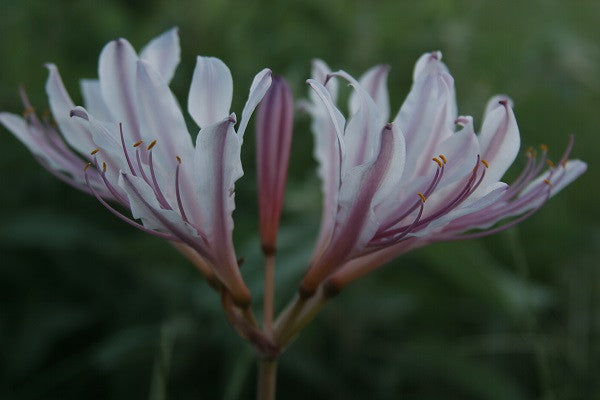
pink spider lily bulbs Peppermint Spider Lily (Lycoris incarnata) – The Southern Bulb CoThe Lycoris incarnata is often called "Peppermint Spider Lily." As soon as you see the bloom, you know why. The blooms look like peppermint sticks where a deep pink stripe runs down the middle of each white petal. These lovely blooms are fascinating and unique. They work best in zones 5b 8a. How they bloom: Lycoris incarnata "Peppermint Spider Lily" bulbs bloom differently than most flowers. Now is a perfect time to plant these bulbs. These bulbs need

The Lycoris incarnata is often called "Peppermint Spider Lily." As soon as you see the bloom, you know why. The blooms look like peppermint sticks where a deep pink stripe runs down the middle of each white petal. These lovely blooms are fascinating and unique. They work best in zones 5b-8a.

How they bloom: Lycoris incarnata "Peppermint Spider Lily" bulbs bloom differently than most flowers. Now is a perfect time to plant these bulbs. These bulbs need 1-2 years after they are planted before presenting blooms. Your bulbs are developing a strong root system right now to support future foliage and eventually blooms. You might see the foliage this February - May, but don't be concerned if you don't. Most people still expect to see something growing during the summer months. You won't see anything. These bulbs are dormant in the summer. After 1-2 years, the flowers suddenly appear with the first later summer and early fall rains. One day there is nothing growing and then suddenly you have a surprise, a fully blooming flower! This bulb acts very similarly to red spider lilies, yellow spider lilies, and schoolhouse lilies. Simply put, they bloom in the fall and then have foliage for the winter.

Foliage: Let's talk foliage for a moment. The "Peppermint Spider Lily" foliage is a lovely green, and will look great by itself in the spring or mixed in with spring blooms. We know that we all want to see the beautiful unusual blooms in the late summer, but the foliage is very important. The foliage is what allows the bulb to grow and multiply. Many people get very concerned if they don't see the bloom the first year that they plant it and believe that maybe the bulb isn't any good. A good rule for perennial bulbs....if the bulb is firm when you plant it, it is healthy and will eventually come up. The foliage is what you watch for since the bulbs aren't going to bloom for 1-2 years. The foliage will grow during the winter months, February - May, so be sure to plant the bulbs where they will receive at least 6+ hours of winter sun. Even if the foliage gets hit by a winter cold snap, it will have taken in nutrients for months! Always allow the foliage to die down naturally and don't cut it off. If you cut it, you are killing the bulb. Once the foliage is completely dead which is usually around the beginning of May, this area can be mowed. Remember, it takes a lot of energy for the bulb to push that bloom up out of the ground and open wide. The more time the bulbs can take in nutrients, the more energy they will have for that fall bloom.

Just a thought...if it looks like you are going to have a cold snap and want to protect your foliage, you might consider covering it with a bucket and then removing the bucket once the daytime temperatures warm up.

Blooms: When talking about color, these unique blooms have been compared to the crinum "Milk and Wine" blooms. Each petal is white with a dark pink stripe running down the center. The blooms will appear late August or early September on a naked stalk like the other Lycoris. In late summer, each bulb sends up an 16-20 inch stem that holds several blooms. Each stalk will hold 6-8 frilly-edged blooms. It may take 1-2 years before the blooms appear, but the show it produces in late summer is spectacular. Once established in your garden they are there for a lifetime! These blooms need water to bloom. They respond to the late summer rains well, but if there is a hard drought, be sure to begin watering the area around the beginning of August to help the bulbs have enough energy to bloom. A naked stalk will rise quickly and a few days later peppermint-colored blooms will appear.

Plant: Don't plant the bulb too deep. You will plant the bulbs 2-3 times deep the height of the bulb (so if your bulb is 1" tall, then you will plant it 2-3 inches deep). Because they bloom on a naked stalk, they look better when planted in groups. You can plant the bulbs close together (2-4 inches apart) to make the blooms look more natural or spread the bulbs out and allow 6-8 inches in between each bulb. The area will look sparse the first couple of years that the blooms come up, but the bulbs will multiply and fill in several years after that.

Lycoris bulbs really do well in any type of soil except full clay. They thrive in soil that has plenty of organic material mixed in but they do not require fertilizer. Newly planted bulbs would actually be harmed by exposure to fertilizer, so if you are going to apply nutrients, limit the application to established plants when the plants are producing their green leafy foliage during the winter. After planting the bulbs, water the soil thoroughly. Damp soil is ok, as long as the bulbs are in a spot where they will receive plenty of winter sun and the foliage is allowed to die down naturally in the spring. Standing water is not good. Once the summer season starts these bulbs will do best in soil that dries out a bit, as this facilitates its entry into the dormant stage when the leaves die back. This period is followed by its blooming season when it will reward daily watering with long-lasting blooms. Too much moisture in the soil will lead to the bulbs rotting.

**The following picture is of Lycoris squamigera, Naked Ladies, which are in the same family, but it gives you ideas on how you can plant them.

Sun Requirements: The single most important thing about landscaping with Lycoris is the sun. They need at least 6+hours of WINTER sun. That means about 6-8 hours of sunlight during the winter months - they do great with full winter sun. Because they are dormant during the summer, the amount of summer sun doesn't matter; however, Lycoris incarnata blooms will last a little longer and tend to appear a little earlier when they bloom in the summer shade. They fade more quickly when in full hot summer sun.

The Lycoris all have the same requirements of the sun. If you look at the photo above of the Lycoris squamigera "Naked Lady" blooms, you will see that they are in the shade of the trees. You can be sure that most, if not all, of those trees, will lose their leaves in the winter when the greenery needs sunlight. Lycoris put on their foliage during the winter (February - April) and that is when it takes in the nutrients it needs to produce the blooms in September. The winter foliage soaks up sun energy during winter as it prepares for summer dormancy. The foliage normally completely dies down around May.

Bulbs to use with Lycoris: There are an assortment of perennial flower bulbs that go well with Lycoris blooms. When the bloom appears in late August or early September, it will look great with rain lilies and other spider lilies. The foliage makes a great backdrop for spring bloomers like Narcissus Jonquils, campernelles, twin sisters, and snowflakes.

Shipping Notes
  • Free Standard Shipping on $100+ Orders to the USA.
  • Except Preorder products are shipped in 48 hours.
  • Delivery to the USA:
  1. Standard Shipping : 3-10 business days
  • If time is of the essence, please consider selecting expedited delivery for faster service.
Exchange/Return Notes
  • We offer a 30-day return/exchange service after receiving.
  • Final sale items are not eligible for returns or exchanges.
  • To process your return/exchange, please contact us at [email protected]
  • Please click here for more details>>> Return & Exchange Policy
SKU: 13534626374

Discover Niche Categories That Outsell pink spider lily bulbs

Top-Converting Item to Boost Your Average Order

4.6 ★★★★★
Based on 17 reviews
Sort
Highest Rating
Newest First
Oldest First
Product Reviews
P
Verified Purchase
Patrick Ramsdell
Port Orchard, US
★★★★★ 4
Septuagint LXX Codex Alexandrinus finally in English!
Format: Hardcover
This is the overall accurate and most complete collection of books of the original covenant scriptures, (the Old Testament.) For the average English reader who doesnt know or care much to learn the spiritual gems of the bible through the languages of modern Hebrew and Ancient pictoral Hebrew, this will be your best version of the O. T. to have by far! Its all in English, translated out of the LXX, Codex Alexandrinus, which is the most ancient and most accurate septuagint text available so far, despite what modern scholars and pastors are wrongly telling you. Why the hell does every church have colies of the NIV Nearly Inspired version, for everyone to use, when they could buy this along with the Greek- English Interlinear N.T with NKJV along the side as well!?? Many scholars will say that the LXX V or Codex Vaticanus is dated earlier and is therfore more accurate but that is not completely true. It is still another great version to use also, as found in Brentons English version and the amazing Apostolic Bible Polyglot but it is still a translation made later in time from out of the Masoretic Hebrew Text. But this NETS version of the septuagint is from the original source Greek O.T. which was made originally around 250 B.C and was made out of Ezras authentic and most accurate Hebrew copy of the Tanakh or O.T., given to him directly by God again, when he was in Babylon. (See 4 Esdras 14 in the Good News Bible with deuterocanonicals/Apochrypha! $8 FROM AMAZON, of which I also did a brief review of a while ago!)You will get the most out of this version of the O.T set of scriptures. But don't forget to also get the other missing scriptures and restore many other lost and forgotten books, and verses of scripture like 4th Esdras, 1st and 2nd Adam and Eve, Jasher and 1st and 2nd Enoch, and the testament of the twelve patriarchs! Plus you will need a separate Set of the Renewed Covent scriptures or (the N.T.) because this bound package of scriptures does still not contain the whole counsel of God. There is no New testament in here in case you were wondering. But this version is still the closest to having the most of Gods words, than any other English O.T version in one bound package, that I have found and this is more accurate in more places than not. But there are a few errors still from the Greek, which get carried over into English, like Genesis 4:26 of which the Aramaic versions, and Hebrew Masoretic text and Jasher have, when the letters are respaced correctly. This verse should tell us that Enosh profaned the name of God, not worshiped or called upon or hoped to call upon God. Some of the Greek text's flaws in which the Hebrew M.T. is superior are: Zechariah 5:1- 2, 12:10 and Genesis 1:1 (of which the Aleph and Tav is present and is unjustly left out and equals The Messiah/God, as in Revelation 1:8!) And psalm 138:2 to name a few. But over all without other deeper study, the Greek O.T. text has more to offer as a whole than the Hebrew version left preserved for us. And there is no finished English translation and bound book yet, of the Aramaic Targumim O.T. TIthat will be the next masterpiece, when someone gets it done. It is still being worked on. See Andrew Gabriel Roth's Aramaic Eastern Peshitta N.T. as well as David Bausher's western peshitta N. T. Interlinear pr plain English. Hopefully one of these guys or both will do the correct smd more co ete Aramaic Targumim for the O. T. and not he later made syriac translation but we will ha e ro wait and see.? Also, some verses in which the LXX is superior over the late made Hebrew M.T. are found in verses like Genesis 11:13- 14, which are missing completely from the Hebrew!!! See Luke 3:36 to verify Kainan or Caianan's existence in the genealogical bible lineage of the Patriarchs! Cainan's existence also makrs creation 565 years earlier then 4004 bc that bishop Ussher wrongly dated from the Hebrew Masoretic Text. And see Ezekiel 21:3- which shows God only killing the unrighteous in the two LXX versions and never the righteous with the wicked, like Abraham pleaded with God in Genesis 18:23. Sadly the late Masoretic Hebrew Text erroneously has God killing both the righteous with the unrighteous! Also see DANIEL 12:4 in this LXX, which has a superior English translation, even though the same better meaning is hidden in the Hebrew. This verse should say the knowledge of evil and cunning to harm us, will increase, not the knowledge of the gospel or technology increasing, like many commentators have said.. Also DANIEL 12:4 should be translated as saying that many people will run away in apostasy and violent madness, not just running to and fro!?? Any serious students can contact me at AnswersInGenesis at live dot com. Every disciplined learned who wishes to mature, needs a copy of this and should read this as their main version of the Tanakh or O.T. I will also be happy to further translate and teach this along with the Hebrew Masoretic Text and both Aramaic Targumim to serious literal minded people, as I am already doing chronologically, through the whole bible, in my own bible study in Tucson on Shabbat (friday) evenings. Enjoy!😊
WAS THIS REVIEW HELPFUL?YesReportShare
Reviewed in the United States on September 7, 2016
E
Verified Purchase
eliot
Chelsea, US
★★★★★ 5
A very well made book
Format: Hardcover
Just anecdotally, I've found that often when the NETS diverges from the Masoretic text it aligns with the Douay translation of the Vulgate. For example, LXX Psalm 42,4 in the NETS renders it: "to God who makes glad my youth" Douay has: "to God who giveth joy to my youth" Whereas JPS Tanakh has: "unto God, my exceeding joy." The Douay has the Latin book names so none of the frankly weird faux Greek spellings. And the Douay is more poetic. Brenton is more poetic for that matter. The point is if you're looking at buying the NETS just know that Brenton and Douay did it hundreds of years ago only better (IMHO) and those books are public domain. Do buy this book if you 1. can't be bothered to learn Greek and 2. prefer a mutilated NRSV over a little legwork learning how the LXX differs from the Masoretic text. On the other hand, it's sewn bound, compact, sleek and convenient. It opens flat and has a pleasing font. It's nice to consult when Liddell & Scott fail.
WAS THIS REVIEW HELPFUL?YesReportShare
Reviewed in the United States on November 26, 2024
W
Verified Purchase
Wendy
Charlottesville, US
★★★★★ 5
Very Nice
Format: Hardcover
Bought this as a gift for my father. He loved it. The book is really great for deep dive into the Bible history and origins. Highly recommend for people already familiar with the Bible and want to learn more. My dad said it was easy to understand.
WAS THIS REVIEW HELPFUL?YesReportShare
Reviewed in the United States on August 14, 2025
J
Verified Purchase
Julie Lowe
Pawtucket, US
★★★★★ 5
Their is one God and he loves you!
Format: Hardcover, Format: Hardcover
This is a great translation of the Septuagint translated from Greek to English. A great buy for anyone wanting to read , study or gain more understanding of the Bible.
WAS THIS REVIEW HELPFUL?YesReportShare
Reviewed in the United States on October 11, 2025
P
Verified Purchase
Paul Stevenson
Grantham, US
★★★★★ 5
A careful, scholarly work
Format: Hardcover
The introduction to this book does a great job of laying out the challenges of translating an ancient translation. It is not, however, aimed at people without a significant background in Hebrew, Greek and translation theory. I give credit to the authors of the introduction, Albert Pietersma and Benjamin G. Wright, for specifying the nature of the translation and its audience. Taken from Nida and Taber, _The Theory and Practice of Translation_ (Leiden: Brill, 1982), p. 31: "a translation in the present-day literary language, so as to communicate to the well-educated constituency." The translators chose this group "on the assumption that it is most probably this audience that has a more than passing interest in traditions of biblical literature other than their own" (p. xiv). I think they are right about this. "Translating an ancient text can only be described as a profoundly difficult undertaking.... "The difficulties of the undertaking are certainly not decreased when one attempts to translate an ancient translation into a modern language. If translating is an act of interpreting, as linguists suggest it is, rather than a simple transfer of meaning, a Greek interpretation of a Hebrew original can be expected to reflect what the translator understood the Hebrew text to mean. The end result is therefore inevitably to some degree a commentary written at a specific historical time and place by an individual person, whose understanding of the Hebrew will often have been at variance with our own, though at times perhaps equally viable." (p. xvi) Indeed, back when I was a linguist- and translator-in-training at the Summer Institute of Linguistics (early 1980s), I was taught the rather simplistic model of translation as a mere transfer of meaning. Experience, though, has taught me that this is virtually impossible. A text of any level of sophistication above that of a stop sign is full of cultural assumptions, lexical polysemy, syntactic ambiguity, and so forth. Any translation is perforce an interpretation. The only way to even begin to compensate for this, if the readers of the translations are not scholars trained in the relevant fields, is to include a massive set of footnotes. The average reader is just not going to take the time to read such a set of notes, even if they are included. The majority of traditional religious readers of a Bible translation are not prepared to deal with the challenges that such footnotes would present to their existing understanding of the text. The New English Translation of the Septuagint is aimed at those who already have at least some of the relevant scholarly background and are not averse to acquiring more.
WAS THIS REVIEW HELPFUL?YesReportShare
Reviewed in the United States on February 8, 2019

recommand products