SKU: 13778010584
is aloe a good indoor plant

is aloe a good indoor plant 30

Sale price$26.59 Regular price$29.54
Save 10%

Pay in installments of $7.38 with ShopPay, AfterPay and Klarna

Shipping Estimate
USA
  • USA
  • CAN

Ships within 48 hours · Estimated delivery Aug 5 - Aug 10

Promo Codes Available:

For Your Every Summer RSVP, with Code: SUMMER15

Description

is aloe a good indoor plant 30Aloe vera is one of the most iconic and ancient succulents in cultivation, celebrated for both its striking architectural form and renowned healing properties. Belonging to the Asphodelaceae family and native to the arid regions of the Arabian Peninsula, this resilient plant has been cherished for centuries across cultures as a natural remedy, a symbol of health, and a timeless ornamental species. The plant forms a rosette of thick, fleshy, lance

Aloe vera is one of the most iconic and ancient succulents in cultivation, celebrated for both its striking architectural form and renowned healing properties. Belonging to the Asphodelaceae family and native to the arid regions of the Arabian Peninsula, this resilient plant has been cherished for centuries across cultures — as a natural remedy, a symbol of health, and a timeless ornamental species.

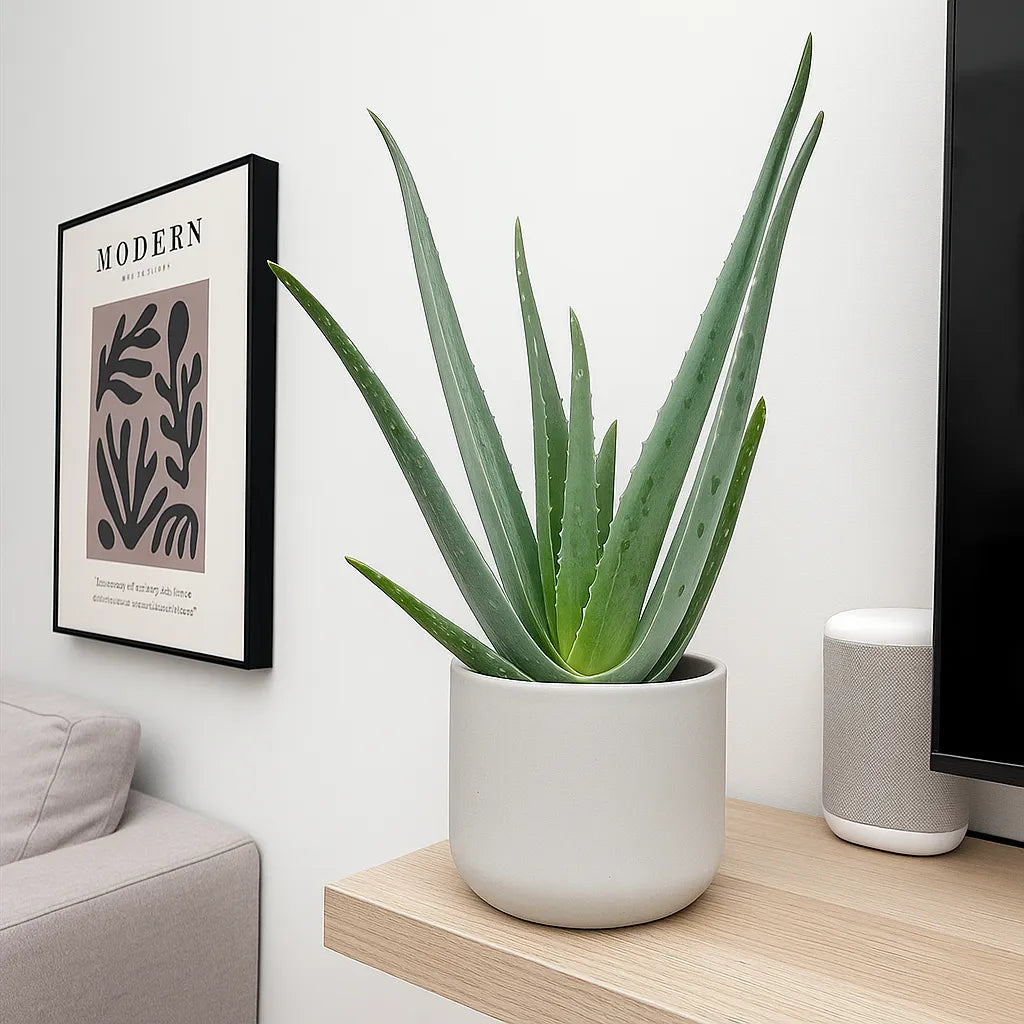
The plant forms a rosette of thick, fleshy, lance-shaped leaves in shades of green to blue-green, often speckled when young. The leaf edges are lined with soft, white serrations, giving the plant a sculptural, modern aesthetic. Inside each leaf is a clear, cooling gel packed with vitamins, minerals, and amino acids — long used in skincare and traditional medicine to soothe burns, moisturise skin, and promote healing.

When grown in ideal conditions, mature plants may produce tall, slender flower spikes bearing tubular yellow to orange blooms, adding a delicate vertical accent to their bold form.


Aloe vera – Care Guide

Light

Thrives in bright, indirect light to full sun. Indoors, position near a south- or west-facing window for maximum brightness. Outdoors, it enjoys full sun but benefits from light shade during the hottest part of the day. Insufficient light may cause leggy growth and pale leaves.

Watering

Water deeply but infrequently. Allow the soil to dry out completely between waterings. Overwatering is the most common cause of issues — Aloe vera stores water in its leaves and can tolerate drought far better than excess moisture. In winter, reduce watering to once every 3–4 weeks. Always ensure excellent drainage.

Temperature and Humidity

  • Temperature: Prefers 18–30°C. Can tolerate short dips to 10°C, but prolonged cold will damage the leaves.

  • Humidity: Adapts well to normal indoor humidity (30–50%). It prefers drier air and is well-suited to centrally heated homes.

Soil and Potting

Use a free-draining succulent or cactus mix, or combine compost with perlite and coarse sand. The roots must never sit in water. Terracotta pots are ideal for their breathability and moisture regulation. Repot every 2–3 years or when the plant becomes root-bound, ideally in spring.

Feeding

Feed sparingly — every 6–8 weeks during spring and summer with a diluted cactus or succulent fertiliser. Overfeeding can cause weak, watery growth. No feeding is necessary during autumn or winter.

Pruning and Maintenance

Remove any dried or damaged lower leaves by cutting them cleanly at the base. Wipe leaves occasionally to remove dust and maintain their healthy sheen. Older plants may produce offsets (“pups”), which can be separated and replanted once they develop roots.

Growth and Maturity

A slow to moderate grower, typically reaching 40–60 cm in height and spread indoors. Given enough space and light, it forms a graceful rosette that continues to expand with age. Mature plants may bloom annually under bright, warm conditions.

Common Issues

  • Yellowing or mushy leaves: Overwatering or poor drainage.

  • Brown tips: Underwatering or fluoride in tap water.

  • Pale leaves: Insufficient light.

  • Pests: Occasionally attracts mealybugs or scale; remove with a cotton swab dipped in rubbing alcohol.


Background and Benefits

Labeled “the plant of immortality” by the ancient Egyptians, Aloe vera has been used for over 6,000 years as a natural remedy for burns, skin conditions, and digestive health. Its inner gel contains vitamins A, C, E, and B12, antioxidants, and enzymes that promote healing and hydration.

Beyond its medicinal heritage, Aloe vera is one of the best air-purifying succulents, known to absorb formaldehyde and benzene from indoor air. It’s also incredibly low-maintenance, making it a perfect choice for both beginners and experienced collectors who appreciate functional beauty.


Quick Care Summary
Light: Bright light to full sun
Water: Allow soil to dry completely between watering
Temperature: 18–30°C; avoid below 10°C
Humidity: Low to average (30–50%)
Soil: Free-draining cactus/succulent mix – compost, sand, perlite
Feed: Every 6–8 weeks in spring/summer
Growth: Compact rosette, 40–60 cm; thick fleshy leaves with serrated edges

⚠️ Toxicity Note: While Aloe vera gel is safe for topical use, the latex layer beneath the leaf skin can be toxic if ingested, especially for pets. Keep out of reach of animals and children.

🌿 Styling Tip:
Display Aloe vera in a terracotta or stone planter to complement its desert aesthetic. It pairs beautifully with other drought-tolerant plants such as Sansevieria boncel ‘Variegata’ or Euphorbia trigona ‘Rubra’ for a sculptural, sun-loving arrangement that brings texture and tranquillity to bright indoor spaces.


    Shipping Notes
    • Free Standard Shipping on $100+ Orders to the USA.
    • Except Preorder products are shipped in 48 hours.
    • Delivery to the USA:
    1. Standard Shipping : 3-10 business days
    • If time is of the essence, please consider selecting expedited delivery for faster service.
    Exchange/Return Notes
    • We offer a 30-day return/exchange service after receiving.
    • Final sale items are not eligible for returns or exchanges.
    • To process your return/exchange, please contact us at [email protected]
    • Please click here for more details>>> Return & Exchange Policy
    SKU: 13778010584

    Discover Niche Categories That Outsell is aloe a good indoor plant

    Top-Converting Item to Boost Your Average Order

    4.4 ★★★★★
    Based on 11 reviews
    Sort
    Highest Rating
    Newest First
    Oldest First
    Product Reviews
    T
    Verified Purchase
    Tiffany haynes
    Charlottesville, US
    ★★★★★ 5
    Beautiful Cover
    Format: Hardcover
    love the cover of this book. It's gorgeous
    WAS THIS REVIEW HELPFUL?YesReportShare
    Reviewed in the United States on February 27, 2025
    A
    Verified Purchase
    aariann ibatuan
    Massapequa, US
    ★★★★★ 5
    Beautiful Book
    Format: Hardcover
    I love this book and it’s so pretty!
    WAS THIS REVIEW HELPFUL?YesReportShare
    Reviewed in the United States on December 13, 2023
    M
    Verified Purchase
    Miscellaneous Notes
    Carnegie, US
    ★★★★★ 5
    Beautiful Book!
    Format: Hardcover
    A beautiful edition of one of my childhood favorites!
    WAS THIS REVIEW HELPFUL?YesReportShare
    Reviewed in the United States on September 22, 2023
    S
    Verified Purchase
    Shava Nerad
    Whiting, US
    ★★★★★ 5
    You can get this online free, but I bought it. Let Fanon turn your brain inside out.
    I actually like the idea of supporting a press that is publishing Fanon. When I was growing up with my dad working with the SCLC and Dr. Martin Luther King, Jr., as part of the night security crew for the summer marches, I was probably more aware than most Americans -- certainly most Americans outside of the black community -- of how much permeability there was between the nonviolent SCLC, and the Black Panther movement, for which Fanon was a seed influence. Youth in the SNCC organization, the youth group associated with the SCLC, often went back and forth between SNCC and the Panthers as they developed their activist identity and their ideas of how justice might be achieved. The phrase "by any means necessary" used by the Panthers often scared the bejeezus out of the white community. But when I sat down with my father -- who was an adherent of formal nonviolence -- he handed me Fanon to read, and told me that it was a valid investigation as to whether violence should be considered if nonviolent means were not entertained by the state. To my dad, who was a peaceful but fiercely justice-oriented man (for those of you who know the idiom "fire of Amos" he had it), he considered that without the counterpoint of the Panthers, MLK would never have gotten a hearing in Washington DC. Just the idea that there were revolutionaries in American society looking at American "apartheid" and saying, "We are willing to take care of our own if you separate us. We see our situation as that of a post-colonial slavery society and use the model of African liberation as our model. We are willing to be peaceful if we are given justice in peace, but we do not believe that you are acting in good faith and will use whatever means necessary to see you follow your own promises of justice and see justice for our own people if you will not see that done." That was actually a step down from Fanon. That was actually optimism. But all white Americans heard out of any of that was: "...by any means necessary." They didn't think of how they were creating the circumstances that might precipitate violence. That whites had created a system that instituted violence to keep slaves, and later free blacks, contained and preserve power and privilege for the white majority. It is hard for most Americans to even realize that America -- although we became independent from England -- continued as a colonial nation and economy on our own continent and territory. That all the institutions of the repression and destruction of indigenous and imported-slave cultures that happened "over there" in countries that Europeans colonized far from home, we did at home as a break-away colony, and the Europeans who conquered America never relented, compromised, or acknowledged that colonial reality in the way that the Spanish, Dutch, Portuguese, Italian, French, and British Empires did in their colonial domains. So Fanon is someone worth reading, not only for Africans, or for African-Americans, but for any American or anyone else in the world who wants to better ponder white privilege in America and how it became so very different from colonial privilege as that faded in Africa, through the lens of this Algerian revolutionary philosopher, who so influenced our Panthers. I remain committed to nonviolence personally, but I understand intensely how MLK and Malcolm balance each other. And how that can actually lead to better peaceful solutions, in a social justice conflict where the status quo has been preserved by judicial and extrajudicial violence by a superior force. This is still relevant in puppet regimes all over the world. In client states of capitalist powers and of Russia and China. In the conflicts surrounding Israel, and the conflicts throughout the Middle East and Central Asia that are often couched in sectarian terms or sectarian vs secular terms. It is vital to understanding countries like Zimbabwe or South Africa, where the dynamics of early black leadership as colonial-wannabes are creating environments of corruption and scandal, and robbing their own people. Everyone should read Fanon. If you can't afford the book here, you can find it online free. This book, and Black Skin, White Masks, both highly recommended. If you don't like Marxist/Socialist politics, try to suspend disbelief a bit. The philosophy, sociology, and psychology is amazing.
    WAS THIS REVIEW HELPFUL?YesReportShare
    Reviewed in the United States on March 28, 2019
    T
    Verified Purchase
    TH
    Bozeman, US
    ★★★★★ 5
    The destruction of racism
    Format: Paperback
    This is a very open and candid view of racism in the early 19th century
    WAS THIS REVIEW HELPFUL?YesReportShare
    Reviewed in the United States on May 22, 2026

    recommand products