SKU: 14044287777
portulacaria afra minima care

portulacaria afra minima care Shop 'Elephant bush - Portulacaria afra' Care and Info

Sale price$21.64 Regular price$24.04
Save 10%

Pay in installments of $6.01 with ShopPay, AfterPay and Klarna

Shipping Estimate
USA
  • USA
  • CAN

Ships within 48 hours · Estimated delivery Sep 24 - Sep 29

Promo Codes Available:

For Your Every Summer RSVP, with Code: SUMMER15

Description

portulacaria afra minima care Shop 'Elephant bush - Portulacaria afra' Care and InfoIntroducing the Elephant Bush, also known as Portulacaria afra, which is a fascinating and popular succulent garden plant native to South Africa. It belongs to the Portulacaceae family and is known for its unique appearance and easy care requirements. The elephant bush succulent gets its name from its resemblance to the foliage of an elephant's trunk. It is also commonly referred to as the dwarf jade plant, small leaf jade, miniature jade, elephant

Introducing the Elephant Bush, also known as Portulacaria afra, which is a fascinating and popular succulent garden plant native to South Africa. It belongs to the Portulacaceae family and is known for its unique appearance and easy-care requirements.

The elephant bush succulent gets its name from its resemblance to the foliage of an elephant's trunk. It is also commonly referred to as the dwarf jade plant, small leaf jade, miniature jade, elephant food, or the Spekboom. The name "Dwarf Jade Plant" comes from its small, jade-like leaves, while "Spekboom" is an Afrikaans term meaning "bacon tree" due to the plant's edible leaves that reportedly taste like bacon.


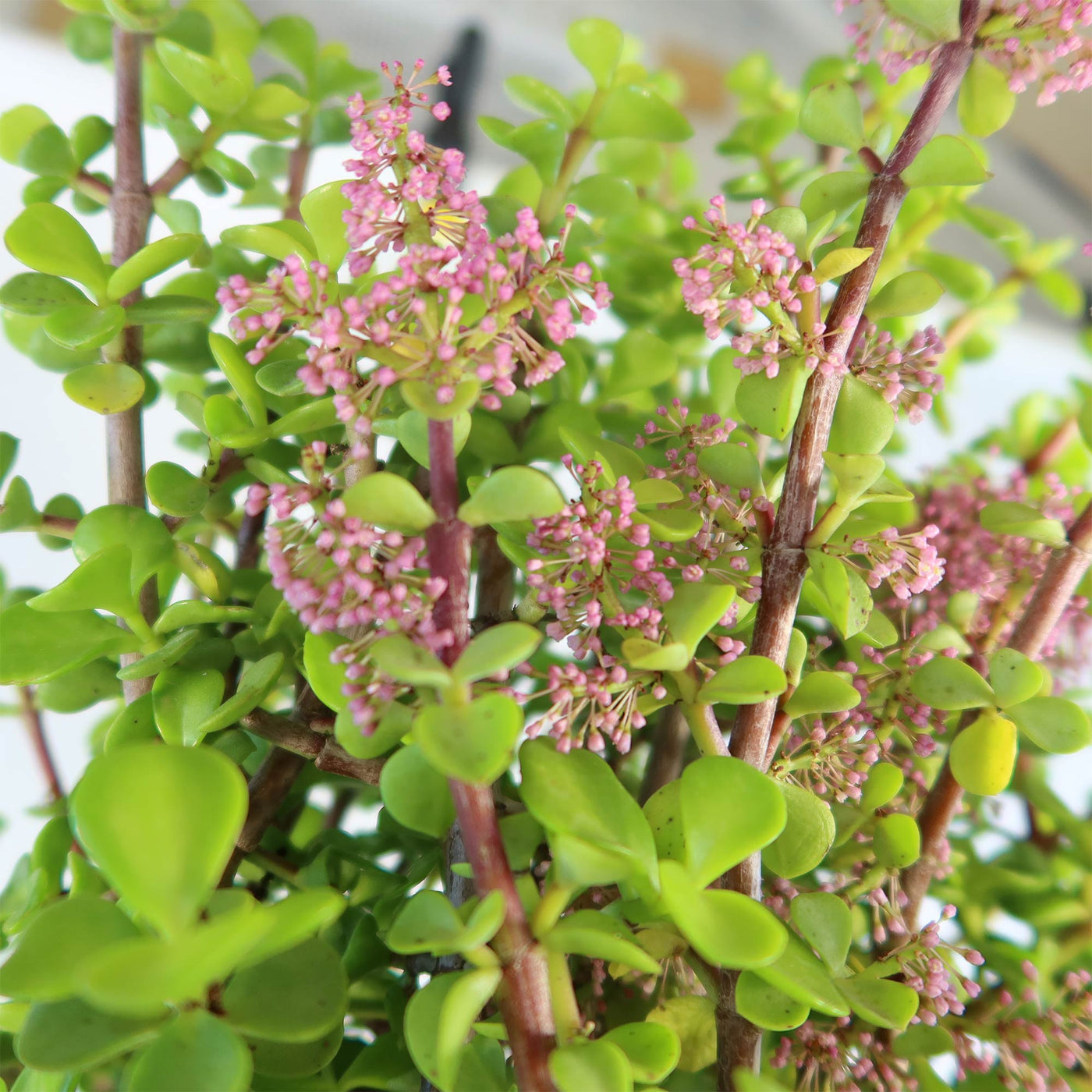
The elephant bush plant features small, round, and fleshy pale green leaves that store water, allowing your elephant bush plant to withstand drought conditions. 

The trailing stems of the elephant bush plants are thick and red-hued, which gives them a unique and appealing appearance in hanging baskets.

When grown as a houseplant, the elephant bush typically reaches a height of 1 to 3 feet.

However, if planted outdoors in its native habitat, your Portulacaria afra can grow much larger, reaching heights of up to 20 feet. The elephant bush makes for an excellent bonsai due to its unique growth pattern and ability to withstand pruning. Its thick, fleshy leaves and sturdy branches give it a robust appearance, making it an ideal succulent for shaping into intricate bonsai designs. 

The elephant bush flowers are small, star-shaped, and usually a light pink or lavender color. While the flowers are not the main attraction of this elephant bush succulent, they can add a touch of beauty when they bloom during the spring to late summer.

The elephant bush Portulacaria afra comes in various varieties, including a slow-growing variegated form Portulacaria afra variegata; a trailing growth bush Portulacaria afra prostrata; and a midstripe rainbow bush Portulacaria afra medio-picta, offers a diverse range of beauty in green spaces.

When and How to Water Your Elephant Bush

Like other drought-tolerant jade plants, your elephant bush succulent prefers a watering routine that allows the soil to dry out between waterings. Overwatering can harm the elephant bush plant and cause root rot.

In the summer, during the growing season, you should water elephant bush succulents once or twice a month when the soil is dry. A good rule of thumb is to water this elephant plant when the top 1-2 inches of soil feel dry to the touch. In the winter, during the dormant period,  you probably do not need to water them at all. 

Remember, it's always better to underwater than to overwater the elephant bush plant. This resilient Portulacaria afra plant can tolerate drought conditions better than excessive moisture. So, keep an eye on the soil moisture and adjust your watering schedule accordingly.

Light Requirements - Where to Place Your Elephant Bush Plant

When growing the elephant bush indoors, it thrives in bright, indirect light. Place your elephant bush plant near a window where it can receive plenty of natural bright light, but make sure to avoid direct sunlight, especially during the hottest parts of the day.

If you notice the leaves turning yellow or getting scorched, it's a sign that the Portulacaria afra elephant bush is receiving too much direct sunlight. So, finding that sweet spot of bright, indirect light is key to keeping your elephant bush succulent plant happy indoors.

If you decide to grow your elephant bush outdoors, it loves basking in the full sun. Although partial shade in the afternoon is frequently preferred, these plants need at least six hours of strong light each day to survive.

This is true, especially in hotter climates where the plant may become stressed by the afternoon sun's intense heat.

Your succulents should not be placed in any areas that receive continuous, direct sunlight, as this could lead to burned foliage.

Remember, the elephant bush is a versatile succulent plant and can adapt to different light conditions. Just keep in mind that it prefers bright, indirect light indoors and full sun to partial shade outdoors.

Optimal Soil & Fertilizer Needs 

Elephant succulents are very airy, porous, nutrient-rich well-drained soil with a pH of 5.5- 6.5; succulents require fast-draining soil that dries completely between waterings. Your soil must have a sandy texture and a low water-holding capacity, just like desert soil.  Ideally, you want to use our specialized succulent potting mix that contains 5 natural substrates to promote the development of a strong root system that helps your African elephant bush plant to thrive.   

When it comes to fertilizing your elephant bush plant, it only needs a small amount of fertilizer applied once a year in spring. These succulents prefer a fertilizer with lower doses of NPK, with a maximum ratio of 5-10-5 that is higher in phosphorus than nitrogen.

Hardiness Zones & More 

When it comes to growing the Elephant Bush plant indoors, the Elephant Bush prefers a cozy environment with temperatures between 65°F and 75°F. It can tolerate slightly cooler temperatures, but it's best to avoid extreme cold or frost. If you notice the leaves starting to shrivel or the tips turning brown, it may be a sign that the air is too dry. You can increase humidity by placing a tray of water near the plant or using a humidifier.

If you are living in USDA zones 9-11, you can grow your Elephant Bush plant outdoors year-round. These zones have mild temperatures and are less prone to frost.  

In cooler zones, it can be kept outdoors during the summer and brought in as the temperature drops. 

Elephant Bush can handle average to slightly higher humidity levels outdoors. Just make sure to provide well-draining soil to prevent waterlogged conditions, as excessive moisture can lead to root rot.

Don't worry if your succulents become too hot; they can tolerate triple-digit temperatures in the summer and prefer constant temperatures above 70 degrees Fahrenheit. 

Wildlife - Portulacaria afra Attracts the Following Friendly Pollinators

Portulacaria afra have tiny, star-shaped flowers, which bloom in clusters, and are a magnet for friendly pollinators. Bees are particularly drawn to its nectar-rich blooms, while butterflies and other beneficial insects are also frequent visitors. In areas where it thrives outdoors, hummingbirds may be attracted to the vibrant blossoms as well. 

Butterflies
Bees
Hummingbirds
Lady Bugs
Multi Pollinators
Other Birds

According to ASPCA, the Portulacaria afra Elephant Bush is friendly to both humans and pets such as dogs and cats. This makes it a great choice for households with curious pets or small children.

How to Propagate Your Portulacaria afra

This African elephant bush is relatively easy to propagate. It can be grown from stem cuttings, which should be allowed to dry for a day or two before being planted in well-draining soil. The cuttings usually root quickly and can be grown into new, young plants.

Key Takeaways

  1. Elephant Bush (Portulacaria afra) is a fantastic succulent with small, jade-like leaves.
  2. Visually appealing and easy to care for, adaptable for both indoor and outdoor growth.
  3. Tolerates a wide range of warm temperatures, between 65°F and 75°F, and handles higher humidity levels.
  4. It can thrives in bright, indirect light. It is suitable for beginner and experienced plant enthusiasts alike.
  5. Often grown as a seasonal accent plant or houseplant.
  6. Order your Elephant Bush today and add something truly exceptional to your garden.

The Bottom Line

Overall, Portulacaria afra, or Elephant Bush, is a remarkable plant that combines beauty, resilience, and ecological value. Its succulent, jade-like leaves and sprawling growth make it a striking addition to both indoor and outdoor settings, while its ability to tolerate drought and thrive in poor soils underscores its low-maintenance appeal. This plant’s capacity to attract friendly pollinators such as bees and butterflies further enhances its value in promoting biodiversity. With minimal care—bright, indirect light, well-draining soil, occasional watering, and protection from frost—Portulacaria afra can flourish for years, serving as both a stunning decorative element and an eco-friendly choice for any garden or home.

Shipping Notes
  • Free Standard Shipping on $100+ Orders to the USA.
  • Except Preorder products are shipped in 48 hours.
  • Delivery to the USA:
  1. Standard Shipping : 3-10 business days
  • If time is of the essence, please consider selecting expedited delivery for faster service.
Exchange/Return Notes
  • We offer a 30-day return/exchange service after receiving.
  • Final sale items are not eligible for returns or exchanges.
  • To process your return/exchange, please contact us at [email protected]
  • Please click here for more details>>> Return & Exchange Policy
SKU: 14044287777

Discover Niche Categories That Outsell portulacaria afra minima care

Top-Converting Item to Boost Your Average Order

4.9 ★★★★★
Based on 15 reviews
Sort
Highest Rating
Newest First
Oldest First
Product Reviews
W
William Nutter
Houston, US
★★★★★ 5
Who knew? Right?
Format: Kindle
Alexander the Great is one of the most prominent figures in ancient history, known for his military conquests and political prowess. Born in 356 BCE in Pella, the ancient capital of Macedonia, Alexander was the son of King Philip II and Queen Olympia. From an early age, Alexander was groomed for leadership and given a rigorous education in military strategy, politics, and philosophy under the tutelage of Aristotle. When Alexander was only 20 years old, he succeeded his father as king of Macedonia. Immediately upon taking the throne, he set his sights on expanding his empire. In 334 BCE, Alexander led an army of approximately 35,000 soldiers across the Hellespont, a narrow strait that separates Europe and Asia. This marked the beginning of his campaign to conquer the Persian Empire. Over the course of the next decade, Alexander achieved a series of stunning victories on the battlefield. He defeated the Persian king Darius III at the Battle of Issus in 333 BCE, and again at the Battle of Gaugamela in 331 BCE. He then continued his conquests into Central Asia and India, where he faced fierce resistance from local armies and encountered new cultures and religions. Despite facing numerous challenges and setbacks, Alexander was a brilliant military strategist who was able to adapt to changing circumstances and inspire his troops to victory. He was known for leading his soldiers from the front, and he fought alongside them in many battles. His leadership style earned him the loyalty and admiration of his soldiers, who were willing to follow him to the ends of the earth. In addition to his military conquests, Alexander was also a skilled politician and diplomat. He understood the importance of winning over the hearts and minds of the people he conquered, and he adopted many of the customs and traditions of the cultures he encountered. He also founded several new cities, including Alexandria in Egypt, which became a major center of learning and culture in the ancient world. Despite his many successes, Alexander's life was cut tragically short. He died in 323 BCE at the age of 32, possibly from malaria or poisoning. His death left a power vacuum in his empire, which led to a period of instability and conflict known as the Wars of the Diadochi. Today, Alexander is remembered as one of the greatest military commanders in history. His conquests had a profound impact on the ancient world, spreading Greek culture and Hellenistic ideas throughout the Mediterranean and Near East. His legacy also lives on in the many cities he founded, which served as centers of trade, commerce, and learning for centuries to come. Alexander the Great was a remarkable leader who left an indelible mark on history. He was a brilliant military strategist, a skilled politician, and a charismatic leader who inspired loyalty and devotion from his soldiers. His legacy continues to be felt today, and his story serves as a reminder of the power of human ambition, courage, and determination.
WAS THIS REVIEW HELPFUL?YesReportShare
Reviewed in the United States on April 13, 2023
V
Verified Purchase
Virginia Jennings
Omaha, US
★★★★★ 1
Disappointing
Format: Paperback
Disappointing
WAS THIS REVIEW HELPFUL?YesReportShare
Reviewed in the United States on March 8, 2025
J
Verified Purchase
Jaren
Los Angeles, US
★★★★★ 5
Being “Othered” is Real
Format: Kindle
Sky Full of Elephants opens with a haunting and unforgettable image: all the white people walking silently into bodies of water. That beginning alone tells you this is not a book that will play it safe. It is bold, layered, and deeply intentional. The writing is beautiful and the story forces readers to confront what Black history truly is: American history. The novel doesn’t just imagine a world; it holds up a mirror to the one we’ve lived in and the one we’re still shaping. It explores identity, belonging, grief, and survival in a way that feels both speculative and painfully real. As someone who grew up attending predominantly white schools, I connected deeply with Sidney’s experiences. Being “othered” (constantly reminded that you are different, that you don’t quite belong) leaves marks that follow you long after childhood ends. Some of the moments Sidney endures felt painfully familiar, and I found myself reflecting on my own younger self while reading. What struck me most, though, was reading this story as a mother. I have a biracial daughter, and her experience has been very different. She has never been made to feel like she doesn’t belong. She has never been othered. She has always been rooted in her Black identity, primarily raised by her Black mother, surrounded by family who affirm her. Even after I remarried and joined a Black family, she was embraced fully, never questioned, never treated as “less than,” never made to feel separate. Reading Sidney’s journey made me profoundly grateful that my daughter’s story has unfolded differently. It also reminded me how much environment, affirmation, and community matter in shaping a child’s sense of self. Sky Full of Elephants is more than a speculative novel. It is a meditation on race, memory, and belonging. It asks hard questions about America while honoring the fullness and complexity of Black identity. This book lingers with you. It sparks reflection. It opens conversations. And for me, it felt both personal and powerful.
WAS THIS REVIEW HELPFUL?YesReportShare
Reviewed in the United States on February 14, 2026
S
Verified Purchase
S. Donaldson
Bozeman, US
★★★★★ 4
Good Read!
Format: Audiobook
I read this along with my son and his girlfriend in a family “book club”. We had a good discussion about the ending, as we each had differing perspectives, but that was fun! The book was really interesting, and the characters were so well defined and deeply moving. Good read, but the ending left us a little confused.
WAS THIS REVIEW HELPFUL?YesReportShare
Reviewed in the United States on March 16, 2026
K
Verified Purchase
Katherine Ross
Massapequa, US
★★★★★ 5
Thought provoking
Format: Kindle
Sky Full of Elephants is a work of speculative fiction that begins with the premise that the white population of the United States has been wiped out. Starting a year after “the event” and following Charlie, a man who spent 20 years in prison due to a cowardly lie, and his resentful, biracial 19 year old daughter, who witnessed her only known family drown themselves, it is at its core a quest for identity in its many forms and how trauma can co-opt that search. In rating and reviewing this book, I’m aware that my lens as a Gen-X, cis-het, white woman, will have a differing view from others’ lived experiences. In reading other reviews, I definitely saw points that I didn’t consider, which I hope is the main point of the book. I do think, as a work of speculative fiction, that it does require the suspension of disbelief from the get go. It is a philosophical “what if” that Mr. Campbell invites the reader to consider. Intrigued by the premise, I was drawn into the story due to Mr. Campbell’s lyrical writing style. The narrative had a rhythmical flow to it that supported the world building and characterizations. I found Charlie to be a very sympathetic character, rebuilding a life shattered by lies in a new world and confronted with the daughter he never had a chance to know. Sydney, Charlie’s daughter, was more of a struggle to empathize with. While her feelings were justified and understandable, her growth throughout the novel was erratic. As the story has an ambiguous ending, perhaps her character will continue to improve. For supporting cast, the grumpy pilot Sailor and his nonbinary child, Zu, offer a counterpoint to Charlie and Sidney’s emerging relationship. The king and queen of Alabama and the thriving town of Mobile were well fleshed out. The Walkers and Sidney’s Aunt Agatha in Orange Beach represented those who were lost in their own way, either due to clinging to their former proximity to whiteness or to the religious biases they were raised with. I found the Walkers to be the most tragic of all. The questions of identity throughout the story are what kept be invested throughout. Are we defined by the color of our skin, our behaviors, the groups we belong to, the choices we make? Are others more valuable or worthy who don’t suffer the same things we do? Does there have to be those that are “lesser” to make us feel whole? As a trauma survivor with C-PTSD, I struggle with my own issues of identity and worthiness, and as a former Special Education teacher, I’ve been witness to that struggle in others. I have never understood or accepted the idea of White Supremacy or Christian Supremacy or any of the myriad ways that humanity continues to other each of us. In reality, there is no “us” or “them” only”we”. Charlie questions who he is as a Black man in the US, a convict, a teacher, a father, and ultimately a fixer and healer. Sidney grapples with her biracial otherness, her wealthy upbringing and sheltered life, the trauma of abandonment, and the lies that her life was built on. The ethical question of the machine at the epicenter of the event adds another layer to the story. While the effects of the first usage were unintended, once they were known is it right to continue to fix it and use it again? Can healing a part of collectiveness that harms or destroys another part ultimately be worth the cost? The world and its people are broken and desperately need healing. But just like the question of eugenics, what of value is lost when specific traits are universally stripped away? And who gets the to decide what is of value anyway? The ambiguity of the ending doesn’t answer the question entirely of what happens when the machine is repaired, but Charlie’s ability to fix things leads me hopeful. Personally, I cared enough about these characters to be interested in a sequel.
WAS THIS REVIEW HELPFUL?YesReportShare
Reviewed in the United States on February 24, 2026

recommand products