SKU: 1407501561
flapjack plant indoor

flapjack plant indoor Paddle Plant ‘Kalanchoe thyrsiflora’

Sale price$25.76 Regular price$28.62
Save 10%

Pay in installments of $7.16 with ShopPay, AfterPay and Klarna

Shipping Estimate
USA
  • USA
  • CAN

Ships within 48 hours · Estimated delivery Oct 2 - Oct 7

Promo Codes Available:

For Your Every Summer RSVP, with Code: SUMMER15

Description

flapjack plant indoor Paddle Plant ‘Kalanchoe thyrsiflora’The Paddle Plant, also known as Kalanchoe thyrsiflora, is a distinctive succulent admired for its compact rosette of thick, rounded, paddle shaped leaves. Its sculptural form and soft, powdery foliage make it a popular choice among succulent collectors, xeriscape gardens, and low maintenance houseplant enthusiasts. This species is especially valued for its ability to thrive in dry conditions with minimal care, making it highly suitable for arid and

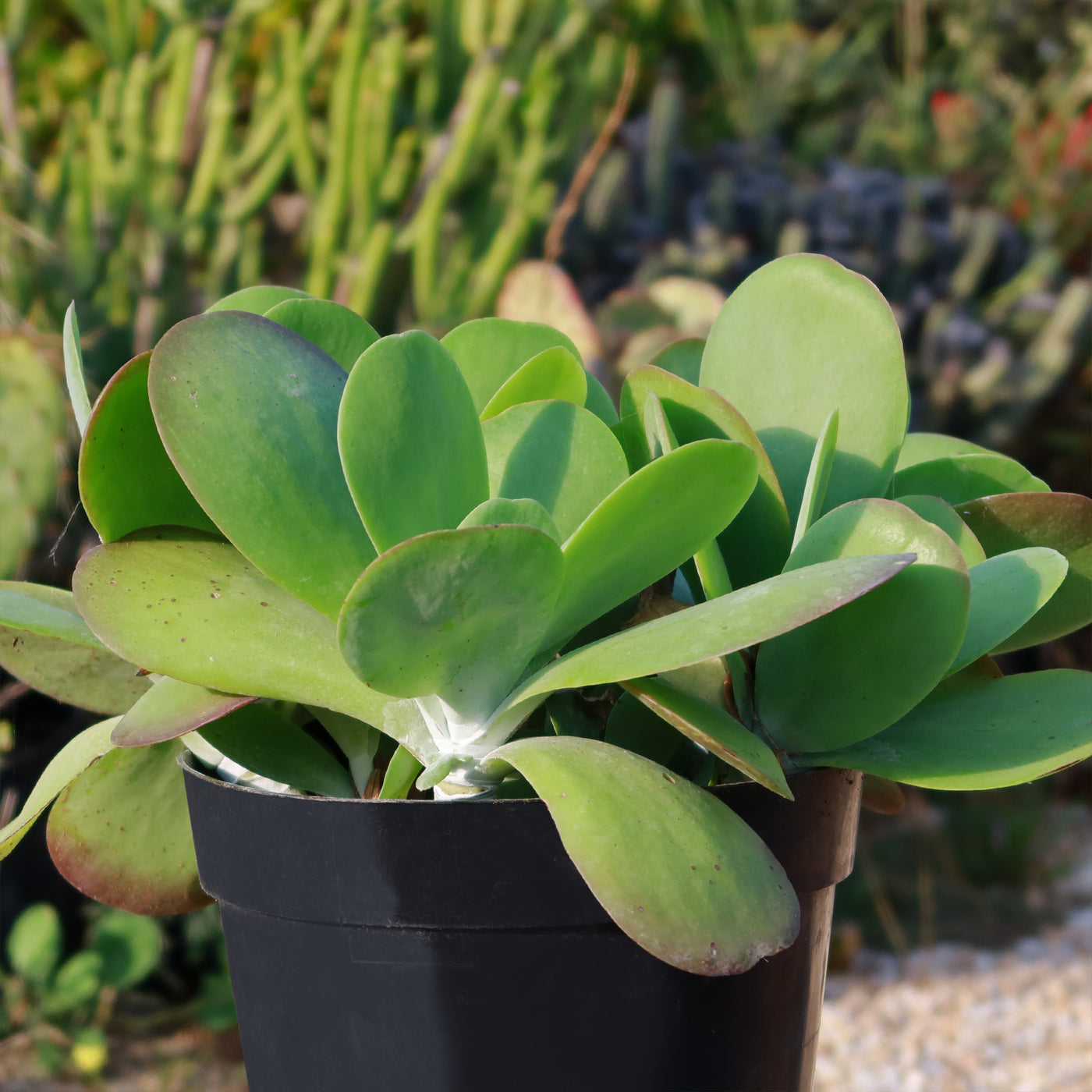
The Paddle Plant, also known as Kalanchoe thyrsiflora, is a distinctive succulent admired for its compact rosette of thick, rounded, paddle-shaped leaves. Its sculptural form and soft, powdery foliage make it a popular choice among succulent collectors, xeriscape gardens, and low-maintenance houseplant enthusiasts. This species is especially valued for its ability to thrive in dry conditions with minimal care, making it highly suitable for arid and water-wise landscapes.

In addition to the common name Paddle Plant, this species is sometimes referred to as the dog tongue, desert cabbage, Flapjack Plant due to its flattened, overlapping leaves that resemble a stack of pancakes.  

Native to South Africa, this succulent features smooth, rounded leaves covered in a white, powdery coating (farina) that helps protect it from intense sunlight and reduces water loss. 

The foliage remains primarily light to medium green and may develop a faint reddish or pinkish blush under strong sun exposure, but it does not typically produce the deep red margins often seen in misidentified forms.

These Kalanchoe thyrsiflora maintain a compact, symmetrical rosette growth habit, making it ideal for container planting, rock gardens, and succulent arrangements. 

It is a slow-growing but highly resilient plant that can reach a moderate size while maintaining a neat, structured appearance. The Paddle Plant is a relatively small succulent that grows up to 18 inches tall and spreads up to 8 inches wide.

In late winter to early spring, mature plants produce a tall flower spike that can reach up to 3 feet in height. The blooms are tubular and yellow, attracting pollinators such as bees. 

After flowering, the main rosette may naturally decline, but the plant often continues its life cycle through offsets that develop around the base, ensuring ongoing growth and propagation.

When and How to Water Your Paddle Succulent 

The paddle succulent plant is a drought-tolerant succulent that prefers to dry out fully between waterings, making it far more forgiving if you forget to water than if you overdo it.

The paddle plant should be watered every 2 to 3 weeks during the growing season, with watering reduced to about once every 4 to 6 weeks during the dormant season, keeping moisture very light.

In the spring and summer, always allow the soil to dry out completely before watering again. This soak and dry approach helps prevent root rot, which is one of the most common issues with this plant.

In the fall and winter, your paddle plant needs even less water as growth slows down. Since cooler temperatures and lower light reduce evaporation, it is best to hold back on watering and only add a small amount when the soil is fully dry.

Related Product

Light Requirements – Where to Place Your Paddle Plant 

When growing indoors, your Paddle kalanchoe thrives in bright, indirect light, which is a key part of proper paddle plant care.

It should be placed near a sunny window, preferably one facing south or west, where it can receive at least 4 to 6 hours of bright light daily.

If natural sunlight is limited, supplement with a grow light to maintain healthy growth and prevent leggy, stretched stems.

Insufficient light can cause the plant to lose its vibrant red margins and slow down its overall growth. 

When growing outdoors, the Paddle Plant prefers the full sun to partial shade. Ideally, it should receive 6 to 8 hours of direct sunlight daily.

Morning sunlight is preferable to intense afternoon sun, which can scorch the leaves if temperatures are excessively high. If growing in hot climates, consider providing some afternoon shade to prevent sun damage, especially during heat waves. 

For both indoor and outdoor growth, it is essential to gradually acclimate the plant to increased sunlight exposure to avoid sunburn. When moving from indoors to outdoors, introduce it to direct sunlight over a week or two, starting with a few hours per day. 

Optimal Soil & Fertilizer Needs 

The Kalanchoe thyrsiflora prefers a very well-draining, sandy or gritty soil mix, along with light fertilization once a year in spring. Planting it in heavy or moisture-retaining soil can lead to compacted roots, poor growth, and eventually root rot, so it is best to use a specialized succulent potting mix with organic mycorrhizae can also support a stronger, healthier root system and help your plant grow more efficiently.

When it comes to fertilizing your kalanchoe plant, apply a balanced, low-strength NPK fertilizer once a year in spring to maintain steady and healthy growth. For best results, use a diluted fertilizer with an NPK ratio around 5-10-5, where slightly higher phosphorus supports stronger roots and fuller leaves.

During fall and winter, when the plant enters dormancy, fertilizing should be avoided completely. Growth slows down during this time, and adding nutrients can build up in the soil and damage the roots.

Hardiness Zones & More 

In the United States, this is mostly an indoor plant, but if you live in southern Florida or Hawaii, then you can cultivate it outdoors in USDA zones 9-11.

It prefers temperatures between 60-80°F and moderate humidity levels. 

Always provide full to partial sun exposure for the best growth and coloration. 

If you live in cooler regions, it is best grown in containers as it is not frost tolerant, and temperatures below 30°F can damage or even kill it. Even light frost can leave marks on the leaves or cause them to become soft and mushy.

How to Grow as a Houseplant

Growing your paddle plant indoors is easy as long as you give it the right environment. It prefers warm conditions, ideally between 60°F to 85°F. It does not handle cold well, so keep it away from drafts, air conditioners, or chilly windows during cooler months. In terms of humidity, it thrives in low to average indoor humidity, which makes it a great match for most homes since it does not need extra misting or moisture in the air.

Set your paddle plant succulent in a bright spot with plenty of indirect sunlight, like near a south or west-facing window.  If your space is a bit dim, you may notice slower growth and less vibrant color, so aim for the brightest area you have without exposing it to intense, prolonged direct rays.

Wildlife – Paddle Plant Flowers Attract the Following Friendly Pollinators 

The Paddle plant produces tall, yellow, tubular flowers that attract friendly pollinators such as bees, butterflies, and hummingbirds. These flowers typically appear in late winter or early spring and provide an essential nectar source for beneficial insects. 

Butterflies
Bees
Hummingbirds
Lady Bugs
Multi Pollinators
Other Birds

According to the ASPCA, the Kalanchoe thyrsiflora is considered mildly toxic to cats, dogs, and birds. If ingested in a large amount, it can cause mild to moderate symptoms, including vomiting, drooling, and digestive upset. However, it is safe to touch and handle, making it a popular choice for indoor plants. 

How to Propagate Your Kalanchoe thyrsiflora 

The Paddle plant kalanchoe can be propagated through leaf cuttings or offsets. To propagate through leaf cuttings, simply remove a healthy leaf from the plant and allow it to callous before placing it in well-draining soil. The easiest method is separating offsets that naturally grow at the base of mature plants. Gently remove them, allow the cut ends to callous for 24-48 hours, then plant them in well-draining soil. Keep the soil lightly moist until roots establish.

Key Takeaways

  1. Kalanchoe thyrsiflora is a unique indoor houseplant with thick, paddle-shaped leaves that form a compact, low-growing rosette, making it ideal for bright windows and container displays.
  2. Unlike Kalanchoe luciae, the true Paddle Plant does not develop strong red margins, typically maintaining soft gray-green foliage even in bright light.
  3. As a drought-tolerant succulent, it stores water in its leaves and thrives with simple, low-maintenance care, making it a great choice for busy plant owners.
  4. When mature, it produces a 3-foot-tall flower stalk with fragrant, tubular yellow blooms that attract pollinators like bees and butterflies.
  5. It adapts well to indoor environments, especially when placed in bright, sunny spots where it can maintain its compact shape and healthy growth.

The Bottom Line 

Overall, the Paddle Plant (Kalanchoe thyrsiflora) is a visually stunning and low-maintenance succulent that adds a bold, modern aesthetic to any garden or home. Its stunning red-tinged leaves and attractive yellow flowers make it a popular choice for succulent lovers. With proper watering, light exposure, and temperature considerations, this plant can be grown successfully indoors and outdoors. Whether grown in a container, rock garden, or xeriscape landscape, the Paddle Plant is a resilient and rewarding addition that brings beauty and texture to any space. 
Shipping Notes
  • Free Standard Shipping on $100+ Orders to the USA.
  • Except Preorder products are shipped in 48 hours.
  • Delivery to the USA:
  1. Standard Shipping : 3-10 business days
  • If time is of the essence, please consider selecting expedited delivery for faster service.
Exchange/Return Notes
  • We offer a 30-day return/exchange service after receiving.
  • Final sale items are not eligible for returns or exchanges.
  • To process your return/exchange, please contact us at [email protected]
  • Please click here for more details>>> Return & Exchange Policy
SKU: 1407501561

Discover Niche Categories That Outsell flapjack plant indoor

Top-Converting Item to Boost Your Average Order

4.9 ★★★★★
Based on 8 reviews
Sort
Highest Rating
Newest First
Oldest First
Product Reviews
C
Verified Purchase
Corwin
Cuba, US
★★★★★ 5
Most Helpful Book I've Read on Plot and Structure
Format: Paperback
This is a well-organized, easy-to-read guide to techniques used to develop plots and sound story structure. It includes 14 chapters and two appendices. They cover such topics as what a plot is, how structure holds plot together, how to get ideas, and how to handle/interweave plot into all the levels of a novel (from whole sections such as the Beginning or middle of the work, down to the micro level of individual scenes). He includes discussion of different "plotting systems" (from writing by "the seat of your pants" to types/methods of creating outlines of various levels of "thoroughness" for those interested in mild outlining to someone with full-blown OCD). It discusses complex plots and sub plots, character arcs in relation to plot, common problems and solutions, revision, and more. Every chapter ends with a few exercises to reinforce the topic covered. The two appendices are a checklist for reminding you of major plot components as you write, and how to create "back cover" (aka the blurbs on the back of your book, or the summaries on the inside flap of dust jackets). As a writer, I am a "seat of the pants" guy, who's reluctantly recognized it isn't working for me (a major motivation for getting this book). Bell's discussion of different styles of outlining, though brief, gave me ideas of how to proceed. While I've often read books that include exercises, I confess to rarely doing them -- Bell is an exception (no, I didn't do *all* of them, but.... :) ). His text uses plenty of examples, drawn from movies and well-known novels. I've read other works on plot and structure (both general books and at least two dedicated to these topics), and have found this one to be by far the most readable, instructive, easy-to-digest, and *helpful.*
WAS THIS REVIEW HELPFUL?YesReportShare
Reviewed in the United States on June 17, 2017
C
Verified Purchase
Cora L. Foerstner
Pawtucket, US
★★★★★ 5
I have a few instructional writing books I reread; this is one of them.
Format: Paperback
Plot & Structure: Techniques and Exercises for Crafting a Plot That Grips Readers from Start to Finish by James Scott Bell may be the best book for plotting and creating structure in fiction stories that I’ve read. I have a few instructional writing books I reread; this is one of them. Plot & Structure works for writers who don’t use outlines and for those who do. Throughout Bell acknowledges and addresses how his ideas about plot and structure can be used by all writers. This isn’t a “my way or the highway” kind of book. Bell gives practical advice for all writers. What’s so great about Plot & Structure? The biggest plus is Bell’s practical and down to earth strategies and clear explanations. Here are the other greats: Bell’s approach isn’t a how-to formula; it’s more of a guide. His genre is thrillers, but he addresses the needs of other genres as well as those of literary fiction. He provides many strategies writers can use to approach plot and structure; plus, he encourages readers to find their own way of working. The exercises at the end of the chapters are practical. If you try some of them, you’ll discover that they aren’t busywork but helpful approaches to solving writing issues. Unless you’re a pro with so many publications behind you that you don’t need help, this isn’t a book to read once and put away. It’s a book you’ll come back to and get more out of with a second or third reading. If you want a formula or step-by-step program, this isn’t a book for you. He gives choices so you can find you own style and way of working. Which is one of the things like I about the book. It’s like going to a writer buffet and choose the strategies that work for you. If you are someone who writes without an outline, you are going to be surprised because Bell doesn’t leave you out of any of the equations. He has strategies for all writers.
WAS THIS REVIEW HELPFUL?YesReportShare
Reviewed in the United States on November 13, 2014
M
Verified Purchase
Mel Bridges
Port Orchard, US
★★★★★ 5
Great advice, guidelines, and suggestions: Bell writes with a contagiously inspiring attitude
Format: Paperback
I admire good organization when it comes to most things, especially in a book that purports to teach about structure. The organization of the book makes it easy to go back and reread a part; for example, if you are working on a beginning, middle, or end section in your fictional story, there are corresponding chapters for what you need. Each chapter has ending exercises that I imagine to be helpful, but I haven't actually worked them through although I've read them. You will read about elements that you need to know to how to do to write an appealing story, like characterization, settings, dialogue, and scene selection. It is recommended that you get a book with these elements as the main focus for a more detailed, expansive treatment (if you haven't done so already). Bell is most helpful on how to construct a scene. However, he does not have much to say about description, other than that it has a tendency to slow the plot and you should give details as needed but not more than that (on the line of a need-to-know-type of basis). Bell also has sections on how to brainstorm plot ideas and test whether the ideas are worthy of attention. This was something I needed to do with my last story idea that burned and crashed. Furthermore he tells of "plotting systems" used by many writers, which are the-strict-only-by-the-outline group (OPs) or the free-rein-no-outline group (NOPs) and writers using a little of both. The suggestions and tips are conveyed in a way that you can take and adapt them to your style. The chapter on common plot problems was very helpful. He even tells of how he squeezes in his writing time. Bell's way doesn't work for me, but you can take it and suit it to your own circumstances. What I like about Bell is that he writes in a non-demeaning way to new writers. There are some writing books which take punches at new writers, be it ever so subtly or blatantly (I would rather not name any names), even though these books may contain invaluable writing advice and tools. It is just refreshing to have Bell's attitude. He motivates me to write and be true to myself, especially in his introduction. So far it is one of the books I keep going back and rereading parts that are pertinent to what I am writing.
WAS THIS REVIEW HELPFUL?YesReportShare
Reviewed in the United States on February 8, 2006
K
Verified Purchase
Ken Goldstein
Charlottesville, US
★★★★★ 5
As Much About Life As Writing
Format: Paperback
Anne Lamott is not a cheerleader, more like the Burgess Meredith with the water bottle and bucket in Rocky's corner between rounds -- I'm also guessing she wouldn't wilt if she had to slash your eye open if like Rocky it got sealed shut. She knows you are going to get hit hard, and she reminds you that you know it too. She tells you not to get distracted by that which doesn't matter to the process of writing. Much of this she learned from her father, who was also a career writer. He taught her it was the doing that mattered, not the surrounding mechanical functions that seem like they matter. What struck me repeatedly in Lamott's mini-lessons was her deep understanding of process -- that output of a work is not so much the full work itself, but an assembly of building blocks, one at a time, each a commitment, and only in totality something more. She does not advocate bonehead process or ridiculous formulaic mandate - this is not a how-to manual -- she just wants us to care about what we are doing and accomplish it in a series of heartfelt steps. There are no shortcuts, it's a little more each day, a continuum that adds up to a satisfying and cohesive whole. This is not breakthrough thinking, but it's a lesson we need to learn over and over, and it's not just about writing. Creative process is the heart of innovation. Think of all the elements that make the iPad great. If all the elements weren't great, it would not be great. Same with a restaurant menu and wine list. Same with an office skyscraper or memorial monument. Same with a short story, same with a novel. Summary impression rests in the details, all the many tiny parts or moments -- and all those details require hard thought and careful design. Lamott is smart about this, she tells you that getting it right is not going to happen out of the gate and unnerving strides at perfection can be your worst enemy. She has an excellent descriptor for the real quality of the first drafts to which we aspire. I'll let you discover that on your own so the word does not get scraped here. Her point is, just get the words out, work on making them better later, a layer at a time. She also allows us not to obsess unnecessarily with locking the full road map before we explore, because again that can impede our work. How far do we need to see ahead? "About two or three feet ahead of you" is plenty she tell us, quoting E.L. Doctorow: "..writing a novel is like driving a car at night. You can only see as far as your headlights, but you can make the whole trip that way." She says this is "right up there with the best advice about writing, or life, I have ever heard." I tend to agree. There is tremendous empathy in Lamott's world view, she offers a sense of shared experience that is reinforcing and comforting. Lamott talks about the imaginary radio station playing in your head -- another colorful descriptor I will let you discover -- that tells us over and over again why we can't do something, why the work we are doing is neither good nor worth doing. Learning to turn off that radio is our key to moving forward, we all hear it from time to time, but when it becomes perpetual, that is when our ability to create interesting work stops completely. Lamott is just so honest and clear about all the factors that stop us from moving forward because she not only has experienced them, she continues to experience them. She does not position herself as a guru or weekend seminar success evangelist, but simply as someone who can reflect on problems of creativity because she deals with problems of creativity endlessly in her own life. She is even more honest in telling us that no one can make these problems go away once and for all, certainly not with any form of temporal success. All we can do is know that these obstructions will always be there, so we must embrace confronting them. Sometimes it really is good to know that none of us are experiencing roadblocks on our own, the fact that someone like Lamott tells you she is experiencing what you are experiencing is precisely the empathy that builds strength and resistance because the experiences are shared, bad and good. Her humility is reinforcing and refreshing and uncompromisingly inspiring. "Bird by Bird" is not a long book, it can be read if you wish initially in a single sitting, but it is the kind of book you will find yourself coming back to for this chapter or that, this phrase or that. Lamott writes with good humor, even when she tackles very difficult and personal matters of her own life and those around her. The more I think about her framework, the more I am convinced it is much more broadly applicable then perhaps she even considered. I see the guidance as useful in company life, in financial life, in family life, in political life, and in government life. All of these require effective process to get them right, there are no shortcuts, and the rewards can be the smallest where the challenges are the greatest. That does not mean the rewards aren't meaningful, but it is the context of those rewards and the expectations that one sets for success that truly inform us when we are steering toward a final draft. Review excerpted from my blog: [...]
WAS THIS REVIEW HELPFUL?YesReportShare
Reviewed in the United States on October 3, 2011
F
Verified Purchase
Farnoosh Brock
Omaha, US
★★★★★ 5
Attention: Writers! This book is for all of us, new or old pros at the craft.
Format: Paperback
Some - because it's too many to list ALL - of reasons I loved Bird by Bird as a writer, an entrepreneur and a human being with stories to share and thoughts to voice - just like you. I wish I had read the Kindle version so I could highlight every chapter and re-read them later, but I got the physical book to add it to the small shelf of books I still keep in my office, and next to the copy of my most favorite book on the topic: On Writing by Stephen King. Bird by Bird is now the 2nd best and useful book I have read on writing. If I weren't inspired to write before, I felt my body fill up with reasons that now draw me to writing. If I had voices of doubt, the ones that slip into your head at 4am and whisper, "Who are you to write? What do you have to say that others want to read?", which I did, I am now courageous enough to ignore them. They don't go away but I can say, screw you, I'm writing anyway. I now can't not write and this feeling is one that I just can't put a price on. For that alone, I'm overjoyed. But there's more. For starters, it's the way she tells you to write about your childhood. It's the simplicity of this advice, and the way she just calls you to do it. I loved her just for that. Write about your childhood even if it was terrible, even if it was dark and lonely, for it shaped you into who you are and who you are is a unique voice for the world to hear. Okay I added all of that but she says it more beautifully and the gist of it says that thou must write about thy childhood especially when you do not know where to start. Make it a good story, turn the bad characters into a description that if they were to read your book, they would not recognize themselves except for their actions - that's apparently how you save yourself from libel - and then just write. I cried at various points in this book and the whole spiel about childhood was one of them, but the others were when she described why we write, and what brings us to the blank page, and how it's not about being published - and it really isn't, I've been published twice and my book has ranked among best-selling categories and sold thousands of copies and it was fun yes but writing is about so much more. If you weren't enough before you published, she quotes someone, then you won't be enough after, and that will stay with me. We all write for our own reasons, and if you feel drawn to writing, if you feel a call to writing and you have been resisting it, stop. Ignoring this urge is like neglecting hunger or thirst just because you are too stubborn to accept the laws of nature. Go with the flow, drop your excuses and write what you feel called upon to write. I also love the writing style of Bird by Bird. She does not break down writing into distinct categories and address each. She simply tells us stories and personal experience and her amazing nuggets of wisdom come through, just oozing out of the page. It is the stories that help you remember the bigger points she was making, and a very similar style as King's On Writing, which helps you learn not just about writing but about the writer's life and highs and lows and how writing integrates into their life, and the big picture. Bird by Bird is sweet, refreshing, funny, and even if Lamott over-dramatizes the life of an author - or perhaps, mine is under-dramatic, who knows - I love her for it. I love that she was oh so vulnerable, and how she dished out tough love and great advice and in the end, simply encouraged us to write. Just write those stories down and do it for reasons that go well beyond publication, fortune, fame, or other dreams that you may have for your writing, because writing is its own sweet delicious fulfilling reward. Add this book to your list of must-read books, my writer friends, and let's put our stories out in the world if not for anyone but ourselves.
WAS THIS REVIEW HELPFUL?YesReportShare
Reviewed in the United States on March 28, 2015

recommand products