SKU: 19757358427
choco moonstone succulent scientific name

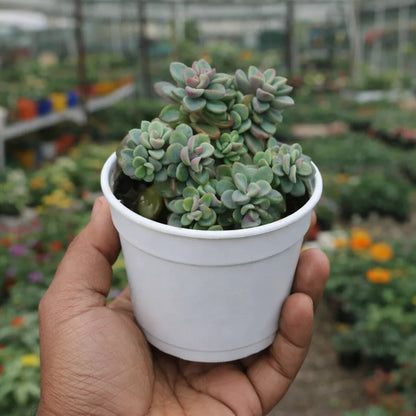
choco moonstone succulent scientific name Buy Graptopetalum Amenthesium (Pink Moonstone) Online – Plant Orbit

Sale price$18.96 Regular price$21.07
Save 10%

Pay in installments of $5.27 with ShopPay, AfterPay and Klarna

Shipping Estimate
USA
  • USA
  • CAN

Ships within 48 hours · Estimated delivery Oct 1 - Oct 6

Promo Codes Available:

For Your Every Summer RSVP, with Code: SUMMER15

Description

choco moonstone succulent scientific name Buy Graptopetalum Amenthesium (Pink Moonstone) Online – Plant OrbitBare Rooted Dispatch in 2 3 days Country of origin: India Its Compulsory to make unboxing video of parcel for refunds within 24 hours. Overview of Graptopetalum Amethystinum Common Name: Lavender Pebbles or Jewel leaf Plant Botanical Name: Graptopetalum amethystinum Family: Crassulaceae Type: Succulent Mature Size: Up to 12 inches tall Native Area: Mexico Hardiness Zones: 9a to 11 (USDA)Graptopetalum amethystinum is a striking succulent known for its

  • Bare Rooted
  • Dispatch in 2-3 days
  • Country of origin: India
  • It’s Compulsory  to make unboxing video of parcel for refunds within 24 hours.

Overview of Graptopetalum Amethystinum

Common Name: Lavender Pebbles or Jewel-leaf Plant
Botanical Name: Graptopetalum amethystinum
Family: Crassulaceae
Type: Succulent
Mature Size: Up to 12 inches tall
Native Area: Mexico
Hardiness Zones:
 9a to 11 (USDA)Graptopetalum amethystinum is a striking succulent known for its attractive, fleshy leaves that can display shades of lavender, pink, and green. This plant is popular among succulent enthusiasts for its unique appearance and relatively easy care requirements.

Care Instructions

Light Requirements

  • Ideal Exposure: Graptopetalum amethystinum thrives in full sun to partial shade, ideally receiving 4 to 8 hours of direct sunlight daily. Gradually acclimate the plant to full sun if it was previously in a shaded environment.

Soil and Potting

  • Soil Type: Use a well-draining soil mix designed for succulents or cacti. A combination of organic materials (like peat or coconut fiber) and inorganic materials (such as perlite or sand) is recommended.
  • Potting Tip: Ensure that pots have drainage holes to prevent water accumulation, which can lead to root rot.

Watering

  • Watering Schedule: Allow the soil to dry out completely between waterings. Water thoroughly when the top inch of soil is dry, typically every 1 to 3 weeks depending on environmental conditions.
  • Signs of Overwatering: Yellowing leaves or mushy stems indicate overwatering, which can lead to root rot.

Temperature and Humidity

  • Optimal Temperature: This succulent prefers temperatures between 65°F to 85°F (18°C to 29°C) during the day and can tolerate lows down to 30°F (-1°C) for short periods. Prolonged exposure to temperatures below freezing should be avoided.
  • Humidity Needs: Graptopetalum amethystinum thrives in low humidity environments, typical of its native habitat.

Fertilization

  • Feeding Schedule: Fertilize during the growing season (spring and fall) with a diluted balanced fertilizer. Avoid fertilizing during winter when the plant is dormant.

Common Issues

Pests

  • Common pests include mealybugs and aphids. Regularly inspect the plant for signs of infestation and treat promptly with insecticidal soap or by wiping leaves with soapy water.

Diseases

  • Overwatering is the main concern for this succulent, often leading to root rot. Ensure proper watering practices to maintain plant health.

Frequently Asked Questions

  1. How often should I water my Graptopetalum amethystinum?
    Water when the top inch of soil feels dry, typically every 1 to 3 weeks depending on the season and environmental conditions.
  2. Can I grow Graptopetalum amethystinum outdoors?
    Yes, it can be grown outdoors in USDA hardiness zones 9a to 11 but should be protected from frost and extreme cold.
  3. Why are my plant's leaves turning yellow?
    Yellowing leaves may indicate overwatering or insufficient light. Adjust your watering habits and ensure adequate sunlight exposure.
  4.  How do I propagate Graptopetalum amethystinum?
    Propagation can be done through leaf cuttings. Allow cuttings to callous for a few days before placing them in well-draining soil.
  5. Is Graptopetalum amethystinum toxic?
    This plant is not known to be toxic; however, it is best kept away from pets and young children who may ingest parts of the plant.By following these care guidelines, Graptopetalum amethystinum can thrive, adding unique beauty and color to your indoor or outdoor garden space.
Shipping Notes
  • Free Standard Shipping on $100+ Orders to the USA.
  • Except Preorder products are shipped in 48 hours.
  • Delivery to the USA:
  1. Standard Shipping : 3-10 business days
  • If time is of the essence, please consider selecting expedited delivery for faster service.
Exchange/Return Notes
  • We offer a 30-day return/exchange service after receiving.
  • Final sale items are not eligible for returns or exchanges.
  • To process your return/exchange, please contact us at [email protected]
  • Please click here for more details>>> Return & Exchange Policy
SKU: 19757358427

Discover Niche Categories That Outsell choco moonstone succulent scientific name

Top-Converting Item to Boost Your Average Order

4.4 ★★★★★
Based on 6 reviews
Sort
Highest Rating
Newest First
Oldest First
Product Reviews
A
Verified Purchase
arcy
Lake Worth, US
★★★★★ 5
Love it
Color: Brushed Nickel, Material Type: Stainless Steel
Great quality works really well
WAS THIS REVIEW HELPFUL?YesReportShare
Reviewed in the United States on March 16, 2026
C
Verified Purchase
C. Witt
Cuba, US
★★★★★ 4
Heavy Duty Paper Towel Holder
Color: Brushed Nickel, Material Type: Stainless Steel, Color: Brushed Nickel, Material Type: Stainless Steel
Nice looking, heavy duty paper towel holder. Looks like it'll be durable. The top did have a couple of dark, tarnished looking spots but it's not too noticeable.
WAS THIS REVIEW HELPFUL?YesReportShare
Reviewed in the United States on June 2, 2023
H
Verified Purchase
Hunter Hart
Pawtucket, US
★★★★★ 5
Free Mini-Screwdriver + microfiber cloth? Thank you
Color: Gold, Material Type: Stainless Steel
100% worth the purchase mainly for the little screwdriver (a real one, just small) and microfiber cloth included. As long as you install it correctly it all holds together very well.
WAS THIS REVIEW HELPFUL?YesReportShare
Reviewed in the United States on March 18, 2026
C
Verified Purchase
Connie
Birmingham, US
★★★★★ 5
Love it
Color: Brushed Nickel, Material Type: Stainless Steel
I love it. It holds the jumbo rolls and that makes it a perfect kitchennitem
WAS THIS REVIEW HELPFUL?YesReportShare
Reviewed in the United States on February 28, 2026
M
Verified Purchase
Mr. Douglas
Louisville, US
★★★★★ 5
The Best Book on the Creation-Evolution Debate
Format: Paperback
“The book The Evolution of Adam is an accessible study of the hermeneutical issues involved in reading Genesis and Paul on Adam in view of evolution.” - Peter Enns In my opinion The Evolution of Adam by Peter Enns is the best book available on the evolution versus creation debate because it goes right to the heart of the matter. Christians grossly misunderstand the creation stories in Genesis because they read them from a modern point of view. The first part of the book deals with Adam in Genesis. The second part of the book deals with Paul's Adam in Romans. The book is short and very well written for the popular audience. PART 1 ADAM IN GENESIS Many stories in the Old Testament have parallels with other Ancient Near Eastern stories. The Adam story is no different as it has strong similarities to Atrahasis. If I may quote Enns, “Israel's creation story was written to say something about their place in the world and the God they worshiped. To think that the Israelites, alone among all other ancient peoples, were interested in (or capable of) giving some definitive, quasi-scientific, account of human origins is an absurd logic. And to read the story of Adam and Eve as if it were set up to so such a thing is simply wrongheaded. It strains credulity to think that, of all the ancient peoples with origins stories, Israel alone escaped this story-telling mentality and gave us something approximating 'history' or 'science' in the modern sense.” The Evolution of Adam shows conclusively that, “the Adam story in Genesis is part of Israel’s literature of national and religious self-definition, not the origin of humanity.” The Adam story is not concerned with human origins as most Christians assume. Adam is Israel. Israel’s history as a nation can be broken down as follows:   1. Israel is “created” by God at the exodus through a cosmic battle (gods are defeated and the Red Sea is “divided”);   2. The Israelites are given Canaan to inhabit, a lush land flowing with milk and honey;   3. They remain in the land as long as they obey the Mosaic law;   4. They persist in a pattern of disobedience and are exiled to Babylon. Israel’s history parallels Adam’s drama in Genesis:   1. Adam is created in Genesis 2 after the taming of chaos in Genesis 1;   2. Adam is placed in a lush garden;   3. Law (not to eat of the Tree of the Knowledge of Good and Evil) is given as a stipulation for remaining in the garden;   4. Adam and Eve disobey and are exiled. PART 2 PAUL'S ADAM Paul’s use of the Adam story, like Paul’s other uses of the Old Testament, is marked by creativity and the prior conviction that Jesus is God’s unexpected solution to a universal plight. Enns' summary of Paul's Adam in Romans 5:12-21 is as follows: 1. Adam is hardly mentioned in the Old Testament. 2. Some see Noah, Abraham, Moses, and David as “new Adams.” Paul represents Jesus as a new Adam. 3. The Fall of man is not taught in the Old Testament. 4. The Fall of man is not taught in the Garden scene. The imputation of Adam’s sin is not taught in the garden story. 5. The Adam/Jesus Parallel in Romans 5 is both clear and not so clear. What does Paul mean when he says that through Adam’s sin, “death came to all, because all sinned.” One might have expected Paul to say, “because Adam sinned” (death is Adam’s fault). 6. Paul’s Jesus/Adam parallel does not stem from a “plain reading” of Genesis. It is selective and theologically driven. The Book of Romans is not about personal salvation, but about the Jew/Gentile relationship. 7. Paul was an ancient man and he had an ancient view of human origins. 8. Paul used the Old Testament in creative ways that violate the grammatical-historical-contextual approach. So he could be doing the same with Adam. 9. Adam was used creatively in Second Temple Jewish literature (Paul’s contemporaries). CONCLUSION Evolution and creation are not in conflict because the early chapters of Genesis have nothing to do with HOW God created the world or the first humans. Therefore science can be studied freely for what it is and the Old Testament can be understood as ancient Israel's story. If I may quote Enns again, “The root of the conflict over evolution and creation for many Christians is not scientific or even theological, but group identity and fear of losing what it offers. The challenge of evolution is here to stay, and its effect on how Christians read Genesis and Paul must be addressed deliberately.” “Evangelicals tend to focus on how to protect the Bible against the attacks of evolution. The real challenge before them is to reorient their expectation of what the story of Adam and Eve is actually prepared to deliver.” If you are looking to solve the evolution-creation debate in your mind then the Evolution of Adam is the book to read. Evolution and creation are both true. God created through evolution. The Bible is not a modern science book.
WAS THIS REVIEW HELPFUL?YesReportShare
Reviewed in the United States on December 15, 2012

recommand products