SKU: 21820800869
orchid potting mix for anthurium

orchid potting mix for anthurium Molly's Bark-Based Mix for Orchids

Sale price$22.12 Regular price$24.58
Save 10%

Pay in installments of $6.14 with ShopPay, AfterPay and Klarna

Shipping Estimate
USA
  • USA
  • CAN

Ships within 48 hours · Estimated delivery Sep 2 - Sep 7

Promo Codes Available:

For Your Every Summer RSVP, with Code: SUMMER15

Description

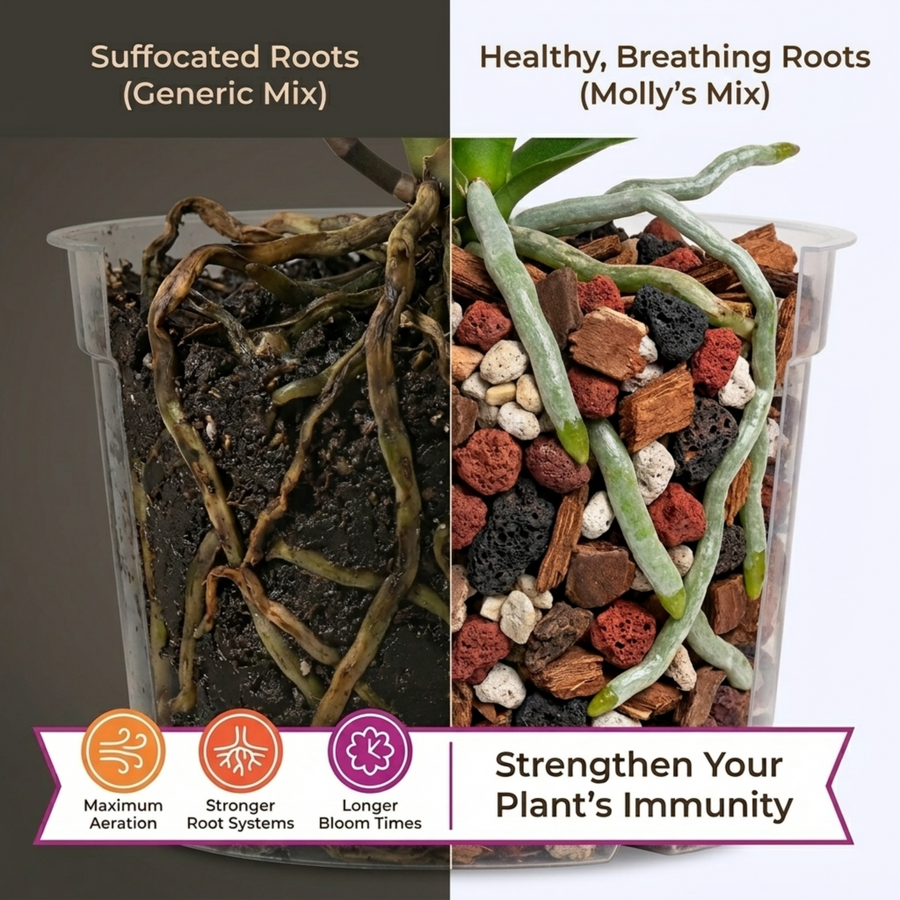
orchid potting mix for anthurium Molly's Bark-Based Mix for OrchidsQuick answer: what is Molly's Orchid Mix? For: Phalaenopsis, Cattleya, Oncidium, Dendrobium, Vanda, and every other epiphytic orchid. What's in it: coarse fir bark, horticultural charcoal, perlite, and sphagnum accent. No peat moss, no soil. Why it works: orchids are epiphytes. In the wild their roots grip tree bark, not dirt. The chunky bark structure mimics that native environment, drains in seconds, and lets roots breathe. Holds shape for 12 to 18

Quick answer: what is Molly's Orchid Mix?

  • For: Phalaenopsis, Cattleya, Oncidium, Dendrobium, Vanda, and every other epiphytic orchid.
  • What's in it: coarse fir bark, horticultural charcoal, perlite, and sphagnum accent. No peat moss, no soil.
  • Why it works: orchids are epiphytes. In the wild their roots grip tree bark, not dirt. The chunky bark structure mimics that native environment, drains in seconds, and lets roots breathe.
  • Holds shape for 12 to 18 months. Most bagged orchid mixes break down to fines in 6 months and start to rot roots from below.
  • Pre-rinsed so you can pot straight from the bag without leaching salts.

More orchid-specific guidance: Do orchids need soil?, Best potting mix for orchids: complete guide.

Orchids are not soil plants. In nature most cultivated orchids are epiphytes, growing on tree bark with their roots exposed to air, catching rain and humidity. Pot them in regular potting soil and the roots suffocate, rot, and the plant dies, often within a single watering cycle. The right orchid potting mix is bark-based, fast-draining, and air-rich.

Molly's Orchid Mix delivers exactly that. Coarse fir bark as the structural base, horticultural charcoal to keep the mix sweet, plus a light proportion of moisture-retaining organics so roots don't dehydrate between waterings. Built for the way orchids actually grow.

What is orchid potting mix?

Orchid potting mix (sometimes called orchid pot mixture, orchid soil, or orchid potting medium) is a chunky, soilless growing medium made primarily from bark, charcoal, and small percentages of moisture-retaining materials. Despite the name, real orchid potting mix contains no actual soil. The "soil" in those product names is a marketing convention, not a description of what's in the bag.

A proper orchid potting mix should:

  • Drain almost immediately when water is poured through it
  • Hold its chunky structure for 1 to 2 years before breaking down
  • Allow constant air contact with the roots between waterings
  • Contain no peat, no garden soil, and no compost as primary ingredients

If a product labeled "orchid soil" feels heavy and dense out of the bag, it's the wrong product. A real orchid mix feels chunky, light, and rough.

What's in the bag

  • Coarse fir bark: the foundation. Mimics the tree-trunk substrate of wild epiphytes, providing the air pockets and grip orchid roots evolved for.
  • Horticultural charcoal: absorbs salts and impurities. Critical for orchids because they're sensitive to mineral buildup from tap water.
  • Coir chips: a small percentage of moisture buffer between waterings. Without some moisture retention, you'd be watering daily.
  • Sphagnum moss (light proportion): retains humidity right at the root crown. Especially important for Phalaenopsis grown in dry indoor air.

Low organic content overall, no soil, minimal peat. The roots stay dry between waterings, then drink fast when watered.

Genera this is for

Designed for epiphytic orchids:

  • Phalaenopsis (moth orchids): by far the most common houseplant orchid. This mix is dialed in for them.
  • Cattleya, Oncidium, Dendrobium, Vanda: all bark-loving epiphytes that thrive in this mix.
  • Brassavola, Encyclia, Miltonia: same family, same care.

Not for: terrestrial orchids (some Cymbidium, Paphiopedilum lady slippers, Bletilla) which prefer a soilier substrate. For those, blend this mix with a small amount of fine bark and worm castings, or contact us for specific recommendations.

Comparing your orchid potting mix options

Option Cost / 5 qt Effort Result quality
Bagged "orchid soil" from box stores $5 to $10 Low Inconsistent. Often too fine, sometimes contains soil or peat.
DIY blend (bark + perlite + charcoal) $15 to $25 with leftover ingredients Medium. Source 3 to 4 ingredients, mix to ratio, pre-soak the bark. High if you get the ratios right. Steep first-time learning curve.
Molly's Orchid Mix (this product) ~$22 None. Open and pot. Consistent. Calibrated for Phalaenopsis, Cattleya, and Dendrobium.

The honest comparison: bagged "orchid soil" from box stores is a coin flip. Some products are good, many are repackaged peat-based potting soil that will kill an orchid. DIY makes economic sense if you grow many orchids and don't mind the upfront sourcing work. Pre-blended is the right call for everyone else, especially if you've already lost an orchid to wrong soil.

Sizing & coverage

One 5 dry quart bag of Molly's Orchid Mix fills approximately:

  • About 10 four-inch pots
  • About 6 five-inch pots
  • About 4 six-inch pots
  • About 2 to 3 eight-inch pots

Most Phalaenopsis sold at supermarkets come in 5 or 6 inch pots, so a single bag handles 2 to 4 typical repots. Choose a pot just slightly larger than the existing root mass; orchids prefer to be tight in their pots.

When to repot

Repot every 1 to 2 years, or sooner if any of these are true:

  • The bark has broken down into smaller chunks (it should still feel chunky, not mushy)
  • The mix smells sour or stagnant
  • Roots are climbing out of the pot in protest
  • The plant has just finished a flowering cycle (best time to repot)

Avoid repotting an orchid that's actively spiking or in bloom. Wait until flowering ends.

Watering with bark mix (it's different)

Bark mix dries out faster than soil and rehydrates more slowly. Use the soak-and-drain method:

  1. Take the orchid to a sink. Pour room-temperature water through the pot until it runs out the drainage holes for several seconds.
  2. Let it drain completely (5 to 10 minutes).
  3. Return to its growing spot.
  4. Repeat when the bark feels dry about an inch down, typically every 7 to 10 days for Phalaenopsis indoors.

Never let the orchid sit in a saucer of water. Drainage is non-negotiable.

FAQ

Will this work for moth orchids (Phalaenopsis)?

Yes. Phalaenopsis is the primary use case. The bark + charcoal + light moisture-retainer ratio is tuned for them.

What's the difference between orchid soil and orchid potting mix?

None in practice. Both terms describe the same product: a chunky, soilless growing medium for orchids. "Soil" is the more common search term; "mix" is the more accurate description. The key thing is the ingredients on the bag, not the marketing word.

Is this the same as orchid bark?

Bark is one ingredient. Orchid potting mix is bark blended with charcoal, coir chips, and a small amount of sphagnum. Pure bark dries out too fast for most home growers; the moisture-retaining components in this mix prevent that.

Can I use regular potting soil if I add perlite?

No. Even with extra drainage, soil compacts and holds water against the roots over time. The structure is wrong, not just the drainage rate. Use a real bark-based mix.

How is this different from sphagnum moss alone?

Sphagnum holds way more water than orchid roots want long-term. Pure sphagnum is fine for transplant or recovery, but for ongoing growth, a bark-based mix prevents root rot. This mix has a small amount of sphagnum for humidity, anchored in chunky bark for drainage.

Can I make my own orchid mix?

You can. The trade-off is sourcing the right grade of fir bark (it should be coarse, sized 1/4 to 1/2 inch), pre-soaking it (raw bark is hydrophobic), and dialing in proportions. We did the work so you don't have to.

Is the mix already fertilized?

No synthetic fertilizer. Orchids are light feeders and bark-based mixes hold no nutrient charge. Use a dilute orchid fertilizer (look for "weakly weekly" recommendations, ~1/4 strength balanced fertilizer) during active growth, less in winter dormancy.

How long does the mix last in the pot?

Most home growers can leave Molly's Orchid Mix in place for 1 to 2 years before the bark breaks down enough to need replacing. Annual repotting is the cleanest discipline; signs that it's overdue include musty odor, water sitting at the surface, and visibly broken-down bark.

Can I reuse old orchid mix from a previous repot?

No. Once bark has broken down, it loses its structure and starts retaining water like soil. Always use fresh mix when repotting. Discard the old mix or compost it.

What pot size should I use?

Smaller than feels right. Orchids prefer to be tight in their pots. The new pot should fit the root mass with about 1cm of breathing room around it. Oversized pots hold too much moisture and rot the roots.

Packaged in a heat-sealed resealable bag.

Related guides

For deeper reading: the orchid care rhythm and the complete orchid potting mix guide.

→ Orchid Care guide

→ Best Potting Mix for Orchids: complete guide

Shipping Notes
  • Free Standard Shipping on $100+ Orders to the USA.
  • Except Preorder products are shipped in 48 hours.
  • Delivery to the USA:
  1. Standard Shipping : 3-10 business days
  • If time is of the essence, please consider selecting expedited delivery for faster service.
Exchange/Return Notes
  • We offer a 30-day return/exchange service after receiving.
  • Final sale items are not eligible for returns or exchanges.
  • To process your return/exchange, please contact us at [email protected]
  • Please click here for more details>>> Return & Exchange Policy
SKU: 21820800869

Discover Niche Categories That Outsell orchid potting mix for anthurium

Top-Converting Item to Boost Your Average Order

4.5 ★★★★★
Based on 17 reviews
Sort
Highest Rating
Newest First
Oldest First
Product Reviews
S
Verified Purchase
Sophia Bezirganian
Charlottesville, US
★★★★★ 5
Most Illuminating Psych Book I've Read
Format: Hardcover
As a psychiatrist, I have yet to read a more illuminating book on how mental illnesses can develop, and how to help patients' to become free of them. Existential Psychotherapy presents a theory of the existential forces that drive all human beings--knowledge of death, of our aloneness in the world, and of "meaninglessness" (the utter inconsequence of our one life in the entirety of the universe). It shows how these forces are powerful influences in shaping human mental health and illness. Other reviewers here point out that the basic existential issues Yalom presents are well-known to academics and to many literate people who are exposed to them in that good, broad, liberal arts education we (still?) get in college. But what Yalom achieves in this book, has not to my knowledge been accomplished before (nor since): a presentation of these ideas to an audience of clinicians in a lucid, beautifully written, way that is salient to the daily practice of psychotherapy. Yalom is a rare psychiatrist who is not only a master of the art of teaching and practicing psychiatry, but for this book, ventured into philosophy, literature, history, and sociology, and then integrated the wisdom each brings to the study of human nature, into a clear and cohesive whole, a beautifully written theory of the existential dimension of men's fears, drives, and actions, and how this dimension creates mental illness or health, depending on how each person handles it. What is amazing is how such a book is now buried in the archives of (relative) obscurity, while others, recycling the same old tired ideas, reign on. So what do these lofty insights in Yalom's book contribute that is unique and powerful to us lowly practitioners toiling daily in our offices in the (seemingly more banal) task of helping patients with daily crises, complaints, resistance to change, and painful repetitions of self-destructive life choices? One very important tool: a true understanding of the power of existential concerns, not only in creating mental illness and self-destructive life paths, but, by shining a light on them-- capturing that elusive force of change: MOTIVATION. This force, and how to harness it to help patients overcome their suffering, has for me been one of my greatest challenges as a doctor. And one for which most books on psychotherapy have fallen short in helping me tackle. In the sections "death" and "will", (two of the four main sections in the book), Yalom forges a path that I could follow, to help my patients free themselves of the fears that block motivation for change. In short, Yalom shows how the anxiety about, (and thus avoidance of) awareness of our death and aloneness, can cripple us into denial, and resistance to changing those of our behaviors that shield us from these truths. But, these very fears, when faced and reframed--as the awareness of one's finite limits, and of the freedom that comes along with one's aloneness, become extremely potent engines for change. Other peoples' judgements, and fear of failure, lead us to believe that the human "judges" are the most important threat in our lives. But in Yalom's world, these feared judgements pale in comparison to the the consequences of inaction. When we live with acute awareness that we waste our only life when we are beholden to judges who are after all, mortal and alone just like us, this can shake us up to MOVE and LIVE, in this finite life, in a way other insights cannot. This example of how avoidance of existential fears leads to anxiety, low self-worth, and depression, is but one vignette in this book. Yalom applies his theory to the gamut of mental illness, and includes discussion of how narcissism, perversions, obssessions, masochism, sadism, ...the list goes on, are fueled by existential concerns. Yalom argues that they all boil down to one of two main strategies we humans employ to "forget" Death, Aloneness, and Meaninglessness: Either we escape too much into the protective cover of the GROUP, and become mindless group robots who drone through life until illness, or loss forces us to suddenly face our mortality, at which point many of us panic, or become depressed, OR, we get sucked into this defiant delusion : "I am SPECIAL"...smarter, more rebellious, unfettered by the social conventions of meek men, thus free of death's jaws". This reaction then can lead to reckless, impulsive, pseudo "powerful" behaviors that are often the fuel of many "acting out" mental problems: addiction, sociopathy, sadism, and narcissism. Enough of my words-read and feel the power of Yalom's words in this great book.
WAS THIS REVIEW HELPFUL?YesReportShare
Reviewed in the United States on April 4, 2006
S
Verified Purchase
Searching the Stars
Phoenix, US
★★★★★ 5
A Great Work on the Dynamics of the Human Condition
Format: Hardcover
Irvin Yalom, Professor Emeritus at Standford in psychiatry, has written a masterful book on the human condition (published in 1980). "Existential Psychotherapy" is singularly one of the best books I have ever read. Why? Yalom has combined 1) his intellectual insights in psychology with 2) his practical observations in therapy with 3) existential thought. He seeks to show that much of the anxiety we face as human beings, and seek comfort for in psychotherapy (or religion), originates from the existential facts of being a mortal, free being. He focuses on four main areas: death (our inner structure will go to nothing), freedom (we are forced to make momentous decisions without full information), isolation (we are alone in many fundamental ways) and meaninglessness (we don't have a clear picture of what it really means). From literature, psychology, philosophy and some theology (Tillich), Yalom has created a definitive text on what it means to open our eyes fully to our existential situation. It is not a depressive text, as the goal is to come to terms with our condition. And ironically, facing the truth of death, for example, makes life richer. This is much more than a self-help book, it is a philosophical-psychological masterpiece. I have a Ph.D. in the philosophy of religion and have published several articles in leading journals and don't give out the kind of praise I am giving here easily. It is one of the best books I have ever read, and I think a wide range of people would profit from it. Yet it's a difficult book, not an easy self-help read. But Yalom is such a clear writer that most readers could follow it. When he uses technical psychological or philosophical terms, he usually explains them. Otherwise, the dictionary must be used. This text would be helpful for people in the helping professions in giving an existential aspect to their work. Religious thinkers and those interested in philosophy should pick it up at any cost. Any educated person could profit from it greatly. It's a long text, and I had to break it up by carefully reading some from each of the main four parts simultaneously to get a view of the whole. It's a bit dry at times, but thoughtful, perceptive, educational in many fields, --it's ....wisdom literature....I can't think of a higher compliment.
WAS THIS REVIEW HELPFUL?YesReportShare
Reviewed in the United States on March 19, 2013
D
Verified Purchase
David L. Pogge, Ph.D.
Pawtucket, US
★★★★★ 5
The best of its kind.
As a clinical psychologist who has been practicing, doing research on, and teaching assessment and therapy for more than 25 years I have encountered many books and many more articles and research papers on psychotherapy. While some have real value, most do little more than take up space and help the people who wrote them advance their careers. All too rarely one comes across a book that changes one's way of looking at things and helps one to approach this field in a new and qualitatively better fashion. Yalom's book on Existential Psychotherapy is one such book. I first read this when I was in graduate school in the early 1980's and just learning about psychotherapy, and about life. This book opened my eyes and gave me an over-arching way of thinking about myself, my patients, and the things that I was doing. Unlike most texts on therapy, it was not limited to the parochial "theoretical orientations" and mechanistic models of therapy technique that I was learning then and have seen proliferate ever since. Since this time I have re-read this book many times, and each time I have gotten more from it. Yalom tries to go through the collected wisdom of mankind, not just in the narrow world of scientific psychology, but in philosophy, art, and religion, to explain how everyone must face certain existential realities such a mortality, temporality, resonsibility and isolation, and how the struggle to face these basic issues underlies many of the symptoms and complaints that lead people to seek the help of mental health professionals. Unfortunately, as Yalom points out, all too often we fail to see these as such, and offer help in the form of superficial, pseudoscientific psychologizing, technical trivialities and medications that often do more harm than good. While, used humbly and wisely, these things are not without value, their value is often fatally limited by their failure to see the larger context of life and its challenges. Once having read and really thought about Yalom's book, that becomes much harder to do; and thereby inevitably enriches one's practice and one's life. Regardless what kinds of therapies and what kinds of patients one works with - or even if one's practice is limited primarily to assessment or research - this book provides a philosophical and conceptual bedrock that can inform and enrich what one does. I am so happy to see that this book is still in print, and I would encourage anyone who plans to make a living trying to be seriously involved in other people's lives to avail themselves of this book. It is a treasure and a masterpiece. I intend to us it in my classes this year and for as long as it remains in print.
WAS THIS REVIEW HELPFUL?YesReportShare
Reviewed in the United States on October 5, 2013
C
Verified Purchase
Classical Fan
Phoenix, US
★★★★★ 5
Very Interesting and Well-Written
Format: Kindle
This is a very interesting and well-written book that discusses philosophy as well as psychology, while also providing numerous vignettes from actual cases, that demonstrate the implementation of the author's ideas. Highly recommended.
WAS THIS REVIEW HELPFUL?YesReportShare
Reviewed in the United States on February 9, 2024
P
Verified Purchase
Pat
Grantham, US
★★★★★ 5
This is a really great book.
Format: Hardcover
I am a layperson so those who read this review should consider that. I have read this book slowly, very slowly and as a layperson have found it to be so very, very enlightening. This material has such depth and there were sections that I read that caused me to put the book down and consider what I had just encountered. Life is not a simple journey especially when we pick up so much detritus on the way. For years, I knocked on so many variously colored doors - entering and finding myself wanting...not them, mind you, but myself. Reading this - pointed me to a gate that swung open to a garden area, albeit, very overgrown, untended. It is here now that I work - some of what I thought were weeds are not. Some of what I thought were flowers are not. I just want to be free and am willing to accept that responsibility. Thank you, Dr. Yalom....you sage of my generation.
WAS THIS REVIEW HELPFUL?YesReportShare
Reviewed in the United States on April 7, 2014

recommand products