SKU: 22446933677
silver and pothos plant

silver and pothos plant 4" Nursery Pot

Sale price$23.39 Regular price$25.99
Save 10%

Pay in installments of $6.50 with ShopPay, AfterPay and Klarna

Shipping Estimate
USA
  • USA
  • CAN

Ships within 48 hours · Estimated delivery Sep 25 - Sep 30

Promo Codes Available:

For Your Every Summer RSVP, with Code: SUMMER15

Description

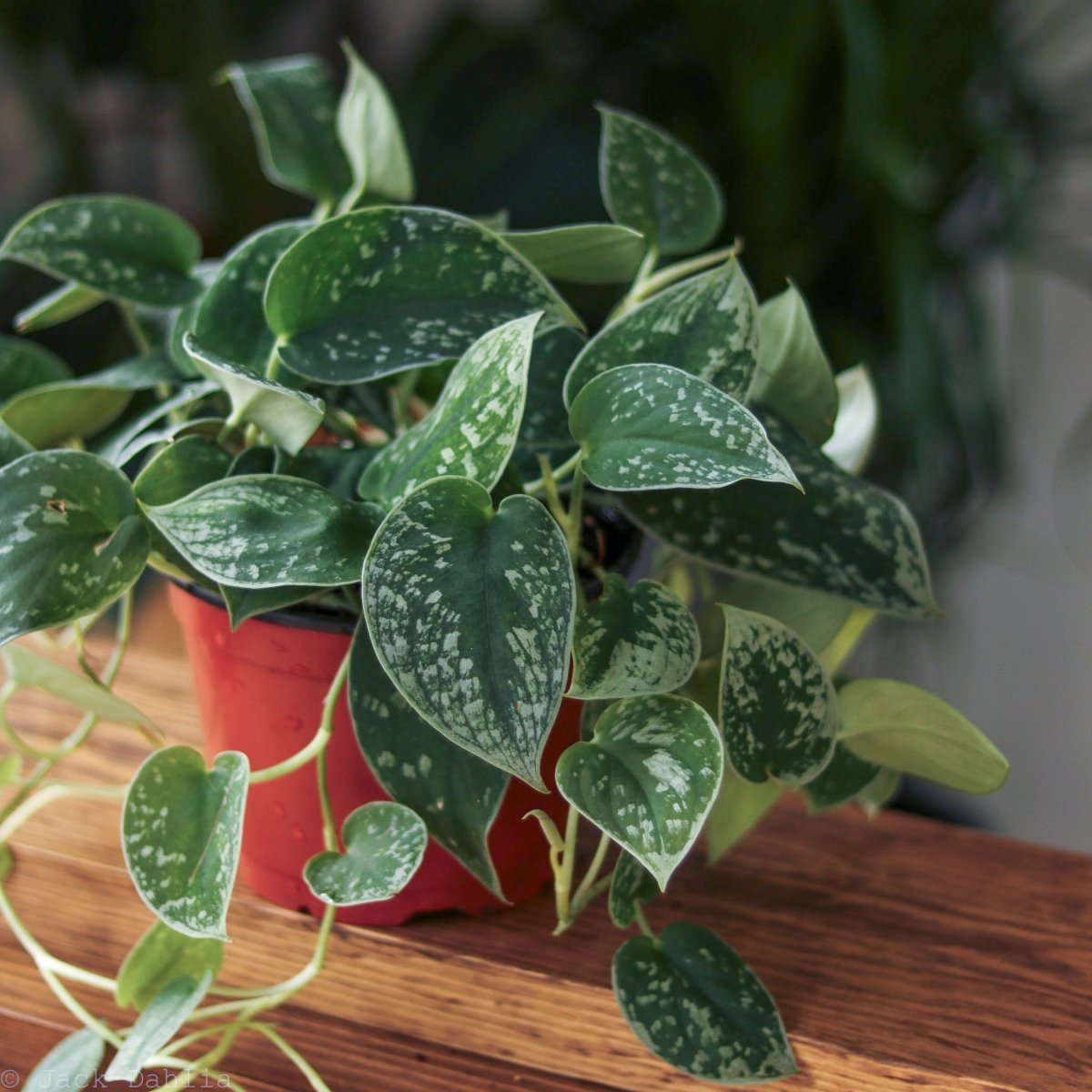
silver and pothos plant 4" Nursery PotMeet the Elegant Silvery Ann The Silvery Ann Scindapsus (Scindapsus pictus Silvery Ann) stands out in the world of Scindapsus pictus varieties due to its delicate, irregular silver variegation and smaller, more heart shaped leaves. Unlike its relatives such as Exotica or Argyraeus, the Silvery Ann features a softer, more ethereal appearance, with large silver patches that often cover entire sections of its foliage. Perfect for collectors who value

Meet the Elegant Silvery Ann

The Silvery Ann Scindapsus (Scindapsus pictus ‘Silvery Ann’) stands out in the world of Scindapsus pictus varieties due to its delicate, irregular silver variegation and smaller, more heart-shaped leaves. Unlike its relatives such as ‘Exotica’ or ‘Argyraeus,’ the Silvery Ann features a softer, more ethereal appearance, with large silver patches that often cover entire sections of its foliage. Perfect for collectors who value variety, this cultivar offers a refined yet low-maintenance addition to any plant collection.


What Sets Silvery Ann Apart?

Distinctive Silver Variegation

The Silvery Ann is known for its high levels of silver variegation. Unlike Scindapsus pictus ‘Exotica,’ which has broader leaves with bold silver streaks, Silvery Ann features smaller, more delicate leaves with irregular, silvery splashes that can appear almost entirely silver in some cases.

Leaf Shape and Texture

Silvery Ann leaves are more petite and heart-shaped compared to the larger, oval-shaped leaves of ‘Exotica.’ The texture is velvety, adding a tactile elegance to its visual appeal.

Growth Habit

While ‘Exotica’ tends to grow larger and longer, Silvery Ann is slightly more compact, making it a great choice for small spaces or intricate displays.

Adaptability

Silvery Ann is highly adaptable and thrives in a variety of lighting conditions, much like its Scindapsus pictus relatives, but it truly shines in bright, indirect light where its silver patches are most pronounced.


Plant Profile

  • Botanical Name: Scindapsus pictus ‘Silvery Ann’
  • Common Names: Silvery Ann, Silver Anne, Silver Pothos
  • Family: Araceae
  • Native Range: Southeast Asia

Care Guide for Silvery Ann Scindapsus

Light:

  • Prefers bright, indirect light to maintain vibrant silver variegation.
  • Tolerates medium light but may develop greener leaves under lower light conditions.

Watering:

  • Allow the top inch of soil to dry out between waterings.
  • Overwatering can lead to root rot; ensure proper drainage.

Humidity:

  • Thrives in average household humidity but appreciates higher levels (50%+).
  • Consider misting or using a pebble tray to boost humidity in drier climates.

Temperature:

  • Ideal range: 60-85°F.
  • Avoid sudden temperature fluctuations and cold drafts.

Soil:

  • Use a well-draining potting mix, such as a blend of peat moss, perlite, and orchid bark.

Fertilizing:

  • Feed monthly during the growing season (spring and summer) with a diluted water-soluble fertilizer.

Pruning and Propagation:

  • Prune to remove yellow or damaged leaves and encourage bushier growth.
  • Easily propagated via stem cuttings; root cuttings in water or soil.

How to Differentiate Silvery Ann from Exotica and Other Varieties

‘Exotica’

Features larger, broader leaves with bold silver streaks and a more defined mottled appearance. The growth habit is more vigorous, making it better for large displays.

‘Argyraeus’

Smaller leaves with fine, speckled silver spots and a more uniform pattern. Argyraeus is less variegated than Silvery Ann, making the latter a standout for its dramatic silver patches.

Silvery Ann

Combines the compact, heart-shaped leaves of ‘Argyraeus’ with the high silver coverage of ‘Exotica,’ offering a softer, more delicate aesthetic.


Why Collectors Love Silvery Ann Scindapsus

  • Unique Appearance: Its high silver coverage and irregular patterns make it a standout among Scindapsus pictus varieties.
  • Space-Friendly: Ideal for small spaces, hanging baskets, or trailing arrangements.
  • Low-Maintenance Beauty: Thrives with minimal care, making it accessible to all levels of plant enthusiasts.
  • Perfect Pairing: Complements other Scindapsus varieties like ‘Exotica’ or ‘Silver Satin,’ creating a visually dynamic collection.

Native Habitat and History

Silvery Ann originates from the tropical forests of Southeast Asia, where it grows as a climbing or trailing plant in the forest understory. Its silver markings are an adaptation to low-light conditions, reflecting light to maximize photosynthesis. In cultivation, this variety has become a favorite for its stunning foliage and easy-care nature.

    Shipping Notes
    • Free Standard Shipping on $100+ Orders to the USA.
    • Except Preorder products are shipped in 48 hours.
    • Delivery to the USA:
    1. Standard Shipping : 3-10 business days
    • If time is of the essence, please consider selecting expedited delivery for faster service.
    Exchange/Return Notes
    • We offer a 30-day return/exchange service after receiving.
    • Final sale items are not eligible for returns or exchanges.
    • To process your return/exchange, please contact us at [email protected]
    • Please click here for more details>>> Return & Exchange Policy
    SKU: 22446933677

    Discover Niche Categories That Outsell silver and pothos plant

    Top-Converting Item to Boost Your Average Order

    4.8 ★★★★★
    Based on 6 reviews
    Sort
    Highest Rating
    Newest First
    Oldest First
    Product Reviews
    R
    Verified Purchase
    Reader KA
    Waukegan, US
    ★★★★★ 5
    Great Historical Reading
    Format: Paperback
    I found "American Slavery, American Freedom" to be a thought-provoking book that contained a great deal of useful information. I wrote in the margins of the book, took notes, and highlighted entire pages. "American Slavery, American Freedom" was well-written and enjoyable to read. I had read countless books on slavery over the years. This book did not focus primarily on slavery. A detailed description of the steps and events that led to the creation of the Commonwealth of Virginia can be found in "American Slavery, American Freedom." The history of Virginia is characterized by slavery and servitude. Since many of the books I had read on slavery lacked a compelling backstory, I found this book refreshing. As far as I can tell, the author denied or downplayed the fact that Thomas Jefferson fathered many children with a slave named Sally Hemmings. The author probably worked on this book for years before its publication in 1975. There was a possibility that Edmund Morgan did not want to write about any "touchy" topics. "American Slavery, American Freedom" was a pleasure to read. I would recommend it to others.
    WAS THIS REVIEW HELPFUL?YesReportShare
    Reviewed in the United States on September 30, 2020
    S
    Verified Purchase
    Sceptique500
    Boise, US
    ★★★★★ 4
    Disturbing Questions
    "Racism became an essential, if unacknowledged, ingredient of the republican ideology that enabled Virginians to lead the nation." writes Edmund S. Morgan in 1975, and ends this book with the rhetorical question: "Is America still colonial Virginia writ large?" These are deeply disturbing questions - questions one is compelled to ponder as one reads this lucid and dispassionate presentation of the how primitive accumulation in Virginia at the beginning of the 17th century was replaced a century later by an orderly and opulent society based on slavery. The answer to such questions is not made easy by the realisation that the only other successful republican experiment - the Athenian democracy - blossomed too on a bed of slavery. Do these questions matter today? Have we not moved on from racism? I'm afraid not. Again the voice of Morgan: "In the republican way of thinking, zeal for liberty and equality could go hand in hand with contempt for the poor and plans for enslaving them." Sounds eerily familiar? Just as today's language used to describe terrorist threats is redolent of the rhetoric that once surrounded the lynching of black bodies. Racism (albeit globalised) is re-visiting the land today, and so are republican virtues and values. The book is long, and in some ways, too detailed. Morgan delights in the telling particular, and at times one wishes he would not linger on some specifics. But this has a purpose. He wants to show the imperceptible and surreptitious mechanisms by which a society acquires its ugly and immoral traits until they become so natural as to be invisible. Step by step, event by event, law by law a construction emerges that would have horrified its founders. Yet, at the time, it seamed the logical, and the right thing to do. A strong point in Morgan's narrative is the links he highlights between the developments in Virginia and the Britain's commercial interests, migration policies, population growth and control, state revenue, and political history or thought. One can better appreciate the import of Virginia for Britain and the mother country's fixation and fascination for the North American colonies. Brash and brutal, Virginian slavery stood openly as godmother at the foundation of the American Republic. Other aspects of slavery also contributed significantly - but as they were indirect, they remained veiled and are hardly recognised even today. New England benefited greatly from its cod trade to the Caribbean, where the product that was found to be unfit for European markets was fed to the slaves, thus freeing up land that otherwise would have been used to sustain them. When will we get a total picture of slavery's import for America's economic foundations?
    WAS THIS REVIEW HELPFUL?YesReportShare
    Reviewed in the United States on July 8, 2003
    P
    Verified Purchase
    Paul
    Lake Worth, US
    ★★★★★ 5
    how a country could develop a "national character" founded on the love of liberty while simultaneously importing thousands and t
    Format: Paperback
    This book lays out hte paradox, how a country could develop a "national character" founded on the love of liberty while simultaneously importing thousands and thousands of bondsmen to provided the "free people" with the necessities of life: i.e., why slavery was necessary to support the kind of freedom the white folk wanted to become accustomed to.... and implicitly, why the industrial revolution finally changed the hearts and minds of enough Americans to make slavery seem unnecessary and therefore, if was no longer a necessary evil, why it had to be overthrown. Morgan writes objectively -- but his feelings are always detectable through his writing style, which is perhaps the best academic English to be found anywhere. I found it gripping. The book was published in 1972, and has doubtless been corrected by many subsequent researchers in some of its particulars -- but it was the fountainhead for a new way of understanding American history that young people all have learned about in high school, but which many baby-boomers have never seriously encountered. Reading it accomplished a MAJOR retrofit in my sense of how the USA got to be the way it is today. Not to put too fine a point on it, the Tea Party and many trump supporters seem to adhere to the values of the original American Republicans [and to think that Black folk should be pushed back to a place where their feelings don't matter], and to long for a return to the status quo ante -- with ante referring to a time long LONG ago
    WAS THIS REVIEW HELPFUL?YesReportShare
    Reviewed in the United States on August 15, 2016
    R
    Verified Purchase
    Richard C. Wolfinger
    Belleville, US
    ★★★★★ 5
    U.S. American Genesis
    Format: Kindle
    Kindle edition worked well. Very interesting and insightful read by a first rate historian. Tells the story of how our ancestors transitioned from Englishmen to Americans. A book well worth taking the time to read.
    WAS THIS REVIEW HELPFUL?YesReportShare
    Reviewed in the United States on June 8, 2022
    M
    Verified Purchase
    michiganreader
    Bozeman, US
    ★★★★★ 5
    History at its best
    This comprehensive history of early Virginia persuasively argues that slavery and racism contributed to the American notions of freedom and democracy for those not enslaved. Although first published in 1975, one would never guess that just from reading it. Morgan's argument emerges from such a careful reading and analysis of primary sources that it remains as important today as it was a quarter century ago. The book also provides valuable insights into many subjects other than slavery, including economic and political relations between Virginia and England, early interactions with Native Americans, and changing colonial and British notions of labor and class. Highly recommended on any of these issues.
    WAS THIS REVIEW HELPFUL?YesReportShare
    Reviewed in the United States on May 23, 2007

    recommand products