Pay in installments of $5.26 with
 ,
,
 and
and

Shipping Estimate
USA
- USA
- CAN
- USA
- CAN
Ships within 48 hours · Estimated delivery Sep 28 - Oct 3
 Promo Codes Available:
For Your Every Summer RSVP, with Code: SUMMER15
Description
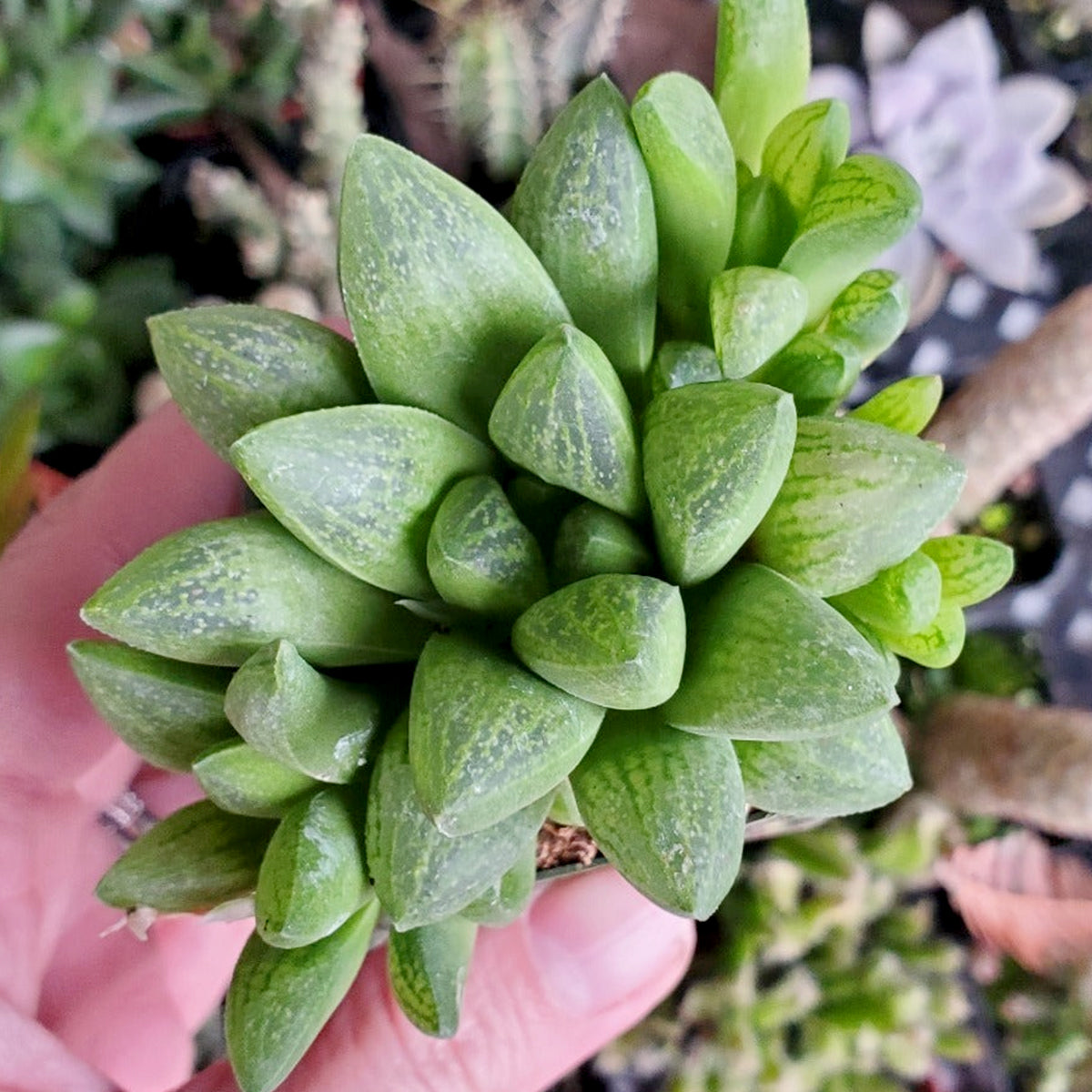
succulent haworthia Haworthia Turgida - Easy To Care SucculentsDescription Light Soil Water Hardiness Haworthia turgida is a delightful, compact succulent thats is very easy to care for. It has plump, finger like leaves with soft, pointed tips, forming loose rosettes that cluster together. The leaves have a soft, translucent green color with a smooth, sea glass like texture, accented by subtle veins and speckled patterns. These details give the plant an almost magical, crystal like appearance. One of the most
-
Haworthia turgida is a delightful, compact succulent that’s is very easy to care for. It has plump, finger-like leaves with soft, pointed tips, forming loose rosettes that cluster together. The leaves have a soft, translucent green color with a smooth, sea-glass-like texture, accented by subtle veins and speckled patterns. These details give the plant an almost magical, crystal-like appearance.
One of the most fascinating features of Haworthia turgida is its ability to change color depending on the light. In bright, indirect sunlight, the green foliage takes on a beautiful reddish tint, adding a dynamic element to its appearance. When placed in shadier spots, the leaves return to their vibrant green hue. With its compact size—reaching only 3 to 4 inches across at maturity—this succulent is perfect for small spaces, terrariums, or as part of a larger arrangement with other drought-tolerant plants.
Haworthia turgida grows by producing offsets, which emerge at the base of the main rosettes. These offsets expand outward, forming a dense mat of closely packed plants. This growth habit makes it ideal for filling in spaces in containers or rock gardens.
Native to South Africa, Haworthia turgida thrives in arid environments and is naturally adapted to handle a variety of light conditions. This adaptability, combined with its striking looks, makes it an excellent choice for both beginners and seasoned plant enthusiasts.
All of the plants may be shipped bare root. -
Haworthia turgida thrives in bright, indirect light but can also adapt to partial shade. While it enjoys a bit of sun, too much direct sunlight can scorch its delicate leaves. If you want to encourage the reddish tones in its foliage, give it access to more intense, filtered light, but be ready to move it to a shadier spot if the leaves start to fade or scorch.
This succulent loves warm weather and thrives in temperatures between 60°F and 80°F. It doesn’t tolerate frost, so if you live in a cooler climate, make sure to bring it indoors during the winter months. While it’s not picky about humidity, it’s best suited for dry conditions, making it perfect for most indoor spaces.
To keep Haworthia turgida happy, plant it in a fast-draining soil mix, like one designed for succulents or cacti. A pot with drainage holes is essential to prevent the roots from sitting in water. Place it somewhere with good airflow to keep the plant healthy and reduce the risk of fungal issues.
Like most succulents, this plant prefers to dry out completely between waterings. Using the "soak and dry" method is the best approach: water thoroughly, allowing any excess to drain away, then wait until the soil is completely dry before watering again. Overwatering is one of the few ways to harm this resilient little plant, as it can lead to root rot or invite pests.
In the spring or early summer, a happy Haworthia turgida may produce delicate flower stalks with tiny, tubular white blooms. While these flowers are modest compared to the plant’s striking foliage, they’re a charming bonus for careful caretakers.
Haworthia turgida is non-toxic to pets and humans, making it a safe choice for households with curious animals or small children.
- USDA hardiness zone 9 to 11
Shipping Notes
- Free Standard Shipping on $100+ Orders to the USA.
- Except Preorder products are shipped in 48 hours.
- Delivery to the USA:
- Standard Shipping : 3-10 business days
- If time is of the essence, please consider selecting expedited delivery for faster service.
Exchange/Return Notes
- We offer a 30-day return/exchange service after receiving.
- Final sale items are not eligible for returns or exchanges.
- To process your return/exchange, please contact us at [email protected]
- Please click here for more details>>> Return & Exchange Policy
4.1 ★★★★★
Based on 7 reviews
Sort
Product Reviews
★★★★★ 5
Very durable
Style: Two pack
These are great for my aggressive chewer. She still naws them down a bit after 6 months but not nearly as much as other toys. The size is perfect. It keeps her engaged in play. They do not squeek which is a plus.
The only worry I have is if she throws it in the air it might break something breakable.
WAS THIS REVIEW HELPFUL?YesReportShare
Reviewed in the United States on April 30, 2026
★★★★★ 5
Favorite bones for my dog
Size: Small, Color: Pink
Dog favorite bones, but broken fast pink bone. I buy multiple times.
WAS THIS REVIEW HELPFUL?YesReportShare
Reviewed in the United States on June 7, 2026
★★★★★ 5
Great for a teething puppy
Size: Small, Color: Pink
This is one of the best training collars we have used. So good that we ordered a second one so each dog has one and we have recommended it to several other people. It has 3 options, beeping, vibration and shock. Each option has several different settings. The collar comes in many different colors. It is very sturdy and it is waterproof. It is adjustable and the clip is very sturdy. I had previously bought a different training collar that did not phase my dog in the slightest and was a complete waste of money. It always seemed to be low on battery even after charging, this one however lasts like a week after charging. I will continue to use this brand for sure
WAS THIS REVIEW HELPFUL?YesReportShare
Reviewed in the United States on June 8, 2026
★★★★★ 5
The Toy Annie Always Comes Back To
Size: X-Small, Color: Pink
⭐⭐⭐⭐⭐
These have become one of Annie's all-time favorite toys.
Annie is a tiny 4-pound dog, and she can be surprisingly picky about toys. She has a basket full of options, but she consistently comes back to her nubby Nylabones.
I think the size and texture are a big part of why she likes them so much. They're easy for her to carry around, chew on, and play with by herself. Whenever I buy a new one, it quickly becomes part of her regular toy rotation.
As a small-dog owner, I appreciate finding toys that are appropriately sized and actually get used instead of being ignored after a few days.
If you have a tiny dog who loves to chew, these are definitely worth trying. They've been a favorite in our house for a long time.
WAS THIS REVIEW HELPFUL?YesReportShare
Reviewed in the United States on May 30, 2026
★★★★★ 4
Dogs love these!
Size: Small, Color: Pink
My miniature Goldendoodle puppies love these! The only drawback is after several weeks of chewing, the bones develop pretty sharp edges long before the actual bone has been worn down. At that point, they are dangerous for the dog’s gums and must be thrown away.
WAS THIS REVIEW HELPFUL?YesReportShare
Reviewed in the United States on June 3, 2026