SKU: 24538693736
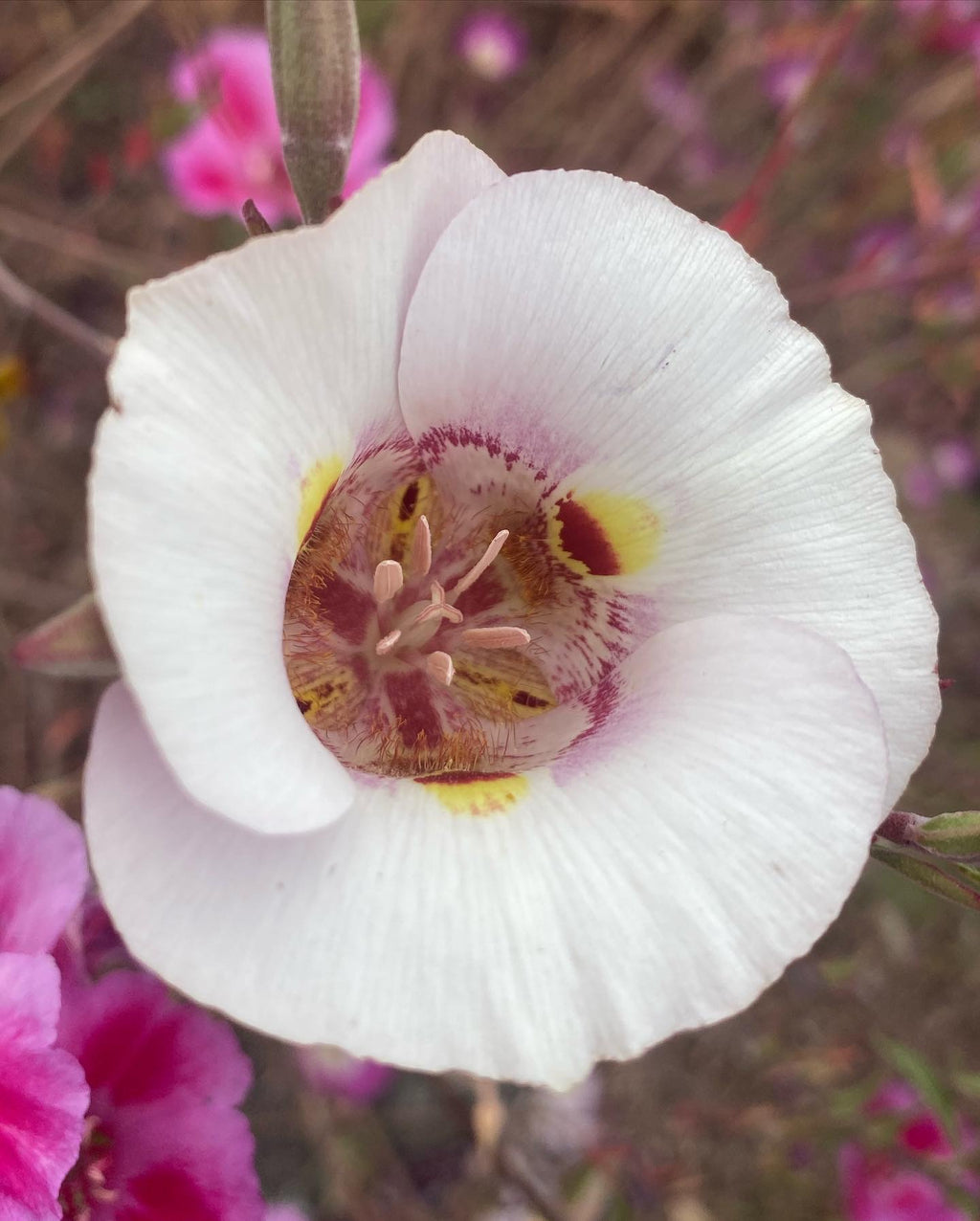
white mariposa lily

white mariposa lily Butterfly Mariposa Lily

Sale price$19.96 Regular price$22.18
Save 10%

Pay in installments of $5.54 with ShopPay, AfterPay and Klarna

Shipping Estimate
USA
  • USA
  • CAN

Ships within 48 hours · Estimated delivery Aug 8 - Aug 13

Promo Codes Available:

For Your Every Summer RSVP, with Code: SUMMER15

Description

white mariposa lily Butterfly Mariposa LilyCalochortus venustus, commonly known as the Butterfly Mariposa Lily, is one of Californias most spectacular native wildflowers. Found in open woodlands, grassy slopes, and dry meadows throughout the Sierra Nevada and Coast Ranges, this perennial bulb produces an extraordinary range of colors and intricate petal markings that have captivated native plant enthusiasts and botanists alike. Growing 12 to 28 inches tall, Calochortus venustus sends up

Calochortus venustus, commonly known as the Butterfly Mariposa Lily, is one of California’s most spectacular native wildflowers. Found in open woodlands, grassy slopes, and dry meadows throughout the Sierra Nevada and Coast Ranges, this perennial bulb produces an extraordinary range of colors and intricate petal markings that have captivated native plant enthusiasts and botanists alike.
Growing 12 to 28 inches tall, Calochortus venustus sends up slender stems with narrow, grass-like leaves that wither as the plant begins to bloom. From May through July, it produces 1 to several large, cup-shaped flowers per stem. The petals may be white, pink, lavender, orange, or deep red—each adorned with contrasting spots, fringed petal hairs, and a central “eye” that resembles a butterfly’s wing. This intricate patterning gives the plant its common name and attracts native bees and other beneficial pollinators.
Butterfly Mariposa Lily prefers full sun and well-draining soils, such as sandy loam, decomposed granite, or gravelly slopes. It thrives in dry summer conditions and should be allowed to go dormant after blooming. Best sown in fall to align with natural moisture patterns. Ideal for native gardens, rockeries, or restoration areas where dazzling seasonal displays are desired.

Height: 1–1.5 feet
Optimum Soil Temperature for Germination: 50°F–60°F
Blooming Period: May–July
Germination: 30–90 days (cold stratification recommended)
Sowing Depth: 1/8"
Great plant for a container or rock garden. USDA zones 8-10, full sun, well draining soil. Blooms in May-June and reaches about 1-1.5' in height.
Each seed packet contains 10 organically grown seeds, open-pollinated, untreated, non-GMO.

Shipping Notes
  • Free Standard Shipping on $100+ Orders to the USA.
  • Except Preorder products are shipped in 48 hours.
  • Delivery to the USA:
  1. Standard Shipping : 3-10 business days
  • If time is of the essence, please consider selecting expedited delivery for faster service.
Exchange/Return Notes
  • We offer a 30-day return/exchange service after receiving.
  • Final sale items are not eligible for returns or exchanges.
  • To process your return/exchange, please contact us at [email protected]
  • Please click here for more details>>> Return & Exchange Policy
SKU: 24538693736

Discover Niche Categories That Outsell white mariposa lily

Top-Converting Item to Boost Your Average Order

4.7 ★★★★★
Based on 13 reviews
Sort
Highest Rating
Newest First
Oldest First
Product Reviews
R
Verified Purchase
Reviewer from San Ramon
Birmingham, US
★★★★★ 5
Cornford's Plato Cosmology/Timaeus
Format: Paperback
This is an excellent and invaluable reference book for Plato's Timaeus. If you are reading Timaeus you MUST have this book. It contains line-by-line commentary, and also, most valuable, some very helpful illustrations (example: illustration of the human body as Timaeus explained it). I would, however, balance this book with other books that attempt to place Timaeus within the rest of Plato's works. I recommend, for example, Peter Kalkavage's Timaeus. There, he attempts to link Timaeus and Republic.
WAS THIS REVIEW HELPFUL?YesReportShare
Reviewed in the United States on February 8, 2011
W
Verified Purchase
Wilbur F. Pierce
Pawtucket, US
★★★★★ 5
An Excellent Choice
Format: Paperback
Excellent introduction, notes and translation.
WAS THIS REVIEW HELPFUL?YesReportShare
Reviewed in the United States on June 8, 2017
D
Verified Purchase
David Lemberg
Cuba, US
★★★★★ 5
Five Stars
Format: Paperback
Professor Cornford's translation with running commentary is definitive.
WAS THIS REVIEW HELPFUL?YesReportShare
Reviewed in the United States on November 5, 2015
J
Jordan Bell
Louisville, US
★★★★★ 5
Plato's dialogue about the physical world
Format: Paperback
The two biggest topics in the Timaeus are astronomy and the elements of bodies, which are constructed using triangles and the tetrahedron, octahedron, icosahedron, and cube. I would like to see a translation of the Timaeus that uses it as a way to introduce all the astronomy that appears in the dialogue. Introducing the astronomy does not mean just talking in words about spheres or the zodiac or the ecliptic, but actually explaining how these were used by astronomers. Cornford has much to say, but to someone who has not learned any Greek astronomy his commentary will be opaque and hard to use. I didn't know the astronomy well enough to readily understand Cornford's explanations. I plan to learn more classical Greek astronomy, perhaps using Evans' , and then read Waterfield's translation of the Timaeus . Before reading this you should have read the Republic and know some classical Greek natural philosophy, mathematics, and astronomy. Although Cornford's commentary makes the dialogue staccato, I am glad for it because I wouldn't otherwise have understood much of what Plato says. The Timaeus and the Parmenides are the two dialogues of Plato that one needs commentary to understand; the Parmenides demands the commentary because so much of what is happening depends on the original language, and the Timaeus demands the commentary because of all the things the reader is supposed to be familiar with. The following is a list of topics I kept while reading the dialogue: theory of Forms 27d-28a, 51a-52a; harmonics 35b-36b; time 37c-38e, 39b-e; vision 45b-46c, 67c-68d; space 52b; surfaces 53c; weight 62d-63e; sound 67a-67c; physiology 70c-79e, 80d-86a; antiperistasis 79e-80c.
WAS THIS REVIEW HELPFUL?YesReportShare
Reviewed in the United States on December 12, 2015
S
Steve Lookner
Boise, US
★★★★★ 4
Helpful, but Waterfield is better for an intro
Format: Paperback
This is basically a scholarly paragraph-by-paragraph commentary on the Timaeus. It's really good for what it is, but I don't recommend it as your first introduction to the Timaeus -- rather, I recommend Waterfield: http://www.amazon.com/Timaeus-Critias-Oxford-Worlds-Classics-ebook/dp/B006NTMD16 A problem with using Cornford as an introduction is that he comments on everything, and it's hard to figure out what the main themes are. I tried reading Cornford as an intro and gave it up, but once I'd read Waterfield I found Cornford extremely helpful both in elucidating passages further than Waterfield does, and in interpreting passages Waterfield doesn't cover. So if you're looking to learn about the Timaeus, I'd suggest Waterfield first and Cornford second (or Cornford alongside Waterfield).
WAS THIS REVIEW HELPFUL?YesReportShare
Reviewed in the United States on February 24, 2014

recommand products