SKU: 26333212074
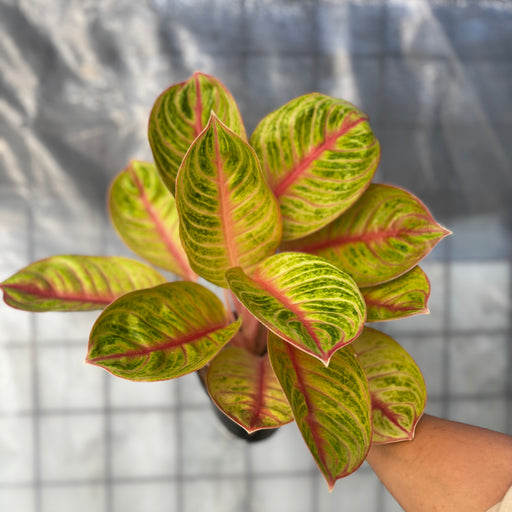
aglaonema amber

aglaonema amber Aglaonema Amber

Sale price$19.12 Regular price$21.25
Save 10%

Pay in installments of $5.31 with ShopPay, AfterPay and Klarna

Shipping Estimate
USA
  • USA
  • CAN

Ships within 48 hours · Estimated delivery Aug 28 - Sep 2

Promo Codes Available:

For Your Every Summer RSVP, with Code: SUMMER15

Description

aglaonema amber Aglaonema AmberFree International Shipping for orders $700+Carefully Selected, Export Ready Plants by Aroid Asia Every plant is individually selected and prepared by our professional export team, with strong attention to plant quality, healthy roots, and secure international delivery. For nearly 6 years, we have been supplying live plants to customers in over 35 countries worldwide. Plant Details Plant size: approx. 612 inches tall Pot size: 46 inches Leaf count:

Free International Shipping for orders $700+
Carefully Selected, Export-Ready Plants by Aroid Asia

Every plant is individually selected and prepared by our professional export team, with strong attention to plant quality, healthy roots, and secure international delivery.
For nearly 6 years, we have been supplying live plants to customers in over 35 countries worldwide.


Plant Details

  • Plant size: approx. 6–12 inches tall
  • Pot size: 4–6 inches
  • Leaf count: typically 2–5 leaves (live plants vary)
  • Condition: fully rooted (not a cutting)

🌿 Natural Variation Notice
Minor cosmetic imperfections such as light marks or slight leaf damage may occur due to natural growth and handling. We carefully avoid plants with serious issues.


Plant Quality Assurance

Photos are for illustration purposes. You will receive a handpicked, healthy plant closely matching the images.
Every plant is unique, but we guarantee strong roots, excellent condition, and premium quality selection for the best growing experience.


Post-Arrival Care (Quick Guide)

To help your Aglaonema adapt after international transit:

  • Light — Bright, indirect light (avoid direct sunlight, especially during the first 7–10 days)
  • Water — Keep the medium consistently moist; avoid letting it dry out completely or become waterlogged
  • Humidity — High humidity is highly recommended (70%+ ideal during the first week)
  • Temperature — Best between 70–86°F; avoid temperatures below 62°F
  • Acclimation tip — Allow 10–14 days for the plant to stabilize before repotting or making major changes

Before You Order

Please review our Shipping Policy & FAQ before purchasing.
Live stock moves quickly — if you love the plant, secure it today by clicking “Add to Cart.”

      Shipping Notes
      • Free Standard Shipping on $100+ Orders to the USA.
      • Except Preorder products are shipped in 48 hours.
      • Delivery to the USA:
      1. Standard Shipping : 3-10 business days
      • If time is of the essence, please consider selecting expedited delivery for faster service.
      Exchange/Return Notes
      • We offer a 30-day return/exchange service after receiving.
      • Final sale items are not eligible for returns or exchanges.
      • To process your return/exchange, please contact us at [email protected]
      • Please click here for more details>>> Return & Exchange Policy
      SKU: 26333212074

      Discover Niche Categories That Outsell aglaonema amber

      Top-Converting Item to Boost Your Average Order

      4.3 ★★★★★
      Based on 13 reviews
      Sort
      Highest Rating
      Newest First
      Oldest First
      Product Reviews
      K
      Verified Purchase
      Kevin S. Grail
      Lake Worth, US
      ★★★★★ 5
      My favorite book, in any genre
      Ronald Wright is an amazing scholar and writer. His style is fun and easy to read while delivering impeccable historical research. I have listed to this book several times over the years and I appreciate it more each time. I recommend the audio version more than the print version because of the compelling way Mr. Wright delivers this 4-Part lecture series to his audience (now in book form). Note to Amazon: Please make this book available on Audible, CDs are cumbersome.
      WAS THIS REVIEW HELPFUL?YesReportShare
      Reviewed in the United States on July 3, 2018
      J
      Verified Purchase
      J. Edgar
      Whiting, US
      ★★★★★ 4
      How many trees do we have left?
      In this book, the author takes a look at the downfall of civilizations. Yes, that's plural. There are several models of how civilization is progressing. One is that we're getting better and better as time goes by. Another, less popular one states that we are actually in decline, going down from some sort of golden age. You'll find many of these proponents in the old age homes and such. For them, the only disagreement is when we are declining from. Wright takes a look at the cyclical nature of the rise and fall of civilizations, taking examples from several once- prospering civilizations. This book stands as a call to action that something must be done to grow smartly and be careful on how we allocate the scant resources we have left. While he doesn't hit an anything new, this book's strength is its concise nature. The several examples are familiar and in that have more impact. The strongest example is one he visits several times to show an analogy of current times: Easter Island. This isolated speck in the Pacific was once a thriving mini-civilization with culture and art. And a lot of trees. These trees helped the islanders fish and raise their ceremonial head sculptures. However, these trees also were a poorly cultivated resource. Someone not too long ago cut down the last tree, and the island is now a wasteland and anthropological curiosity. We are doing the same thing. How many trees do we have left to cut?
      WAS THIS REVIEW HELPFUL?YesReportShare
      Reviewed in the United States on October 14, 2009
      W
      Verified Purchase
      W Lorraine Watkins
      Fort Morgan, US
      ★★★★★ 3
      Good on Review Short on Direct Experience
      It is an extensive review of the literature on rise and fall of civilizations with observations on our's. Extremely well footnoted and referenced it however suffers from the author appearing to have little direct primary experience in the study of his topic. Nonetheless there is good information here and substantiation of the notion that cultures come and go, frequently going as a result of the lack of capacity necessary to change group behavior in response to certain challenges. He presents compelling evidence that those overwhelming challenges often revolve around irrational and compulsive exploitation of natural resources. Sadly I share the author's pessimism in regard to our global culture being likely to respond adequately to the ongoing destruction of our livable earthly environment. I fear the planet is headed for a massive kill off in the disturbingly near future.
      WAS THIS REVIEW HELPFUL?YesReportShare
      Reviewed in the United States on April 13, 2013
      P
      Verified Purchase
      phamv
      Carnegie, US
      ★★★★★ 5
      I hate to be the kind of person preaching on Doom's ...
      This is an impressive quick read. I hate to be the kind of person preaching on Doom's Day, but I do find the definition of progress to be a multi-faceted, direct correlation to humanity, or as this book challenges, inversely related. As Le Corbusier once stated in Towards a New Architecture, "[Progress is] the study of minute points pushed to its limits." I think that we forget that limits do exist. On a sustainability level, we seem to forget that growth is bound to a carrying capacity which is only a constant. We exceed limits in population, in wealth, in energy consumption, and we are doing so blindly because we believe we are progressing. This is the first that I heard the term "progress traps" (which I think Wright may have coined himself), and I believe we seem to fall under the impression that distilling or expanding our limitations is an ultimate form of progress, when in fact, its lack in sustainability will only push us back. If you have the time, it's a pretty quick and enlightening read. If you are still on the fence with the concepts discussed in the book, I recommend finding it at a local library before committing to buy. For me, I recommend it. Also, if you are interested, there is a documentary based on this book called "Surviving Progress" (2011). I prefer the book so much more, but the documentary wasn't that bad.
      WAS THIS REVIEW HELPFUL?YesReportShare
      Reviewed in the United States on August 29, 2015
      M
      Verified Purchase
      MITCHELL T WEBB
      Cuba, US
      ★★★★★ 5
      Negro Slave Bible
      I like the large print. And, I appreciate the honest commentary.
      WAS THIS REVIEW HELPFUL?YesReportShare
      Reviewed in the United States on May 7, 2026

      recommand products