SKU: 28269011596
philodendron glad hands for sale

philodendron glad hands for sale Philodendron Glad Hands

Sale price$25.62 Regular price$28.47
Save 10%

Pay in installments of $7.12 with ShopPay, AfterPay and Klarna

Shipping Estimate
USA
  • USA
  • CAN

Ships within 48 hours · Estimated delivery Sep 2 - Sep 7

Promo Codes Available:

For Your Every Summer RSVP, with Code: SUMMER15

Description

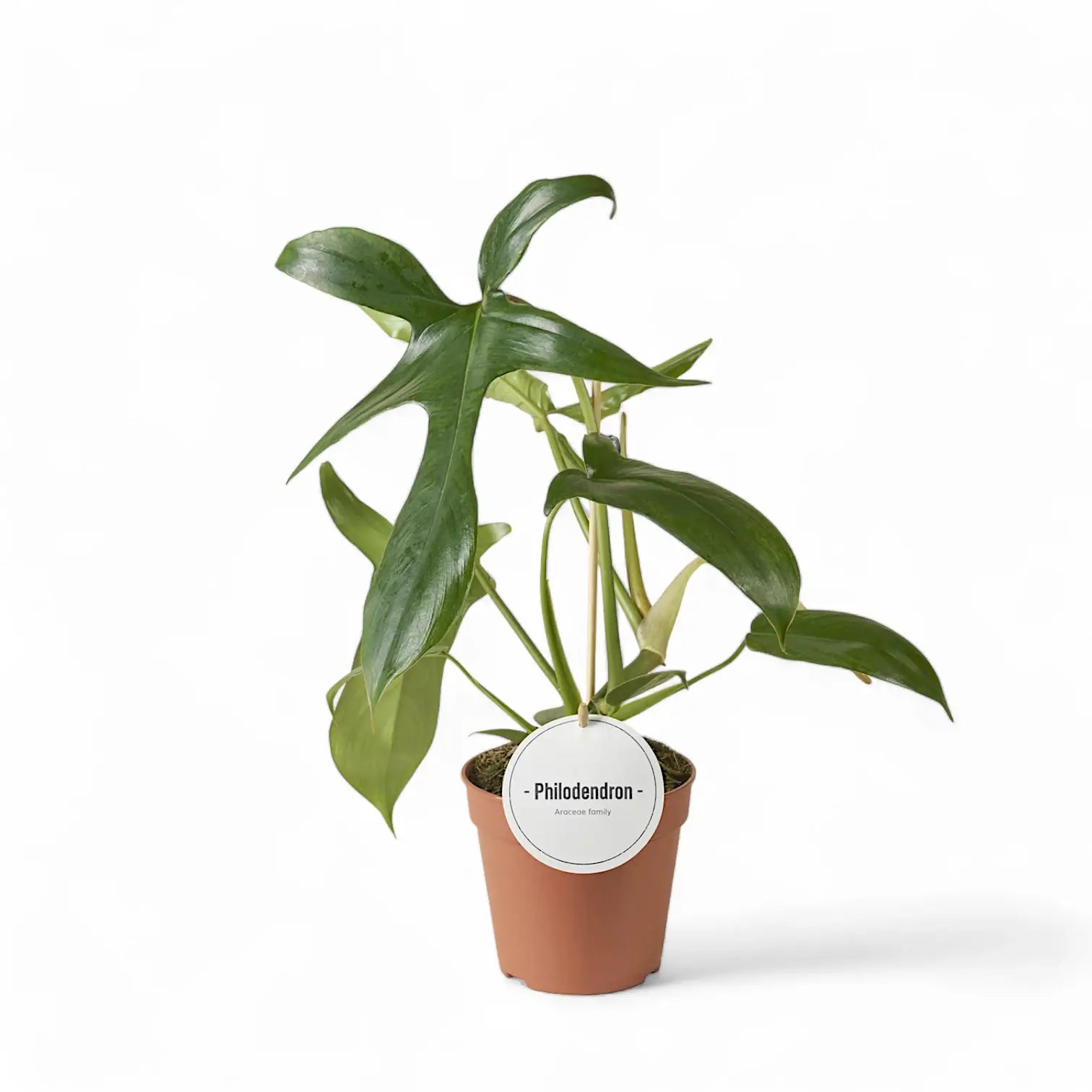
philodendron glad hands for sale Philodendron Glad HandsPhilodendron 'Glad Hands' (quercifolium) Philodendron 'Glad Hands' is a narrow form of Philodendron pedatum, grown for deeply divided leaves with long, slim lobes that spread from the blade like fingers. The full leaf shape develops over time, so young plants can look slimmer and less divided before the stem gains size and support. This plant grows from a climbing stem with clear nodes and aerial roots. As the stem extends, each node can produce

Philodendron 'Glad Hands' (quercifolium)

Philodendron 'Glad Hands' is a narrow form of Philodendron pedatum, grown for deeply divided leaves with long, slim lobes that spread from the blade like fingers. The full leaf shape develops over time, so young plants can look slimmer and less divided before the stem gains size and support.

This plant grows from a climbing stem with clear nodes and aerial roots. As the stem extends, each node can produce another leaf and attach to support through new root points. A pole, plank, or trellis helps the plant anchor, keeps the stem upright, and gives divided leaves space to spread.

Narrow lobes and node-by-node growth

  • Growth habit: Climbing Philodendron with nodes, aerial roots, and a stem that responds well to vertical support.
  • Leaf shape: Long, narrow lobes give older leaves a hand-like outline.
  • Development: Leaf divisions become clearer as the plant gains size, support, and stronger root growth.
  • Petiole spread: Leaves are held away from the stem, so established plants need space around the support.
  • Root behaviour: Aerial roots help the climbing stem attach and support larger foliage over time.

Pedatum background and quercifolium name

Philodendron pedatum (Hook.) Kunth was published in Enumeratio Plantarum 3:49 in 1841. It is an accepted South American species that grows as a climber in wet tropical habitats. Philodendron quercifolium Engl., published in Botanische Jahrbücher für Systematik 26:546 in 1899, is now placed under Philodendron pedatum.

The quercifolium name refers to oak-like divided leaves and still appears around this plant in cultivation. This narrow form shows a slimmer, more finger-like expression of pedatum-style leaf division once the stem is rooted and climbing. Older leaves gain a more defined outline, not just a larger size.

Care for divided leaves

  • Light: Provide bright filtered light. Strong indirect light supports shorter internodes and more developed leaves, while harsh direct sun can scorch exposed lobes.
  • Watering: Water thoroughly once the upper substrate has dried slightly. Keep moisture steady during active growth, but do not leave the pot standing in water.
  • Substrate: Use a chunky aroid mix with bark or coco chips, perlite or pumice, and a moisture-holding base. The roots need both moisture and air around them.
  • Pot choice: Choose a pot with drainage holes and enough depth to hold the support firmly. Avoid oversized pots that keep the lower stem wet for too long.
  • Repotting: Repot when roots fill the pot or the support becomes unstable. Move up gradually so the root zone stays aerated.
  • Support: Add a pole, plank, or trellis early. Attach the stem loosely so aerial roots can reach the support without being crushed.
  • Humidity: Aim for moderate to high humidity. Around 50–70% helps the narrow lobes open without dry tips or tears.
  • Temperature: Keep at about 18–28°C. Cool, wet conditions slow root activity and can damage the lower stem.
  • Feeding: Feed lightly during active growth with a balanced fertiliser. Reduce feeding when light and leaf production slow down.
  • Growth rate: Expect moderate climbing growth once rooted and supported. Leaf shape improves gradually as the stem strengthens.
  • Pruning: Remove yellowing leaves and trim stretched stems above a node if the plant needs reshaping. Healthy cut sections can be used for propagation.
  • Placement: Give the plant room around its support so the lobed leaves can spread without rubbing against walls, shelves, or neighbouring plants.
  • Semi-hydroponics: This Philodendron can adapt to mineral or semi-hydro substrates if roots are transitioned gradually and the reservoir is kept clean.
  • Propagation: Take stem cuttings with at least one node and preferably an aerial-root nub. Keep cuttings warm and humid while roots form.

Juvenile leaves, torn lobes and stem stretch

  • Leaves staying juvenile: Check support, light, and root health. A divided leaf shape develops more reliably on a climbing, well-rooted stem.
  • Yellow lower leaves: Inspect the substrate and roots. Persistent wetness around the lower stem can cause older leaves to decline quickly.
  • Brown lobe tips: Look for dry roots, low humidity, fertiliser buildup, or hot sun through glass.
  • Long gaps between leaves: The stem may be reaching for light or growing away from its support. Move it into brighter filtered light and secure new growth.
  • Torn new leaves: New lobes can catch while unfurling. Keep watering stable and humidity moderate rather than forcing the leaf open.
  • Loose stem attachment: If the stem pulls away from the support, retie it gently at the nodes and guide new aerial roots toward the surface.
  • Pests: Check leaf undersides, petiole bases, and cataphylls for thrips, mites, scale, and mealybugs.

Pet safety and skin irritation

Philodendron 'Glad Hands' should be kept away from pets and children that may chew leaves or stems. Philodendron contains calcium oxalate crystals, which can irritate the mouth, throat, and digestive tract if ingested. Sap may irritate sensitive skin after pruning or propagation.

Name meaning and botanical background

Philodendron means “tree-loving”, a reference to the climbing habit common in the genus. The epithet pedatum means foot-like, matching the divided leaf outline of Philodendron pedatum. Quercifolium combines Latin roots for oak and leaf, referring to an oak-like leaf shape. The name 'Glad Hands' suits the hand-like spread of the leaf lobes.

Choose Philodendron 'Glad Hands' for a climbing Philodendron with slim, fingered leaves and a distinctive narrow-lobed outline.

Shipping Notes
  • Free Standard Shipping on $100+ Orders to the USA.
  • Except Preorder products are shipped in 48 hours.
  • Delivery to the USA:
  1. Standard Shipping : 3-10 business days
  • If time is of the essence, please consider selecting expedited delivery for faster service.
Exchange/Return Notes
  • We offer a 30-day return/exchange service after receiving.
  • Final sale items are not eligible for returns or exchanges.
  • To process your return/exchange, please contact us at [email protected]
  • Please click here for more details>>> Return & Exchange Policy
SKU: 28269011596

Discover Niche Categories That Outsell philodendron glad hands for sale

Top-Converting Item to Boost Your Average Order

4.4 ★★★★★
Based on 12 reviews
Sort
Highest Rating
Newest First
Oldest First
Product Reviews
B
Verified Purchase
Benjamin Herzog
Lowell, US
★★★★★ 5
Fascinating and well written
Format: Hardcover
This is one of those books that makes you re-see everyday things with new awareness and a more critical eye. Well-researched, organized and written. Highly recommend!
WAS THIS REVIEW HELPFUL?YesReportShare
Reviewed in the United States on October 3, 2022
A
And So It Goes
San Leandro, US
★★★★★ 1
Pop culture: yoga, croases, costumes, tattoos of sacred symbols …is not religious appropiation.
Format: Hardcover
Neither are Christmas trees, a pagan tradition, except to religious fundamentalists. Religion, all religions … which are all patriarchal by origin and definition is to be challenged for hypocrisy … see Madonna for in your face pop blasphemy. This is not scholarship.
WAS THIS REVIEW HELPFUL?YesReportShare
Reviewed in the United States on January 20, 2023
K
Verified Purchase
Keith Hansen
Draper, US
★★★★★ 5
An Invitation to Better Dialogue
Format: Paperback
Perry Schmidt-Leukel has tackled one of the most difficult intellectual minefields of all - religious pluralism. I admire his attempt, desire and intentions. This work is based off of a 2015 Gifford lecture in Glasgow. Religious Pluralism is one of the three possible stances that address the Problem of Religious Diversity. The other two stances are significantly more common and also close sisters - Exclusivism and Inclusivism. Pluralism is the most radical stance but also one most needed in a globally-connected world with seemingly ineradicable conflict and violence. One can safely ignore, by the way, the stance that all religions are nothing but projections of immature minds (Naturalism); this is a gaslighting position which tries to throw the baby out with the bathwater and does not really address the issue of religious diversity. Religion should be treated with the seriousness it is due and humans are inherently homo religiosus as history and culture attest. There are several reasons why Pluralism should be considered the superior stance. First, it is the most pragmatic as alluded to in my above statement on conflict. Second, if one understands Truth as something that no human or group of humans can ever have a monopoly on then Pluralism makes more sense than the other two. I should add that we should approach understanding of Truth more as a peregrination than as some fixed or static destination. Third, much of religious diversity is due to historical, cultural and especially linguistic differences but if we spend time in interreligious dialogue, we can begin to see that the religions are often saying the same things but using different jargon. The jargon should not be confused with Reality or Truth. As humans, we must continually be humbled by our lowly ability to understand reality as it is in itself and our immense limitations of language. Language too often creates division and can also circumscribe our ability to understand. Yet, it is all we really have to communicate with. Perry spends some time first outlining what a program of sustained interreligious dialogue would look like and some foundational principles. He then addresses some of the biggest elephants in the room - The Son, The Prophet and The Buddha - and how we can approach possible reconciliation, or at least how we can begin to frame the discussion. The other main issue is the problem of a Creator God in Buddhism. If I were to offer a point of criticism to Perry's approach it is that he does not include in his discussion Philosophical Religions such as Platonism/Neoplatonism and Panentheism. However, I understand that would have really complicated things and he clearly wanted to only focus on the main traditional religions. Perry then finishes up with a very fresh and thought-provoking discussion on a fractal interpretation of religion. That may be the most profound chapter of the book. The book is full of insight but should be taken as only an overview (albeit a very good one) and a hopeful beginning to more in-depth analysis and discussion. I look forward to reading more from Schmidt-Leukel and I hope more people can move from their exclusivist and inherently conflict-bound view of the world to a more peaceful and uniting view of the very same one reality we are all experiencing and are all a small part of.
WAS THIS REVIEW HELPFUL?YesReportShare
Reviewed in the United States on January 18, 2026
A
Verified Purchase
Alan Race
Boise, US
★★★★★ 5
Pluralism as a positive good
Format: Paperback
Anyone iterested in how religions might think of their co-religionists should read this book. It pushes at the boundaries of settled views and points the way to a different future for interreligious relations. One of the best books on the fiedl for some time.
WAS THIS REVIEW HELPFUL?YesReportShare
Reviewed in the United States on March 4, 2017
E
Verified Purchase
Evan
Whiting, US
★★★★★ 5
Digital Detective Delight
Format: Paperback
Learn Computer Forensics is a standout resource that makes diving into digital investigations feel both exciting and achievable. Right from the first pages, you are drawn in with relatable scenarios...uncovering clues from a smartphone or piecing together a story from social media posts. The author’s warm, conversational style turns what could be a dry subject into a fascinating journey, making complex ideas like evidence preservation and chain of custody feel straightforward and even a little fun to explore. As you work your way through the book, you’ll find clear, hands-on advice for setting up your own forensic workstation and choosing the right tools for the job. Chapters on Windows artifacts, RAM analysis, and email investigations guide you step by step. What makes these sections especially engaging is the way each lesson includes practical exercises. By winding your way through browser history or reconstructing email paths, you gain real skills instead of just theory. It feels less like following a checklist and more like cracking a case alongside a friendly mentor. What really sets this edition apart is its human touch. The author peppers in personal anecdotes...like tips for sketching a crime scene or handling tricky insider-threat investigations...that add personality and context. You’ll walk away not only understanding how to pull data from a disk image but also why certain methods matter in real-life cases. If you want a forensics book that feels less like a textbook and more like a conversation with a seasoned investigator, this is it. It earns every one of its five stars.
WAS THIS REVIEW HELPFUL?YesReportShare
Reviewed in the United States on June 2, 2025

recommand products