SKU: 30864129045
veer baby stroller

veer baby stroller Veer Switch&Roll Stroller (Switchback Seat, &Roll Frame) Brown Mica

Sale price$25.00 Regular price$27.78
Save 10%

Pay in installments of $6.95 with ShopPay, AfterPay and Klarna

Shipping Estimate
USA
  • USA
  • CAN

Ships within 48 hours · Estimated delivery Aug 4 - Aug 9

Promo Codes Available:

For Your Every Summer RSVP, with Code: SUMMER15

Description

veer baby stroller Veer Switch&Roll Stroller (Switchback Seat, &Roll Frame) Brown MicaThe Switch&Roll stroller offers over 40 expansion configurations to grow with your family as life evolves. The seat offers 4 positions of recline, can face forward or backward, and provides 3 plevels of leg support to allow specific positioning for maximum comfort. The seat can even be used as a feeding booster seat with included attachment straps. An infant insert, Veer Bassinet, or car seat can be added for true from birth use (sold separately).

The Switch&Roll stroller offers over 40 expansion configurations to grow with your family as life evolves.  The seat offers 4 positions of recline, can face forward or backward, and provides 3 plevels of leg support to allow specific positioning for maximum comfort. The seat can even be used as a feeding booster seat with included attachment straps. An infant insert, Veer Bassinet, or car seat can be added for true from-birth use (sold separately).

Thoughtfully designed for baby, toddler and parent comfort, the stroller glides effortlessly over city streets, grass, hills and gravel with lightweight, never flat, oversized tires and adjustable rear-wheel suspension that makes every ride feel smooth and easy. The Napa Leather covers on the extendable handle and front bumper bar are removable for cleaning and add luxurious comfort for baby and care giver.  Handle can be used and extended with or without the leather covers, as can the bumper bar.  Leather covers are also easily replaceable. 

The Switch&Roll is the only stroller engineered with a supportive seat-back exoskeleton as well as dual-dampeners for superior suspension and comfort for baby through 50 lbs. A generous, water resistant / UPF 50+ canopy with an extendable visor protects little ones from the elements, a peek-a-boo window makes it easy to check on baby without interrupting nap time or provide added ventilation on hot days.  The soft, hose-washable Luxe performance fabrics makes cleanup less of a chore but are also easy to remove for machine washing -- the seat can even be used without the seat pad.  

Caregivers love the generous 30lb capacity basket with concealed zip pocket, several elasticized pockets and easy access. The bumper bar can swivel out to allow an older child to climb in or out, and it’s also removable and can be replaced with the Veer feeding tray (sold separately). The frame was specifically engineered for safe climbing into and out of for older kids. 

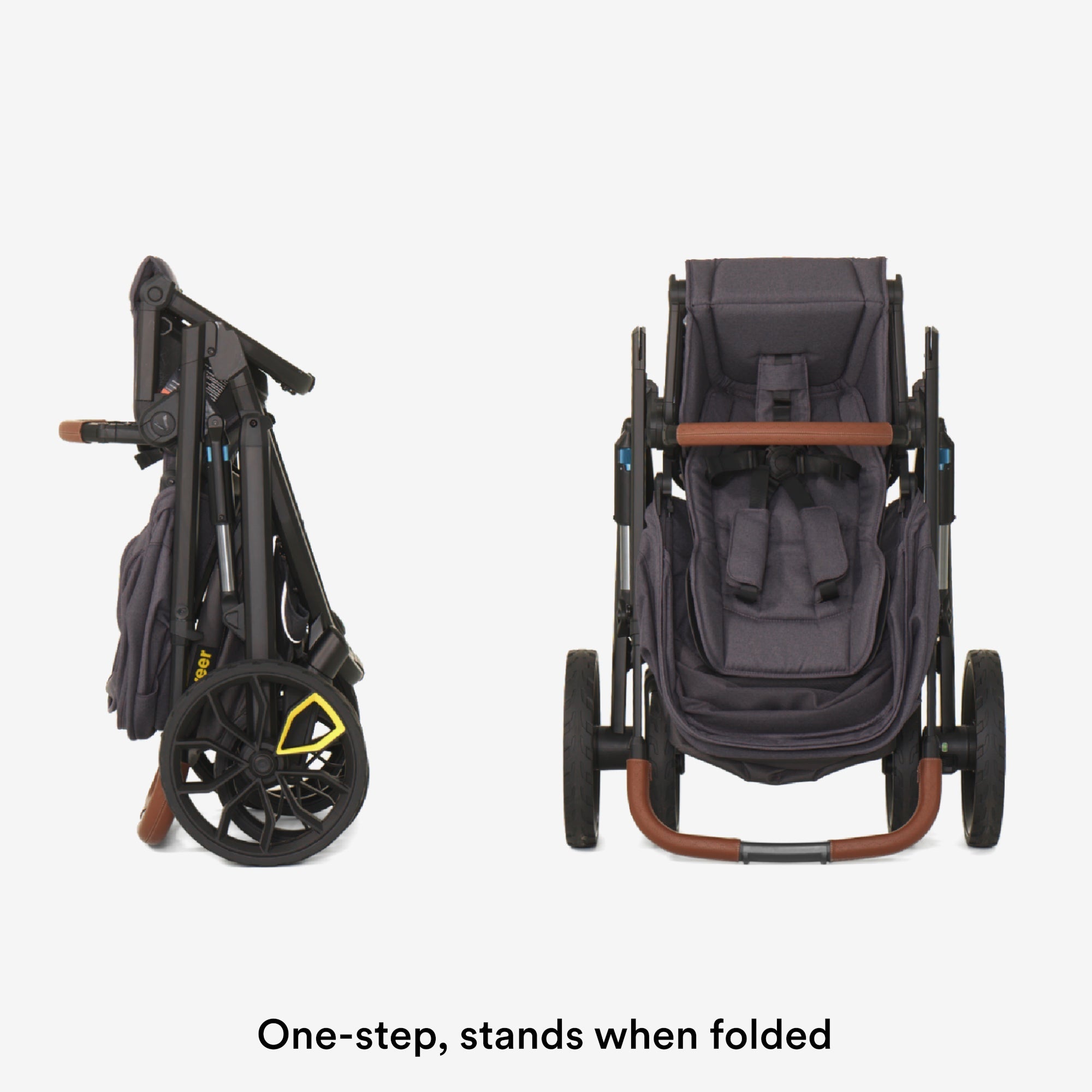
A one-step, compact fold makes it easy to store, and it is even self-standing.  The stroller can be folded with or without the seat attached. All four wheels are quick release which allow for an even smaller footprint especially when traveling by car.

From birth.  For life.

  • Includes Switchback seat, removable soft goods seat inserts, stroller frame, hidden booster seat straps, detachable 50+ UPF canopy, XL basket with zip and elasticized compartments, removable Napa Leather handle and bumper bar covers
  • Removable fabric is hose-or machine-washable
  • Adapts to become a feeding booster (attachment straps included)
  • Reversible Seat can face in either direction with a 5-point safety harness, single-hand, one-click 4 position recline
  • More points of suspension for maximum baby comfort strolling over any terrain: dual seat dampeners, flex exoskeleton seat bottom and back, tunable rear shocks and dual front wheel suspension
  • Quick compact fold, quick release wheels allow for an even smaller footprint
  • Lightweight, extra-large never-flat tires absorb bumps better
  • Adjustable handle height and a one-touch brake
  • Transforms by adding a bassinet, a second seat, a car seat-- all are interchangeable and can be used in multiple combinations on this remarkable expandable stroller (additional accessories sold separately)
  • 2 Cup holder mounts (cup holders and Catch-Alls sold separately) 
  • Meets or exceeds ASTM, SOR and EN-1888 safety standards and is JPMA Certified 

Dimensions

  • Seating Area Height: 19"
  • Seating Area Width: 12"
  • Seating Area Depth: 9.5"
  • Unfolded In Use: 40" L x 25.5" W x 44" H (with handle in low position)
  • Folded with Seat: 25.5" L x 36" W x 15" H
  • Folded without Seat: 25.5" L x 33" W x 11" H
  • Front Wheel: 9.5" W
  • Rear Wheel: 12" W
  • Handlebar Height: 40 – 44"
  • Lowest Position: 40" H
  • Highest Position: 44" H

Capacity

  • Seat Weight Capacity: 50 lbs in rear (40 lbs in front with Second Seat Adapter Kit)
  • Basket Weight Capacity: 30 lbs
  • Suitable from birth with Infant Insert

Weight

  • Seat: 7.5 lbs
  • Frame: 20.25 lbs
  • Frame + Seat: 28.75 lbs
Shipping Notes
  • Free Standard Shipping on $100+ Orders to the USA.
  • Except Preorder products are shipped in 48 hours.
  • Delivery to the USA:
  1. Standard Shipping : 3-10 business days
  • If time is of the essence, please consider selecting expedited delivery for faster service.
Exchange/Return Notes
  • We offer a 30-day return/exchange service after receiving.
  • Final sale items are not eligible for returns or exchanges.
  • To process your return/exchange, please contact us at [email protected]
  • Please click here for more details>>> Return & Exchange Policy
SKU: 30864129045

Discover Niche Categories That Outsell veer baby stroller

Top-Converting Item to Boost Your Average Order

4.0 ★★★★★
Based on 18 reviews
Sort
Highest Rating
Newest First
Oldest First
Product Reviews
B
Verified Purchase
Blake West
Houston, US
★★★★★ 4
Interesting anthropology and critique, but dense and obtuse writing
Format: Kindle
The good part is that at the end of the day, I learned a lot here, and Polanyi raised a lot of very interesting and under-discussed historical points to create his argument. It felt very similar to David Graeber (or I guess Graeber is similar to Polanyi) in that way. The bad part is that, whereas Graeber writes with exceptional clarity and vividness, Polanyi is obtuse and dense. And I've read other books from this era, I don't think it's the time. I think it's Polanyi's writing. Beyond that, his work serves more as analysis than prescription. It's a bit unclear exactly what he's advocating for. Which maybe is OK, though I prefer when non fiction writers offer solutions rather than just pointing out problems. All in all, if you can settle in with his writing, there are definite gems in there.
WAS THIS REVIEW HELPFUL?YesReportShare
Reviewed in the United States on June 5, 2026
K
Verified Purchase
Kitty Bryant
Waukegan, US
★★★★★ 5
Inspiring analysis of economic history
Format: Paperback
Polanyi presents economic history through an analysis of the "utopian" catastrophy of the self-regulating market economy. Polanyi argues that the free market economy treats the most essential elements of human society - labor, nature, and money - as if they should be exploited like commodities. When liberalism (free marketeerism) rules, then the economy dictates what is possible in human society, and these rules are intolerable because they create conditions under which humans are impoverished and disempowered. In his final chapter he lays out the battle ground between liberalism and its alternatives, which when he was writing (1945) were socialism and fascism. Fascism refuses the dictates of economic liberalism but substitutes in its place the dictates of a state that denies individual freedom. Socialism, alternatively, holds the only promise of true freedom for the individual where economic and political rules are developed and enforced democratically for the protection of society. While this is not an easy read because it demands a background in history, he is a fluent and persuasive writer.
WAS THIS REVIEW HELPFUL?YesReportShare
Reviewed in the United States on February 2, 2023
F
Verified Purchase
Freh
Whiting, US
★★★★★ 5
This 1944 classic recounts the fatal flaws of market liberalism that led to the Great Depression and World Wars I & II
Format: Paperback
The Great Transformation: The Political and Economic Origins of Our Time. Karl Polanyi. 1944. In 1944, the opposing monumental classics, The Road to Serfdom by Friedrich Hayek and The Great Transformation by Karl Polanyi, were published. From the right, Hayek argued that market liberalism led to prosperity, political liberty, and prevention of authoritarian governance. From the left, Polanyi argued that the rise of market liberalism during the industrial revolution led to intolerable hardship, inevitable unsustainable countermeasures, and finally collapse into fascism, the Great Depression, and World Wars I and II. Since their publication during World War II, these markedly opposed ideas have now been tested by seventy years of history. For the first thirty years after the war, policies reflecting Polanyi’s ideas led to a mixed economy of government policies and regulated markets in the US, northern Europe, and elsewhere that produced robustly increased prosperity broadly shared at all income levels. For the next forty years, ascendency of Hayek’s ideas led to reduction of the role of government with attendant economic instability, rising inequality (with all economic gains going to the rich in the US), and coercive imposition of market liberalism by authoritarian governments with disastrous results throughout Latin America and the former Soviet Union. Given the adverse consequences of resurgent market liberalism, the rebuttal of its ideas in The Great Transformation is as important today as ever. In The Great Transformation, Polanyi maintains that before the industrial revolution, markets did not play an important role in human society—they were embedded in society rather than the other way around. Goods and services were generally distributed without the motive for profit by the non-market mechanisms of reciprocity according to social relations, centralized storage with redistribution, and production for one’s own use known as householding. When present, the role of markets was peripheral and subordinate to politics, religion, and social relations. The industrial revolution brought about an almost miraculous improvement in the tools of production accompanied by catastrophic dislocations of the lives of the common people, of which poverty was merely the economic aspect. During this time, English thinkers created the theory of market liberalism, which radically reversed the previous subordination of markets to society by removing the role for government so that society was instead subordinated to self-regulating markets (without government interference). This change required that human labor, nature, and money be turned into commodities that could be bought and sold without regard to human and social considerations. Efficient functioning of markets also required callous indifference to the social dislocation, poverty, and damage to nature that resulted and even to hunger as a motivating factor for the working class. This change from regulated to self-regulating markets that organized the whole of society on the principle of gain and profit marked a great transformation of the nature of society by the removal of democratic control of markets. The goals of this transformation were unrealistically utopian and could never be achieved without annihilating the human and natural substance of society. Even during its installation, laissez-faire proved to be a myth. Government action was mandatory to adjust the supply of money and credit, to enforce provisions for labor and land, and to prevent political disruption. Even with this level of government activity, market liberalism still imposed unsustainable hardships on ordinary people from speculative excess, growing inequality, competition from imports, depressions, unemployment, poverty, and reduced entitlement to assistance. By the late 1800s, these impossible pressures of the self-regulating market necessarily led to a countermovement in industrialized nations to protect their societies from the market. This countermovement included protectionism for national markets and competition for colonies to take resources from other societies. In exotic and colonial regions with the absence of protective measures unspeakable suffering resulted. Thus Polanyi characterizes market societies as having two opposing movements, referred to as a “double movement.” These two contradictory movements resulted in simultaneous struggles to expand the scope of the market because of the opportunities for some and to limit the scope of the market because of the adverse consequences for many. These internal contradictions led to disruptive stresses and strains that were unsustainable for market societies. In the domestic economy, class conflict resulted from issues like the choice between inflation for stability of workers incomes and employment and deflation for stability of currency for investors. Market liberals from Spencer to Mises held that popular democracy was a danger to capitalism and that workers should not have the right to vote. In the international economy, relentless shocks imposed by the gold standard forced nations to consolidate around heightened national and imperial boundaries. In international politics, intensified political, military, and economic rivalries finally culminated in World War I. By this time, the class struggle over market liberalism was at an impasse. For a critical decade, economic liberals supported authoritarian intervention in service of their deflationary policy to protect currency exchange and investment. This merely weakened the democratic forces that might otherwise have averted the fascist catastrophe. During the Great Depression, the gold standard finally collapsed, foreign debts were repudiated, capital markets and world trade dwindled away, and the global political and economic system disintegrated. In a second great transformation of society that followed, the replacements of market society by fascism, socialism, and the New Deal were similar only in discarding laissez-faire principles. The conflict between the market and the elementary requirements of an organized social life had ultimately destroyed society. World Wars I and II merely hastened its destruction. In 1944, Polanyi appears to have regarded the utopia of market liberalism as utterly discredited. He expressed the hope that the passing of market economy could become the beginning of an era of unprecedented freedom. He noted that freedom as the absence of power and compulsion as claimed by market liberals is not possible in a complex society. The function of power is to ensure the measure of conformity which is needed for the survival of the group: its ultimate source is opinion. Regulation both extends and restricts freedom; only the balance of freedoms lost and won is significant. The comfortable classes enjoy the freedom provided by leisure in security. They resent the suggestion to spread out income, leisure, and security to extend to others the freedom they enjoy. Obviously, those who lack security cannot enjoy the same freedom as the comfortable classes. Those who want more freedom for all need not fear that either power or planning will undermine their freedom. Regulation and control in a complex society strive to give us all the security we need to achieve freedom not only for the few, but for all.
WAS THIS REVIEW HELPFUL?YesReportShare
Reviewed in the United States on July 22, 2017
U
Verified Purchase
Usman A. Ghani
Draper, US
★★★★★ 5
Must read for contemporary (and all) times.
Format: Paperback
This is a great book. I wonder why we were not taught this in the freshman year, or at least as a counterpoint to Econ101. It opens up the perspective to seeing culture, economics, politics, and technology in an integrated way with an emphasis on social choesion as a unifying fabric for humanity and, looking for the right rate of economic reform. Much of what we do as "development" can in fact be harmful in the long (also short) run if we are not sensitive to the premises Polanyi is alerting us to. This is not counterpoint or counterfactual thesis per se. I am a strong proponent of the market system and also realize that this system is subsumed and must be complementary to the larger, complex social system where things are interconnected. An effective policy can only result from the collective consideration of these together. Polanyi's writing style is clear, direct, and simple and, unlike deeply nomenclature-intense economics write-ups, this book is rather an easy read. When we prescribe/teach The Industrial Revolution as an essential or secondary reading, The Great Transformation should also be a companion reading.
WAS THIS REVIEW HELPFUL?YesReportShare
Reviewed in the United States on September 6, 2013
T
Verified Purchase
Tanthallas
Waukegan, US
★★★★★ 5
Read!
Format: Paperback
Well, I was going to review this wonderful work. However, Robert Moore's review is so spot on that there is really no need to take up more space. Also I need a nap. Anyway, this book is truly fascinating. If you are at all interested in Political Economy, this is perhaps one of the most important books you will ever read. There is no school which has the authors name attached to it, nor is there a political movement dedicated to the realization of his ideas. In most cases this is because the author did not contribute original thought or make an adequate connection of his thought process with reality. In Polanyi's case, this is because the originality of his thought cuts through the specialized form in which science and social studies is presented today and cannot possible be claimed to belong to 'economics' any more than it can of 'sociology', 'anthropology', 'history', 'international relations', etc.. Read this book.
WAS THIS REVIEW HELPFUL?YesReportShare
Reviewed in the United States on July 3, 2009

recommand products