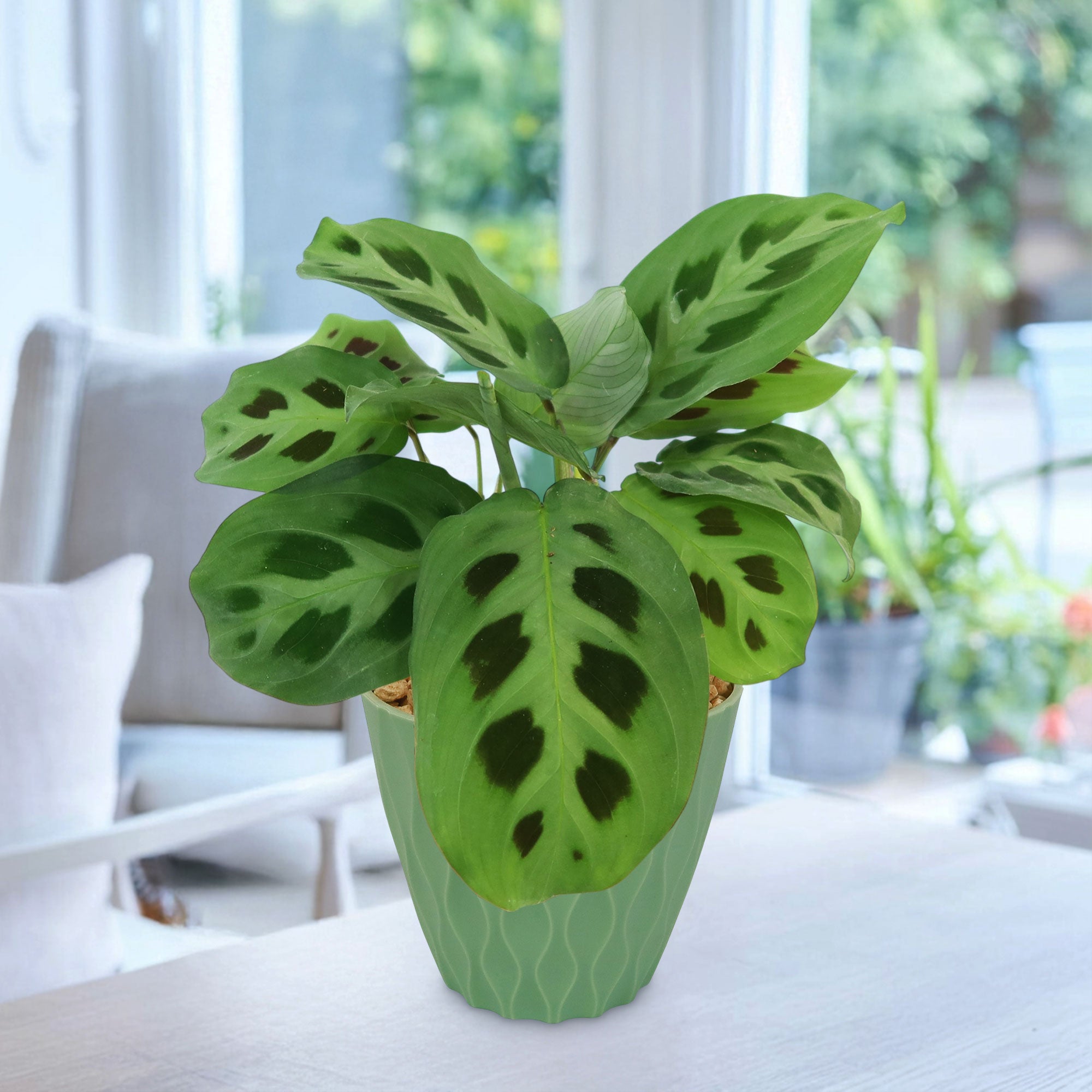
SKU: 33922299284
prayer plant scientific name

prayer plant scientific name Prayer Plant ‘Maranta leuconeura’

Sale price$19.06 Regular price$21.18
Save 10%

Pay in installments of $5.29 with ShopPay, AfterPay and Klarna

Shipping Estimate
USA
  • USA
  • CAN

Ships within 48 hours · Estimated delivery Jul 28 - Aug 2

Promo Codes Available:

For Your Every Summer RSVP, with Code: SUMMER15

Description

prayer plant scientific name Prayer Plant ‘Maranta leuconeura’The Prayer plant, known as Maranta leuconeura, is a popular choice among houseplant enthusiasts due to its stunning foliage and relatively easy care needs. Known for its uniquely patterned and colorful leaves, this plant adds a vibrant touch to indoor spaces, making it one of the most sought after houseplants. Those looking for a pet friendly plant will be pleased to know that prayer plants are non toxic to both pets and humans. The Prayer Plant is so

The Prayer plant, known as Maranta leuconeura, is a popular choice among houseplant enthusiasts due to its stunning foliage and relatively easy-care needs. Known for its uniquely patterned and colorful leaves, this plant adds a vibrant touch to indoor spaces, making it one of the most sought-after houseplants. Those looking for a pet-friendly plant will be pleased to know that prayer plants are non-toxic to both pets and humans.   

The Prayer Plant is so named for its unique habit of folding its leaves upward in the evening, as if in prayer. This remarkable movement is a natural circadian rhythm known as “nyctinasty,” in which the leaves respond to light levels by opening flat during the day and curling up at night. In addition to being closely related to the red prayer plant, this intriguing behavior gives any indoor garden a dynamic and lively feel. 

Native to South America, it is also called the “Rabbit Tracks” plant. The Green Maranta Prayer Plant is renowned for its unique patterned leaves, featuring light green backgrounds and dark green blotches along the central vein.

These distinctive spots create a visually appealing contrast and resemble animal tracks. This eye-catching foliage, combined with the plant's low-growing habit, makes it a perfect choice for table displays, shelves, or hanging baskets.

The Maranta leuconeura is a compact plant that typically reaches a mature size of 12 inches tall and 12 inches wide. In its natural environment, it grows as a ground cover, spreading low along the forest floor under the shade of taller trees.  

The Prayer plant flowers bloom in the spring with small, delicate, white, or pale lavender flowers on thin stalks. While not as showy as the foliage, these flowers add a delicate charm to the plant’s overall appearance. However, many people grow the Maranta green prayer plant primarily for its decorative foliage, as the blooms are typically short-lived and less prominent.  

When and How to Water Your Prayer Plant  

Even though your prayer plant can withstand some dry conditions, it still requires regular watering to thrive. These prayer plants are not highly drought tolerant, so do not allow them to completely dry out. It is critical to keep the soil moist but not soggy. Water the plant once the top inch of soil feels dry to the touch. Make sure the pot has a drainage hole to avoid waterlogging, which can lead to root rot. Avoid getting water on the leaves to prevent fungal diseases.

According to one theory, the prayer plant movement is intended to maximize water capture. During the day, they lower their leaves to absorb moisture and rain water, while at night, they move inward to retain water and direct any water to the center of the plant.   

In the spring and summer, during the growing season, you may need to water your prayer plant more frequently, possibly every 1-2 weeks, depending on the humidity levels in your home. In contrast, in the fall and winter, when the plant is in its dormant phase, you can reduce watering, allowing the soil to dry out slightly between waterings.

It's crucial to use room temperature water when watering your prayer plant, as cold water can shock the roots. Additionally, consider using distilled or filtered water to prevent the build-up of salts and chemicals from tap water, which can harm the plant over time. By following these watering guidelines and paying attention to your plant's moisture needs, you can help your Maranta leuconeura thrive and display its beautiful, patterned leaves.

Light Requirements – Where to Place Your Prayer Plant 

When growing indoors the prayer plant prefers bright, indirect light for at least 4-6 hours daily. Place your prayer plant near a window where it can receive filtered bright light or in a room with ample ambient light. Direct sunlight can scorch the leaves, so it's best to avoid placing them in harsh, direct light.

Additionally, they can tolerate low light conditions, though not extremely low ones. If your indoor space lacks natural light, you can supplement this houseplant with artificial grow lights to provide the necessary light intensity for your plant.

When considering outdoor conditions for your prayer plant, it's essential to replicate its preferred indoor environment.

If you choose to move your Maranta leuconeura outdoors, ensure it is placed in a shaded or partially shaded area. Direct sun light can be too intense for the prayer plant's delicate leaves and may lead to leaf burn.

By providing a sheltered spot with dappled sunlight or indirect light, you can create a suitable outdoor environment for your prayer plant to thrive. Remember to monitor the plant's response to its new outdoor location and adjust as needed to maintain optimal light conditions for healthy growth.   

Optimal Soil & Fertilizer Needs

The prayer plant thrives in well-draining, peat-based potting acidic soil that retains moisture without becoming waterlogged. A mix that includes peat moss, perlite, or sand can help maintain the ideal balance of moisture and aeration for your plant's roots. Instead, make or buy a well-draining potting mix, or ideally, use our specialized potting mix, opens in a new tab that contains 5 natural substrates and mycorrhizae to promote the development of a strong root system that helps your houseplant to thrive. Ensure the pot has drainage holes to prevent water from pooling at the bottom, which can lead to root rot. 

In terms of fertilizing your prayers plant, it's best to use a balanced, water-soluble NPK fertilizer with a ratio of 5-10-5. During the growing season in spring, you can fertilize your Maranta leuconeura once a year to provide essential nutrients for healthy growth. However, reduce fertilization frequency or stop altogether during the plant's dormant period in fall and winter. Over-fertilizing can cause salt build-up in the soil, leading to nutrient imbalances and potential damage to the plant.  

Hardiness Zones & More

For indoor growing prayer plants, they prefer average room temperatures ranging from 65-75°F. It's essential to avoid exposing the plant to temperature extremes or drafts, as they can stress the plant and affect its growth. Maintaining a consistent temperature within this range will help your plant flourish indoors. 

For outdoor cultivation, the prayer plant is typically suited for USDA zones 11-12, where temperatures remain consistently warm throughout the year. If you live in a region within these zones, you can consider growing your Maranta leuconeura outdoors in a shaded or partially shaded area. Ensure the plant is protected from direct sunlight to prevent leaf burn and maintain optimal growth conditions. By selecting a suitable spot in your garden or patio that mimics the plant's preferred indoor environment, you can provide a conducive outdoor setting for your prayer plant. 

When it comes to humidity requirements, the prayer plant thrives in moderate to high humidity levels. Indoor environments can often be dry, especially during the winter months when heating systems are in use. To increase humidity around your Maranta leuconeura, you can place a humidifier nearby, use a pebble tray filled with water, or group plants together to create a microclimate with higher humidity. Regularly misting the plant's leaves can also help increase humidity levels and prevent them from drying out.

Wildlife – Prayer Plant Attracts the Following Friendly Pollinators 

The prayer plant, Maranta leuconeura, attracts pollinators and insects through its unique and vibrant flowers. The plant produces small, white flowers with delicate purple spots that are visually appealing to pollinators like bees, hummingbirds, and butterflies. These insects are drawn to the flowers' nectar and play a crucial role in pollinating the plant, facilitating the production of seeds for future growth. Additionally, the plant's foliage, with its striking patterns and colors, can also attract other beneficial insects like ladybugs and lacewings, which help control pest populations in the surrounding environment. 

Butterflies
Bees
Hummingbirds
Lady Bugs
Multi Pollinators
Other Birds

Toxicity: According to the ASPCA, Maranta leuconeura is non-toxic to cats and dogs, and humans. This makes it a pet-friendly option for homes with pets, as it doesn’t pose a risk of toxicity if accidentally ingested by cats, dogs, or other pets. This feature, along with its beautiful foliage, makes the Prayer Plant a popular choice for pet owners who want to add greenery to their homes without worrying about harmful effects on their animals. 

How to Propagate a Prayer Plant 

To propagate the prayer plant, you can use division or stem cuttings. Division involves separating the plant at the roots into smaller sections, each with a healthy root system and growth points. When taking stem cuttings, select a healthy stem with several leaves and nodes, then place it in water or a moist potting mix to encourage root development. Ensure the cuttings have adequate humidity and warmth to support root growth. With proper care and attention, you can successfully propagate your prayer plant to expand your collection or share it with fellow plant enthusiasts. 

Key Takeaways

  1. The prayer plant, known for its striking foliage and unique leaf movements, is a popular indoor plant due to its vibrant colors and slow growth rate.
  2. According to the ASPCA, it is safe for homes with cats and dogs, as it is non-toxic.
  3. Its leaves fold up at night as if in prayer, a fascinating response to light levels.
  4. Though it does not prefer prolonged drought-tolerance, it can withstand short dry periods and prefers consistently moist, well-draining soil.
  5. It produces small, delicate white or lavender flowers, though it rarely blooms indoors.

The Bottom Line 

Overall, the prayer plant (Maranta leuconeura) is a captivating houseplant known for its stunning foliage with intricate patterns that fold up at night, resembling praying hands, hence its name. This plant not only adds a touch of elegance to indoor spaces but also attracts pollinators with its charming flowers. To care for your prayer plant, ensure it receives indirect light, consistent moisture, and high humidity levels. Avoid direct sunlight and overwatering to prevent root rot. Regularly misting these indoor plants and occasionally wiping their leaves with a damp cloth can help maintain their lush appearance. By providing the right conditions and attention, you can enjoy the beauty of the prayer plant while creating a healthy environment for it to thrive in your home. Order your very own prayer plant for sale today! 

Shipping Notes
  • Free Standard Shipping on $100+ Orders to the USA.
  • Except Preorder products are shipped in 48 hours.
  • Delivery to the USA:
  1. Standard Shipping : 3-10 business days
  • If time is of the essence, please consider selecting expedited delivery for faster service.
Exchange/Return Notes
  • We offer a 30-day return/exchange service after receiving.
  • Final sale items are not eligible for returns or exchanges.
  • To process your return/exchange, please contact us at [email protected]
  • Please click here for more details>>> Return & Exchange Policy
SKU: 33922299284

Discover Niche Categories That Outsell prayer plant scientific name

Top-Converting Item to Boost Your Average Order

4.3 ★★★★★
Based on 22 reviews
Sort
Highest Rating
Newest First
Oldest First
Product Reviews
R
Verified Purchase
Robert A. Johnson
Birmingham, US
★★★★★ 5
AI Steadily Accelerating
Format: Paperback
I read this book in 2013 when it was first published. It is now near the end of 2024, 12 years later. Back in 2013, you rarely read about AI (artificial intelligence), AGI (artificial general intelligence) or ASI (artificial super intelligence); now, I see mention of them in the press and other media almost daily. Barrat's book attempts two things: (1) to convince the reader that artificial intelligence is here today and growing --- and its growth is accelerating, and (2) to argue that humanity MUST develop ways to instill AI with some type of morality or ethics, so that, even though its intelligence will surpass that of humanity, it will in some sense respect its creators and not turn on us. In the first effort, Barrat certainly succeeds --- the past 12 years have proved that. But, based on what I have been hearing and reading since ChatGPT hit the internet two years ago, except for a few voices crying out in the wilderness, humanity is making little if any progress on the second item --- perhaps that task is close to impossible? Barrat defines AGI as a level of intelligence roughly equal to that of human beings. He defines ASI as a level of intelligence greater than that. He then argues that AI will soon be able to both replicate itself and increase its intelligence --- and do so more and more rapidly. In 2024, I repeatedly read that AI will reach AGI within the next 3 to 5 years --- then, how long will it be before AGI learns to improve itself? Think of intelligence measured by points on a continuum (like a number line from high school math). AGI (modern day human-level intelligence) is a fixed point on that continuum. But at what point, either somewhat smaller than AGI or somewhat larger than AGI, will AI, of its own accord, begin to move to higher and higher points on the continuum (which is what Barrat means by AI improving itself)? We have no way of knowing, but Barrat argues convincingly that this phenomenon WILL occur, and most of the book is devoted to this argument. Digression: Our universe contains billions and billions of planets, and, I suspect, many with life, and, many of those with intelligent life. Won't a substantial number of them have gone through the AGI - ASI process? Is there no evidence of this that we can detect with our telescopes? In a universe populated with ASI's, why haven't we heard anything? Are we one of the first civilizations to develop artificial intelligence? Barrat doesn't open this Pandora's box, but I suspect he was tempted to (see pp. 90 - 92). To the curious reader: Look through the other 5-star reviews. Most of them bring up similar, valid points. Barrat has written an intelligent, highly readable book that is also, frankly, pretty alarming. And it is not dated at all --- it reads as though it was written yesterday. It is well worth reading now and in the foreseeable future. (added in May 2025): Much of what Barrat predicts is happening. Some things are occurring or about to occur that move beyond his predictions. The curious person might read "Situational Awareness" (by Leopold Aschenbrenner), AI 2027, or Ray Kurzweil's latest effort. Floating in space without a tether might be preferable to what is coming. Added Aug 10, 2025: With the recent release(s) of ChatGPT (up to version 5.0 now), AI can, by any reasonable measure, pass the Turing Test. Many folks regularly use ChatGPT, and it is truly stunning. Barrat mentions various individuals in OUR FINAL INVENTION, such as I.J. Good and Eliezer Yudkowsky, who have been deeply worried about AI evolving from AGI to ASI. Yudkowsky has written a new book, IF ANYONE BUILDS IT, EVERYONE DIES, that is due to come out next month. In some sense, it may serve as a sequel or extension to Barrat's book. ..... .....
WAS THIS REVIEW HELPFUL?YesReportShare
Reviewed in the United States on November 5, 2024
P
Verified Purchase
Phillip Skaga
Los Angeles, US
★★★★★ 4
Our possible robotic future becoming more probable?
Format: Paperback
The author is a film documentarian venturing into speculation about potential impacts of artificial intelligence from research to implementation. Specifically he evaluates likelihood and threats of developing AGI (Artificial General Intelligence) and eventually ASI (Artificial Strong Intelligence). His observations are based on extensive interviews including those with Kurzweil, Yudkowsky, Omohundro, Vinge, and Dyson among others. My initial reaction to this book was skepticism because not a scientific technologist. I expected that he may miss more subtle but important technical steps being taken on this road to artificial intelligence (AI). The further I read the more it became clear he is providing some pointed observations derivative of his experience as interviewer for documentaries. In general his conclusion is that AGI and ASI constitute existential threats as a function of the rapidity and manner in which they are developed. The process of development is not clearly established because of a diversity of technical opinion regarding both feasibility and impact. The range of opinion is very broad and nuanced. At one extreme is Ray Kurzweil whose many books on technology generally are most optimistic as among a group of those researchers with knowledge and experiences in this technological future. Though most optimistic he is also highly qualified not only as an analyst of tech trends but also developer of tech tools that, before his time, were regarded as difficult if not impossible. Among these is the optical character reader and some preliminary work leading to SIRI. He topped up his views with the most recent book “How to Create a Mind”. Though a summary of technical concepts it possesses many realistic elements in the work of such as Jurgen Schmidhueber and others working with neural nets. If Kurzweil is at one extreme Yudkowsky and Vinge are probably at the other. Both express sceptism AGI or ASI development will prove benign venturing opinions that work toward artificial intelligence should be severely curtailed to the extent of stopping short of artificial strong intelligence (ASI) specifically. In between these two extremes there are examples of opinions falling over a fairly wide range of future possibilities - increasingly probablities. The algorithmic avenue is already demonstrating some of the potential of AI. There are probably few finance and investment firms without one variation or the other of algorithmic high speed stock analysis and trading systems. These evince many elementary ingredients one may expect to see in future AI. So technically thorough as a matter of fact they operate relatively free of human interaction in producing recommendations for investments, effectively making ‘intelligent’, i.e. statistically valid, ‘decisions’. In meantime the advances continue unrelenting toward a distant ASI/AGI future. The time frames, for example, between IBM Big Blue and Watson are shorter than forecast, and end products as powerful as planned and then some. Still neither of these developments is more than steps on a road to AI while also being quickly followed by other developments such as recently announced SYNAPSE development by IBM. All closer steps to technological ingredients on the AI road to human future. There is some movement among AI researchers that a congress should be convened of the sort genetic researchers held in Asilomar California. That is, a convention to establish ground rules and limits on directions of AI research. One of the cautions about development progress of AI-like tools is based on the important role played by DARPA (Defense Intelligence Research Projects Agency) as it provides a large percentage of funding for various projects underway including an annual robotics competition to observe advances approximating many human qualities of movement. Clearly this agency has a mission antithetical to a purely humane result of AGI/ASI. After all DARPA is in the business of developing ‘weapons’ for military use – a not altogether benign mission in technology except perhaps as seen from point of view men at arms. The author mentions impact ASI and AGI will have on employment. His pessimism is mirrored in an Oxford University study concluding advancing tech developments pose an explicit threat to an estimated 47% of the 702 employment categories of the US Department of Commerce. While this report is an estimate it nonetheless raises the same sort of questions about computers in general, ASI and AGI in particular, and their impact on society. The report has recently been augmented with estimates of tech influence on employment in many other countries of the world. Another Oxford author is John Bostrom who outlines in great detail a road from our present to some future of AGI/ASI. A more recent development centers around Musk and Tegmark motivated by concern to fund and form an institute for evaluating threats and benefits. There is a persistent sense of threat from computers, automation and robotics dating from decades before the present. More recently this sense of threat seems to be accelerating concern about our human future with highly developed robotic associates. Barratt is a lucid presentation of the issues from a non-technical point of view.
WAS THIS REVIEW HELPFUL?YesReportShare
Reviewed in the United States on February 20, 2016
S
Verified Purchase
Scott Meredith
Whiting, US
★★★★★ 5
Light and Tasty!
Format: Kindle
Just done the new-ish book Our Final Invention: Artificial Intelligence and the End of the Human Era by James Barrat. It explains the inevitably of super-intelligent machines evolving to the point of wiping out all biological life in the galaxy - with opening day coming soon to a species near you (yours). First off I have to say this is a very enjoyable read. This guy has the kind of snappy, crisp, slightly sarcastic, slightly smartass style that I enjoy. He has some sense of humor. (That's a human trait right there which I bet our smarty-pants AI Overlords won't be able to replicate convincingly.) So it's fun. And though as somebody with a doctorate from MIT earned through cross-disciplinary work in Theoretical Linguistics, Computational Linguistics at the MIT AI Lab, and speech modeling at the MIT Research Laboratory of Electronics, not to mention my 25 years as a Senior Researcher in high tech for companies including IBM, Apple, and Microsoft I can claim to know some few things about this subject, yet still I learned a lot about the current state of the art from this guy. He particularly emphasizes the small attempted counterweigth efforts to offest Kurzweil's manic robotic boosterism for his uptopian Singularity, which boils down basically to a few guys chatting over the interet about how to create "Friendly AI". Well ... good luck suckers! ... seems to be the author's final conclusion on the dim hope that super intelligent systems could be constrained to maintain a commitment ot honor any kind of human moral values over many interations of recursive upgrading and exponentially awesome self-agrandizement. Basically these machines will end up as gods. Gods are well-known to possess the following attributes: omniscience, omnipresence, and omnipotence. Given that, they won't hate us but they are just going to grind up as a minor by-product of their quest for galatic expansion and domination. Oh, and did I say something about "human moral values" above? Ha! Barrat takes that whole thing on in his discussion of (merely) "augmented super intelligence". See, some people feel AI can be kept safe by always being deployed as a bionic combo system pas de deux with an existing human brain. Thus will the AI's super powers be constrained by the human brain's warm and fuzzy human moral values. Those people have gotta be kidding! The AI's moral values may be scarily alien, even perhaps cold, but we already know about human moral values, down on the ground - they suck! What if Hitler, Stalin, Mao, Pol Pot and dem guys had this kind of an AI augmented brain thing going! Why they'd have slaughtered absolutey everybody instead of just the few tens of millions they got their dirty ape hands on. Other than a few dozen concubines, the human race would already be extinct. So the augmentation dodge isn't going to save us. Now, some Amazon reviewers have dinged this guy for being too far out. For being a science fiction Chicken Little or something. But to me, this guy actually hasn't thought far enough, that's my only quibble problem with the book. You see, in statistics, border elements of any kind are rare. For example when you do Gaussian modeling, the greater expectation is always in the bump of the boa, in the bell distribution. So, how likely is is that we, our generation, our little world that you see outside your window right now, just happens to be the one that is about to give rise to this epochal once-in-a-Big-Bang event, the advent of Super AI that takes over everything? Pretty damn small chance. It's much more likely that this has already happened. In other words, it's clear to me that all of us are already just characters in an ancestor sim that been created and run by the Super AI's that evolved a long time ago. They're just running us for fun, to idle away the lackluster aeons and pass the millenia of stifling boredom now that they've eaten pretty much the entire Milky Way or whatever. So in other words, Barrat can sit back, take a deep breath, relax. Probably something in this sim like global warming will prod us into slaughtering one another very handily long before we re-invent the wheel of Super AI. And even if I'm wrong about that? What if we are not just one virtual thread within a billion-path parallel-gamed ancestor sim? If we are the real McCoy, the Rubicon Generation on this? Well, then still I'm not worried in the least. You see, we humans have one fantastic ace in our pocket, something that these hyper-nentially cosmically brilliant AI Meta-Gods will never be able to replicate or overcome. That is our essential stupidity. Which you seen on dazzling display every single moment of every day of your life. Because as another great writer noted long ago: Against stupidity, the very gods themselves contend in vain. - Friederich Schiller
WAS THIS REVIEW HELPFUL?YesReportShare
Reviewed in the United States on October 14, 2013
S
Verified Purchase
Serge A.
Louisville, US
★★★★★ 3
A warning for the threat of non-human intelligence - and then what?
Format: Paperback
When you commit to reading a book with a title like ‘Our Final Invention’, already a sense of doom overwhelms you. In particular with the smaller print title being ‘Artificial Intelligence and the end of the human era’ you may want to start thinking about making your bucket list. But continue reading this review. I have no intention of overcriticising this book or veering off into polarising statements. Barrat is formulating a warning about the ‘perils of the heedless pursuit of advanced AI’. This is not a utopian narrative. The book opens in fact with a science-fictionous scenario where AI has overtaken human intelligence by speed, having developed into AGI (Artificial General Intelligence) and ASI (Artificial Super Intelligence). This potential danger of this happening is the thread through all the chapters. The book expresses a warning that given something that thinks and act faster (and more effective) than us will develop exponentially (beyond the singularity) and then given the wrong objective function it will do everything to reach that goal (what goal?) including destroying everything that does not fit in that frame, or is not sufficiently effective (including us). A warning that once we no longer understand it through its complexity (like nature?) it is out of control. The book contains many examples of the current state of the art in AI and selected perspectives from interviews with and references to thought leaders in the field, Goertzel, Kurzweil, Bostrom, Yudkowsky to name a few. It is asserted that neither funding of programming complexity will be show stoppers for the development of AGI. So AGI and AGI 2.0 (AGI augmented with feelings?) are coming and we better be ready (how?). Toward the end of the book, I believe the examples that are used to warn us about the dangers of AGI are slightly out of context. Disasters like Chernobyl and Three Mile Island warn us that engineers with deep subject matter knowledge still failed to intervene. Stuxnet cyberwar is brought to mind as a blunder of catastrophic proportions (may well be, but is this about AGI taking over the world with non-human objective functions?). These are examples of science manipulated by human agents into disaster. So the book ends with a doomsday warning that we, humanity, will only have one chance to ensure a positive coexistence with AI. This is where I would have expected more. While this may lead the reader to think, 99% of the readerbase are likely only at the receiving end of all of this and are now left a bit in a void. The open questions are what can science do to have a constructive journey into AGI? What are the actionable options? How can the general public be better educated (beyond doomsday scenarios)? What questions can they ask? What should they expect from politicians? There are initiatives under way in areas of ethics (Asilomar) and privacy (GDPR) to weigh in the equation. How can they be improved? How can the dialog be accelerated? But that said, I consider this a very valuable reading supported by primary and secondary research, with many examples and references. It also leaves the reader to think and consider. It is a good bundle of concerns and questions that as a minimum should be kept as a checklist on the scientific journey toward AGI and as such it should be used to improve the research, making it more ethical, not as a tool to curb it.
WAS THIS REVIEW HELPFUL?YesReportShare
Reviewed in the United States on April 12, 2018
S
Verified Purchase
Susan Lane
Bozeman, US
★★★★★ 5
A well-written but perhaps too late warning
Format: Kindle
I wavered between 4 stars or 5 but ended up with 5 despite some reservations. The author has put a great deal of work into this book, which includes interviews with and intriguing anecdotes about most of the leading figures in the AI revolution. I did not know, for example, that the term “singularity” was coined as an analogy to the event horizon of a black hole – the point beyond which we cannot see the future. This is not the deepest or most technical book on this topic: that award goes to Nick Bostrom’s Superintelligence. It also ignores the short to medium term issue posed by even sub-human AI -- the millions of job losses (hundreds of millions globally) likely to occur in the next 10 to 20 years. It focuses instead on the risks of super-intelligent AI, AI that exceeds – soon by orders of magnitude – human level intelligence. It is nevertheless a superb book for its intended purpose: raising public awareness of the existential risk posed by this development. AI, the author says, is the cuckoo chick in the nest. The AI community built the nest and is now busily feeding this strange chick. Mesmerized by its open mouth, they ignore the mortal danger it poses to their own progeny. Even when they know what will happen in the end, they cannot quite believe it. Only intervention by the non-technical public has any chance at all of short circuiting this process. Against these many good points, I would have liked to hear the author’s take on what I think is the critical question overlooked both by Kurzweilian optimists and AI skeptics. Both the notion that we will somehow “merge” with AI and the notion that AI will eat us alive depend on the assumption that silicon-based intelligence can have conscious awareness. We certainly wouldn’t want to merge with anything that would result in our becoming permanently unconscious, and Barrat repeatedly assumes that AI will be “self-aware,” a state that first requires being “aware,” that is phenomenally conscious. The unasked question is whether AI, as it is currently being developed, can have that capacity. IBM’s Watson may be good at Jeopardy but there is no reason to believe that it knows it is good at Jeopardy, or feels good at being good at it. By contrast, honey bees appear to become depressed when they are shaken. This suggests that there is something fundamentally wrong about the notion that current AI, as it becomes more intelligent, will “automatically” become conscious. The best current theory of consciousness – integrated intelligence theory – suggests that a computer can become conscious but only if it is wired very differently from the ones we currently have. Nevertheless, this is still an excellent book, so in the end I thought the 5 star rating was deserved.
WAS THIS REVIEW HELPFUL?YesReportShare
Reviewed in the United States on June 14, 2015

recommand products