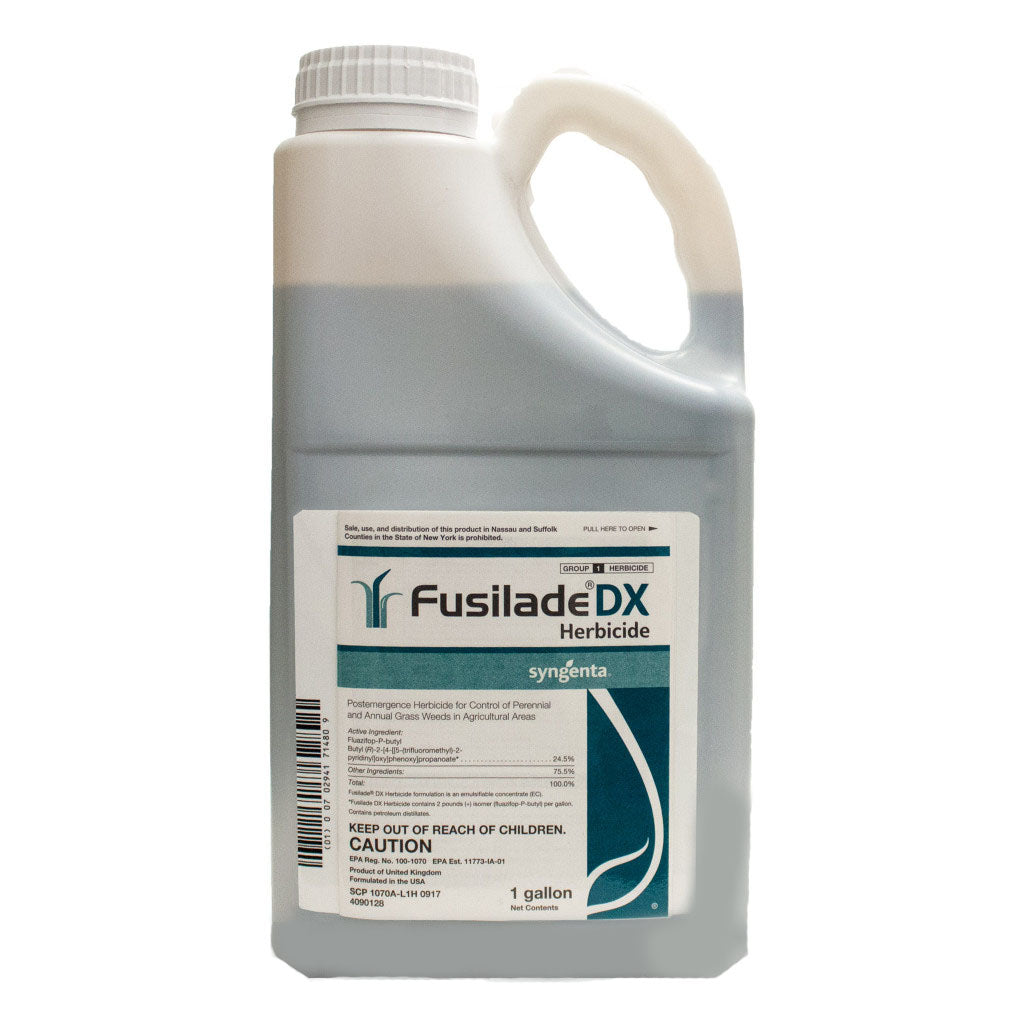
SKU: 34002306411
brake fx herbicide label

brake fx herbicide label gallon (128 oz)

Sale price$26.15 Regular price$29.06
Save 10%

Pay in installments of $7.26 with ShopPay, AfterPay and Klarna

Shipping Estimate
USA
  • USA
  • CAN

Ships within 48 hours · Estimated delivery Aug 2 - Aug 7

Promo Codes Available:

For Your Every Summer RSVP, with Code: SUMMER15

Description

brake fx herbicide label gallon (128 oz)Fusilade DX Herbicide is a highly effective herbicide that controls annual and perennial grass weeds. Contains an active ingredient that provides post emergent control of unwanted weeds in broad spectrum crops, non crop areas, fallow land, and non bearing crops. It can be tank mixed with other herbicides and works well in tillage situations. The Syngenta Fusilade DX is a systemic herbicide that controls annual and perennial weeds such as bentgrass,

Fusilade DX Herbicide is a highly effective herbicide that controls annual and perennial grass weeds. Contains an active ingredient that provides post-emergent control of unwanted weeds in broad spectrum crops, non-crop areas, fallow land, and non-bearing crops. It can be tank mixed with other herbicides and works well in tillage situations. The Syngenta Fusilade DX is a systemic herbicide that controls annual and perennial weeds such as bentgrass, crabgrass, johnsongrass, goosegrass, foxtail, wild oats, downy brome, ryegrass, corn, sandbur, and wild cane. It is proven to eliminate grass weeds soon after the application. The treated grass becomes yellow or red and eventually dies. It usually happens within a week after treatment, depending on environmental conditions. Offer rainfastness of one hour after the application. Available in a one-gallon jug.


APPLICATION DIRECTIONS

Tank Mix Requirement: Fusilade DX Herbicide may be tank mixed with other pesticides. Refer to the specific crop sections on this label for tank mixing directions. It is the pesticide user’s responsibility to ensure that all products are registered for the intended use. Read and follow the applicable restrictions and limitations and directions for use on all product labels involved in tank mixing. Users must follow the most restrictive directions for use and precautionary statements of each product in the tank mixture.

TIMING – Best control of susceptible grasses is obtained when Fusilade DX Herbicide is applied to actively growing grasses before they exceed the listed growth stages shown on this label. Refer to the grass weed tables for specific directions on weed growth stages.

SPRAY ADDITIVES – Only spray additives cleared for use on growing crops under 40 CFR 180.1001 may be used in spray mixture.

Always add one of the following:

  • Crop Oil Concentrate – Add a non-phytotoxic crop oil concentrate or a once-refined vegetable oil concentrate containing 15-20% approved emulsifier, at 0.5-1% v/v (0.5-1 gal/100 gal) in the finished spray volume for ground applications. For aerial applications, add 1 pt of crop oil concentrate per acre

  • Nonionic Surfactant – Add nonionic surfactant containing at least 75% surface-active agent, at 0.25-0.5% v/v (1-2 qt/100 gal) in the finished spray volume for ground application. For aerial application, add 1 pt of surfactant per acre.

  • Other Adjuvants – Adjuvants other than COC or NIS may be used providing the product meets the following criteria:

  1. Contains only EPA exempt ingredients.
  2. Is nonphytotoxic to the target crop.
  3. Is compatible in the mixture. (May be established through a jar test).
  4. Is supported locally for use with Fusilade DX Herbicide on the target crop through proven field trials and through university and extension guidance.

Always refer to the product label and follow directions concerning rates, target crops, environmental effect such as drought or weed stress, and use in a tank mix with other labeled pesticides.

In addition to crop oil concentrate or nonionic surfactant, liquid nitrogen fertilizer (28% or similar) can be added to the spray mixture in soybeans only. This 28% liquid nitrogen fertilizer is water soluble and can be used at a rate of one gallon per acre. Liquid nitrogen fertilizers cannot be used as a substitute for crop oil concentrate or nonionic surfactant in the spray mixture.

Diammonium phosphate (aqueous ammonium polyphosphate) commonly sold as a solution (10-34-0) can be added to the spray mixture. This water-soluble material can be used at a rate of 2 pt/A. Diammonium phosphate cannot be used as a substitute for crop oil concentrate or nonionic surfactant in the spray mixture.

USE RESTRICTION

  • Do not apply to grasses which are stressed due to moisture, temperature, low soil fertility, mechanical or chemical injury.
  • Do not apply to grasses which have tillered, formed seed heads, or exceeded listed growth stages.
  • Do not apply Fusilade DX Herbicide if rainfall is expected within 1 hour.
  • Do not plant rotational grass crops such as corn, sorghum, and cereals within 60 days of last application of Fusilade DX Herbicide or crop injury may occur.
  • Do not plant rotational crops not listed on the label within 30 days after the last application of Fusilade DX Herbicide or illegal residues may occur.
  • Avoid drift to all other crops and non-target areas. Grass crops are highly susceptible to Fusilade DX Herbicide.

Fusilade DX Herbicide Annual Grass Control - Region A

  • Barnyardgrass
  • Broadleaf signal grass
  • Crabgrass
  • Downy Brome
  • Fall Panicum
  • Field Sandbur
  • Foxtails
  • Goosegrass
  • Italian Ryegrass
  • Itchgrass
  • Johnsongrass, seedling
  • Junglerice
  • Red rice
  • Shattercane
  • Sorghum Almum
  • Southern sandbur
  • Texas Panicum
  • Volunteer Cereals
    • V. Barley

    • V. Corn

    • V. Milo

    • V. Oats

    • V. Rye

    • V. Wheat

  • Wild Proso Millet

  • Witchgrass

  • Wild Oats

  • Woolly Cupgrass

*See label for the complete list of crops and application rates.

Shipping Notes
  • Free Standard Shipping on $100+ Orders to the USA.
  • Except Preorder products are shipped in 48 hours.
  • Delivery to the USA:
  1. Standard Shipping : 3-10 business days
  • If time is of the essence, please consider selecting expedited delivery for faster service.
Exchange/Return Notes
  • We offer a 30-day return/exchange service after receiving.
  • Final sale items are not eligible for returns or exchanges.
  • To process your return/exchange, please contact us at [email protected]
  • Please click here for more details>>> Return & Exchange Policy
SKU: 34002306411

Discover Niche Categories That Outsell brake fx herbicide label

Top-Converting Item to Boost Your Average Order

4.7 ★★★★★
Based on 18 reviews
Sort
Highest Rating
Newest First
Oldest First
Product Reviews
S
Verified Purchase
SoxKeepYouWarm
Bozeman, US
★★★★★ 5
Great high contrast gaming monitor
Great high contrast gaming monitor. I think they oversell some of the features and try to push the monitor beyond what it's really capable of but after some tweaking it's still a very good monitor I don't plan on returning. pros: - great contrast with MiniLed, almost as good as Oled* - very low latency with no noticeable overdrive - hdr looks excellent with miniled setting set to "high" - great brightness if you switch the base display profile to "fps", the default is pretty dim cons: - mine has a dead pixel in the very corner, it's so close to the edge of the screen it's barely detectable even when I'm looking for it so I decided not to return - scan lines when viewing at 240hz, it's not noticeable in games but when you look at blocky solid colors (more yellows and blues) it really stands out. Hard not to notice that all the Amazon yellow buttons have horizontal lines through them. I've left mine at 120hz, don't really notice a huge difference between the two rates anyway, completely resolves the issue. - the miniled implementation likes to avoid blooming, but comes at the cost of reducing the brightness of highlights. IE: if you have a black screen you'll notice your mouse appears slightly dimmer, but the blacks are still near-black. If you switch the miniled setting to "high" you get a normal brightness mouse but some bloom. - default settings cause a good amount of black crush (black and near-blacks get pushed to no-brightness). I had to reduce the black equalizer setting down to 8 to fix this. The default setting looks more dramatic in movies but the loss of detail in dark scenes was pretty bad.
WAS THIS REVIEW HELPFUL?YesReportShare
Reviewed in the United States on August 21, 2022
K
Verified Purchase
Koby
Whiting, US
★★★★★ 4
Nice monitor
I have had this for a little over 2 years. The only problem that has occurred a few times is that the PC display screen goes blank. I don't know the origin of this problem but it seems to be in the monitor. If I use the monitor controls, I can view the monitor settings and eventually the PC display resumes. It has happened only a few times over the 2 years. Also, the screen control buttons are a little difficult use because they are underneath the screen and cannot be seen. Just have to go by feel. Otherwise a very nice monitor.
WAS THIS REVIEW HELPFUL?YesReportShare
Reviewed in the United States on March 5, 2026
C
Verified Purchase
caleb me
Houston, US
★★★★★ 5
Worth the hefty price tag
After considering OLED for a while and waiting for the price to drop, I finally decided to try this when on sale. I had very high expectations and was fully prepared to refund at the first sign of trouble. Lets start with the cons in my experience. 1. After setting up the monitor and looking through the settings, trying to turn the RGB LEDs on worked... for the most part. The lights on the back worked fine, on the front there are two zones that are supposed to light up also, but only one of them worked. After doing some searching apparently a simple firmware update or downgrade can fix this, so it is not a hardware issue but a software one. I do not need LEDs on a monitor anyway, especially an OLED that has those nice true blacks, so I don't want anything on to distract my eye. I turned the LEDs off completely and never card to change firmware just to be able to turn them on again. 2. The first day I setup the monitor, tested it a bit, then went to bed. The following day I turned on the monitor and after a few hours of using it I closed all my programs and went to desktop (which is a true black single color background). To my surprise the LEDs were still on, the screen looked no different from my other non OLED screens. After digging through various settings and power cycling the monitor a few times I decided to contact support. I explained my issue and got transfer once or twice through Samsung support chat before finally getting through to help. The first thing that I was asked to do was unplug the power cord that runs from the adapter box to the monitor, not from the wall to the adapter box, and not power cycling using the button on the monitor. After waiting about a minute and plugging it back in the black were true black again and I felt like an idiot. The important takeaway here is that the box will run some power to the screen even if the screen is of, so if you need to power cycle make sure you unplug the screen. After doing the reset once my pixels have remained true black where they should and have not been an issue since. Before we get to the pros is want to mention settings. There are quite a few settings of which most are helpful, just about anything you would want to change you can. The only problem is that with so many settings it can be hard to find what you're looking for sometimes. So far this is one of my only monitors to not change settings ever after setup, I have had ASUS and ACER monitors before that both will occasionally change a setting if a certain game launches or if the hdmi/vda/dp gets unplugged. Finally we have the pros. 1. OLED monitor at a PC desktop form factor. This thing looks great, it is great to watch movies and videos on, and colorful and cinematic games look amazing, I have never seen a non OLED come anywhere close it is not even the same ballgame. I have had TN VA and IPS displays before and IMO all three of those look far more similar to each other than to this. 2. Responsiveness and Refresh rate. 240hz is incredibly solid for modern gaming, not as bug of jump from 60 to 144 or even 120, but still noticeable. Due to the OLED tech the overall screen response time is insane, it isn't as simple as the 1ms, 0.5ms or 0.1ms that you see advertised on these monitor pages, if you look into it in depth, this monitor has a response time that is about 2x faster then the next best non OLED gaming monitor, and that monitor is even 360hz! What does this meant though? Blur essentially does not exist on this monitor, comparing to 144hz, 165, and 60hz, when setting this monitors refresh rate to match, it is significantly clearer and less blurry. At 240hz even taking a still image with a high fps camera it is hard to detect or extremely minimal, where my VA 165hz displays at least 5 clearly visible ghosted images at once just with my phone camera. To summarize, this monitor I expected to be good but not worth the price tag, but after quite some use it has completely blown me away and I am definitely keeping it. The only monitor jump that has been as noticeable as jumping from non OLED to OLED is the jump from 60-144hz.
WAS THIS REVIEW HELPFUL?YesReportShare
Reviewed in the United States on October 5, 2023
Y
Verified Purchase
YouNeedMorePeople
Draper, US
★★★★★ 3
Too compromised for the price
HDR: Windows 10/11 report 1015nits peak brightness which is its real peak luminance. Quantum HDR2000 is a fabricated specification unique to Samsung. In real content (games/movies) it is no where near capable of 2000nits and instead barely produces over 800nits peak brightness for 10% highlight. The 2000nit figure comes from best case scenario - 10% test slide used by calibrators and reviewers to measure luminance. The monitor detects such a scenario and temporarily boosts brightness so that they can publish impressive brightness figures. Yes this is essentially cheating and Samsung has been called out recently for the same "trick" on their TV's. Samsung could have opted to have the monitors HDR performance certified by VESA but chose not to in favor of their own marketing favorable terminology. In reality the monitor is some where between VESA DisplayHDR600 and DisplayHDR1000 due to a combination of Samsung severely limiting brightness for the sake of preventing blooming alongside possibly preventing the backlight from being overdriven to manage thermals. Scanlines: The monitor displays horizontal scanlines at its maximum 4K 240hz refresh rate. This is a limitation of the display driver or scaler and has been present on all 1440p+ 240hz Samsung monitors dating back to the original G7. This is not a software/firmware issue as the original G7 and Neo G9 still suffer from it to this day after over a dozen firmware updates between the two. Dropping down to 120hz rids you of scanlines but then you have to ask, why did I buy a 240hz display? A compromise is using a custom resolution/refresh rate of 165hz but then you have to ask yourself, why didn't I save $200 and purchase the Neo G7 instead? Anything above 165hz and the scanlines get very noticeable. Anti Reflective Coating: The Neo G8 uses a completely different AR coating compared to the Neo G7. Its extremely thick/hazy and has a sparkly sheen to it and as a result is a huge detriment to clarity. HDMI 2.1: As of right now the monitors HDMI 2.1 ports are either broken due to a firmware mishap or not full bandwidth HDMI 2.1 ports. 4K 120hz is the max possible refresh rate using an HDMI 2.1 capable GPU and even that can be finicky at times. DSC should make 4K 240hz possible just like the Displayport 1.4 port but its just not working correctly at the moment. Curve: The curve is non uniform and extremely aggressive at the center while flattening at the sides. It results in a very odd almost crease like presentation dead center and takes quite a bit of adjustment. I understand the 1000R curve is done to compensate for the VA panels poor viewing angles but its just too much for desktop/productivity and warps everything you're looking at. 1800R or 1500R max would be ideal although I wish Samsung would ditch this obsession with curves and just give us flat panels. Neo G7 vs Neo G8: So why buy the Neo G8? Well there really is no reason unless you enjoy horizontal scanlines at 240hz. The Neo G7 has the same HDR brightness (1015nits reported to Windows), gets you 165hz scanline free without having to fiddle with custom resolutions, uses a more traditional matte anti glare coating and as of writing this review appears to have the same HDMI 2.1 limitation.
WAS THIS REVIEW HELPFUL?YesReportShare
Reviewed in the United States on June 30, 2022
S
Verified Purchase
Steve B.
Chelsea, US
★★★★★ 5
WHAT YOU NEED TO KNOW! And why people have issues with this Monitor, It's their fault.
Got mine today! Great packaging, no dead pixels! LOOKS AWESOME! This is what you need to know before buying this Monitor! Please read SO YOU KNOW! It will also help you with any other monitor, video card, or cables. This is a 4K 240Hz Monitor! There are 3 different versions of this Monitor in the user manual, and Samsung has never been great on literature to know what you need to push this monitor to its full potential. I read the 4-star reviews for this Monitor first. In there, I read about a guy who was getting tearing and replaced the DP (Display Port) cable to a 16K cable. I want to explain this to educate people and help. The base refresh rate for any resolution is 60Hz, so let's do the math backwards to fully understand. 16K at 60Hz = 8K at 120Hz = 4K at 240Hz = 2K at 480Hz Since not only Samsung, but every corporation tries to save money, the other 2 monitors in the user's guide doesn't require a 16K cable. Since I'm sure they all have the same packaging, there's no reason to believe the supplied DP (Display Port) cable is 16K. In Fact, I can see nothing on the cable that says so. However, I spent $6 for a 10' 16k cable delivered with the Monitor. This is the most important thing to know once you have your 16K DP (Display Port) cable. To push 16K your device (Video Card) has to have DP (Display Port) 2.1 AMD was on top of the ball on this and uses DP (Display Port) 2.1 for its RX 7000 series and up. I use a RX 7900XTX, so I'm covered. Nvidia used DP (Display Port) 1.4 on their RTX 4000 series cards to save money and charge you way too much! Nvidia implemented DP 2.1 on their RTX 5000 series cards. I don't know for INTEL cards; I would search the specs. I've read reviews from RTX 4000 people, and I can only assume that they don't understand that Nvidia DLSS has to be a factor, they aren't aware that their video cards can't push a true 4K at 240Hz. The last thing to add is the Dimensions that Samsung Provides! Yes, its 27" tall! But it's a telescopic stand, I only have 20.5" clearance, and it fits nice. I think it could go down to 19". Power Color Hellhound RX 7900 XTX AMD 9950 X3D Asus Rog Strix X870E-E Gaming Wi-Fi 32GB G.Skill Royal Neo at 8000Mhz Nothing else is important for this post
WAS THIS REVIEW HELPFUL?YesReportShare
Reviewed in the United States on July 15, 2025

recommand products