Pay in installments of $5.21 with
 ,
,
 and
and

Shipping Estimate
USA
- USA
- CAN
- USA
- CAN
Ships within 48 hours · Estimated delivery Sep 26 - Oct 1
 Promo Codes Available:
For Your Every Summer RSVP, with Code: SUMMER15
Description
slipper orchid potting mix Paph. Maudiae HybridsIf you've ever seen a "lady slipper" orchid with charming mottled leaves and elegant flowers, chances are you've encountered a Paphiopedalum Maudiae hybrid. They get their common name, "lady slipper," from the unique, pouch like lower petal (the labellum) that truly resembles a tiny slipper. Paphiopedilum Maudiae itself isn't a species found in the wild; it's a primary hybrid, meaning it's a direct cross between two species: Paphiopedilum callosum and
If you've ever seen a "lady slipper" orchid with charming mottled leaves and elegant flowers, chances are you've encountered a Paphiopedalum Maudiae hybrid. They get their common name, "lady slipper," from the unique, pouch-like lower petal (the labellum) that truly resembles a tiny slipper.
Paphiopedilum Maudiae itself isn't a species found in the wild; it's a primary hybrid, meaning it's a direct cross between two species: Paphiopedilum callosum and Paphiopedilum lawrenceanum. This classic cross was first registered way back in 1900, and it has since become the foundation for a whole lineage of delightful "Maudiae-type" hybrids that are prized for their easy-going nature and striking appearance.
Let's dive into the parents for a moment. Paphiopedilum callosum hails from Southeast Asia, specifically Thailand, Cambodia, Vietnam, and Laos, often found growing terrestrially or lithophytically (on rocks) in shady, humid forests at elevations from 1,000 to 4,500 feet. It prefers intermediate to warm temperatures, with days between 70-85°F and nights around 60-65°F. Paphiopedilum lawrenceanum is found in Borneo, growing terrestrially in humus and leaf litter in shaded, moist locations, usually at elevations of 500 to 1,500 feet. It also thrives in warm conditions, with daytime temperatures from 75-85°F and nighttime lows of 65-70°F. Their progeny, the Maudiae hybrids, generally prefer similar intermediate to warm temperatures.
The foliage of these Maudiae hybrids is a treat in itself! The leaves are typically oblong to elliptic, growing to about 6 to 12 inches long, and are wonderfully mottled with varying shades of dark and light green, giving them a charming, almost camouflage-like pattern that's captivating even when the plant isn't in bloom. They tend to grow in a fan-like habit, creating a lovely display of leaves.
Maudiae hybrids are known for their single, long-lasting blooms, often lasting a month or two. The flower stems are typically upright and can reach 10 to 12 inches tall. The flowers themselves are generally about 4 to 5 inches across.
Here's where it gets really fun with the colors:
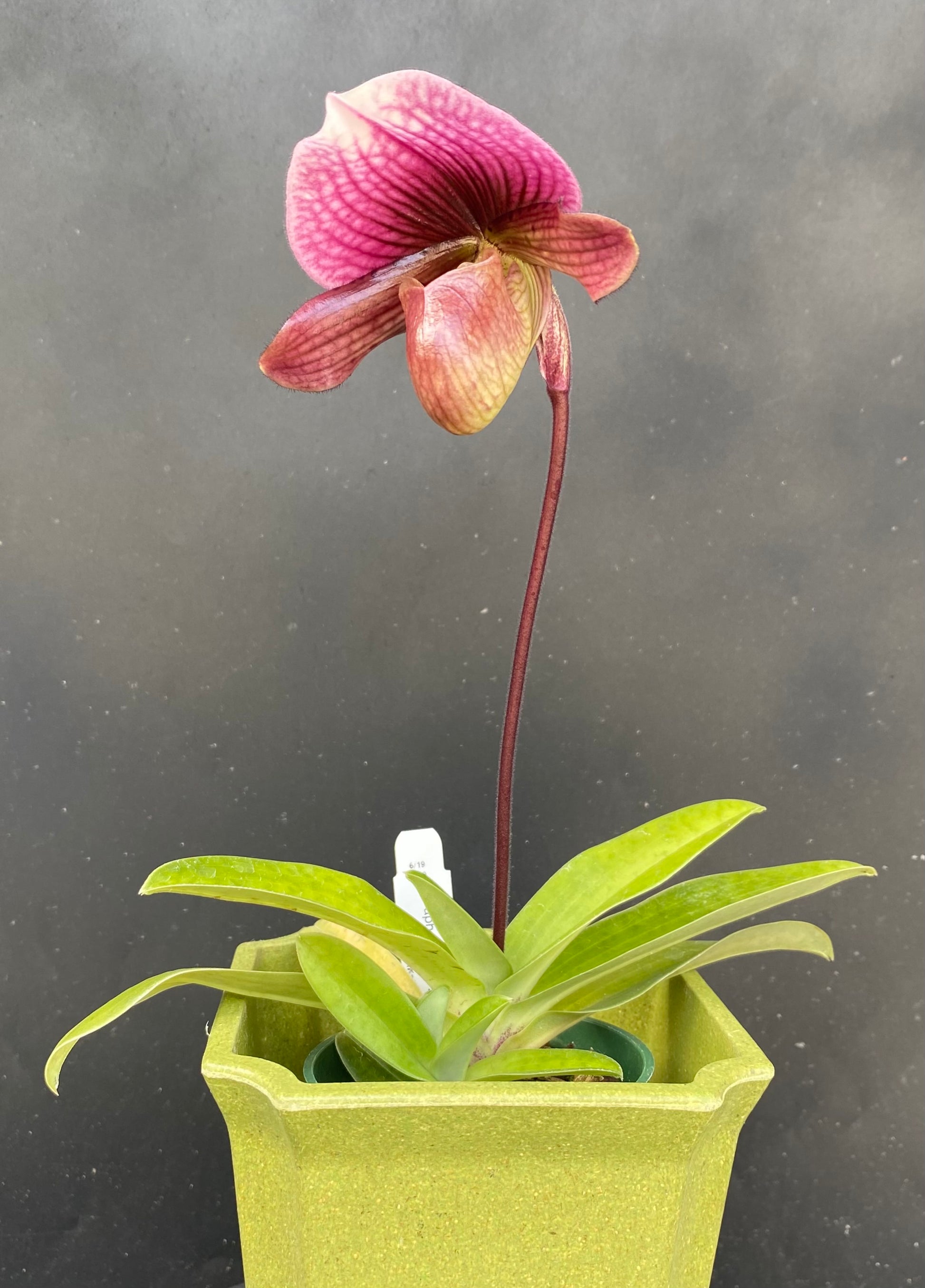
Coloratum forms: These are what most people think of when they picture a classic Maudiae. They typically feature a striking contrast of colors. The dorsal sepal (the upright "flag" at the back of the flower) is often white with bold, vertical green stripes or veins, sometimes with a blush of pink or burgundy. The petals, which extend sideways, are usually a lovely green, often with some reddish-brown veining or a deeper maroon flush, giving them a rich, velvety texture. The pouch-like labellum, the "slipper," is usually a harmonious green, sometimes with a slightly darker venation. These "coloratum" forms can range from having prominent pinks and greens to deeper reds and bronzes. A famous example, Paphiopedilum Maudiae coloratum 'Los Osos' AM/AOS, was a standard for colored Maudiaes.
Alba forms: These are the enchanting "green and white" Maudiae hybrids. "Alba" refers to the absence of red or purple pigments, leaving only the chlorophyll-derived green and the white from the base color. In these forms, the dorsal sepal is typically pristine white with crisp, emerald green venation. The petals are a delicate light green, and the pouch is a pure, soft green. These are particularly sought after for their serene and elegant appearance. One of the finest examples, Paphiopedilum Maudiae 'The Queen' AM/AOS (also known as 'Bankhaus'), which has even earned a rare FCC/AOS (First Class Certificate from the American Orchid Society), boasts large, vigorous green and white flowers and foliage that is a dark olive blue-green with ghostly lighter areas.
Vinicolor forms: These are the dramatic "wine-colored" or "dark red" forms. The name "vinicolor" speaks for itself! These Maudiae hybrids are intensely pigmented, displaying deep shades of burgundy, maroon, and nearly black. The dorsal sepal, petals, and pouch are all saturated with these rich, dark hues, often with a glossy, almost lacquered finish. They are truly captivating and command attention. A historically significant clone is Paphiopedilum Maudiae 'Ebony Queen' FCC/AOS, which received the highest award from the American Orchid Society in 1982 and was pivotal in creating the demand for vinicolor Paphiopedilums.
While generally not known for their strong fragrance, their visual appeal more than makes up for it! They typically bloom from spring to early summer, but with good care, they can often surprise you with multiple blooming periods throughout the year.
Care Instructions:
Light: Paphiopedilum Maudiae hybrids are shade-loving orchids and do best in low to moderate light. An east-facing window or a shaded south or west window (with sheer curtains to diffuse direct sun) is ideal. If the leaves develop a reddish tinge, it's a sign of too much light.
Water: They appreciate consistent moisture and should not be allowed to dry out completely. Water regularly, typically once or twice a week, allowing water to run through the pot for a good 10-15 seconds to flush out any salt buildup. Ensure the potting medium remains moist but never soggy.
Temperature: These are warm-growing orchids. They are quite comfortable in typical home environments. Daytime temperatures of 70-85°F and nighttime temperatures of 60-65°F are preferred. They can tolerate slightly cooler nights into the low 50s, but it's best to keep them a bit drier when temperatures drop.
Humidity: Moderate humidity, around 40-50%, is beneficial. In drier indoor environments, consider placing the pot on a tray of pebbles with water, ensuring the pot itself isn't sitting in the water. Good air circulation is important, especially with higher humidity.
Potting Medium: Paphiopedilums are terrestrial orchids, so they thrive in a well-draining, moisture-retentive mix. Common potting media include fine or medium-grade fir bark, sphagnum moss, perlite, and coarse sand. Repotting is generally recommended every 1-2 years or when the medium starts to decompose.
Fertilizer: Fertilize regularly with a balanced orchid fertilizer (like a 20-20-20) at a reduced strength, typically 1/4 to 1/2 the label rate. Fertilize every watering or every other watering. Consistent flushing with clear water helps prevent salt buildup.
Grown in 4" pots and available in limited supply. Orders of two or more come with complimentary eco pots. Please indicate color choices at check-out.
Shipping Notes
- Free Standard Shipping on $100+ Orders to the USA.
- Except Preorder products are shipped in 48 hours.
- Delivery to the USA:
- Standard Shipping : 3-10 business days
- If time is of the essence, please consider selecting expedited delivery for faster service.
Exchange/Return Notes
- We offer a 30-day return/exchange service after receiving.
- Final sale items are not eligible for returns or exchanges.
- To process your return/exchange, please contact us at [email protected]
- Please click here for more details>>> Return & Exchange Policy