SKU: 35098417481
engenia herbicide weight per gallon

engenia herbicide weight per gallon Propose Imazapic 2L Herbicide (Plateau Generic)

Sale price$24.80 Regular price$27.56
Save 10%

Pay in installments of $6.89 with ShopPay, AfterPay and Klarna

Shipping Estimate
USA
  • USA
  • CAN

Ships within 48 hours · Estimated delivery Sep 20 - Sep 25

Promo Codes Available:

For Your Every Summer RSVP, with Code: SUMMER15

Description

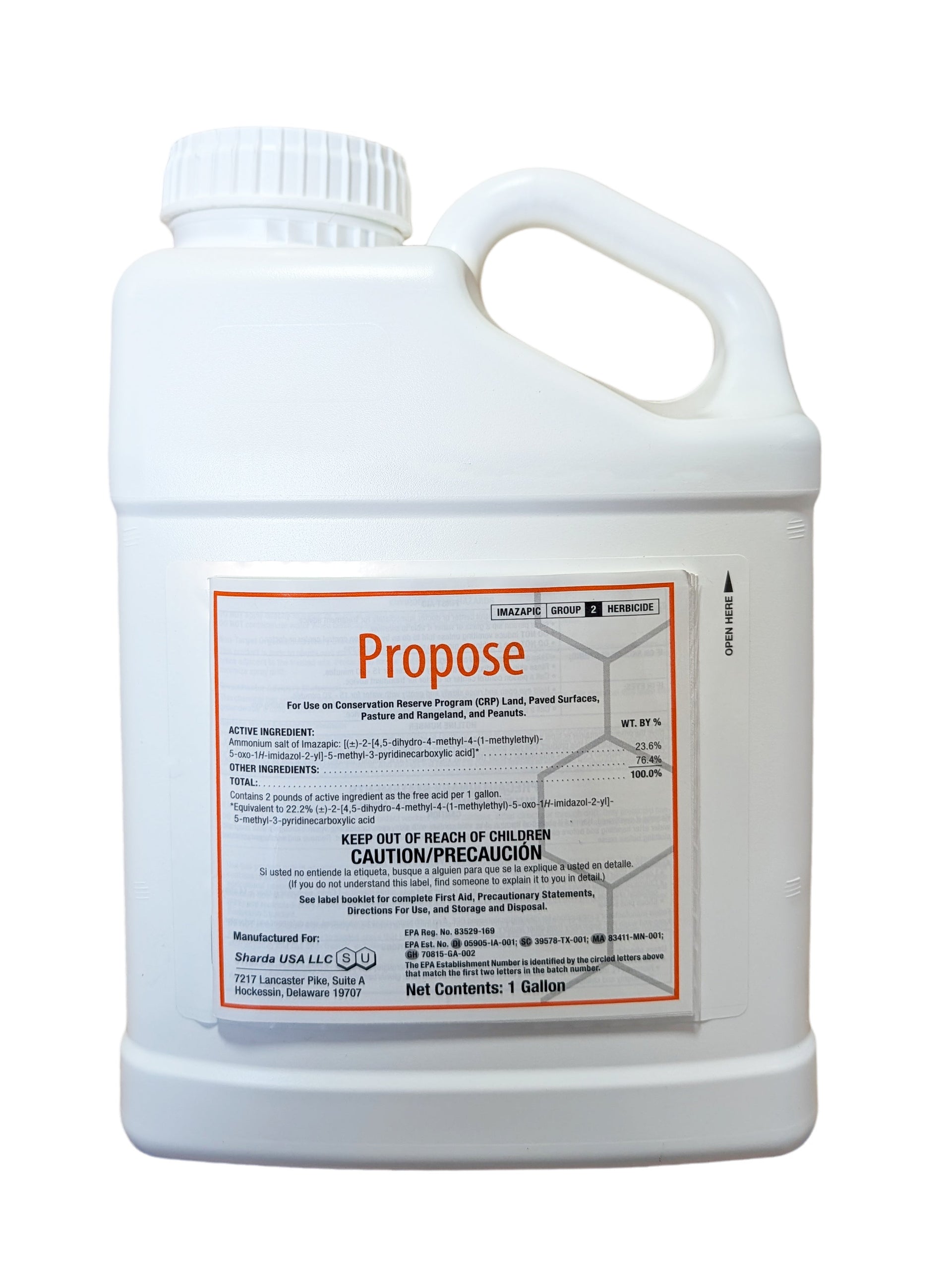
engenia herbicide weight per gallon Propose Imazapic 2L Herbicide (Plateau Generic)Propose Herbicide is a professional grade selective herbicide formulated with 23. 6% imazapic for long lasting pre emergent and post emergent control of annual grasses, perennial grasses, broadleaf weeds, sedges, and invasive vegetation. As a generic equivalent to Plateau Herbicide, Propose is widely used for rangeland improvement, pasture weed management, Conservation Reserve Program (CRP) acres, prairie restoration, pollinator habitat establishment,

Propose Herbicide is a professional-grade selective herbicide formulated with 23.6% imazapic for long-lasting pre-emergent and post-emergent control of annual grasses, perennial grasses, broadleaf weeds, sedges, and invasive vegetation. As a generic equivalent to Plateau® Herbicide, Propose is widely used for rangeland improvement, pasture weed management, Conservation Reserve Program (CRP) acres, prairie restoration, pollinator habitat establishment, rights-of-way maintenance, industrial vegetation management, and wildlife habitat enhancement. Propose works by inhibiting the AHAS/ALS enzyme system responsible for plant growth. Once absorbed through foliage and roots, it moves throughout the plant and accumulates in growing points, providing effective control of many difficult annual and perennial weeds. In addition to post-emergent activity, Propose provides residual soil activity that helps prevent germination of susceptible weeds and invasive annual grasses. Widely recognized for cheatgrass and medusahead management, Propose is also used to release native grasses, improve wildlife habitat, establish prairie plantings, suppress invasive vegetation, and reduce wildfire fuel loads in rangeland and conservation programs.

Features & Benefits

Generic equivalent to Plateau® Herbicide

Provides both pre-emergent and post-emergent weed control

Controls annual grasses, perennial grasses, broadleaf weeds, and sedges

Excellent control of cheatgrass, medusahead, johnsongrass, and invasive annual grasses

Helps establish native grasses, prairie plantings, and pollinator habitats

Valuable tool for CRP acres, rangeland restoration, and wildlife habitat management

Provides residual activity to reduce future weed germination

Supports wildfire fuel reduction by suppressing invasive vegetation

Rainfast within one hour after application

Use Sites

Conservation Reserve Program (CRP) land, pasture, rangeland, rights-of-way, railroad corridors, utility rights-of-way, pipeline rights-of-way, highway rights-of-way, airports, petroleum tank farms, utility plant sites, pumping stations, storage facilities, non-agricultural fence rows, prairie restoration sites, wildlife habitat areas, non-irrigation ditch banks, industrial turf areas, golf course non-residential turf areas, recreational non-residential turf areas, and other non-crop vegetation management sites.

Target Weeds

Cheatgrass, medusahead, downy brome, annual ryegrass, perennial ryegrass, johnsongrass, bahiagrass, dallisgrass, smutgrass, vaseygrass, crabgrass, goosegrass, foxtail, sandbur, signalgrass, stiltgrass, wild oats, nutsedge, leafy spurge, Russian knapweed, Dalmatian toadflax, kochia, bindweed, ragweed, pigweed, lambsquarters, chickweed, dandelion, curly dock, horseweed, purslane, puncturevine, smartweed, sunflower, thistle, whitetop, garlic, onion, pepperweed, and numerous other annual and perennial weeds.

Application Notes

Propose may be applied pre-emergence or post-emergence depending on target species and management objectives. Best post-emergent performance occurs when weeds are actively growing and treated with an appropriate adjuvant. Soil moisture is important for residual activity and control of germinating weeds. Applications may be made as broadcast, spot, or aerial treatments where permitted by the label. For optimum post-emergent performance, use a methylated seed oil adjuvant. Vortex Xtra is an excellent companion adjuvant for improving herbicide uptake and control of difficult perennial weeds.

Why Choose Propose Herbicide?

Propose is one of the most versatile vegetation management herbicides available for range improvement, invasive grass control, prairie restoration, wildlife habitat enhancement, and CRP management. Its ability to control annual and perennial weeds while promoting desirable forage species makes it a valuable tool for land managers, ranchers, conservation professionals, and vegetation management contractors.

Product Information

Active Ingredient: Imazapic (Ammonium Salt) 23.6%
Acid Equivalent: Imazapic Acid 22.2%
HRAC Group: Group 2 Herbicide (ALS/AHAS Inhibitor)
Chemical Family: Imidazolinone
Formulation: Soluble Liquid (SL)
EPA Reg. No.: 83529-169
Manufacturer: Sharda USA LLC
Shipping Notes
  • Free Standard Shipping on $100+ Orders to the USA.
  • Except Preorder products are shipped in 48 hours.
  • Delivery to the USA:
  1. Standard Shipping : 3-10 business days
  • If time is of the essence, please consider selecting expedited delivery for faster service.
Exchange/Return Notes
  • We offer a 30-day return/exchange service after receiving.
  • Final sale items are not eligible for returns or exchanges.
  • To process your return/exchange, please contact us at [email protected]
  • Please click here for more details>>> Return & Exchange Policy
SKU: 35098417481

Discover Niche Categories That Outsell engenia herbicide weight per gallon

Top-Converting Item to Boost Your Average Order

4.5 ★★★★★
Based on 6 reviews
Sort
Highest Rating
Newest First
Oldest First
Product Reviews
G
Verified Purchase
Gabby M
Lexington, US
★★★★★ 4
Powerful Family History
Format: Paperback
After the birth of her son, Thi Bui feels an increased sense of urgency about learning the stories of her own parents. Like all but her youngest sibling, she was born in Vietnam, though the children came of age in the United States. While the war itself haunts all of them, was the reason they left their homeland, the wounds her parents bear go far beyond the military conflict. This was only the second graphic novel I’ve ever read (both have been memoirs), and like the first was also selected by my book club. I feel like the limitations of the format mean it will always be a less preferred one for me, because I found myself wanting more words, more depth to the writing itself. But the story is deeply compelling, detailing her father’s brutal childhood, her mother’s much softer one, how they came together, and how the Vietnam War disrupted the future they thought they might have. It’s not as straightforward as “Americans bad”, and Bui is not afraid of the moral ambiguity of that time and place, where the best interests of the majority of the Vietnamese people was an open question for larger forces that seemed to have little room for consideration of what might have actually made regular lives easier to lead. And apart from the larger geopolitical machinations around them, the family had their own share of tragedy, including the death of their first child and a later stillbirth. But three living children and another on the way was enough for her parents to make frantic arrangements to leave, finally succeeding and eventually making their way to the United States. But of course, that was not the end of their story, just the beginning of a new chapter. Bui’s childhood as she depicts it makes it clear that it wasn’t the stuff dreams are made of, but what shines through is her tremendous empathy for her parents and how they became the people she experienced them as. Overarching the narrative is a meditation on parenthood, as it is the birth of her own child that inspires her to ask her parents more. They might have made major mistakes, but it is clear that they loved their children and did what they thought was best for them, making countless sacrifices to give them the best opportunities possible, even if that love was not always shown the way that they wanted and needed to feel it. Vietnamese perspectives on the war in their country were not something I was exposed to growing up (honestly the Vietnam War itself wasn’t something I remember being taught with particular rigor in high school apart from its connection to electoral politics), and I appreciated learning more about the history of the country and how the people who actually lived through the conflict thought about it. Even though this is not my preferred format, I think Bui uses it well to engage in some non-linear storytelling and to very literally illustrate what she’s trying to get it, like the way she parallels the way her relatively rural parents must have felt seeing Saigon for the first time with the way she felt when she first moved to New York, a sense of awe and possibility. It’s a powerful, moving work and I would recommend picking it up!
WAS THIS REVIEW HELPFUL?YesReportShare
Reviewed in the United States on February 3, 2026
R
Verified Purchase
Riyen
Waukegan, US
★★★★★ 5
Truly, the best we could do
Format: Kindle
An excerpt from my analysis essay I submitted for my literature course: By revisiting her family’s past from before, during, and after the Vietnam War, she gained a deeper understanding of the emotional burdens her parents carried and the sacrifices they made that defined the entirety of their lives. Bui’s illustrated graphic memoir reveals that trauma does not simply disappear over time; instead, it becomes inherited, processed, and transformed. Through this process, Thi Bui is able to move toward empathy for her parents, acceptance of who they are, and a more complete sense of self.
WAS THIS REVIEW HELPFUL?YesReportShare
Reviewed in the United States on April 21, 2026
K
Verified Purchase
Kathy
Louisville, US
★★★★★ 5
Phenomenal. A must-read!
Format: Paperback
I first learned about this book only a week ago when visiting my sister for Thanksgiving in Eugene, Oregon. We went to the Jordan Schnitzer Museum of Art where I saw some work on display by the author, and there was a copy of her book available to look at, so I perused through and decided to buy it and read it. I'm so glad that I did! This is an incredible, poetic story that spans four generations, multiple wars and conflicts, and examines the fragility of the author's relationship with her parents and with her sense of place and motherhood. This book is one of the best I've read in a long time, and the art is moving and beautiful. It gave me new insight into the struggles of refugee life, and created a truly relatable narrative. I devoured this story in one Saturday. I highly recommend it.
WAS THIS REVIEW HELPFUL?YesReportShare
Reviewed in the United States on December 2, 2018
S
Verified Purchase
Sav
Battle Creek, US
★★★★★ 5
A well composed memoir
Format: Paperback
Full review on nguyentoread.com The Best We Could Do is Thi Bui's graphic memoir. Thi was born in Vietnam three months before the Vietnam War reached what we consider to be the end of the war. She came to America with her family in 1978. Bui's memoir spans multiple generations. In learning of her mother's and father's pasts, we learn the history of their parents. We see the struggles and pains of two people from very different walks of life trying to live during a time of war and chaos. We see glimpses of the agony everyone in the middle of the Vietnam War faced. Those who were not directly involved on either side but were caught in the middle of larger powers at war. This memoir more closely details the lives of her parents leading up to them arriving in America and making their life there. I was unsure if this memoir would focus largely on the experience of being a Vietnamese immigrant in America. There were parts that showed how it was for Bui's parents in a country where tensions were still high after the Vietnam War, where discrimination largely due to that was overt, and where degrees were not recognized and people who had spent their lives working and creating careers for themselves were not qualified for most work and had to hurdle multiple challenges to learn a language and complete education all over again if they wanted to provide a better life for their children. What Bui so beautifully captures in this memoir is the why behind how her parents were in raising her. Although Bui was born in Vietnam she was young when her family arrived in America. So I think her experience is one that many first generation Vietnamese-American people of my generation can understand and sympathize with. The wanting to know why their parents are the way they are but unable to ask because many have parents, like Bui's mother, who reluctantly share their stories and don't allow their children that glimpse that could help them better understand. In the panel which was most poignant to me, Bui draws her father as he looks over her work that would become The Best We Could Do. He says "You know how it was for me. And why later I wouldn't be... normal."
WAS THIS REVIEW HELPFUL?YesReportShare
Reviewed in the United States on May 20, 2019
N
Verified Purchase
Noah Beitzel
Birmingham, US
★★★★★ 5
This book made me love my parents more
Format: Kindle
I loved the raw depictions of vietnamese history and human emotions. I recommend this book to anyone experiencing intergenerational trauma. 5 stars, this book helped me understand my father and mother just a little more, and that is priceless
WAS THIS REVIEW HELPFUL?YesReportShare
Reviewed in the United States on September 25, 2025

recommand products