SKU: 36799604863
crassula hobbit jade plant

crassula hobbit jade plant Jade Bonsai Tree

Sale price$23.46 Regular price$26.07
Save 10%

Pay in installments of $6.52 with ShopPay, AfterPay and Klarna

Shipping Estimate
USA
  • USA
  • CAN

Ships within 48 hours · Estimated delivery Jul 31 - Aug 5

Promo Codes Available:

For Your Every Summer RSVP, with Code: SUMMER15

Description

crassula hobbit jade plant Jade Bonsai TreeIntroducing a stunning jade bonsai tree plant, also known as Crassula ovata 'Hobbit', similar to Gollum jade. It is a cultivar of the Crassula ovata species, originally from South Africa. This lovely plant goes by several common names, such as Hobbit Jade, Shrek's Ears, and Ogre's Ears. It's important to note that while Crassula ovata Hobbit is referred to as a "tree," it is actually a succulent plant that can develop a bonsai like base, giving it a

Introducing a stunning jade bonsai tree plant, also known as Crassula ovata 'Hobbit', similar to  Gollum jade. It is a cultivar of the Crassula ovata species, originally from South Africa. This lovely plant goes by several common names, such as Hobbit Jade, Shrek's Ears, and Ogre's Ears.

It's important to note that while Crassula ovata Hobbit is referred to as a "tree," it is actually a succulent plant that can develop a bonsai-like base, giving it a tree-like appearance. This adds to its unique charm and makes it a popular choice among bonsai enthusiasts.


The jade bonsai tree probably needs to be 10 gal minimum to start looking like a tree; ours is a15gal, which is why it has a more mature trunk and developed appearance compared to dwarf jade bonsai trees. The larger size allows for more intricate shaping and growth potential.

When cultivated as a small bonsai tree, this jade bonsai tree typically reaches a height of around 6-8 inches, showcasing a compact shape and bushy appearance.

However, when grown as a regular potted plant, it can grow up to 3 feet tall.  Imagine adding a rare and beautiful plant to your collection that develops into a woody, branching shrub that makes an excellent large bonsai tree.

If given the proper care, the jade hobbit plant can live up to 70 years. Although it grows slowly, adding only two inches to its height each year, this plant can grow to a maximum height of three to six feet. 

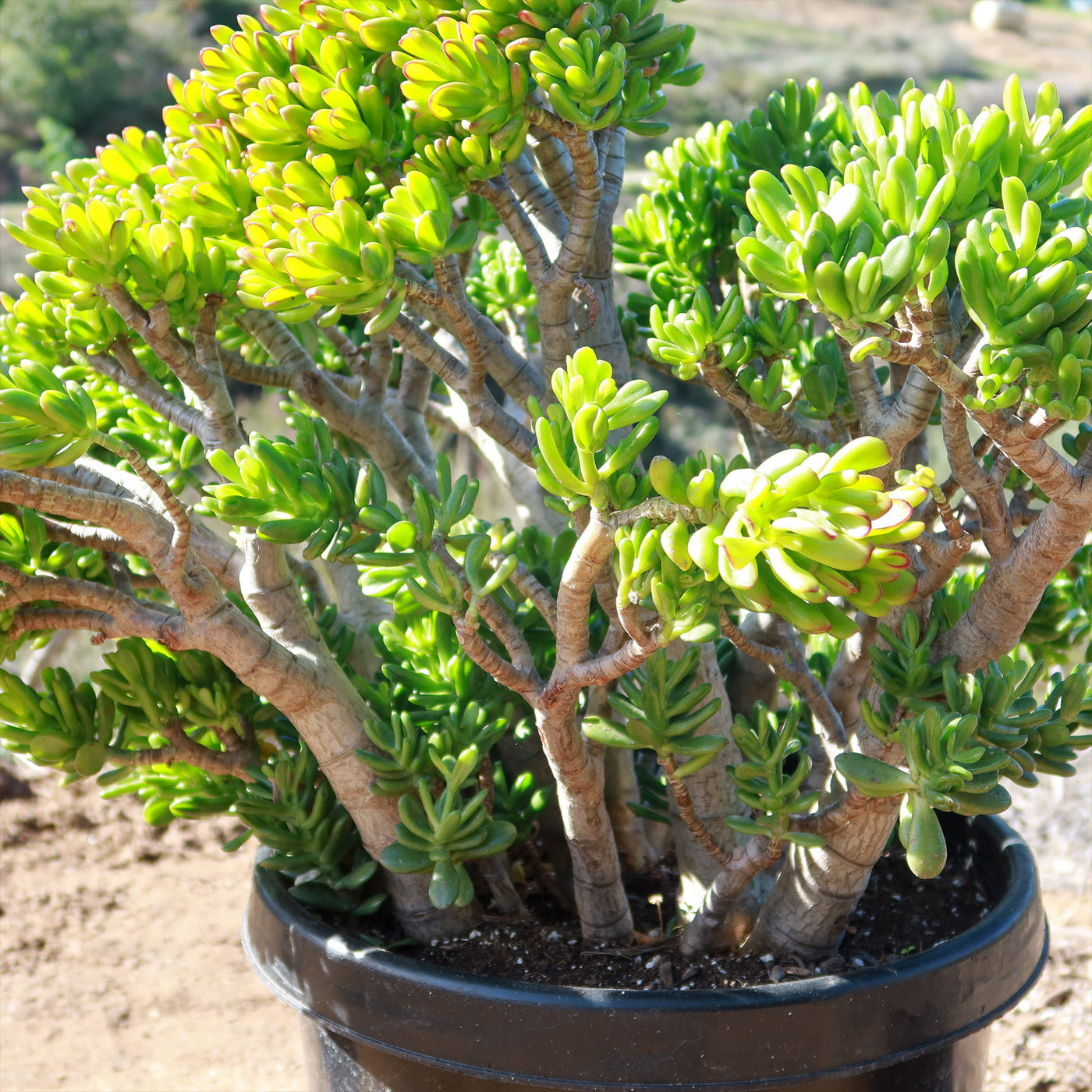
The jade bonsai tree boasts thick, fleshy leaves that are tubular and spoon-shaped, resembling the ears of characters from movies like "The Hobbit" or "Shrek." Its leaves have a glossy, jade-green hue, and when exposed to direct sunlight, they may develop reddish edges.

The flowers of this jade bonsai tree are pinkish-white, star-shaped, and bloom from late winter to late spring, making it a true showstopper. Although it typically does not bloom indoors, this jade succulent's green and white variegated leaves are attractive.

When and How to Water Your Hobbit Jade Plants

The jade bonsai tree is drought-tolerant by nature, and its fleshy, water-storing stems can hold a lot of water.  However, their root structure is easily susceptible to overwatering, so make sure that you don't overwater, as it can lead to root rot and fungal infections. The Hobbit Jade prefers watering once every 1-2 weeks in the growing season, and once a month in the dormant season.

The Crassula ovata hobbit prefers to be watered using the "soak and dry" technique. This involves thoroughly watering the jade hobbit plant before allowing it to completely dry out between watering sessions. 

Both potted and outdoor variegated jade hobbit plants should receive a deep soak once or twice a month during their growth periods, ensuring proper drainage so that the roots don't become waterlogged. Avoid watering your outdoor Crassula species when it's raining or during the winter months.

Light Requirements - Where to Place Your Jade Hobbit Plant

If growing indoors, place your Crassula ovata hobbit directly in front of a west- or south-facing window.

If they don't receive enough light, their stems may grow leggy and become paler, and their spines will shorten. So, make your jade hobbit plant happy and give it plenty of light.

When grown outdoors, providing enough light for these desert jade hobbit plant (Crassula ovata Hobbit) succulents is one of the most important aspects of their care.

It is important to grow your jade plants in areas that receive at least 4-6 hours of bright, indirect light daily to keep them happy. Under bright sunlight, bright red margins appear on leaves that are up to 2 inches long.

It's critical to remember that during a heatwave, during long periods of extreme heat, your jade hobbit tree could still sustain sun damage or get sunburned. You can protect the plant in this situation by moving it indoors or to a shaded area.

Optimal Soil & Fertilizer Needs 

The hobbit jade plants prefer sandy, well-drained soil, as excess moisture can promote root and stem rot. Planet Desert specializes in succulents and has a specialized succulent potting soil that includes an organic substrate with mycorrhizae to help with the growth of a healthy root system to help your Crassula ovata hobbit jade succulents thrive.

When it comes to fertilizing your jade hobbit plant, organic fertilizers with an equal mixture of 5-10-5 (NPK) once a year in the growing season (spring) will keep your soil alive. So, skip those harsh chemicals and give your hobbit jade succulent some love with some awesome organic fertilizer!

Hardiness Zones & More 

In the United States, this is mostly an indoor plant, but if you live in southern Florida or Hawaii, then you can cultivate it outdoors in USDA zones 9-11.

If you live in a colder climate, it's best to keep the bonsai indoors during winter or provide protection from frost.

When placing the Jade Bonsai Tree outdoors, choose a location that receives bright, indirect sunlight or partial shade. Avoid exposing it to direct, intense sunlight, as it can scorch the leaves. Additionally, ensure the soil has excellent drainage to prevent waterlogging.

How to Grow Best Indoors Jade Bonsai Tree

When it comes to indoor bonsai cultivation, the Crassula ovata hobbit prefers average room temperatures between 60-75°F. It can tolerate slightly cooler temperatures during winter, around 50-55°F, but avoid exposing it to freezing temperatures. The Jade Bonsai Tree is adaptable and can tolerate average indoor humidity levels. However, it appreciates a slightly more humid environment, especially during the dry winter months. To increase humidity, you can place a tray filled with water near the growing bonsai or use a humidifier.

Wildlife - Hobbit Jade Plant Attracts the Following Friendly Pollinators

The Hobbit Jade Plant is known to attract butterflies, bees, and hummingbirds due to its vibrant flowers and sweet nectar. These pollinators play a crucial role in the plant's reproduction and overall ecosystem health.

Butterflies
Bees
Hummingbirds
Lady Bugs
Multi Pollinators
Other Birds

Key Takeaways

  1. The curled, tubular leaves resemble little green fingers or trumpet-shaped tubes, which inspired its name ‘Hobbit’ after J.R.R. Tolkien’s mythical characters.
  2. Unlike the standard jade, the ‘Hobbit’ grows more compact and twisted, making it a naturally ideal candidate for bonsai without needing extensive shaping.
  3. In feng shui, it is considered a “money magnet” plant, and the unusual tubular leaves are thought to resemble fingers grasping prosperity.
  4. The tips of its tubular leaves can turn bright red when exposed to plenty of sunlight or cool night temperatures, adding seasonal color variation.

How to Propagate Your Crassula ovata 'Hobbit'

Crassula ovata 'Hobbit' can be propagated through stem cuttings or leaf cuttings. To propagate through stem cuttings, simply cut a healthy stem from the plant and allow it to callous before planting it in well-draining soil. Leaf cuttings can be taken by gently twisting a leaf from the plant and allowing it to dry out before planting it in soil.

Final Thoughts

Overall, the Jade Bonsai tree (Crassula ovata Hobbit) is a super cool plant with some awesome features. It's got these thick, succulent leaves that give it a unique and tree-like appearance. Crassula ovata Hobbit, often referred to as a "tree," is actually a succulent plant that can create a bonsai-like base, enhancing its unique charm and making it a popular choice among bonsai enthusiasts. Provide bright, indirect sunlight or partial shade, and use well-draining soil. Protect it from frost during colder months.

Shipping Notes
  • Free Standard Shipping on $100+ Orders to the USA.
  • Except Preorder products are shipped in 48 hours.
  • Delivery to the USA:
  1. Standard Shipping : 3-10 business days
  • If time is of the essence, please consider selecting expedited delivery for faster service.
Exchange/Return Notes
  • We offer a 30-day return/exchange service after receiving.
  • Final sale items are not eligible for returns or exchanges.
  • To process your return/exchange, please contact us at [email protected]
  • Please click here for more details>>> Return & Exchange Policy
SKU: 36799604863

Discover Niche Categories That Outsell crassula hobbit jade plant

Top-Converting Item to Boost Your Average Order

4.1 ★★★★★
Based on 9 reviews
Sort
Highest Rating
Newest First
Oldest First
Product Reviews
B
Verified Purchase
bowonwing
Massapequa, US
★★★★★ 5
Glorious book on Man's (unfortunate) wars with himself
Format: Hardcover
If you have any interest in the subject matter, buy this book, it is fantastic. Many beautiful paintings and maps, some on full pages. One comment. In various parts of this book it has something called "Directory," which is just paragraphs on events that the writer did not see deserving a full page in the book. On page 42 we have "Directory: Before 1000 CE," and included is a paragraph on "Teutoburg Forest, Roman-Germanic Wars, 9 CE" The paragraph ends with: "Although there were subsequent expeditions to Germany, the Roman frontier became fixed at the Rhine (River)." Surely, this is one of the greatest battles and results in European history and should have had a full two pages in this book instead of just a short paragraph. See the Battle of the Teutoburg Forest, 9 CE. Another short fall of this book is no mention of Boudica, who in AD 60 0r 61, was defeated by the Romans (commander- Suetonius Paullinus), who went on to "rule" England and Wales to about AD 410. This is my review of Graham Webster's book "Boudica: The British revolt against Rome in AD 60: Lucid, well written on Boudica, queen of the East Anglian kingdom of the Iceni tribe, and much more. Sixteen pages of black and white photographs. Contents (all of these Chapter headings have sub-headings)1. Sources 2. The Opposing Forces and the State of Britain 54 B.C. 3. Britain between the Invasions 54 B.C.-A.D. 43 4. The Conquest of A.D. 43 5. The Storm Breaks A.D. 60 6. The Evidence from the Ground 7. The Trail of Destruction Epilogue References Bibliography Glossary of Latin Terms and Words Index 24 Plates 8 Maps and Diagrams The Epilogue, a timeless piece of writing, should be read by everyone, young and old. The last sentence of the book in the Epilogue reads: "They may help us to see more clearly what is happening in the world today, and even help us prevent some of the worst excesses of human folly and greed for power, which brings incalculable misery and suffering to the innocent majority." Re: Boudica and the final battle with Suetonius Paullinus and the approximately 12,000 men under his command and Boudica's warriors, which could have been as great as 100,000, page 99, (but could be less); we apply "O2S4 MEC:" Objective (Simplicity); Offensive, Sprit of; Superiority at Point of Contact (Economy of Force); Surprise (Security); Security (Surprise); Simplicity (Objective); Movement (Mobility); Economy of Force (Superiority at Point of Contact); Cooperation (Unity of Command) On pages 98-99 in the book we have Fig. 5-, (if this is indeed the place of the final battle took place) "The battle between Boudica and Paullinus in its possible Mancetter context," it is clear that Paullinus had chosen the place of the battle and his position to force Boudica's warriors to a frontal attack and thereby creating "Superiority at Point of Contact." And this is probably what happened, as Boudica's warriors attacked and were funneled into the Roman Legion "buzz saw" due to their "simple" frontal attack. From Fig. 5 again, it is clear that there was forest behind Paullinus and his men and the River Anker in front of them. I do not know if it would have possible to attack Paullinus from the rear by going through the forest. However, again from Fig. 5, it is apparent that Boudica's warriors probably could have attacked Paullinus from the right and left flanks (even though the Roman cavalry was on both flanks), creating a three pronged attack, negating some of the Roman's "Superiority at Point of Contact." It is clear that Boudica lost "Cooperation (Unity of Command)," or never had it in the first place, leading to the rout by Paullinus' much smaller force over a much larger force and the fate of Britain for about the next 400 years. The Roman brutality that caused this uprising and Boudica's, and her warriors response, are part of history. Paullius' (whatever you think of him), choice of the battlefield was tactically brilliant, and no one, including Boudica, could match it on the field of battle that day.
WAS THIS REVIEW HELPFUL?YesReportShare
Reviewed in the United States on April 15, 2019
C
Verified Purchase
Chase Kimball
Louisville, US
★★★★★ 5
Poor formatting for Kindle, GREAT as a hardback
Format: Kindle
So far I am loving this book, and hating its formatting for the Kindle. Probably because of all the maps and illustrations, it is hard to enjoy on my Kindle, and I have to awkwardly change the size of the page 3-4 times on every page while I try to read it. My guess is I would really love it as a physical book. LATER: As noted I was very disappointed trying to read this on a small Kindle, but the book looked so promising that I repurchased it in hardback. WOW what a difference. Wonderful illustrations, maps, the works. Given the number of important battles chosen, it would not be possible to go into great detail on any single one, but most people are not going to remember all those details anyway, and this book gives you what you really need, and the level of detail you are likely to remember and to help you appreciate the importance of the event. Strongly recommended in hardback.
WAS THIS REVIEW HELPFUL?YesReportShare
Reviewed in the United States on March 21, 2024
M
Verified Purchase
marmite
West Palm Beach, US
★★★★★ 5
A must-have for its educational value and the sheer pleasure it brings
Format: Hardcover
"Battles that Changed History" from the DK History Changers series is an absolute gem for history enthusiasts of any age. The book offers a captivating journey through pivotal moments, providing in-depth insights into the strategies, key figures, and circumstances that shaped the course of history. The visual richness of DK's signature style, combined with well-researched content, makes this book not only informative but also visually stunning. Each battle is presented with clarity, making complex historical events accessible and engaging. Whether you're a seasoned history buff or a casual reader, "Battles that Changed History" is a must-have for its educational value and the sheer pleasure it brings to exploring the world's transformative conflicts.
WAS THIS REVIEW HELPFUL?YesReportShare
Reviewed in the United States on November 12, 2023
F
Verified Purchase
FirstSense
Charlottesville, US
★★★★★ 5
Great book, the battle descriptions should've been more detailed
Format: Hardcover
The book looks great, both the dust jacket and the book cover are printed with the cover image. The dust jacket is textured with a matte finish and shiny silver text, while the book cover looks exactly like the front cover image provided here on Amazon (with a glossy finish). In my opinion, the dust jacket looks better. The book itself looks great. The texts are a bit too short for my taste though, as I would've like to read more detailed descriptions of each battle. Read the sample of the Battle of Marathon that's provided here. It will give you a good idea of the level of detail provided for each battle. Also, some of the battles that didn't get the full 2 page treatment were, in my opinion, significant and were deserving of getting it (Battle of Kadesh for example), while some less significant battles did get it, oddly enough. All in all, I'd definitely recommend the book, but it does have a few shortcomings mentioned above. PS. Also, Amazon, please work on your packaging. Add a few of those (styro)foam pieces with the book or something. My book did arrive mostly ok, and mostly unscathed, but when I picked up the package, the book was moving freely inside the banged up package. I'd say I got lucky it didn't get damaged too badly (apart from a few minor impact traces -- I'd say condition it arrived in was 9/10).
WAS THIS REVIEW HELPFUL?YesReportShare
Reviewed in the United States on April 28, 2019
W
Verified Purchase
WryGuy2
Houston, US
★★★★★ 4
Very good book with a few minor flaws
Format: Hardcover
As most books published under the DK banner, this is a visually excellent book that is a pleasure to look at. It is well written and chock-full of outstanding illustrations and maps. I do have a few minor "ding" though. First, I think that the book should have included a "why" the battle changed history. While in most cases, this rationale is included in the text, in a few cases one has to wonder "why" this battle was important; for example, they chose the World War I battle of Verdun, but they also said that the battle was "inconclusive"; if so, how did it change history? Second, I have to question the choice of some of the battles. For example, the editors list "Arnhem", which ended up as a costly allied failure, but fail to mention the wildly successful Soviet "Operation Bagration", which destroyed the German Army Group Center. Third, there were some minor factual inaccuracies. The battles of Passchendaele and Dunkirk were both shown on a map as being located in Northern Italy instead of northern France, while Operation Overlord, the Allied invasion of France, was shown on a map as being more at Pas de Calais vice the beaches of Normandy. In spite of these nits, this is a good book worthy of belonging in you library. Four stars.
WAS THIS REVIEW HELPFUL?YesReportShare
Reviewed in the United States on May 7, 2020

recommand products