SKU: 3739262434
philodendron verrucosum 2

philodendron verrucosum 2 Philodendron verrucosum – Foliage Factory

Sale price$26.89 Regular price$29.88
Save 10%

Pay in installments of $7.47 with ShopPay, AfterPay and Klarna

Shipping Estimate
USA
  • USA
  • CAN

Ships within 48 hours · Estimated delivery Oct 2 - Oct 7

Promo Codes Available:

For Your Every Summer RSVP, with Code: SUMMER15

Description

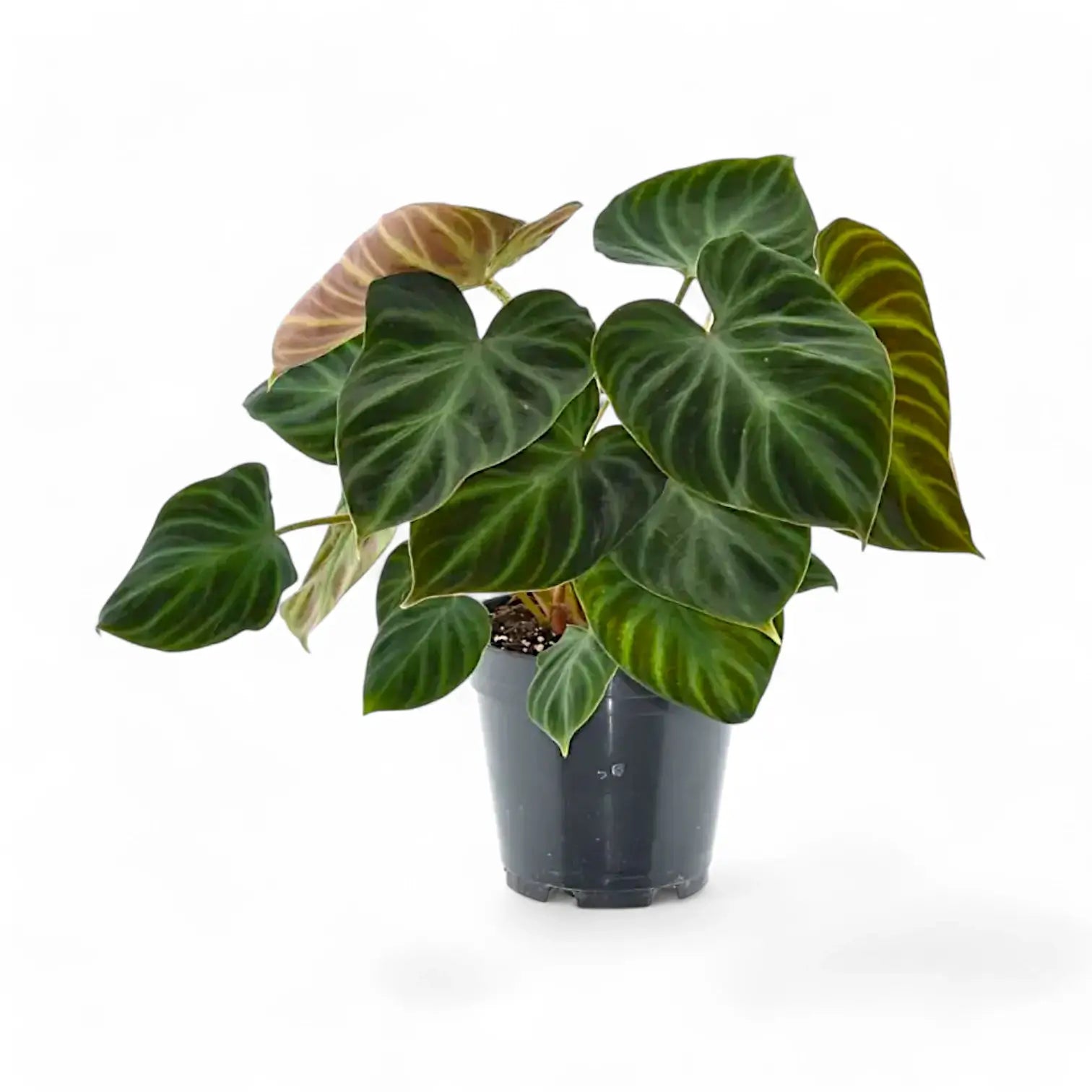
philodendron verrucosum 2 Philodendron verrucosum – Foliage FactoryPhilodendron verrucosum Philodendron verrucosum has broad, heart shaped leaves with a velvety to matte surface and textured petioles. The foliage can appear dark green to bronze green on top, with paler undersides that may show red purple tones. This species is native from Costa Rica to Peru, where it grows as a climber in wet tropical forest. Indoors, its scaly looking petioles and soft leaf surface need careful handling, stable humidity, and space

Philodendron verrucosum

Philodendron verrucosum has broad, heart-shaped leaves with a velvety to matte surface and textured petioles. The foliage can appear dark green to bronze-green on top, with paler undersides that may show red-purple tones.

This species is native from Costa Rica to Peru, where it grows as a climber in wet tropical forest. Indoors, its scaly-looking petioles and soft leaf surface need careful handling, stable humidity, and space for new leaves to open cleanly.

Visible traits of Philodendron verrucosum

  • Leaf shape: Broad cordate leaves form a rounded, heart-shaped profile.
  • Leaf surface: Velvety to matte texture marks more easily than glossy Philodendron foliage.
  • Colour detail: Dark green to bronze-green upper leaves with paler undersides that can show red-purple tones.
  • Petioles: Scaly to hairy-looking petioles remain visibly textured below the leaf blade.
  • Growth habit: A climbing stem develops nodes and grows upward on vertical support.

Climbing behaviour of Philodendron verrucosum

Philodendron verrucosum climbs from node to node, producing aerial roots along the stem. A stable pole or plank keeps the plant upright and gives developing leaves space to open without rubbing against older foliage.

The velvet leaf surface responds quickly to handling damage, dry air, and pests. Place the plant where new leaves can unfurl freely and avoid brushing the leaf surface during routine care.

Care for Philodendron verrucosum

  • Light: Bright filtered light keeps growth compact while protecting the velvet leaf surface from scorch.
  • Water: Water once the upper part of the mix has started to dry; soggy roots can lead to yellowing and collapse.
  • Humidity: Higher humidity helps new velvet leaves unfurl without sticking or tearing.
  • Substrate: A chunky aroid mix keeps thick roots aerated and reduces wet-root stress.
  • Support: A moss pole or plank gives aerial roots contact points as the stem climbs.
  • Temperature: Warm, stable conditions reduce leaf deformation and root stress.

Common issues with Philodendron verrucosum

  • Stuck leaves: Low humidity can cause new leaves to catch, wrinkle, or tear during unfurling.
  • Dry edges: Crispy margins can come from dry air, irregular watering, or salt buildup in the substrate.
  • Pests: Thrips and spider mites can mark soft velvet leaves quickly, especially on new growth.
  • Root decline: Dense wet substrate can cause yellowing, limp leaves, and slow recovery after watering.

Botanical background of Philodendron verrucosum

Philodendron verrucosum was described by L. Mathieu ex Heinrich Wilhelm Schott in 1856. The name verrucosum refers to a rough or warted surface, matching the species’ textured petioles.

Safety note for Philodendron verrucosum

Like other Philodendron, this plant contains calcium oxalate crystals and should be kept away from pets and children who may chew the leaves or stems.

Shipping Notes
  • Free Standard Shipping on $100+ Orders to the USA.
  • Except Preorder products are shipped in 48 hours.
  • Delivery to the USA:
  1. Standard Shipping : 3-10 business days
  • If time is of the essence, please consider selecting expedited delivery for faster service.
Exchange/Return Notes
  • We offer a 30-day return/exchange service after receiving.
  • Final sale items are not eligible for returns or exchanges.
  • To process your return/exchange, please contact us at [email protected]
  • Please click here for more details>>> Return & Exchange Policy
SKU: 3739262434

Discover Niche Categories That Outsell philodendron verrucosum 2

Top-Converting Item to Boost Your Average Order

4.9 ★★★★★
Based on 11 reviews
Sort
Highest Rating
Newest First
Oldest First
Product Reviews
J
Verified Purchase
John Moore
San Leandro, US
★★★★★ 5
Guided tour through a difficult work
Format: Paperback
For the non-expert reader of Plato, this is a very good text for working through Timaeus. Actually, it may be useful to expert readers as well, but I wouldn't know about that, being firmly situated in the non-expert camp. Though some scholars may take exception to certain parts of Cornford's translation and interpretation, for those of us trying to get through it for the first time and on our own, this is still an exceptional guide. By the way, for an alternative translation and interpretation, the reader may want to check out Kalkavage's translation (Focus Philosophical Library), it is very good (I would rate it 5 stars also) and has some extremely helpful appendices for understanding references to music, astronomy, and geometry.
WAS THIS REVIEW HELPFUL?YesReportShare
Reviewed in the United States on January 6, 2013
R
Verified Purchase
Reviewer from San Ramon
Dallas, US
★★★★★ 5
Cornford's Plato Cosmology/Timaeus
Format: Paperback
This is an excellent and invaluable reference book for Plato's Timaeus. If you are reading Timaeus you MUST have this book. It contains line-by-line commentary, and also, most valuable, some very helpful illustrations (example: illustration of the human body as Timaeus explained it). I would, however, balance this book with other books that attempt to place Timaeus within the rest of Plato's works. I recommend, for example, Peter Kalkavage's Timaeus. There, he attempts to link Timaeus and Republic.
WAS THIS REVIEW HELPFUL?YesReportShare
Reviewed in the United States on February 8, 2011
W
Verified Purchase
Wilbur F. Pierce
San Leandro, US
★★★★★ 5
An Excellent Choice
Format: Paperback
Excellent introduction, notes and translation.
WAS THIS REVIEW HELPFUL?YesReportShare
Reviewed in the United States on June 8, 2017
D
Verified Purchase
David Lemberg
Grantham, US
★★★★★ 5
Five Stars
Format: Paperback
Professor Cornford's translation with running commentary is definitive.
WAS THIS REVIEW HELPFUL?YesReportShare
Reviewed in the United States on November 5, 2015
J
Jordan Bell
Omaha, US
★★★★★ 5
Plato's dialogue about the physical world
Format: Paperback
The two biggest topics in the Timaeus are astronomy and the elements of bodies, which are constructed using triangles and the tetrahedron, octahedron, icosahedron, and cube. I would like to see a translation of the Timaeus that uses it as a way to introduce all the astronomy that appears in the dialogue. Introducing the astronomy does not mean just talking in words about spheres or the zodiac or the ecliptic, but actually explaining how these were used by astronomers. Cornford has much to say, but to someone who has not learned any Greek astronomy his commentary will be opaque and hard to use. I didn't know the astronomy well enough to readily understand Cornford's explanations. I plan to learn more classical Greek astronomy, perhaps using Evans' , and then read Waterfield's translation of the Timaeus . Before reading this you should have read the Republic and know some classical Greek natural philosophy, mathematics, and astronomy. Although Cornford's commentary makes the dialogue staccato, I am glad for it because I wouldn't otherwise have understood much of what Plato says. The Timaeus and the Parmenides are the two dialogues of Plato that one needs commentary to understand; the Parmenides demands the commentary because so much of what is happening depends on the original language, and the Timaeus demands the commentary because of all the things the reader is supposed to be familiar with. The following is a list of topics I kept while reading the dialogue: theory of Forms 27d-28a, 51a-52a; harmonics 35b-36b; time 37c-38e, 39b-e; vision 45b-46c, 67c-68d; space 52b; surfaces 53c; weight 62d-63e; sound 67a-67c; physiology 70c-79e, 80d-86a; antiperistasis 79e-80c.
WAS THIS REVIEW HELPFUL?YesReportShare
Reviewed in the United States on December 12, 2015

recommand products