SKU: 40977536229
plant hyacinth bulbs in pots

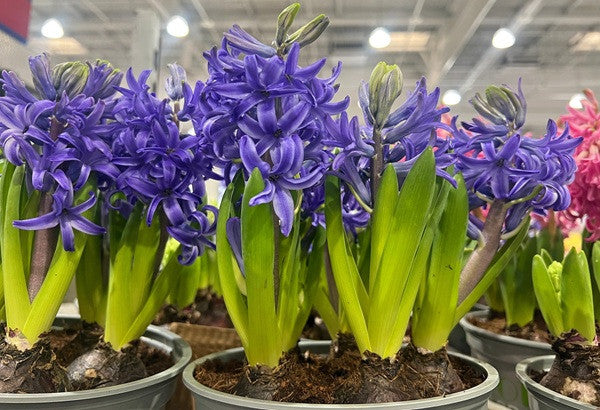
plant hyacinth bulbs in pots Hyacinthus Hyacinth Purple 'Splendid Cornelia'

Sale price$24.80 Regular price$27.56
Save 10%

Pay in installments of $6.89 with ShopPay, AfterPay and Klarna

Shipping Estimate
USA
  • USA
  • CAN

Ships within 48 hours · Estimated delivery Jul 26 - Jul 31

Promo Codes Available:

For Your Every Summer RSVP, with Code: SUMMER15

Description

plant hyacinth bulbs in pots Hyacinthus Hyacinth Purple 'Splendid Cornelia'If youre looking for a flower that truly says spring is here, the hyacinth is it. With its rich fragrance and dense, colorful blooms, this classic bulb adds beauty and charm wherever its planted. Hyacinths are perfect for tucking into garden beds, borders, or pots near entryways where their sweet scent can be enjoyed up close. Plant them once, and youll look forward to their cheerful return every year in cooler climates of zones 4 7 a sure sign that

If you’re looking for a flower that truly says “spring is here,” the hyacinth is it. With its rich fragrance and dense, colorful blooms, this classic bulb adds beauty and charm wherever it’s planted. Hyacinths are perfect for tucking into garden beds, borders, or pots near entryways where their sweet scent can be enjoyed up close. Plant them once, and you’ll look forward to their cheerful return every year in cooler climates of zones 4-7 — a sure sign that warmer days are on the way.

This bulb works as a wonderful accent piece. Their striking pop of color in April really adds to your garden. These are smaller bulbs, and have a tendency to dry out, so be sure to plant them as soon as possible! They are striking when planted in en masse of 60+ bulbs. If you want to try planting them en masse, simply dig a trench about 4-6 inches deep, place the bulbs about 1-2" apart, and cover the entire area with soil. Then water.

What to expect: This bulb will put on its foliage in February/March to prepare for its April bloom. The flowers will grow to about 10-12" tall. Each shoot will produce a cluster of star-shaped blooms. The lovely blooms will last for 2-3 weeks depending on the heat. But the green foliage will add to your garden for at least another month. Allow the foliage to die back naturally. When it is completely dead, then you can cut if off. Remember, the foliage is what takes in the sun energy to allow the bulbs to make it through the year and produce beautiful blooms the next year.

Care and planting: These bulbs do best when planted where they will receive at least 6+ hours of winter sun.

Simply plant them about 6" deep. Plant the bulbs 1-2" apart if you want them to look more natural or up to 6" apart if you are planning to let them fill in the area over the next few years. The size of this bloom allows it to look great in containers, as a border, along walkways, in rock gardens, or in an open area. They like well-drained soil.

Plant in pots: Can I plant them in pots? Yes! They still need that winter sun though so be sure to place the pot in a very sunny location that will receive 6+ hours of sun. Just water them a little until the foliage and blooms start to appear and then be sure to water them a little more. Place them in a pot with well-drained soil. You can plant a lot of bulbs in a small pot to have a dramatic showing. If the weather is nice between February and May, you can set the pot outside to take in great nutrients directly from the sun. We know april is a little late for a freeze, but be sure to keep the pot out of the temperatures below 34 degrees as the pot gets cold from all sides and can freeze the bulbs. Remember that the bulbs will multiply so after the foliage has died back you may want to go ahead and transplant some of the bulbs into other pots for the next season.

Forcing hyacinths is an easy way to enjoy color and fragrance indoors weeks before spring actually arrives.

Planting

  1. Choose clean pots with drainage holes.
  2. Fill with well-draining potting mix.
  3. Set bulbs pointed end up, leaving the top 1/2 of the bulb exposed above the soil.
  4. Space bulbs close together or plant one bulb per small pot.
  5. Water thoroughly after planting.
  6. Keep soil barely moist, not wet until you see growth

Bringing them into bloom

  1. Place pots to a cool, bright room
  2. Once shoots are 2–3 inches tall, place in brighter light
  3. Keep temperatures cool (55–65°F) for longer-lasting blooms TIP -- Cooler temperatures slow growth but produce stronger stems and longer-lasting flowers. Warmer rooms speed bloom time but shorten the show.

How to plant forced hyacinths in the ground

  1. After blooms fade, cut off the spent flower spike
  2. Keep the leaves growing as long as possible
  3. Water lightly and place pots in bright light
  4. Once foliage yellows and dies back, plant bulbs outdoors Or plant earlier if the ground isn’t frozen and foliage is still green
  5. Plant at normal depth (about 6–8 inches)

In warmer climates, forced hyacinths are best enjoyed:

  • Indoors for fragrance and beauty
  • Then planted outside as a bonus—not a guarantee

Plant them outside if you can—it doesn’t hurt. Just think of any future bloom as a happy surprise, not a promise

Shipping Notes
  • Free Standard Shipping on $100+ Orders to the USA.
  • Except Preorder products are shipped in 48 hours.
  • Delivery to the USA:
  1. Standard Shipping : 3-10 business days
  • If time is of the essence, please consider selecting expedited delivery for faster service.
Exchange/Return Notes
  • We offer a 30-day return/exchange service after receiving.
  • Final sale items are not eligible for returns or exchanges.
  • To process your return/exchange, please contact us at [email protected]
  • Please click here for more details>>> Return & Exchange Policy
SKU: 40977536229

Discover Niche Categories That Outsell plant hyacinth bulbs in pots

Top-Converting Item to Boost Your Average Order

4.5 ★★★★★
Based on 28 reviews
Sort
Highest Rating
Newest First
Oldest First
Product Reviews
I
Verified Purchase
Immer
Lowell, US
★★★★★ 4
As A Dominant Species, We Dance On The Razor’s Edge
Format: Hardcover
Under A White Sky Elizabeth Kolbert’s claim to fame is her book The Sixth Extinction. In comparison Kolbert’s under A White Sky is rather short and disorganized, yet her coverage of those working on solutions to Climate Change is pretty darn interesting.  In her conclusion, she writes, “This has been a book about people trying to solve problems created by people trying to solve problems.” Putting this sentence at the book’s beginning rather than buried at its end would have provided a reader a compass to help determine where Kolbert was going with her dialogue. As she wades through the reversed direction of the Chicago river; Asian carp; Cane toads; forced and accelerated evolution in regard to coral, in particular in regard to the Great Barrier Reef (without discussing the importance of the worlds reefs; the continual flooding of New Orleans both despite and because of the actions of The Army Corps of engineers, one begins to ponder a general connection that might exist, while the book itself is headed toward a two star rating. Then, Kolbert got to Global Warming and Climate science. The book’s last sixty pages are worth the complete price of admission. The chapter begins with carbon sequestration, the pros and cons of how it can be done, and does it also contribute to the growing problem. The stoppered bathtub” analogy is perhaps the best analogy I’ve heard in regard to the anthropocentric carbon dioxide problem on the Earth. The tub is full of water/ the sky’s CO2 level; the tubs stoppered, so the water isn’t going anywhere, and the atmosphere’s increased CO2 level won’t drop in the near future either; and even if the water flow to the tub is reduced, it will still accumulate until over flowing, as will reduced emissions continue to amass in the atmosphere. In a sense, we are already beyond the tipping point in terms of global temperature increase. Harvard University Center for the Environment director Dan Schrag says, “I’m a scientist. My job is not to tell people the good news. My job is to describe the world as accurately as possible.” He predicts, due to the fact that the oceans must equilibriate. “If we were to stop CO2 emissions tomorrow, which of course isn’t possible, it’s still going to warm for centuries. That’s just basic physics.” Thus enters the topic of geoengineering, and the connection with people trying to solve problems created by people trying to solve problems truly comes into focus. Kolbert , in a rather clandestine way connects the dots of her past “local problems”, but now the problem fix, if it doesn’t work could create problems beyond solving. She hits the nail on the head with this. Humans have been around 35-50 thousand years, but only the last ten thousand or so have they thrived, largely due to agriculture and differentiation of what one can do because of agriculture. But ag has only been able to thrive because of the rather consistent global weather of the past ten thousand years, due to glacial retreat. This has been presented in great detail by Jared Diamond in his book Guns, Germs, and Steel. The CO2 we’ve put into the atmosphere isn’t going anywhere, as we continue to pour more into the mix. Her interviews with climate scientists do not bode well for our species, as everything they think of to combat the CO2 conundrum brings more as the bathtub continues to fill. One could say humans have become victims of their own success as a species. Ultimately, one gets the feeling from Kolbert and her interviews, that the enormous fluctuations in the Earth’s climate over geological time, and those yet to come, render whatever we do as humans as a moot point. The Earth will shake is off as a dog rids itself of fleas. She also brings to the argument, when the blank really hits the fan, as it will despite, or because of any preventative efforts by man, the resulting population displacements will be staggering. A sobering, informative book as we, as a species, dance on the razor’s edge.
WAS THIS REVIEW HELPFUL?YesReportShare
Reviewed in the United States on September 24, 2021
C
Verified Purchase
Christine Liu
Whiting, US
★★★★★ 5
fascinating and compellingly written
Format: Hardcover
Elizabeth Kolbert is one of my favorite nonfiction authors. She has such a knack for writing in a clear, compelling way that makes you think and marvel and ask questions you've never considered before. In her previous book, The Sixth Extinction, she catalogs all the ways in which humans have drastically changed the natural world, ushering the new age of the Anthropocene. Under a White Sky is an exploration of the ways scientists around the world are trying to undo those changes. There are people engineering unique solutions to combat a variety of environmental threats: invasive carp in the Chicago River and cane toads in Australia, Louisiana's rapidly disappearing Mississippi River delta, rare species that now depend entirely on human conservation for their continued survival, and, perhaps most pressingly, the problem of rising carbon emissions and global climate change. That there are brilliant minds working innovatively to solve these problems inspires optimism. But these sobering portraits really highlight the extreme human measures it takes to keep at bay the problems caused by humans interfering with nature in the first place. We've already transformed the planet; how much more will it be transformed by these interventions, and in what ways?
WAS THIS REVIEW HELPFUL?YesReportShare
Reviewed in the United States on March 11, 2021
C
Verified Purchase
Carlos
Birmingham, US
★★★★★ 5
Exactly what I ordered
Format: Paperback
As described the book was in great condition and ut was delivered with care
WAS THIS REVIEW HELPFUL?YesReportShare
Reviewed in the United States on August 12, 2025
W
Verified Purchase
Wayne C. Solomon
New York, US
★★★★★ 5
Five Stars
Format: Paperback
Look no further. This work is the Rosetta Stone of storytelling.
WAS THIS REVIEW HELPFUL?YesReportShare
Reviewed in the United States on May 24, 2017
D
D. Christofferson
Fort Morgan, US
★★★★★ 2
It's good for storytelling but has content in stories that's inappropriate in this century
Format: Audiobook
Well modulated interesting and excellent storytelling ability, and skills to teach us of the same. However. I get to the 2nd lesson, it's a book of fiction for the story premise. She describes a woman in her family who can't get pregnant (in the old days), knowing her husband really wants children,and gets happy, as she turns to her "maid" and exclaims that this is alright, he can have a child with their maid! Then the storytelling author, laughs, jokes, about pleasing him and when she says the audience is laughing too, that maybe he can get a 2nd maid pregnant too. Laughing and joking I. The man's eyes as she tells it, about men and their sex drives. I'm not reading g a Victorian romance novel or of the plantation owners in the south, I'm reading a book of lessons on good story telling. This turned me off 500%, and I am done with this author and this book. Is this told by an FDLS polygamist, or ...what? What would make this story in 2013, OK to teach in a college course, or in this book? I don't care if she even made it up for a family old story.
WAS THIS REVIEW HELPFUL?YesReportShare
Reviewed in the United States on January 14, 2025

recommand products