Pay in installments of $7.35 with
 ,
,
 and
and

Shipping Estimate
USA
- USA
- CAN
- USA
- CAN
Ships within 48 hours · Estimated delivery Oct 18 - Oct 23
 Promo Codes Available:
For Your Every Summer RSVP, with Code: SUMMER15
Description
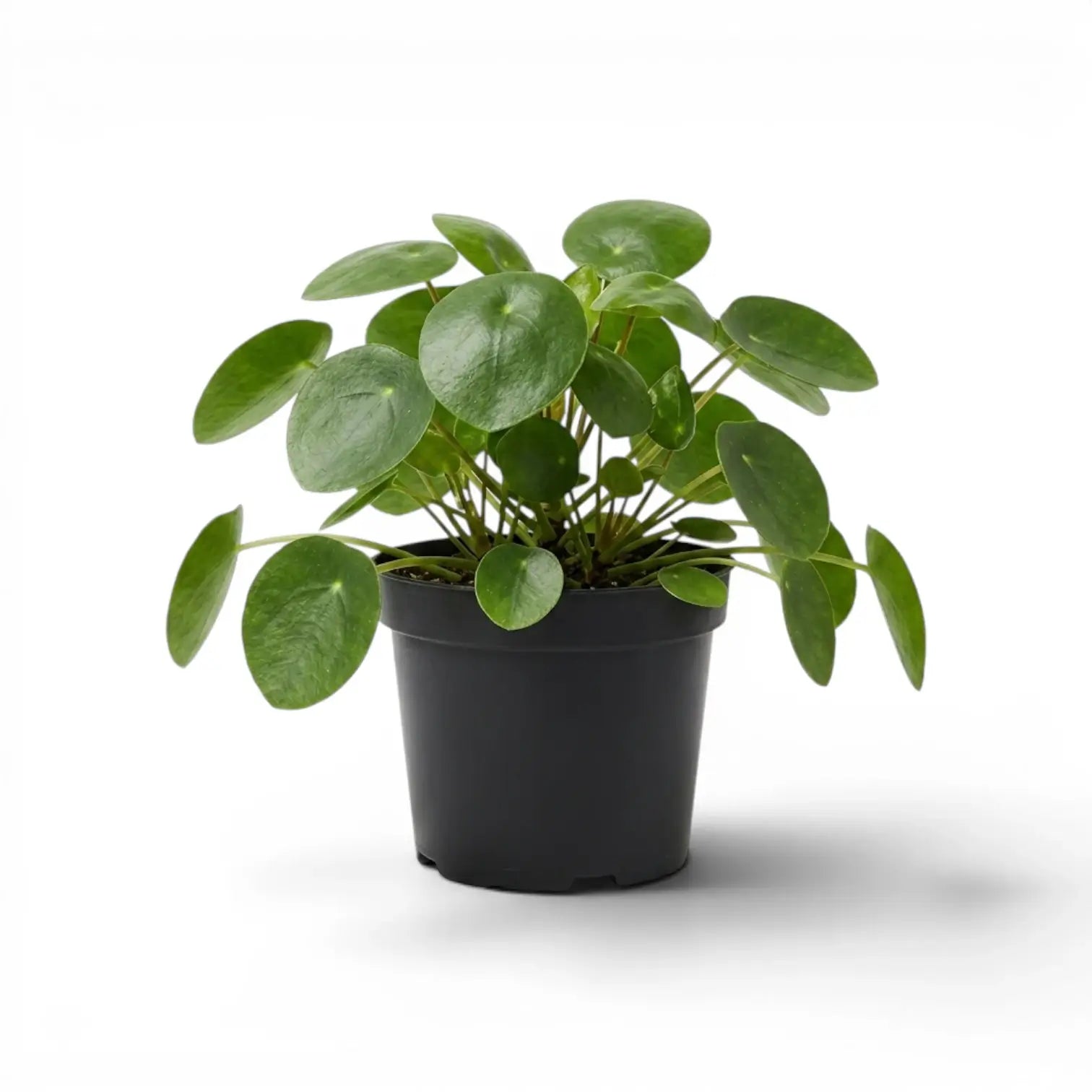
money plant with round leaves Pilea peperomioides – Foliage FactoryPilea peperomioides Pilea peperomioides is the classic round leaved Pilea, with coin shaped green leaves held on slim petioles around an upright central stem. It grows compactly at first, then often develops a visible stem and small offsets around the base. As the plant matures, the leaf canopy can rise above the pot and the basal pups become easier to separate. Bright indirect light keeps the growth more even, while occasional rotation helps the
Pilea peperomioides
Pilea peperomioides is the classic round-leaved Pilea, with coin-shaped green leaves held on slim petioles around an upright central stem. It grows compactly at first, then often develops a visible stem and small offsets around the base.
As the plant matures, the leaf canopy can rise above the pot and the basal pups become easier to separate. Bright indirect light keeps the growth more even, while occasional rotation helps the leaves develop around the stem rather than leaning strongly to one side.
Round coin leaves on Pilea peperomioides
- Leaf shape: Round, peltate leaves attach near the centre, giving the plant its familiar coin-leaf form.
- Leaf colour: Fresh green leaves sit on slender petioles and create an open canopy.
- Growth habit: An upright central stem develops over time, often with basal pups around the parent plant.
- Propagation: Offsets can be separated once they have enough root growth of their own.
- Pot behaviour: A snug pot and airy substrate keep watering easier to control.
- Mature growth: Older plants can form a taller visible stem below the leaf canopy.
Growth and origin of Pilea peperomioides
Pilea peperomioides is native to parts of south-western China, including Yunnan and Sichuan. Indoors, it behaves as a compact, upright perennial that grows in bright filtered light and a substrate that dries partly between waterings.
The rounded leaves turn toward the strongest light source, so rotating the pot keeps the plant from leaning strongly to one side. Older plants may develop a taller bare stem below the leaf canopy, especially after leaf drop or low-light growth.
Care guide for Pilea peperomioides
- Light: Give bright indirect light. Too much direct sun can scorch leaves, while low light can stretch the stem and petioles.
- Watering: Let the upper part of the substrate dry before watering again. Yellowing and leaf drop often follow repeated overwatering.
- Humidity: Normal indoor humidity is usually enough, but very dry air can cause crisp leaf edges.
- Temperature: Keep it warm and stable, away from cold draughts and cold windowsills.
- Substrate: Use a free-draining houseplant mix with added aeration for the fine roots.
- Repotting: Repot when the root ball fills the pot or watering becomes difficult to manage.
- Feeding: Feed lightly during active growth. Skip fertiliser if the plant is stressed, recently repotted or growing slowly.
- Propagation: Remove pups when they have several leaves and visible roots, then pot them into a small airy mix.
Common issues with Pilea peperomioides
- Yellow leaves: Usually linked to wet substrate, poor drainage or watering before the pot has dried enough.
- Leaning growth: Caused by one-sided light. Rotate the pot regularly for a more balanced canopy.
- Crispy edges: Can come from drying too far, hot direct sun or very dry air.
- Leaf drop: Often follows stress from overwatering, cold draughts or sudden changes in light.
- Fungus gnats: More common when the substrate stays wet for too long.
- Pests: Check stems and leaf undersides for spider mites and mealybugs.
Safety for Pilea peperomioides
Pilea peperomioides is commonly treated as a pet-safe houseplant. Chewing can still cause mild stomach upset, so keep it away from pets that regularly bite leaves.
Botanical background for Pilea peperomioides
Pilea peperomioides was described by Friedrich Ludwig Diels in 1912. The species belongs to Urticaceae, and the epithet peperomioides refers to its resemblance to Peperomia.
Shipping Notes
- Free Standard Shipping on $100+ Orders to the USA.
- Except Preorder products are shipped in 48 hours.
- Delivery to the USA:
- Standard Shipping : 3-10 business days
- If time is of the essence, please consider selecting expedited delivery for faster service.
Exchange/Return Notes
- We offer a 30-day return/exchange service after receiving.
- Final sale items are not eligible for returns or exchanges.
- To process your return/exchange, please contact us at [email protected]
- Please click here for more details>>> Return & Exchange Policy