SKU: 41367789318
bitter melon seeds planting

bitter melon seeds planting Indian Long Bitter Melon Seeds, Khổ qua rừng gai. Non-GMO Heirloom

Sale price$20.17 Regular price$22.41
Save 10%

Pay in installments of $5.60 with ShopPay, AfterPay and Klarna

Shipping Estimate
USA
  • USA
  • CAN

Ships within 48 hours · Estimated delivery Sep 20 - Sep 25

Promo Codes Available:

For Your Every Summer RSVP, with Code: SUMMER15

Description

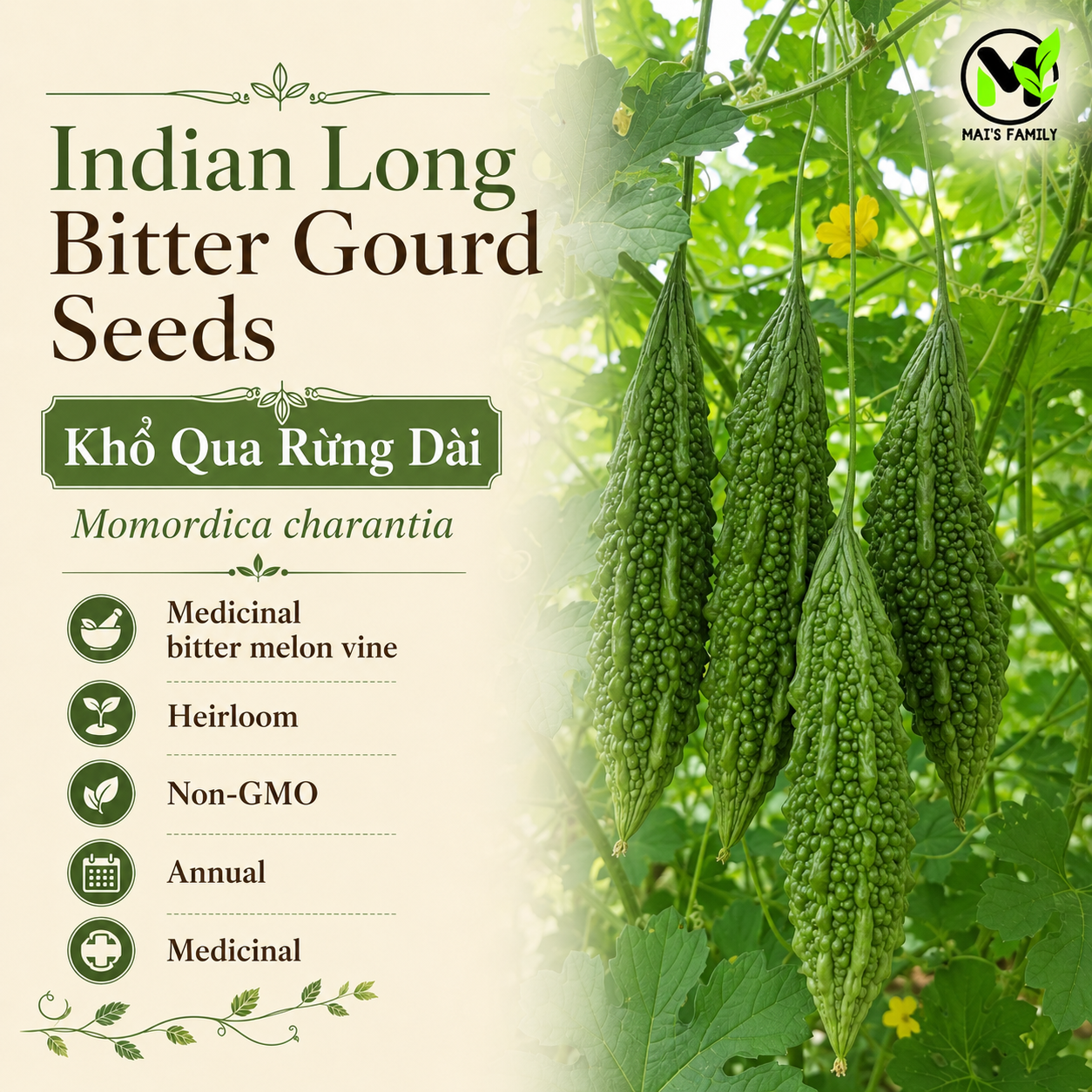
bitter melon seeds planting Indian Long Bitter Melon Seeds, Khổ qua rừng gai. Non-GMO HeirloomIndian Long Bitter Melon Seeds Kh Qua Rng Gai Momordica charantia Grow your own Indian Long Bitter Melon, also known as Kh Qua Rng Gai or Bitter Gourd, a unique warm season Asian vegetable grown for its long green fruits with textured, bumpy skin and classic bitter flavor. This heirloom, non GMO bitter melon variety grows as a vigorous climbing vine and is best supported with a strong trellis. Indian Long Bitter Melon is popular in Vietnamese, Indian,

Indian Long Bitter Melon Seeds – Khổ Qua Rừng Gai

Momordica charantia

Grow your own Indian Long Bitter Melon, also known as Khổ Qua Rừng Gai or Bitter Gourd, a unique warm-season Asian vegetable grown for its long green fruits with textured, bumpy skin and classic bitter flavor. This heirloom, non-GMO bitter melon variety grows as a vigorous climbing vine and is best supported with a strong trellis.

Indian Long Bitter Melon is popular in Vietnamese, Indian, and Asian home cooking. The young fruits are commonly used in soups, stir-fries, stuffed bitter melon dishes, and traditional garden meals. For best eating quality, harvest fruits while they are still young, green, firm, and tender.

Why Grow Indian Long Bitter Melon?

  • Unique Indian long bitter melon variety
  • Also known as Khổ Qua Rừng Gai or Bitter Gourd
  • Heirloom, non-GMO seeds
  • Annual warm-season climbing vine
  • Produces long green fruits with textured, bumpy skin
  • Popular in Vietnamese, Indian, and Asian cooking
  • Great for soups, stir-fries, stuffed bitter melon, and home garden recipes
  • Best grown on a trellis for better airflow and easier harvest
  • Suitable for gardens, raised beds, and large containers

Growing Information

  • Botanical Name: Momordica charantia
  • Common Names: Indian Long Bitter Melon, Bitter Gourd, Khổ Qua Rừng Gai
  • Plant Type: Annual climbing vine
  • Seed Type: Heirloom, non-GMO
  • Sunlight: Full sun
  • Soil: Fertile, loose, well-draining soil
  • Watering: Keep soil evenly moist, but not soggy
  • Seed Depth: 1/2–1 inch deep
  • Plant Spacing: 12–18 inches apart
  • Row Spacing: 3–4 feet apart
  • Best Season: Spring to summer after danger of frost
  • Support: Trellis recommended
  • Best Temperature: Warm soil and steady warm weather

How to Germinate Bitter Melon Seeds

Bitter melon seeds have a hard seed coat and need warmth to germinate well. For best results, soak seeds in warm water around 60–70°C for 8–12 hours. After soaking, wrap the seeds in a moist paper towel and place them inside a covered container, glass jar, or ziplock bag.

Keep the seeds in a warm, dark place for about 5–7 days, checking regularly to make sure the paper towel stays moist but not soaking wet. Once the seeds begin to sprout, carefully plant them into pots or prepared soil.

Avoid cold, wet soil because it can slow germination or cause seeds to rot.

Planting & Care Tips

Plant after the danger of frost has passed and the weather is consistently warm. Bitter melon grows best in full sun with fertile, well-draining soil. Provide a strong trellis or support, as the vines climb quickly and need good airflow.

Keep soil evenly moist during germination, flowering, and fruiting. Avoid overwatering or soggy soil. A layer of mulch can help retain moisture and keep the root zone stable during hot weather.

Harvesting

Harvest Indian Long Bitter Melon fruits while they are young, green, firm, and tender. Regular picking encourages the vine to continue producing. Older fruits may become more bitter and can turn yellow-orange as they mature.

Important Growing Note

Germination and growth results may vary depending on temperature, moisture, soil, sunlight, and growing conditions. Bitter melon is a warm-season crop and needs steady warmth for best results.

Packed by Mai’s Family LLC
Website: maisfamily.us

Shipping Notes
  • Free Standard Shipping on $100+ Orders to the USA.
  • Except Preorder products are shipped in 48 hours.
  • Delivery to the USA:
  1. Standard Shipping : 3-10 business days
  • If time is of the essence, please consider selecting expedited delivery for faster service.
Exchange/Return Notes
  • We offer a 30-day return/exchange service after receiving.
  • Final sale items are not eligible for returns or exchanges.
  • To process your return/exchange, please contact us at [email protected]
  • Please click here for more details>>> Return & Exchange Policy
SKU: 41367789318

Discover Niche Categories That Outsell bitter melon seeds planting

Top-Converting Item to Boost Your Average Order

4.3 ★★★★★
Based on 5 reviews
Sort
Highest Rating
Newest First
Oldest First
Product Reviews
B
Verified Purchase
Bryan Kerr
Houston, US
★★★★★ 5
2,800 years worth of people have heard/read Homer
Format: Hardcover
I just finished reading volume 1 of Homer's Iliad published by The LOEB Classical Library in conjunction with Harvard University Press. The translation is by A.T. Murray with revisions made by William F. Wyatt. The LOEB Classical Library is a academically trusted collection of Greek and Latin publications. The translations are normally more literal than those you might find at your local Barnes and Noble, therefore they read more like an archaic form of English. Homer's Iliad can be found on nearly every great works of literature list. Harold Bloom considered Homer to be in the same family with Cervantes, Dante, and Shakespeare. The Iliad has been read for thousands of years, and every reputable honors program includes his works in their required readings lists. His writings influenced Tolkien and George R.R. Martin. His descriptions of war are grotesque and inspiring. The pantheon of deities he created in his stories set the stage for the Greek mythology that followed him. This is the understanding I had when approaching the book. The bar was set rather high and unlike most expectations these ones were surpassed. As I finished reading volume 1, I asked myself, "how could a writer from the 8th century B.C. have achieved so much, when so many from our era have achieved so little?" Homer had no paper trail of literary criticism to follow. He had no classes in writing style and technique, and yet the Iliad is of such a high caliber that we still read him today. Wayne C. Booth brought to our attention Homer's "leave nothing up to the reader" style of reading. If Homer wants you to favor one group over another, he is going to come out and say it. He can tell you every thought and intent of each character. Homer doesn't care that it would be impossible for anyone to know the thoughts of Agamemnon or Hector. He knows what they thought and that's enough. Many writers today shy away from such literary techniques in favor of modes that demand "reader response." This is not necessarily bad, it's just a different approach but many of their works, if not all, will not demand the attention of 2,800 years worth of readers.
WAS THIS REVIEW HELPFUL?YesReportShare
Reviewed in the United States on August 4, 2012
T
Verified Purchase
Tunc
Grantham, US
★★★★★ 5
Excellent for learning Homeric Greek
Format: Hardcover
The book is bilingual Homeric Greek-English. It is a Word to word translation of the wonderful ancient text... Reading Iliad is a must for all modern man. With this book, with the help of the opposite page English translation, you can read it in its original too. Homeric Greek is not biblical Greek. It's even older and more beautiful.. So, It may not be the best book for biblical greek readers or learners. But if you are serious about learning ancient Greek and want to do it by reading it word by word with the help of English translation, this book is the right one to start with. Homeric Greek is a dead language, therefore people don't know how to pronounce it. There are many theories about it but there is an interesting guy on YouTube with the nickname "kleber kosta", and he is the best reader of Iliad when it comes to pronouncing it.
WAS THIS REVIEW HELPFUL?YesReportShare
Reviewed in the United States on April 28, 2012
P
Verified Purchase
Patricia Spicer
Dallas, US
★★★★★ 5
Homer's Iliad, Books 1-12
Format: Hardcover
This is a wonderful adjunct to any text for anyone interested in Homeric Greek. It reads well in and of itself and seems to be highly accurate. Of course I recommend it.
WAS THIS REVIEW HELPFUL?YesReportShare
Reviewed in the United States on January 24, 2014
J
Verified Purchase
Jo Ann Singer
Omaha, US
★★★★★ 5
Good standard pony
Format: Hardcover
I recommend this book for scholars who want to read the original Greek but don't want the burden of translating. I like the small size of the book that can be toted around to the doctor's and on an airplane. There are enough notes on difficult passages to make the casual reader aware of the specialist's debate.
WAS THIS REVIEW HELPFUL?YesReportShare
Reviewed in the United States on February 2, 2014
J
Verified Purchase
Jason Ball
Cuba, US
★★★★★ 4
what most people want in a loeb library book
Format: Hardcover
The language and translation are fine. I was hoping for an unabridged version with nothing left out. Not so, I am pretty sure there is more that has been expurgated. I might be wrong
WAS THIS REVIEW HELPFUL?YesReportShare
Reviewed in the United States on November 26, 2019

recommand products