SKU: 41897370872
succulent string of

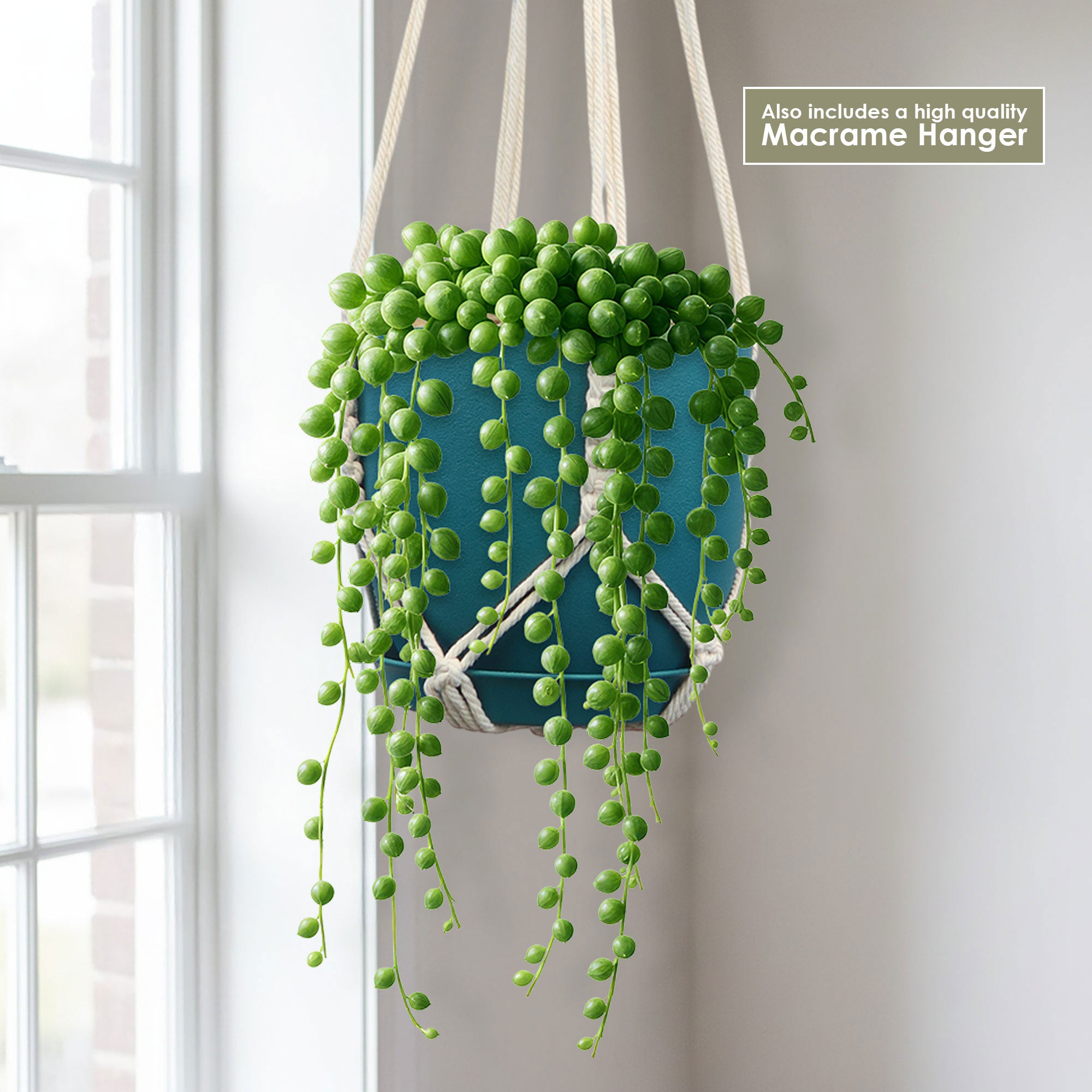
succulent string of String of Pearls 'Senecio rowleyanus' 2 Gal. / Black / Without Pot

Sale price$22.60 Regular price$25.11
Save 10%

Pay in installments of $6.28 with ShopPay, AfterPay and Klarna

Shipping Estimate
USA
  • USA
  • CAN

Ships within 48 hours · Estimated delivery Jul 30 - Aug 4

Promo Codes Available:

For Your Every Summer RSVP, with Code: SUMMER15

Description

succulent string of String of Pearls 'Senecio rowleyanus' 2 Gal. / Black / Without PotThe String of Pearls, also known as Senecio rowleyanus, is a unique trailing succulent from the daisy family, admired for its distinctive cascading growth habit. This plant is also commonly called string of beads, string of peas, and rosary vine. The String of Pearls gets its name from its distinctive, long, trailing stems that are adorned with small, spherical leaves that resemble pearls. Each of these bead like leaves features a unique translucent

The String of Pearls, also known as Senecio rowleyanus, is a unique trailing succulent from the daisy family, admired for its distinctive cascading growth habit. This plant is also commonly called string of beads, string of peas, and rosary vine. 

The String of Pearls gets its name from its distinctive, long, trailing stems that are adorned with small, spherical leaves that resemble pearls. Each of these bead-like leaves features a unique translucent “window”, a thin, clear strip that allows light to pass into the leaf for photosynthesis. These little green pearls hang delicately from the stems, creating a beautiful cascading effect. In its natural habitat, the stems trail along the ground, rooting where they come into contact, and form dense mats.

Native to South Africa, this charming string of pearls houseplant features trailing stems with pea-like or tiny melon-shaped leaves spilling over planters and hanging baskets, much like its closely related plant string of rubiesGo to othonna capensis ruby necklace.

Your String of Pearls typically grows up to 2 feet long rather than tall, as it is a naturally trailing and hanging plant. 

The moderately fast-growing nature of this string of pearls plant makes it a great choice for a variety of landscapes.

The flowers of the string of pearls bloom during the spring and summer months, with white flowers along the stalk and bright yellow anthers. However, it's important to note that String of Pearls plants are primarily grown for their unique bead-like foliage rather than their flowers. Nonetheless, if your string of pearl plants does flower, it's definitely a treat to behold!

This string of pearls also comes in another lovely variety, a variegated string of pearlsGo to senecio rowleyanus string of pearls variegated, with its white-creamy foliage.

When and How to Water Your String of Pearls Plant

String of Pearls is a drought-tolerant succulent that thrives with minimal watering. To keep your plant healthy, allow the soil to dry out between waterings, and only water when the top inch of soil feels dry. The spring of pearls plant prefers watering every 10-14 days in the growing season, and every 3-4 weeks in the dormant season.

During the spring and summer growing season, water every 10–14 days on average. As the plant actively grows, it may require slightly more frequent watering, especially in warm or bright environments. 

In fall and winter, reduce watering to about once every 3–4 weeks. Since the plant enters a semi-dormant phase, it uses less moisture and is more vulnerable to overwatering. 

Too much water can quickly kill a String of Pearls plant, so it’s always safer to underwater than to overwater. Using terracotta or clay pots helps absorb excess moisture and keeps roots healthier by preventing soggy soil conditions.

Related Article

Light Requirements - Where to Place Your String of Pearls 

When grown indoors, place it near a window that receives bright indirect sunlight for at least 4-6 hours a day. South-facing or west-facing windows are usually the best choices. You can also use artificial grow lights to provide the necessary light if natural sunlight is limited.

When growing outdoors, your low-maintenance string of pearls prefers full sun to partial shade to thrive. Four hours of direct morning or evening sun can also be beneficial for your Senecio rowleyanus, but be careful not to expose it to intense, direct sunlight for extended periods, as it can scorch the leaves of your String of Pearls succulent.

Keep an eye on your string of pearl succulents for any signs of light stress. If the leaves start to turn yellow or brown, it could be a sign that the light is too intense. On the other hand, if the leaves become elongated and spaced out, it might indicate that your pearl succulent is not receiving enough light. 

Optimal Soil & Fertilizer Needs 

Use a well-drained soil for your Senecio rowleyanus, and NPK fertilizer (5-10-5) once a year in spring for healthy growth. Planet Desert has got your back with our specialized succulent potting mix or cactus soil mix that includes 5 natural substrates with organic mycorrhizae, perfect for promoting shallow root systems and happy String of Pearls succulents.

Apply the NPK fertilizer once a year in the spring of about 5-10-5 ratio, to provide a gentle boost of nutrients. However, during the cooler months or when your Senecio rowleyanus is in a dormant phase, it's best to avoid fertilizing altogether. 

If you notice any signs of fertilizer burn, such as leaf discoloration or wilting, flush the soil with water to remove any excess nutrients. 

Hardiness Zone & More 

In the United States, this is mostly an indoor plant, but if you live in southern Florida or Hawaii, then you can cultivate it outdoors in USDA zones 9-12. 

When it comes to humidity, the String of Pearls is adapted to low-humidity environments.

It can tolerate average indoor humidity levels, but it's important to avoid excessive moisture around the plant.

Ensure good air circulation and avoid placing your String of Pearls in areas prone to high humidity, such as bathrooms or kitchens.

Indoor Growing String of Pearls Plant Requirements

If you are growing your String of Pearls indoors, ideally, keep your plant in a warm environment. In general, it prefers average room temperatures between 60°F and 85°F, which helps it stay healthy and active. Its trailing growth habit makes it an excellent houseplant for hanging baskets, shelves, and high planters, where its cascading stems can be fully displayed and appreciated.

Wildlife - String of Pearls Flowers Attracts the Following Friendly Pollinators

When in bloom, String of Pearls produces small, delicate white flowers that can attract friendly pollinators such as bees, butterflies, hummingbirds, and other beneficial insects in outdoor or greenhouse settings. These subtle blooms add ecological value while enhancing the plant’s ornamental charm.

Butterflies
Bees
Hummingbirds
Lady Bugs
Multi Pollinators
Other Birds

According to the ASPCA, String of Pearls is mildly toxic to cats, dogs, and horses if ingested in large amounts. So, if you have furry friends at home, it's best to keep your string of pearls out of their reach or opt for pet-friendly alternatives. 

How to Propagate Your String of Pearls Plant

For propagating a string of pearls Senecio rowleyanus, simply snip off a healthy stem or string of pearls plant seed (from leaf tips) and place it in well-draining soil. After a few weeks, you should start to see roots forming, indicating successful propagation by stem cuttings.

Key highlights

  1. String of Pearls is one of the best trailing houseplants, featuring long cascading strands that look beautiful in hanging baskets and shelves.
  2. This plant is highly drought-tolerant, storing water in its round leaves and requiring minimal watering.
  3. String of Pearls remains compact and space-efficient, making it ideal for small homes, desks, and modern interiors.
  4. The plant can produce delicate, fragrant white flowers under the right growing conditions, adding subtle ornamental value.

Final Thoughts

Overall, the String of Pearls plant is a unique and eye-catching succulent that is loved for its trailing stems adorned with small, bead-like leaves resembling pearls. It's a popular choice for indoor gardens and hanging baskets, adding a touch of whimsy and elegance to any space. With its distinct appearance and low-maintenance nature, the String of Pearls hanging plant is a delightful addition to any plant lover's collection!

Don't miss out on this opportunity to add something truly exceptional to your garden or in hanging baskets. Order your very own Senecio Rowleyanus string of pearls today! 

Shipping Notes
  • Free Standard Shipping on $100+ Orders to the USA.
  • Except Preorder products are shipped in 48 hours.
  • Delivery to the USA:
  1. Standard Shipping : 3-10 business days
  • If time is of the essence, please consider selecting expedited delivery for faster service.
Exchange/Return Notes
  • We offer a 30-day return/exchange service after receiving.
  • Final sale items are not eligible for returns or exchanges.
  • To process your return/exchange, please contact us at [email protected]
  • Please click here for more details>>> Return & Exchange Policy
SKU: 41897370872

Discover Niche Categories That Outsell succulent string of

Top-Converting Item to Boost Your Average Order

4.8 ★★★★★
Based on 26 reviews
Sort
Highest Rating
Newest First
Oldest First
Product Reviews
L
Verified Purchase
Luigina B Yerino
New York, US
★★★★★ 5
Native American telling of the Nativity
Format: Hardcover
Intriguing. Told through Native American thought. I've shared it with others who in turn have purchased it for their grandchildren. Led me to purchase the New Testament translated by the same person.
WAS THIS REVIEW HELPFUL?YesReportShare
Reviewed in the United States on April 16, 2025
R
Verified Purchase
Ryan Remington
Fort Morgan, US
★★★★★ 5
Wow.
Format: Hardcover
Not only did Terry Wildman knock the retelling out of the park, the artists created a visually stunning representation of the story. I am in awe and can’t wait to find worthy applications of this book.
WAS THIS REVIEW HELPFUL?YesReportShare
Reviewed in the United States on September 28, 2024
J
Verified Purchase
Jon and Carissa Yoder
Draper, US
★★★★★ 5
Beautiful
Format: Hardcover
The familiar story of Jesus through the lens of a First Nations storyteller. It is beautiful and brought me to tears. I can’t wait to read it to my kids.
WAS THIS REVIEW HELPFUL?YesReportShare
Reviewed in the United States on November 30, 2024
S
Steph A
Waukegan, US
★★★★★ 5
Insightful Iteration of the Christmas Story, Minus the European Lens
Format: Hardcover, Format: Hardcover
Premise Birth of the Chosen One is a picture book adaptation of the birth of Jesus, with text taken from the First Nations Version: An Indigenous Translation of the New Testament. This translation was overseen by Terry M. Wildman, in collaboration with an intertribal committee of First Nations Americans. I recommend checking out the website to learn more about this beautiful project, and checking out the clip of the First Nations version of The Lord’s Prayer. A quick disclaimer: Although I am multitribal Indigenous American, I am not well-acquainted with the culture. As I struggled a bit to write this review, I shared the story with my mom, who is much more familiar with our culture. To my observation, my mom found the book to be beautiful and moving. Storytelling The story of Jesus’ birth, attested to in Scripture, is often filtered through a European lens. So often, nativity portrayals depict lightly complected versions of Mary and Joseph– an incongruous incarnation of their middle-Eastern heritage. Renaissance artwork was, I believe, instrumental in forming these pictures within the western imagination. Birth of the Chosen One tells the story of Jesus’ birth through the lens of Indigenous American storytelling. I’m so grateful for this portrayal, which offers representation to young Indigenous readers, while also affording those of other backgrounds insight into a different culture. Translation of Proper Nouns One of the most striking elements that distinguishes this translation of the Christmas story from more common English translations is the translations of the names. While reading the story to myself, I was a bit perplexed by some of the names (Mary, for example, is known as Bitter Tears). In sharing the story with my mom, however, she pointed me to the Hebrew origins of the familiar names we read in the Christmas story. I learned from my mom that one meaning of Mary is, indeed, “bitter,” and we also learned from the story that Bethlehem means “House of Bread.” As my mom pointed out, this is a very powerful truth, since Jesus describes Himself as the “Bread of Life.” Throughout the story, these translated names bring new meaning to the birth of Jesus. It was eye-opening to see how much of the story is missed, with Anglicized names that don’t mean as much to the average reader as they would have meant to the Ancient Hebrew/Jew. Helpfully, the Author’s Note at the end of the story offers a list of corresponding Anglicized / translated names and locations. Narrative Rendering Just as the translated nouns bring fresh meaning to the familiar account of Christmas, the narrative also draws out the truth of Jesus’ coming in a way that is both powerful and meaning-ful. Jesus Himself spoke in stories, and I am personally a huge fan of allegory. For me, the different style presented the sweet simplicity of the truth of the Gospel, with refreshing novelty. The words of Jesus’ birth, so familiar to me, take on new meaning with different stylistic presentation. My favorite passage in the story comes from the mouth of Creator’s Chosen One (the angel Gabriel). He tells Bitter Tears, “He will set people free from their bad hearts and broken ways.” I consider the phrase “bad hearts and broken ways” to be a more meaning-ful iteration of the concept of sin. And, the Gospel itself is referred to as “the good story,” which I considered to be a beautiful (and once again, more powerful) descriptor. Illustrations Hannah and Holly Buchanan render the story of Jesus’ birth in lively colors, with images that bring First Nations culture to life. The twin sisters are completing PhDs in art history, and the Indigenous characters are depicted in traditional attire. While I don’t have the vocabulary to describe all of the details, I do really like seeing the Nativity presented in this way– with characters portrayed in a more relatable way. Readers who are not First Nations have the opportunity to visit Bethlehem, the House of Bread, in a new way, rather than in the style and coloration of European art. The following elements stood out to me: Use of sweet, colorful wildflowers– both in the meadow landscape and as a decorative vine/garland Jesus’ star is portrayed as hugely illuminating and BRILLIANT, with the size and radiance of a sun The characters’ faces are expressive. Bitter Tears often appears solemn or thoughtful. The Seekers of Wisdom blend thoughtfulness and hope. Chief Looks Brave (Herod) appears as a stony-faced background silhouette. (I found this stylistic choice to be especially effective). Content / Discussion Note On the page about the heavenly chorus, the text describes “a great number of spirit warriors.” The illustration includes the single “spirit-warrior,” portrayed as a man with eagle feathers and an eagle headress– alongside other eagles. My hesitation here is that the spirit-warriors / angels are being depicted as eagles. The book of Ezekiel, however, does describe certain supernatural beings with aquiline characteristics. Recommendation Status Birth of the Chosen One is an important Christmas story because it removes the Western lens through which many of us have been taught to read the nativity. The direct translations from the original Hebrew language are eye-opening and offer much-needed context. I would consider myself well-acquainted with the Christmas story, and I learned from this book. I’m also so happy for the representation offered in Birth of the Chosen One. Recommended for readers of all ages, regardless of cultural background. Disclosure: I received a complimentary copy of the book from the publisher. Opinions expressed are my own.
WAS THIS REVIEW HELPFUL?YesReportShare
Reviewed in the United States on November 30, 2024
M
Mouttet Menagerie
Waukegan, US
★★★★★ 5
Native retelling of Christmas story
Format: Hardcover
Birth of the Chosen One is a beautiful retelling of the Christmas story. I will say that I struggled with the reading of it from the aspect of years (and years) of hearing and reading the original version. I can see where Birth of the Chosen One could be a good introduction to Christianity for First Nation Peoples or Native Americans. I appreciated that Terry Wildman has both Ojibwe and Yaqui heritage. I also appreciated that the illustrators are members of the Miami tribe. Experience as a tribal member gives these three the authority to present a Native American version of the story. The book closes with a note from Terry Wildman that will help readers keep track of the Native American names in the story. I received a complimentary copy of Birth of the Chosen One. This is my honest review.
WAS THIS REVIEW HELPFUL?YesReportShare
Reviewed in the United States on October 28, 2024

recommand products