Pay in installments of $6.85 with
 ,
,
 and
and

Shipping Estimate
USA
- USA
- CAN
- USA
- CAN
Ships within 48 hours · Estimated delivery Oct 12 - Oct 17
 Promo Codes Available:
For Your Every Summer RSVP, with Code: SUMMER15
Description
dividing pineapple sage plant Organic Salvia elegans 'Pineapple Sage' PlantUsually available: All year Life cycle: Perennial Height: 1. 2 1. 5m Position: Full sun Soil preference: Well drained This is how we pack and send your Herb Plants to all states except TAS & WA You will receive 1 Pineapple Sage Herb Plant in a 50 X 75mm tube General growing instructions All of our Herb Plants are grown organically with certified organic potting mixes and fertilizers Botanical Name: Salvia elegans Pineapple sage is an herbaceous
Usually available: All year
Life cycle: Perennial
Height: 1.2 - 1.5m
Position: Full sun
Soil preference: Well drained
This is how we pack and send your Herb Plants to all states except TAS & WA
You will receive
- 1 Pineapple Sage Herb Plant in a 50 X 75mm tube - General growing instructions
All of our Herb Plants are grown organically with certified organic potting mixes and fertilizers
Botanical Name: Salvia elegans
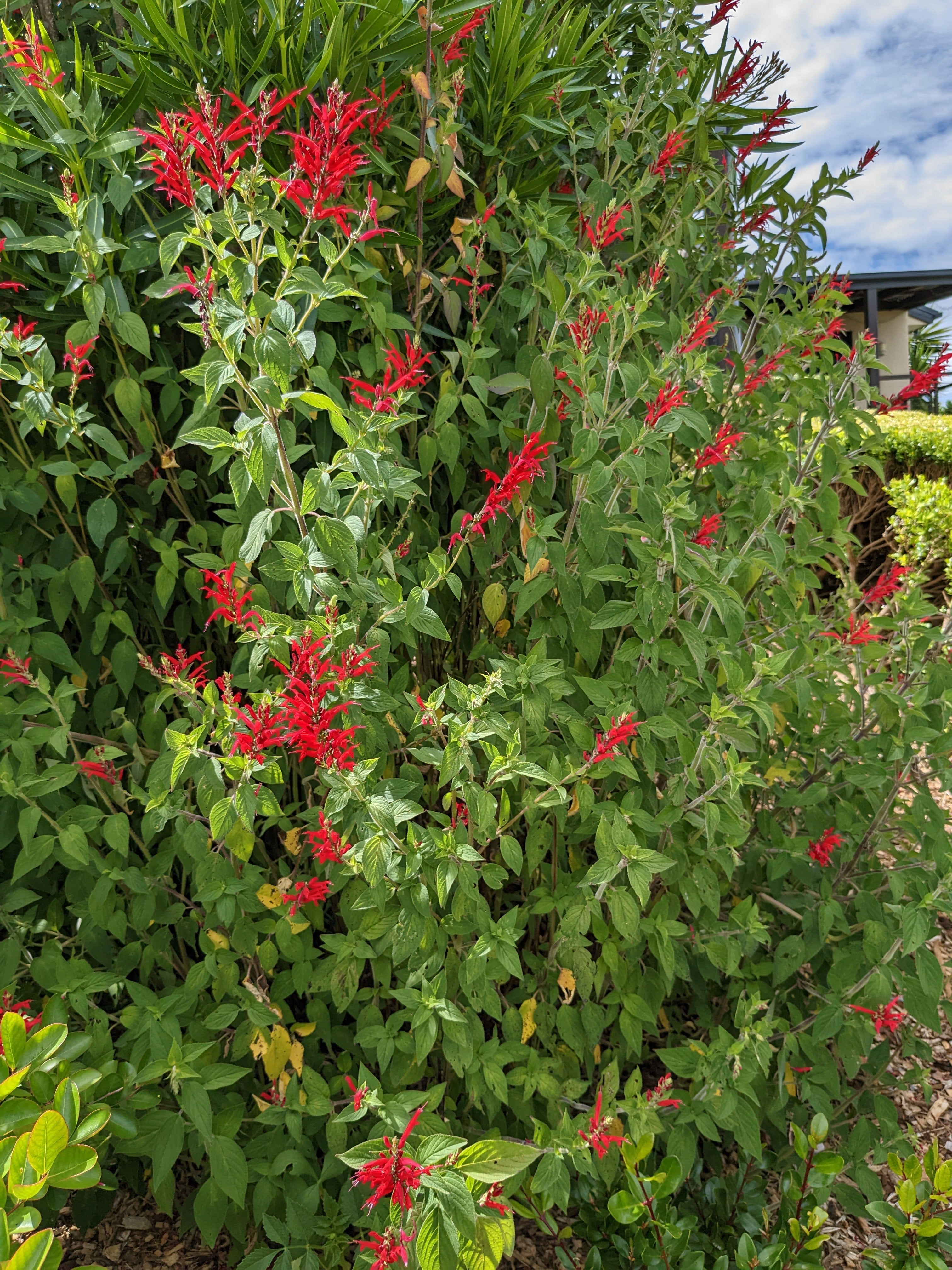
Pineapple sage is an herbaceous perennial with scarlet red flowers, growing 1.2 to 1.5 meters. The ovate leaves are a grey-green colour, with some people describing them as having a yellow tinge. They are quite large at 5-10 cm and end in a point. The oppositely positioned leaves are covered in small hairs and distinctly veined. The leaves remain scented all year and crushing them releases the best scent.
The flowers are a distinct scarlet red colour and they grow in whorls of 6-12 flowers on inflorescences. The have a tubular appearance and are about 2.5 cm long, with two distinct lips. The lower positioned flowers open first and then the others gradually follow, over a long autumn blooming period. Pineapple sage is a short-day plant, which means it requires a longer period of darkness and flowers as the days grow shorter.
Pineapple sage develops a dense, rounded form and produces numerous leafy, erect stems and lateral branches that hold the striking red, flower spikes. As the season progresses the stem becomes woody and the roots extend deeper underground forming a large clump.
This sage is native to Mexico and Guatemala and is found growing naturally in the temperate, pine oak forests at 1800-2700 meters above sea level. It is a great butterfly and bird attractant, with studies indicating it is one of the local hummingbirds’ three most commonly visited plants.
Like all sages, pineapple sage is visually appealing and may be grown as a nice addition to the garden. However, it does also have some culinary applications and was used for traditional medicine by Mexicans. Salvias have a long history of being used for many medical conditions. The genus name ‘Salvia’ is derived from ‘salvere’, which is Latin for ‘to save’.
This sage may also be called Tangerine Sage in some areas and has been cultivated since 1870. There is also a variety of pineapple sage with purple tinged leaves. Another sage, called Honey Melon also has pineapple scented leaves, but it flowers in summer, instead of autumn.
The salvia family has over 900 members with an extensive history as culinary, medicinal and ornamental plants. Ornamental salvias have become collectors’ items, as gardeners try to find a place in their garden for each and every one. There are salvias that will suit every type of soil and climate. More information on the Salvia genus and Common Sage (Salvia officinalis) may be found on our Common Sage page.
Growing Conditions
Pineapple sage requires a well-drained soil, with a good nutrient base. If your soil is sandy, it may be suitable to add some organic matter. Pineapple sage does need regular watering and may wilt on hot days if this is lacking. Unlike some other herbs, it should recover once watered. As one of the taller herbs, pineapple sage can have a tendency for straggly branches and may benefit from staking and wind protection.
As a short day plant, it does well with at least six hours of light each day and flowers in autumn and the days grow shorter. However, in some areas the autumn days may be quite cool and the days may grow too cold to allow a long period of flowering. In areas with no frost, pineapple sage may flower for a longer period, particularly if it is well watered.
Pineapple sage is a plant that does well in temperate regions and it may be more compact in cooler areas. The plant may be treated as an annual in colder areas. It does tolerate frost to some extent, but may die down and return the following year. If your plant does this you may choose to simply cut it back to ground level when the season begins to change. Alternatively, you can bring the plant indoors or offer other protection over the cooler months so you can see what degree of cold temperatures is tolerated.
Propagation may be by cuttings which take root easily and will be ready for planting out in the warmer spring weather. Allow up to a meter or more between plants and fill the gaps with annuals until the plant grows bigger. The main plants can also be divided at a later date.
This aromatic sage does well as a garden backdrop and is well suited to container gardening, as long as a large container is chosen. Pineapple sage requires a lot of garden space and while waiting for it to grow, planting annual herbs or under-storey growth is a good way to fill empty ground. The soft grey-green foliage is ideally suited to contrasts with the deep purples of annuals like Dark Opal Basil. It also looks very nice with a planting of Creeping Thyme, which can remain in place as the pineapple sage grows taller.
Culinary Uses
Pineapple sage has a different flavour to common garden sage and it is not considered to be a culinary substitute for normal sage. It is best used fresh to preserve the flavour. Cooking at high temperatures will damage the leaves and the flavour will be lost. Despite this some people recommend using the chopped leaves in herb breads to impart a subtle flavour.
The leaves and flowers are both edible and may be used as part of salads or as garnishes. They are a nice addition to fruit salads as the crushed leaves will impart a pineapple aroma. They can also be used in cold soups, to garnish cool drinks and iced or herbal teas. An interesting idea is to mix chopped leaves with cream cheese for a tasty spread.
Medicinal Uses
Pineapple sage was used extensively in early traditional medicine by the Mexicans who found it growing in their environment. They found value in using it for anxiety and to treat high blood pressure. They also felt it had applications in assisting with depression.
For additional information on traditional health applications for sage and salvias please see Common Sage.
All information provided on this website is for informational purposes only. Please seek professional advice before commencing any treatment.
Shipping Notes
- Free Standard Shipping on $100+ Orders to the USA.
- Except Preorder products are shipped in 48 hours.
- Delivery to the USA:
- Standard Shipping : 3-10 business days
- If time is of the essence, please consider selecting expedited delivery for faster service.
Exchange/Return Notes
- We offer a 30-day return/exchange service after receiving.
- Final sale items are not eligible for returns or exchanges.
- To process your return/exchange, please contact us at [email protected]
- Please click here for more details>>> Return & Exchange Policy