SKU: 43823519218
silver house plant

silver house plant Shop 'Silver Squill - Ledebouria Socialis Miner' Care and Info

Sale price$19.90 Regular price$22.11
Save 10%

Pay in installments of $5.53 with ShopPay, AfterPay and Klarna

Shipping Estimate
USA
  • USA
  • CAN

Ships within 48 hours · Estimated delivery Sep 12 - Sep 17

Promo Codes Available:

For Your Every Summer RSVP, with Code: SUMMER15

Description

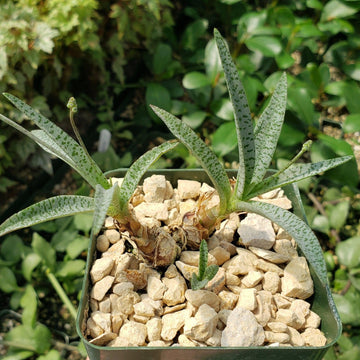
silver house plant Shop 'Silver Squill - Ledebouria Socialis Miner' Care and InfoIntroducing the silver squill plant, known as Ledebouria socialis Miner. It is also known as the Violet Squill, Leopard Lily, & Wood Hyacinth. It gets its common name, silver squill, because of its unique silver grey foliage. This dwarf plant has a fast growth rate and reaches a height of up to 8 inches, with the most widely cultivated bulbs multiplying fast. The Silver Squill, a bulbous perennial plant in the Asparagaceae family, shares fleshy leaves

Introducing the silver squill plant, known as Ledebouria socialis Miner.  It is also known as the Violet Squill, Leopard Lily, & Wood Hyacinth. It gets its common name, silver squill, because of its unique silver-grey foliage.

This dwarf plant has a fast growth rate and reaches a height of up to 8 inches, with the most widely cultivated bulbs multiplying fast. The Silver Squill, a bulbous perennial plant in the Asparagaceae family, shares fleshy leaves with succulents but is not classified as a succulent. Native to Eastern South Africa, the silver squill plants are winter dormant.


At maturity, teardrop-shaped bulbs form above the ground. Its fleshy, lance-shaped leaves store energy in its bulb. The 'Miner' variety of Ledebouria socialis stands out with its distinctive leaves.

The leaves are elongated and have a beautiful silver-green coloration with dark green leopard spots or markings. These markings resemble the spots found on a leopard's coat; hence, this silver squill plant is also known as "Leopard Lily."

The contrast between the silver background and the dark spots creates an eye-catching and visually appealing display.

The flowers of the variegated silver squill miner bloom very rarely, but in its natural habitat, the silver squill in early spring grows small green flowers or white-pale pink on pink stems that emerge from the rosette-shaped foliage. The plant's elegant appearance is enhanced by its delicate stems or foliage, not its flowers.

Additionally, this silver squill has the ability to produce offsets, or "pups." Ledebouria socialis propagation is best done through its teardrop-shaped bulbs, which are formed by dividing tubers and rhizomes. As they mature, they can be separated and propagated to create new plants. This makes it a great option for those interested in expanding their succulent collection or sharing plants with friends. 

Watering Needs 

Silver squill has minimal watering needs. It's important to strike a balance and avoid overwatering or underwatering this perennial plant. When watering your silver squill plant, allow the top inch of soil to dry out before watering again. This will help prevent the risk of root rot. It's best to water it thoroughly and then let the excess water drain out completely. 

The watering needs of the silver squill ledebouria socialis include regular watering, typically during its active growth period during spring and summer, but the soil should never be wet for long. During the winter rest period, cut down on watering. Observing the plant's leaves can also give you an indication of its watering needs. 

If the leaves start to appear wrinkled or droopy, it may be a sign that your Ledebouria socialis needs water. On the other hand, if the leaves become mushy or discolored, it could be a sign of overwatering.

Light Requirements 

When growing indoors, place your silver squill plant in a location where it can receive bright light throughout the day. A north- or east-facing window is usually ideal for filtered or indirect light. If you don't have access to natural light, you can use artificial grow lights to provide the necessary light requirements for your Ledebouria socialis.

For outdoor cultivation, this silver squill prefers bright, indirect light for at least 4-6 hours daily. The silver squill light requirement includes filtered sunlight. It thrives in minimal direct sunlight, but too much of it should be avoided as it can scorch the leaves.

Keep an eye on the leaves of your silver squill. If they start to turn yellow or pale, it may be a sign that your succulent is not receiving enough light. If, on the other hand, the leaves become bleached or develop brown spots, this could indicate that they have been exposed to too much direct sunlight.

Remember to rotate your Ledebouria socialis occasionally to ensure even light exposure to all sides. This will help prevent the succulent plant from leaning or growing unevenly toward the light source. 

Optimal Soil & Fertilizer Needs 

For silver squill plants, it's best to use well-draining sandy soil that allows excess water to flow out easily. The silver squill soil should be humus rich. It should be sandy for good drainage. Fine to medium-grained is a good option. Ideally, you want to use our specialized succulent potting mix that contains 5 natural substrates and organic mycorrhizae to promote the development of a strong root system that helps your succulent thrive. 

As for fertilizer, Silver Squill doesn't require heavy feeding. You can use a balanced fertilizer with NPK (5-10-5) during the growing season, which is typically in the spring. During the dormant period in fall and winter, you can reduce or stop fertilizing altogether. Avoid over-fertilizing, as it can lead to nutrient burn and damage the plant's roots. 

Hardiness Zone & More 

When grown indoors, the silver squill thrives in temperatures between 60-75°F. It can handle slightly cooler temperatures, but it's best to avoid exposing it to frost or extreme heat. 

For outdoor cultivation, it is suitable in USDA zones 9–11. It's important to avoid exposing it to temperatures below 50°F, as it can cause damage to the foliage and overall health of Ledebouria socialis

In terms of humidity, Silver Squill prefers moderate humidity levels, around 40–60%. You can achieve this by misting the leaves occasionally or by placing a tray of water near the silver squill plant to increase humidity. However, it can still tolerate lower humidity levels, so it should do well if you are growing silver squill indoors. 

Final Thoughts

Overall, the silver squill plant (Ledebouria socialis 'Miner') is versatile and features a silver-green coloration that can thrive both indoors and outdoors. It prefers temperatures between 60-75°F indoors and is adaptable to average humidity levels. When grown outdoors, it is typically hardy in USDA zones 9–11 but may require protection from frost in colder climates. When it comes to care, the silver squill plant is relatively low-maintenance, requiring infrequent watering and well-draining soil. With the right care and conditions, this plant can add a touch of unique beauty to any space. 

Shipping Notes
  • Free Standard Shipping on $100+ Orders to the USA.
  • Except Preorder products are shipped in 48 hours.
  • Delivery to the USA:
  1. Standard Shipping : 3-10 business days
  • If time is of the essence, please consider selecting expedited delivery for faster service.
Exchange/Return Notes
  • We offer a 30-day return/exchange service after receiving.
  • Final sale items are not eligible for returns or exchanges.
  • To process your return/exchange, please contact us at [email protected]
  • Please click here for more details>>> Return & Exchange Policy
SKU: 43823519218

Discover Niche Categories That Outsell silver house plant

Top-Converting Item to Boost Your Average Order

4.3 ★★★★★
Based on 25 reviews
Sort
Highest Rating
Newest First
Oldest First
Product Reviews
J
Verified Purchase
Jcjxjdicjz
Boise, US
★★★★★ 5
This is my Superman
Format: Paperback
Before super villains came along, Superman fought corrupt businessmen and world leaders. In this volume, you get stories like Superman trapping a wealthy mine owner in his own mine so he can feel what it’s like for his exploited workers (as I type that, I thought of a great parallel that might get this review removed haha), forced warring leaders to settle their differences in person, and destroyed a ghetto to get the government to pay to give the poor people modern housing (today our government would just leave them homeless but I digress) At some point in this volume, you get the first supervillain and it gradually goes away from this great Superman at that point but this Superman is my Superman, rough scripting/art and all
WAS THIS REVIEW HELPFUL?YesReportShare
Reviewed in the United States on April 8, 2021
A
Verified Purchase
Amazon Customer
Boise, US
★★★★★ 5
Superman: The Golden Age: Volume 1 Review
Format: Paperback
If you’re a fan of, or are interested in the Golden Age of comics, this book is for you. This is really the mainstream beginning of superhero comics. Before everything became mired in continuity, there were one-shot stories that were fun, and often dark. I definitely also recommend this for people who want to get into Superman as a character. For the price, the amount of content you get just can’t be beat.
WAS THIS REVIEW HELPFUL?YesReportShare
Reviewed in the United States on January 31, 2020
C
Verified Purchase
C. T. Dixon
Fort Morgan, US
★★★★★ 5
This is a Superman I can believe in
Format: Paperback
This is the original Superman, the one who made the character a hit. His powers have limits - a fire threatens his life! - and he uses them for the little guy, against social injustice. One of the best stories, from Action #5, has Supes fighting a breaking dam and flood, but mostly he's fighting human crookedness - crooked lobbyists, crooked football coaches, crooked mine owners, crooked taxi rackets. This Superman is a law unto himself, dependent on nothing but his strength and his personal sense of right. He's a lot more like Samson in that way than he's a Christ figure, and the result is stories in which he lightheartedly smashes slums so the government will have to build decent housing for the poor, smashes cars of reckless drivers, smashes an oil well to bankrupt the crooked promoters. Private property means nothing to him. Neither do legal rights. He's not here to fight for law and order, he's here to fight for justice as he sees it. The police? the government? They're feckless at best, and more often they're part of the problem. There's a strong Progressive sensibility here: if institutions don't benefit the people, the people need to take charge and change things. That's the Superman we see here, and it's the Superman I like best - the original Superman with brute vigor, a passion for justice with no subtlety, and no taking himself too seriously. It's not art, but it's what made comic books. And it still stands up.
WAS THIS REVIEW HELPFUL?YesReportShare
Reviewed in the United States on February 16, 2014
K
Verified Purchase
Kid Kyoto
San Leandro, US
★★★★★ 5
Where it all began
Format: Paperback
Superman was a hit almost from day one, selling not only millions of comics but quickly went on to star in radio shows, movie serials, TV shows, cartoons, movies and every other media under the sun. And it all starts here. This volume reprints the very first Superman stories from 1938 - the Superman chapters from Action Comics 1-13, the New York World's Fair special and Superman #1, some of the rarest and most valuable comic books ever published. The art is crude but serviceable, but the stories are surprisingly political. Rather than fighting super villains or aliens Superman spends more of his time taking on corrupt businessmen and politicians. In one early story he ends a war in Europe by kidnapping an arms maker and forcing him to fight in the trenches. After his experience he swears never to make weapons again. This is a Superman who takes on the real issues of his time, and while the solutions are simplistic his goals are a lot more impressive than stopping bank robbers or killer robots. An early super villain, the Ultra Humanite, puts in a appearance but even his plot is centered around labor unrest rather than death rays. This is a fascinating look into the history of American comics. politics and popular culture. I recommend it to anyone with an interest in those subjects.
WAS THIS REVIEW HELPFUL?YesReportShare
Reviewed in the United States on June 26, 2011
A
Verified Purchase
Adam Graham
Houston, US
★★★★★ 4
The Menacing Man of Steel
Format: Paperback
This story tracks Superman's first fifteen stories beginning with Action Comic #1 through Action Comics #13 and also includes the New York World's Fair Comics #1 story and a few pages that Superman #1 added to its reprints of the stories in Action Comics #1-#4. These fourteen stories features Superman as defender of the weak against a variety of foes including munitions dealers who Jerry Siegel charged with starting wars to line their own pockets, heartless mine owners, gangsters, and slum lords. Superman's tactics were far rougher than they would become as Superman became a little more mild during the 1940s. Superman,like Batman struck fear in the hearts of criminals. Though Batman needed a cool name and a scary costume, all Superman needed to was to keep dropping and catching suspects until they talked. Superman's rough edge would begin to get out of line. In Action Comics #8, he decided to solve the problem of slums by tearing them down forcing the government to rebuild as they had during recent hurricanes. The police responded by putting a warrant out for him for understandable reasons. From here, Siegel made Superman even more forceful culminating in Action Comics #11 which sees the Man of Steel declare war on "Reckless Drivers." Declaring war involves forcibly seizing control of a radio station to broadcast a warning and then destroying all the automobiles in the police impound lot, among other very destructive acts. The stories serve as an almost cautionary tale of the danger of someone with unstoppable and no humility. It reflects the brashness of a 23-24 year old writer. Thankfully Superman would grow in the 1940s into a character that inspired by hope than by fear. However, despite the more menacing Superman in this book, there are some fun stories in here. My Absolute favorite is Action Comics #6 which features an agent pretending to represent Superman and selling merchandising rights for the Man of Steel, which turned out to be prophetic of the merchandising machine Superman would become. Action Comics #7 features another story of Superman helping out somebody whose just in trouble and needs help. Action Comics #13 introduces the Ultra-Humanite, the first real supervillain, though we only get to meet him briefly. Overall, this is great for adult Superman collectors who want to read all of his stories. For kids, I'd probably recommend Superman in the Forties for a more balanced look at the Man of Steel.
WAS THIS REVIEW HELPFUL?YesReportShare
Reviewed in the United States on October 26, 2013

recommand products