SKU: 44399308088
jade plant care indoor

jade plant care indoor Jade Plant | Easy Care Succulent

Sale price$21.29 Regular price$23.66
Save 10%

Pay in installments of $5.92 with ShopPay, AfterPay and Klarna

Shipping Estimate
USA
  • USA
  • CAN

Ships within 48 hours · Estimated delivery Aug 5 - Aug 10

Promo Codes Available:

For Your Every Summer RSVP, with Code: SUMMER15

Description

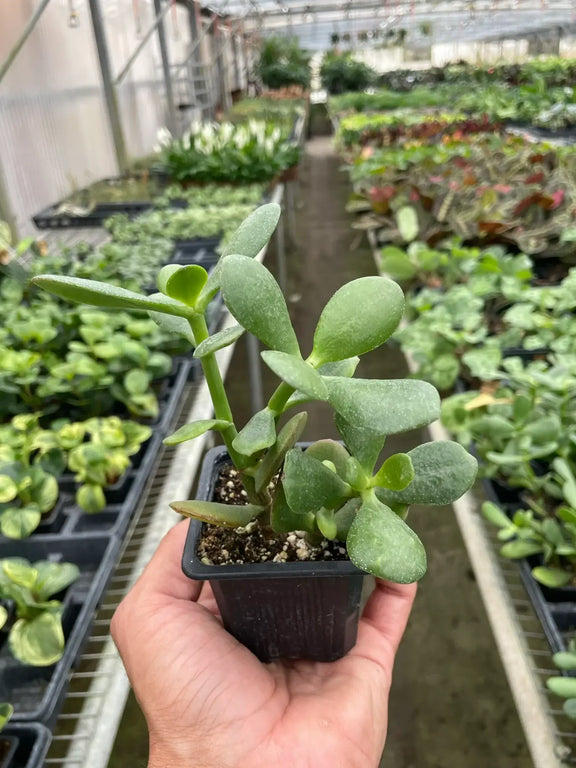
jade plant care indoor Jade Plant | Easy Care SucculentThe Jade Plant, scientifically known as Crassula ovata, is a beloved succulent admired for its thick, oval shaped green leaves and woody stems that resemble a miniature tree. Its compact growth habit and long lifespan make it a popular choice for homes and offices, often associated with good luck and prosperity. Native to South Africa, this low maintenance plant thrives in a variety of indoor conditions and can adapt to outdoor settings in warmer

The Jade Plant, scientifically known as Crassula ovata, is a beloved succulent admired for its thick, oval-shaped green leaves and woody stems that resemble a miniature tree. Its compact growth habit and long lifespan make it a popular choice for homes and offices, often associated with good luck and prosperity.

Native to South Africa, this low-maintenance plant thrives in a variety of indoor conditions and can adapt to outdoor settings in warmer climates. Whether displayed on a sunny windowsill or as part of a succulent collection, the Jade Plant adds a touch of natural elegance and charm.

  • Common Names: Jade Plant, Money Plant, Lucky Plant
  • Botanical Name: Crassula ovata
  • Size: Grows up to 2-3 feet tall indoors with proper care; larger outdoors.

Care Instructions

  • Light: Prefers bright, indirect light but tolerates direct sunlight. A few hours of morning or evening sun helps maintain its vibrant green foliage.
  • Water: Allow the soil to dry out completely between waterings. Water sparingly, as the plant stores moisture in its thick leaves. Overwatering can lead to root rot.
  • Humidity: Thrives in dry indoor conditions and does not require additional humidity. Avoid misting.
  • Feeding: Fertilize once every 2-3 months during the growing season (spring and summer) with a cactus or succulent fertilizer. No feeding is needed during fall and winter.
  • Temperature: Maintain temperatures between 60°F and 75°F. Protect from frost and prolonged exposure to temperatures below 50°F.
  • Soil: Use a well-draining cactus or succulent potting mix.

Frequently Asked Questions

  1. Why are the leaves of my Jade Plant wrinkling?
    Wrinkled leaves often indicate underwatering. Water thoroughly, then allow the soil to dry out completely before watering again.

  2. Can the Jade Plant grow outdoors?
    Yes! In warmer climates (zones 10-12), it thrives outdoors in sunny, well-draining areas. In cooler climates, it can be placed outdoors during summer and brought indoors for winter.

  3. How do I propagate my Jade Plant?
    Propagation is easy through stem or leaf cuttings. Allow cuttings to dry for a day or two, then place them in well-draining soil.

Why Choose the Jade Plant?

The Jade Plant is a timeless and low-maintenance succulent that fits perfectly into any indoor or outdoor space. Its compact size, ease of care, and association with good fortune make it a favorite among plant lovers and gift-givers alike. Whether used as a decorative accent or part of a succulent arrangement, this plant adds natural beauty and charm.

Shipping Notes
  • Free Standard Shipping on $100+ Orders to the USA.
  • Except Preorder products are shipped in 48 hours.
  • Delivery to the USA:
  1. Standard Shipping : 3-10 business days
  • If time is of the essence, please consider selecting expedited delivery for faster service.
Exchange/Return Notes
  • We offer a 30-day return/exchange service after receiving.
  • Final sale items are not eligible for returns or exchanges.
  • To process your return/exchange, please contact us at [email protected]
  • Please click here for more details>>> Return & Exchange Policy
SKU: 44399308088

Discover Niche Categories That Outsell jade plant care indoor

Top-Converting Item to Boost Your Average Order

4.9 ★★★★★
Based on 29 reviews
Sort
Highest Rating
Newest First
Oldest First
Product Reviews
B
Bill Muehlenberg
Houston, US
★★★★★ 5
Another welcome Pillar commentary
Format: Hardcover
The newest volume in the excellent Pillar New Testament Commentary series is another first-rate effort. The American New Testament professor has already done a very good commentary on 1-3 John (BECNT, 2008). His newest commentary adds to a now rather impressive line-up of Pillar commentaries. As to the Pastorals, the four most important and substantial commentaries from a basically conservative, evangelical stance over the past few decades have been these: 1992: George Knight (NIGTC – 500 pages) 2000: Jerome Quinn and William Wacker (ECC – 900 pages) 2000: William Mounce (WBC – 640 pages) 2006: Philip Towner (NICNT – 900 pages) Mention should also be made of two other commentaries. One is the 1999 volume by I. Howard Marshall (with Philip Towner) in the ICC series. It is also 900 pages and looks to be outstanding. But I do not own it (the ICC series is SO expensive), so I cannot comment further on it. Another is the shorter, 300+ page work by Gordon Fee (NIBC, 1984) which can also be added to any list of highly recommended volumes on the Pastorals. Now we have Yarbrough to join these important works. He provides us with a very workable, informed and detailed examination of the Pastoral Epistles. He spends 95 of his 600 pages on introductory matters. As to authorship, it has become somewhat trendy of late to deny Pauline authorship. Even some conservatives have gone in this direction Yarbrough offers ten pages on this, and affirms the traditional stance, saying: “For eighteen centuries, Pauline authorship was never doubted by the churches’ intellectual leaders; even in the last two centuries, many have doubted the doubters.” As to the commentary proper, one tends to first head to well-known, contentious, difficult, or important passages. So let me reflect on a few of these. One of the most hotly debated passages in the Pastorals of course has to do with the matter of women in leadership. Paul covers this in several places, but the most crucial passage is 1 Timothy 2:11-15. This is certainly a difficult passage in many respects, and one that is hotly debated. The two main camps on this have been the complementarians, who argue that men and women are equal in worth and status, but have differing, hierarchical roles, and the egalitarians, who argue that women can fully serve in church leadership positions. This debate has been going on for quite some time now. Because all of 1 Tim. 2 must be considered here (dealing as it does with propriety in public worship), Yarbrough has a lengthy general discussion about these issues first. He then devotes another 20 pages to the actual contentious passage. He offers a “qualified complementarian reading” on all this. Egalitarians may not fully agree, but they should appreciate his careful and gracious exegesis here. And of course he has written on this elsewhere, as in his chapter in the important volume edited by Kostenberger and Schreiner: Women in the Church, 3rd ed. (Crossway, 1995, 2016). Another issue that can be rather difficult to understand and deal with concerns those who “have suffered shipwreck with regard to the faith. Among them are Hymenaeus and Alexander, whom I have handed over to Satan to be taught not to blaspheme” (1 Tim 1:18-20). Paul says something similar in 1 Cor. 5. Says Yarbrough, “From these two passages it may be inferred that in grave cases of ethical or doctrinal lapse, and perhaps drawing on Job 2:6, Satan was viewed as ‘God’s agent in judicial administration.’ Whereas congregations would normally have prayed for one another, there were evidently cases where petition would shift from divine protection to divine discipline (with Satan as God’s agent). Sometimes harsh measures are required to wake people up (see 2 Thess. 3:10-14).” Since discussions about overseers are found in all three epistles, both Paul and Yarbrough spend much time on the topic. In one of the passages he makes this remark: “In sum, ‘the overseer is to be’ introduces more than a random wish list for the pastorally inclined do-gooder. It points to a quality and depth of godliness that are indiscernible for the magnitude and gravity of pastoral labor that Paul models, expects of Timothy, and hopes to see replicated in generations to come at Ephesus and beyond.” Two more issues that can be contentious for some is found in 1 Tim. 5:23: “Stop drinking only water, and use a little wine because of your stomach and your frequent illnesses.” Some teetotallers try to argue that this is not actual wine, but watered down grape juice. And some of the health and wealth gospellers insist that no faith-filled believer should ever get sick. Yarbrough gives short shrift to both of these ideas. Another famous passage dealing with wealth is 1 Tim. 6:6-10 which speaks of false teachers and the love of money. Yarbrough affirms the biblical balance Paul seeks to present here: “Birth and death both illustrate the tenuous relation between life and material goods. Paul wants to relativize (not trivialize or eliminate) the importance of earthly acquisitions, since he observes people tempted to enlist God in their material quest. . . . It is important to note that this is not an adoption of an ideal of Hellenistic philosophy. Nor is it an endorsement of poverty. . . . If God does grant wealth, and if a believer has not sold his or her soul to acquire it, Paul will later give directions for its proper utilization (see on vv. 17-19 below).” Other matters could be mentioned here. But all up this is a very competent and usable commentary, one that will stand the test of time. It offers careful exegesis and helpful theological insights. It is a very welcome addition to the Pillar series. The PNTC series really has become one of the premier sets for evangelicals and those who want the best of biblical scholarship and careful exegesis.
WAS THIS REVIEW HELPFUL?YesReportShare
Reviewed in the United States on November 11, 2018
J
Jimmy R. Reagan
Birmingham, US
★★★★★ 5
Great, New Commentary!
Format: Hardcover
This commentary by Robert Yarbrough will become, I predict, a top-rated volume on the Pastoral Epistles. These epistles are ideal for the style of commentary we find in the Pillar New Testament Commentary (PNTC) series. As respected and valuable as the NICNT volumes by the same publisher are, these Pillar volumes are simply more valuable. They have a better center of focus, are more consistently conservative, and have more value for pastors without sacrificing scholarship. This volume succeeds in reaching that standard too. As you might have guessed, the editorship of D. A. Carson likely keeps this series moored to that lofty perch. BTW, don’t miss the editor’s preface where Carson fawns over Yarbrough’s work here. I was in love with this commentary within a few pages of its fine Introduction. So many commentators lose their way in the Pastoral Epistles. I have long suspected that it has far more to do with the authors dislike of what these epistles say rather than any actual problem found within them. Yarbrough is not sucked into the irrational fear of using the term “pastoral epistles” as so many are today either. It’s a breath of fresh air. He opens the Introduction with eight theses on pastoral heritage in these epistles. To my mind, that was a great way to present introductory issues. Next, he does a section each on Father, Son, and Spirit respectively in the Pastoral Epistles (PE). He was particularly perceptive in discussing Paul as a working pastor, even dispensing some silly critical theories along the way. He then tackles in turn geography, people, and key terms. He ends with a section on authorship and other usual introductory matters and masterfully reaches conservative conclusions. The commentary itself was even better! The phrase “real help” comes to mind. He showed off his skill, for example, in the perpetual battlefield of Titus 2. He gently yet surefootedly takes us where that disliked passage goes. He’s kind to dissenters, careful in scholarship, but not afraid to reach a conclusion. I don’t know about you, but that’s how I like my commentaries. 5 stars all the way!
WAS THIS REVIEW HELPFUL?YesReportShare
Reviewed in the United States on October 11, 2018
K
Verified Purchase
Kathya1010
Cuba, US
★★★★★ 4
A Thorough Commentary that Needs Less Neutrality
Format: Kindle
Dr. Yarbrough has addressed the meaning of the Pastoral Epistles with the excellence we have have come to expect from him. However, sometimes he seems reluctant to take a stand on some controversial issues (other than on Pauline authorship and matters of basic Christian orthodoxy, to both of which he is correctly firmly committed). When several possibilities of meaning are possible, for example, it would be helpful to know which hypothesis he favors, and why. While occasionally he does state a definitive opinion, more often he does not, perhaps in a laudable but somewhat overdone effort to avoid controversy with fellow theologians. However, when one reads a 1000+ page commentary written at a scholarly level, one expects the author to give his or her expert opinion on such matters—indeed, it is a major reason that one purchases and studies a commentary. To conclude on a more positive note, Dr. Yarbrough’s observations on Greek word usage, including numerous Old Testament passages from the Septuagint, the Apostolic Fathers and apocryphal works, were very helpful in aiding the reader in understanding fine shades of meaning. His pastoral observations and deductions based on the text are simply excellent. His discussions of the strengths and weaknesses commonly encountered in Christian leaders in Western countries versus those observed in leaders from other nations were fascinating and edifying, not to mention occasionally convicting (in a good way)—even for readers who aren’t pastors, like me.
WAS THIS REVIEW HELPFUL?YesReportShare
Reviewed in the United States on November 25, 2025
N
Verified Purchase
Nicholas Quient
Port Orchard, US
★★★★★ 1
Unimpressive
Format: Hardcover
Concerning various controversial questions of like Pauline authorship and women in ministry, Yarbrough's commentary is lackluster, polemical, and altogether dismissive of large swaths of evangelical scholarship that run counter to his claims. There are better commentaries from an evangelical perspective (I. Howard Marshall, Philip Towner) that seriously address such questions without resorting to hand-waving. Overall, an unimpressive and polemical work that is superseded by better words.
WAS THIS REVIEW HELPFUL?YesReportShare
Reviewed in the United States on September 10, 2019
K
Verified Purchase
Kailey Goodman
Waukegan, US
★★★★★ 5
Great for NP school
Format: Paperback
This is very informative and easy to read! No fluff but just the nitty gritty of what you need to know
WAS THIS REVIEW HELPFUL?YesReportShare
Reviewed in the United States on May 13, 2025

recommand products