SKU: 44636269050
marijuanas plant seeds

marijuanas plant seeds Buy Melonade Cannabis Seeds – Premium Cultivars

Sale price$26.13 Regular price$29.03
Save 10%

Pay in installments of $7.26 with ShopPay, AfterPay and Klarna

Shipping Estimate
USA
  • USA
  • CAN

Ships within 48 hours · Estimated delivery Aug 7 - Aug 12

Promo Codes Available:

For Your Every Summer RSVP, with Code: SUMMER15

Description

marijuanas plant seeds Buy Melonade Cannabis Seeds – Premium CultivarsThe History of Melonade Seeds Melonade is a heavily Sativa dominant hybrid strain (90% Sativa 10% Indica) that won a well deserved first place for Best Sativa Flower at the 2018 Central Valley Cannabis Cup. It also won other titles at the 2019 High Times Michigan Cannabis Cup, including third place for Best Hybrid Flower for Melonade no. 7. Melonade Seeds Genetic Journey Bred by crossing two cannabis classics Watermelon Zkittlez and Lemon Tree

The History of Melonade Seeds

Melonade is a heavily Sativa-dominant hybrid strain (90% Sativa/10% Indica) that won a well-deserved first place for Best Sativa Flower at the 2018 Central Valley Cannabis Cup. It also won other titles at the 2019 High Times Michigan Cannabis Cup, including third place for Best Hybrid Flower for Melonade no.7.

Melonade Seeds Genetic Journey

Bred by crossing two cannabis classics – Watermelon Zkittlez and Lemon Tree – Melonade strain boasts a balanced genetic profile that is heavily Sativa-leaning. Lemon Tree is the result of combining Lemon Skunk with Sour Diesel strains. Conversely, Watermelon Zkittlez is a near-perfect balance between Sativa and Indica genetics, featuring 60% Sativa and 40% Indica resulting from the crossbreeding of parent strains – Watermelon and Zkittlez.

How to Germinate Melonade Seeds

Seed starting is an excellent way to bring new life to your garden, and germinating them using a paper towel ensures that your seeds germinate rapidly. This simple and efficient approach allows you to monitor the germination process precisely, ensuring your melonade seeds receive the necessary moisture and temperature to sprout. Use this step-by-step guide for germinating your Melonade cannabis seeds with the paper towel approach:

  1. Before starting, ensure you have the following germination tools: Ziplock bags, high-quality Melonade seed, cheap paper towel, purified water, and tweezers.
  2. Then, moisten the sheets of paper towels with water. You should also make sure that the paper towels are damp but not drenching wet.
  3. Place the moistened kitchen paper towel on a flat surface and spread your Melonade seeds – leave about 1’ apart to avoid overcrowding.
  4. Fold the wet paper towel so that your Melonade seeds are sandwiched between them.
  5. Place the paper towels with the Melonade seeds inside the Ziplock bag, making sure that it covers the bottom of the bag. Also, leave a small opening at the top of the bag to allow air exchange and prevent the Ziplock bag from becoming too humid.
  6. Keep the Ziplock bag in a warm and humid environment, away from direct sunlight. Some ideal places you can store them are inside a cupboard, drawer, or closet.
  7. Monitor the moisture level of the paper towel and the development of the germinating Melonade seeds. Ensure that the sheets are moist, and add more water if required.
  8. Look for signs of germination – you’ll see the growth of roots and then the shoot. After 3 to 10 days, the Melonade seeds should sprout.
  9. As soon as the Melonade seeds sprout, use the tweezers to gently transplant them and plant them right into your favorite growing medium, such as hydro or organic soil.

Why are Feminized Seeds Better than Regs?

Cannabis has gained popularity and acceptability for medicinal and recreational use in recent years. As a result, more and more individuals are starting to cultivate their own cannabis plants at home. One popular way of production is to use feminized cannabis seeds. These cannabis seeds are developed specifically to generate solely female plants. Conversely, regular cannabis seeds have a 50% risk of developing male plants that do not yield the necessary buds for consumption. However, growers may get a larger weed seed yield by using feminized seeds, which produce resinous blooms rich in cannabinoids. These seeds have gained popularity among growers for several reasons:

  1. Increased output: By utilizing feminized cannabis seeds, farmers may increase their production because all plants will be female. This implies that each plant will yield the required buds, resulting in a larger supply of useable cannabis.
  2. Efficient resource use: When using conventional seeds, farmers frequently eliminate male plants to prevent pollination. However, growers can save resources by employing feminized seeds instead of male plants that contribute nothing to the finished product.
  3. Consistency in potency: Female cannabis plants contain higher amounts of cannabinoids and terpenes. Growers can get more consistent potency in their buds by producing exclusively female plants from feminized seeds.
  4. Saves time: Feminized cannabis seeds save time since they eliminate the need to detect and remove male plants from your growing room. This permits producers to concentrate their efforts and resources on developing female weed plants.
  5. It is cheap: While feminized seeds are slightly more expensive than conventional seeds initially, the enhanced output and efficiency make them a more cost-effective alternative for producers over time.

So, whether you’re a beginner eager to try your hand at growing or an experienced farmer looking for better results, consider exploring the world of feminized seeds to maximize the possibilities of your homegrown cannabis experience.

Growing Melonade Seeds

Should I Grow Melonade Seeds Indoors or Outdoors?

Melonade seeds can develop to manageable heights inside but can also shoot for the stars when cultivated outdoors in big pots under the sun.

Growing Melonade Indoors

Indoor cultivation of cannabis has increased in popularity due to its convenience and the level of control it offers. Melonade seeds flower at 45-50 days, and between day 50 and 57, cannabis growers are ready to harvest.

Benefits

Some of the pros of growing Melonade seeds indoors are:

  • It takes a shorter period than most strains to flower and be ready for harvest.
  • Indoor cultivation allows you to manage every element of the environment, including humidity, temperature, light, and air circulation, resulting in high-quality cannabis buds.
  • Growing Melonade seeds indoors can offer more privacy from neighbors or others who might prejudge the cultivation process.

Any drawbacks of growing Melonade Seeds indoors?

Despite the drawbacks, many growers cultivate Melonade seeds indoors for security, privacy, and year-round growing conditions. These possible drawbacks include:

  • Initial costs: Setting up an indoor growing environment can be expensive due to the need for equipment like lights, humidifiers, fans, and tents.
  • Ongoing costs: There are costs such as electricity bills for lights and climate control systems.
  • Maintenance: Indoor Melonade plants require more care and maintenance, as moisture and nutrients aren’t naturally replaced like they are outdoors.
  • Space for your plants: As your Melonade plants grow, especially during the flowering stage, they can double in size, requiring more space.

Growing Melonade Seeds Outdoors

Growing Melonade cannabis outside is exciting, rewarding, and relatively simple — no matter your experience level. To cultivate Melonade cannabis seeds outdoors, producers should consider various aspects influencing your yield, including the space, legal compliance, sunlight and air exposure, water access, soil quality, and season.

Pros

The benefits of growing Melonade seeds outdoors are:

  • It is cheap and easy since your Melonade outdoor plants get most of their resources from “Mother Energy.”
  • It is entirely natural and doesn’t harm the environment in any way.
  • It yields more than the indoor Melonade cannabis plant.
  • It generates the good-looking, most flavorful buds.

Cons

One of the most significant drawbacks of growing Melonade outdoors is the reliance on the local climate. Growers in regions with less-than-ideal weather conditions may struggle to maintain the optimal Melonade environment, potentially leading to a compromised harvest. Furthermore, outdoor Melonade plants are more susceptible to pests and diseases affecting plant health and yield.

The Best Grow Medium for Melonade Seeds

When it’s time to pick the best growing medium for your Melonade seeds, it’s essential to understand your options. Here are the two main grow mediums you can use are:

  1. Soil is the most popular medium because it is abundant and easy to prepare. It is also nutrient-rich and only requires a little supplemental nutrition to nurture your Melonade plants.
  2. Hydroponics is a soilless way of cultivating plants. It nourishes crops with mineral nutrient-rich solutions in water, which are absorbed faster than soil. As a result, cannabis plants grown this way grow quicker than in soil or other growth mediums.

The Best Climate for Melonade Seeds

The ideal climate for growing Melonade cannabis seeds is dry and sunny. Specifically, the Melonade strain thrives outdoors in a temperate climate and is ready for harvest in the Northern Hemisphere in early to late October. Conversely, indoor cultivators are recommended to grow their Melonade seeds in conditions similar to a Mediterranean climate, which is mild and humid. This environment helps ensure that cannabis plants develop dense buds and a rich terpene profile. The ideal indoor temperature range is between 24-29°C during the day and 18-21°C at night. You should also monitor humidity levels and adjust them according to the Melonade plant's growth stage.

Problems to Look Out For When Growing Melonade Seeds

One factor to consider is the height of your Melonade strain. The Sativa genetics allow your Melonade plants to reach a height of 200cm, requiring either an ample grow space or a backyard to attain their full potential. Furthermore, keep the soil consistently moist but not soggy. This is because overwatering your plants can cause root rot and other issues.

How Difficult is it to Grow Melonade Seeds?

Melonade seeds are highly resistant to various cannabis pests and diseases, including mold, mildew, fungus, and mites. These cannabis plants can also handle temperature variations but don't generate unnecessary stress for them.

Are Melonade Seeds Suitable for Beginners?

Yes, Melonade seeds are suitable for beginners. These easy-to-grow seeds are described as stable and fast-flowering with strong branches and a compact plant and bloom structure, making them a good choice for novice growers.

How Much Do Melonade Seeds Yield?

Melonade seeds can produce a yield of 500-650 grams per square meter (indoors) and 900-1,200 grams per plant (outdoors).

How to Get Better Yields from Your Melonade Seeds

If you want to grow Melonade cannabis seeds, you might want to consider some tips and training techniques to optimize your cultivation. For optimal indoor or outdoor cultivation, experts recommend wide, vertical spaces and using LST, SCROG, mainlining, or lollipopping methods to get a uniform plane and increase the lower flowers' size.

The Best Grow Techniques for Melonade Seeds

The best training techniques for growing your Melonade seeds, especially indoors, include:

Trimming

Trimming cannabis is an important phase in the production process that farmers should not skip. Proper trimming may considerably influence both the output and quality of your buds, making it critical for those trying to optimize their harvest while maintaining high-quality production standards. In addition to improving yields, effective trimming enhances bud quality by eliminating undesirable elements such as fan leaves or sugar leaves, which contain lesser quantities of cannabinoids than the flowers themselves. Well-trimmed buds are visually attractive because they highlight the density of trichomes, which are small resin glands carrying cannabinoids. Neatly clipped nugs also let you see the bud’s structure, coloring, and general quality.

Wet and dry trimming are the two most effective cannabis trimming processes. Wet pruning removes leaves shortly after harvest when the plant is still damp. Dry trimming happens after the plant has dried for a few days. Both approaches have advantages and disadvantages; pick according to personal preferences, available time, and environmental circumstances.

Ultimately, recognizing the necessity of trimming cannabis is critical for producers trying to increase productivity while maintaining high-quality standards for their harvested buds. By eliminating unnecessary plant material around buds and focusing on proper practices throughout this process, you may ensure better growing circumstances, resulting in larger yields and an improved flavor profile when consumed by consumers.

Mainlining

Mainlining weed plants is an innovative method that uses low-stress training (LST), topping, and a ScrOG net to achieve an equally distributed, symmetrical plant structure. This approach boosts yields by fostering the formation of several big, homogeneous colas and tailoring light exposure to each branch. It also works well in hydroponic systems and does not require a net. Some advantages of mainlining cannabis plants include:

  • Better yield: By growing many main branches, or “mainlines,” you increase the number of bud locations on your Melonade plant, leading to bigger yields.
  • Easier maintenance: Mainlined Melonade plants are easier to manage than conventional growing methods due to their structured structure, which reduces the likelihood of tangled branches and uneven development patterns.
  • Even canopy: Mainlining contributes to an even canopy, allowing all plant areas to receive similar hours of light. This keeps some parts from being shaded out and encourages more equal development throughout the plant.
  • Less difficulties with diseases and pests: A well-maintained mainline system lowers insect hiding locations, like spider mites, while also enhancing airflow around your plants, lessening the chance of mold or bud rot during the flowering phase.

Lollipopping

Lollipopping cannabis is a common pruning technique that producers employ to increase production and enhance plant quality. Cutting the lower leaves and branches produces a lollipop-like structure that lets your plant concentrate its energy on developing larger, more potent buds in the upper canopy. This approach enhances total yield and improves ventilation and light penetration throughout the cannabis plant. Some of the benefits of Lollipopping your Melonade seeds are:

  • Improved airflow – removing unwanted foliage from the bottom of your plant promotes air circulation, lowering the likelihood of mold or pests harming your cannabis.
  • Easier maintenance – a well-pruned cannabis plant is easier to handle during its growth cycle since it requires less water and nutrients than an unpruned one.
  • Improved light penetration – with fewer leaves blocking sunlight, more light can reach all regions of your cannabis plant, which is especially crucial when growing indoors with restricted lighting options.

The optimal time to begin lollipopping your Melonade cannabis plants is during their vegetative period, which lasts around 4-6 weeks, depending on the strain. During this time, your plant concentrates on growing its root system and leaves rather than producing buds. You should finish any significant pruning, including lollipopping, at least a week before transitioning to a flowering light schedule. Giving your cannabis plant enough time to recuperate from pruning guarantees that it is not stressed as it enters its most vital development phase: bud production.

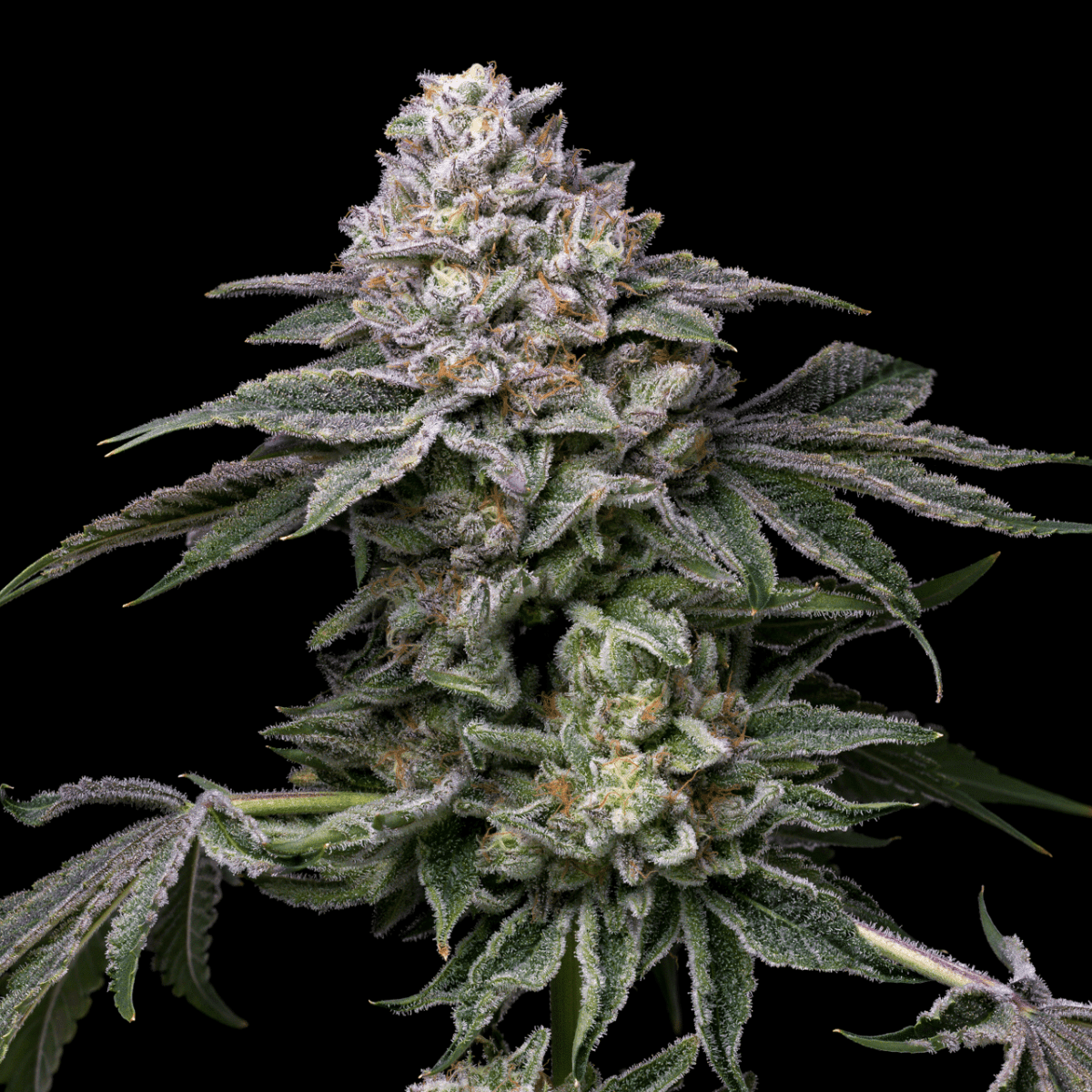
What does a Melonade plant look like?

The Melonade strain is a botanical masterpiece, captivating growers and enthusiasts alike. Its appearance is a symphony of natural beauty, harmonizing various elements into a lush and vibrant composition.

  • Form and structure: The Melonade plant stands with an elegant posture, neither too tall nor too squat. Its branches also extend gracefully, creating a balanced silhouette.
  • Color palette: The leaves of Melonade are a luscious shade of light green, reminiscent of fresh spring foliage. There’s more — a subtle blush of orange hues graces the flowering tops.
  • Trichome extravaganza: Trichomes — the plant’s crystalline jewels — blanket the surface like a glistening frost, turning the light green leaves into a celestial spectacle.

Where Can I Buy Melonade Seeds?

Get our premium-grade cannabis seeds to grow the Melonade strain for your own stash of dense, frosted nugs. Premium Cultivars offers the finest feminized and autoflower cannabis seeds online. Plus, USA buyers are guaranteed 100% free delivery on all cannabis seeds with orders above $100.

How Do I Buy Melonade Seeds?

Purchasing Melonade seeds from our online store is a straightforward process. Visit our official website, browse the cannabis seeds, and once you find Melonade seeds, select the size pack you want, such as 3, 6, 12, 24, or bulk. Next, add the Melonade seeds to your shopping cart and checkout. Complete the transaction using secure and encrypted payment methods, such as debit and credit cards – American Express, Mastercard, Discover, and Visa.

Shipping Notes
  • Free Standard Shipping on $100+ Orders to the USA.
  • Except Preorder products are shipped in 48 hours.
  • Delivery to the USA:
  1. Standard Shipping : 3-10 business days
  • If time is of the essence, please consider selecting expedited delivery for faster service.
Exchange/Return Notes
  • We offer a 30-day return/exchange service after receiving.
  • Final sale items are not eligible for returns or exchanges.
  • To process your return/exchange, please contact us at [email protected]
  • Please click here for more details>>> Return & Exchange Policy
SKU: 44636269050

Discover Niche Categories That Outsell marijuanas plant seeds

Top-Converting Item to Boost Your Average Order

4.4 ★★★★★
Based on 19 reviews
Sort
Highest Rating
Newest First
Oldest First
Product Reviews
A
Phoenix, US
★★★★★ 3
Good to excellent content - terrible publishing policy
Format: Hardcover
Lewis (Not "Flewis") wrote a decent text a number of years ago. It was then expanded to a companion volume (Analytical Sedimentology) with another author. The two nicely complement each other but the mind boggles at a price of almost $100 per each. The publisher has clearly made little effort to control the cost. Redundancy between the two volumes is excessive, hard cover rather than soft is used and, indeed, both could easily have been combined in one less pricey volume. A valuable resource to students and professionals has therefore been compromised by publisher, author or both due to ignorance, greed or stupidity. A terrible shame!
WAS THIS REVIEW HELPFUL?YesReportShare
Reviewed in the United States on January 5, 1998
J
Verified Purchase
JMB1014
Carnegie, US
★★★★★ 5
An Excellent Introduction to Legal and Constitutional Reasoning
Format: Hardcover
This is an excellent introductory volume for people who feel confused by the debate over "original intent" versus a "living Constitution." David A. Strauss is a law professor at the University of Chicago. His book is a quick read (139 pages), with no notes, bibliography or other impedimenta - just an index. It's a very lucid explanation of legal reasoning and how the Supreme Court has followed this basic process over time. Hence the "living constitution" is really just an instance of the English common law tradition functioning normally. This book will teach many Americans how legal reasoning actually operates in practice. It is a common-sensical and conservative process that seeks at once to promote predictability and fairness. By and large, it has worked well. The phrase "living Constitution" has been denigrated by people who seek to turn back the calendar to a day when more "traditional" values were imposed by law. In so doing, they have invoked an historical fiction, the "original intent" of the framers of the Constitution. The myriad problems arising from this effort, if not its disingenuousness, have been discussed with insight and erudition by such excellent minds as Jack Rakove ("Original Meanings")and Akhil Reed Amar ("The Bill of Rights," and "The American Constitution: A Biography"), to name just two. The real point of this book, I think, is to explain basic legal reasoning to a mass audience. This does a great service. It also shows how naturally the common law evolves, how it tends to restrain judicial activism and yet to permit flexibility as times and circumstances change. As Dean Roscoe Pound of the Harvard Law School put it in his book, "The Spirit of the Common Law," the common law is "essentially a mode of judicial and juristic thinking, a mode of treating legal problems rather than a fixed body of definite rules...." This is a critical distinction. Some so-called conservatives insist that judges must simply apply the law like automatons, as if it were a "fixed body of definite rules." They then seek to enlist the founding fathers in declaring what those rules are, or how definite they must be. But as Dean Pound and centuries of legal history demonstrate, this notion is far removed from the truth, and remote from any useful notion of adjudication. All Anglophone law schools, lawyers and judges are engaged in the process Dean Pound discusses. The common law tradition arose in England over the course of centuries. We imported it to this country in part because it was workable and practical, and because it was brilliantly and systematically expounded by Chief Justice Edward Coke in the 17th century and by Lord William Blackstone shortly before the American Revolution. No one would suggest that the common law tradition means the law is the captive of judges' subjective whims. Such an assertion would have sounded ludicrous to the English as well as to the founders. But as Strauss - and volumes of legal history - unsurprisingly demonstrate, the common law tradition is the key to constitutional interpretation. The common law is an inherently conservative instrument. It evolves incrementally. Those who complain about the "living Constitution" argue that judges merely rule according to their subjective prejudices. They contend that it is the legislative branch that should be charged with interpreting the Constitution. Of course, all three branches of government must interpret the Constitution from time to time. But the legislative branch should not have the last word in determining whether its own enactments meet constitutional scrutiny: To borrow from Chief Justice Coke, no one (including the legislature) may be the judge of his own cause. The function of determining whether legislation conforms to the Constitution has been and still is wisely confided to the courts, which by virtue of centuries of practice (as reflected in published opinions) have substantial expertise in the area and are independent. One also hears complaints that judges are insulated from reality. But courts are not insulated - they are independent. And they are independent precisely so they are not subject to being influenced by lobbyists or terrified by a challenger in a primary election. To show how the common law works, Strauss discusses the evolution of constitutional thought in relation to two major issues: freedom of speech and segregation in public schools. He explains how the "clear and present danger" test in freedom of speech cases evolved, implicating not just such considerations as the threat of imminent harm, but also that some kinds of speech have lower societal value (libel, obscenity, fighting words), while other kinds of speech have more societal value (great literature, political speech). Strauss goes on to discuss how Brown v. Board of Education (1954) was far less a radical overturning of an entrenched precedent, Plessy v. Ferguson (1896), than a logical step in the development of the law. In so doing, he uses an example from the law of torts, where customers injured by dangerous products originally were barred from suing the manufacturer unless they had a contractual relationship with it. At first, the fact that a product was inherently dangerous overcame the requirement of a contractual relationship. As it became harder to draw a line between ordinary products and those that were inherently dangerous, however, the old requirement of a contractual relationship was found to have outworn its purpose and customers were permitted to sue the manufacturer who had created a foreseeable risk of harm. Thus, in products liability cases, as in racial equality cases, the law evolved to meet the new demands posed by changed circumstances. Strauss shows the development of the law by discussing cases on racial equality decided after Plessy that gradually undercut the Plessy decision until it was no longer tenable. Strauss does what law professors do every day: teach the law by showing how it evolved. His explanation, however, is so concise and clear that it makes the discussion seem not just sensible but compelling. Thus we see that the law works. As Strauss points out, we never wrangle over some constitutional issues because they are cut and dried (you have to be 30 years old to be a senator) or because certainty is required (January 20 is the day the new president takes office, no matter how unstable the current domestic or world situation). Other provisions require more effort to interpret, but this is because the founders brilliantly provided that some matters could be spelled out specifically in advance, while others would have to be expressed in more general terms, which could be adjusted to changing needs and times (e.g., the "necessary and proper" clause in Article I, Sec. 8). Interestingly, Strauss does not consider amendments to the Constitution to be part of what makes it a living document, since the amendment process is so onerous, slow, and seldom used. He points out how some amendments merely ratified the status quo, or served to clean up outliers, resolved technical issues, or were ahead of their time. As he offers these judgments, which seem balanced and reasonable, he also explains some of the less familiar amendments in a way that will have readers raising their eyebrows and saying "Oh, so that's where that came from." At the outset of the book, Strauss sets out three objections to originalism: That it is often, as a practical matter, impossible even for professional historians to discover what the intentions were of various founders with respect to matters discussed in the Constitution. That even if an intent of the founders could be discovered, it would pertain to the understanding they had about their world: how does one go about trying to fit that understanding to our world? That as Thomas Jefferson pointed out, one generation is to another as one sovereign nation is to another. The world belongs to the living. The notions of people long dead cannot bind us in the present or future. Strauss correctly observes that the third of these objections is by itself fatal to originalism. The founders were not so impressed with themselves that they felt their "intentions" should be forever imposed on posterity. Had they been dedicated to such a dubious project, they would surely have done a better job of documenting their debates and compromises during the Philadelphia convention. But little remains of those deliberations aside from the notes kept by James Madison. The Constitution, moreover, reflects their understanding that the future could not be shackled forever to the time in which they lived. They realized that the slave trade, for example, would prove intolerable and therefore provided that it could be abolished by at least 1808. So was their "original intent" to permit the slave trade, or was it that the slave trade should be abolished? And what does this say, if anything, about their intentions toward the institution of slavery - a word that did not even appear in the Constitution until the Thirteenth Amendment was adopted in 1865? Most damning of all to the originalist position is what Thomas Jefferson said on the subject. In a letter dated July 12, 1816, to Samuel Kercheval, Jefferson wrote "Some men look at constitutions with sanctimonious reverence, and deem them like the arc of the covenant, too sacred to be touched. They ascribe to the men of the preceding age a wisdom more than human, and suppose what they did to be beyond amendment. I knew that age well; I belonged to it, and labored with it. It deserved well of its country. It was very like the present, but without the experience of the present; and forty years of experience in government is worth a century of book-reading; and this they would say themselves, were they to rise from the dead. I am certainly not an advocate for frequent and untried changes in laws and constitutions. I think moderate imperfections had better be borne with; because, when once known, we accommodate ourselves to them, and find practical means of correcting their ill effects. But I know also, that laws and institutions must go hand in hand with the progress of the human mind. As that becomes more developed, more enlightened, as new discoveries are made, new truths disclosed, and manners and opinions change with the change of circumstances, institutions must advance also, and keep pace with the times. We might as well require a man to wear still the coat which fitted him when a boy, as civilized society to remain ever under the regimen of their barbarous ancestors." He added, "Let us follow no such examples nor weakly believe that one generation is not as capable as another of taking care of itself, and of ordering its own affairs." He even called for revision of the constitution at stated periods. While originalists would love to claim Jefferson as one of their own, his words - and indeed his whole life - prove that he was completely at odds with their approach. Men like Jefferson and Franklin, who were devotees of science, were fascinated by the progress men could make in trying to understand and improve their lives. Jefferson was an eager student of nature and did considerable experimentation with crops on his plantation. He famously wrote his "Notes on the State of Virginia" to refute the widely read claims of the French naturalist Buffon about the supposedly weak, degenerate, and insipid life forms to be found in the New World. The idea that such men, who were committed to the growth of knowledge, would seek to confine all future generations to the limited understanding they possessed of the universe in 1787, is worse than laughable. It can only be explained by the polemical purposes of those whose arguments for a regressive social order are so feeble that they have to seek refuge behind an imaginary "original intent" that they erect - as if the founders wanted their limited knowledge and often unarticulated, conflicting, or ambivalent intentions to restrict the great national experiment forever. Given the explicit language of Thomas Jefferson, quoted above, it is apparent that "originalism" actually belies and defies the express intent of Jefferson, one of the most eminent of the founders. It seems paradoxical but it was his original intent that his original intent should not govern future generations! Original intent also appears anomalously restrictive when one considers that the founders never contemplated the existence of an Air Force, though they expressly provided for the Army and the Navy. And ask an originalist what the original intent was with respect to the Second Amendment's use of the term "arms." The founders had no concept of assault rifles or machine guns, let alone nerve gas, laser-guided bombs, predator drones, or nuclear weapons. How do we impose an intention on them to assert what they could not have foreseen, namely, that ordinary householders in the 21st century should have a personal, constitutional right to be able to obliterate a small army in a matter of seconds, based on the founders' notions about the 18th century saber, musket or pistol? Likewise, the Eleventh Amendment says nothing to prohibit a person from suing her own state - just other states. Yet even "textualists" read an unwritten provision into the Eleventh Amendment because it suits their view of how "sovereign" the states should be. When given this kind of a taste of their own medicine, originalists collapse in helpless sputtering and exasperation. Exposed to Strauss' very sensible discussion, the concerns of originalists reflect opportunism and disingenuousness. After all, we should not expect lawyers and judges to become armchair historians, especially under the time pressures of litigation and in the face of hotly contested issues. We should not pretend the founders had some monolithic intent, least of all with respect to matters of which they had no concept. And as Jefferson pointed out, the relationship of one generation to another is like that of one sovereign nation to another: we cannot expect to bind future generations by the intentions of people who are long since dead. In short, there will always be those who resist change and those who welcome it. If you really want to see "judicial activism" at work, you will not find much of it in the common law tradition. A far better example is the recent decision - by the so-called conservatives on the Supreme Court - in Citizens United v. Federal Election Commission.
WAS THIS REVIEW HELPFUL?YesReportShare
Reviewed in the United States on May 18, 2010
B
Verified Purchase
Benjamin Douglass
Fort Morgan, US
★★★★★ 5
An Excellent Read
Format: Kindle
The author talks about our constitution as a "living document" and expertly draws the distinction between this and the originalist interpretation as a "dead document."
WAS THIS REVIEW HELPFUL?YesReportShare
Reviewed in the United States on October 5, 2018
F
Verified Purchase
Frederick S. Goethel
Lowell, US
★★★★★ 4
The Constitution: A Living or Static Document
Format: Hardcover
There has been a debate over the past several decades on whether the US Constitution is a living document that should be interpreted according to current mores and standards or whether it is a static document that should be interpreted using only the meaning found in the original wording of the document. The author, in this book, makes the case that the Constitution is, in fact, a living document that should be interpreted by modern standards and by using principles of common law. There are examples given that, quite frankly, are very persuasive. For instance, if the Constitution were interpreted using original language, we would not have the freedom of speech that we now enjoy. A careful reading of the First Amendment will show that only Congress was prohibited from making laws that abridged free speech. There were no constraints on the states or on other governmental bodies. Whether or not you agree with the author on how the Constitution should be interpreted, this book will make for some though provoking reading and interesting discussion. The book was well written, fairly easy to understand and should be read by all who are concerned about where the Supreme Court is now and where it is headed.
WAS THIS REVIEW HELPFUL?YesReportShare
Reviewed in the United States on May 23, 2010
G
Verified Purchase
garynini
Houston, US
★★★★★ 5
Clear, cogent, and illuminating
Format: Kindle
Clear, cogent, and illuminating explanation of the difference between two approaches to interpreting the Constitution: originalism and the Living Constitution
WAS THIS REVIEW HELPFUL?YesReportShare
Reviewed in the United States on September 18, 2015

recommand products