Pay in installments of $6.52 with
 ,
,
 and
and

Shipping Estimate
USA
- USA
- CAN
- USA
- CAN
Ships within 48 hours · Estimated delivery Aug 3 - Aug 8
 Promo Codes Available:
For Your Every Summer RSVP, with Code: SUMMER15
Description
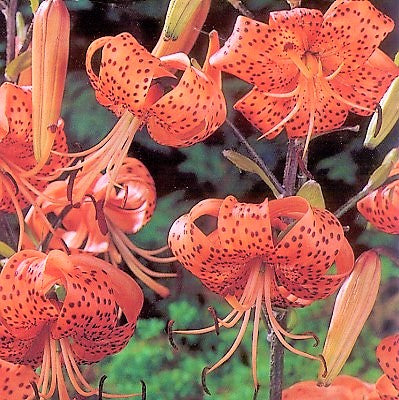
tiger lily benefits Tiger Lily Species Lily – The Lily Pad Bulb FarmLilium Tigrinum (lancifolium) is an heirloom favorite, quite properly known as the "Tiger Lily" of "Grandma's garden" fame. It has large unscented pendant orange flowers with black spots and recurved tips. It is a notoriously vigorous grower and naturalizes easily, producing a big crop of stem "bulblets" every year and aerial bulbils (resembling black beads thickly arranged along the stem). Once they develop rootlets, these bulbils can be easily
Lilium Tigrinum (lancifolium) is an heirloom favorite, quite properly known as the "Tiger Lily" of "Grandma's garden" fame. It has large unscented pendant orange flowers with black spots and recurved tips. It is a notoriously vigorous grower and naturalizes easily, producing a big crop of stem "bulblets" every year and aerial bulbils (resembling black beads thickly arranged along the stem).
Once they develop rootlets, these bulbils can be easily raised to blooming size, in fact will plant themselves if allowed to drop to the ground. If you seek a rapidly-propagating lily, this one's FOR YOU! In the Orient this species is raised for its edible bulbs (delicious in veggie stir-fry dishes. Very enduring and virus-resistant. We barely keep up with the revival of demand for this hard-to-get species. 16-18 cm bulb size. Choose between 1 bulb or a 3-pack.
Once they develop rootlets, these bulbils can be easily raised to blooming size, in fact will plant themselves if allowed to drop to the ground. If you seek a rapidly-propagating lily, this one's FOR YOU! In the Orient this species is raised for its edible bulbs (delicious in veggie stir-fry dishes. Very enduring and virus-resistant. We barely keep up with the revival of demand for this hard-to-get species. 16-18 cm bulb size. Choose between 1 bulb or a 3-pack.
Botanical name: Lilium lancifolium 'Splendens'
Form: Perennial
Hardiness Zone: 3-9
Flower Color: Orange/black spots
Foliage Type: Linear, green leaves arranged in whorls or spirals up the stems
Bloom time: July-August
Height: 3-4 ft
Spread: 12 inches
Light requirements: Full or partial sun
Plant depth: 6 inches of soil over top of bulb
See "Growing Tips" for more detailed instructions
Form: Perennial
Hardiness Zone: 3-9
Flower Color: Orange/black spots
Foliage Type: Linear, green leaves arranged in whorls or spirals up the stems
Bloom time: July-August
Height: 3-4 ft
Spread: 12 inches
Light requirements: Full or partial sun
Plant depth: 6 inches of soil over top of bulb
See "Growing Tips" for more detailed instructions
Tips and Growing Instructions
Visit our How-To Cultivation Library for more growing tips.
Species lilies, also known as Tiger Lilies, are wild lilies, native to North America, Europe, and Asia. Delicate and full of charm, there are 80 - 100 accredited Species. Most species lilies do not require specialized care and will naturalize themselves very well. They are very adaptable to most soil conditions and environmental conditions, and they do quite well in warm, moist climates with fertile soil. Tiger Lily bulbs for the most part are smaller than hybrid varieties, but will produce good quality stems and a lot of blooms. Their delicate, beautiful flowers are quite showy and most will bloom for long periods compared to other lilies.
Lilies are incredibly easy to grow and few garden pests trouble them. The most natural location for lilies is on sloping ground with excellent drainage. Lilies prefer to have their blooms in the sun and their roots in the shade. Try planting them among annuals or perennials that will keep their roots cool.
The general rule of thumb for planting spring bulbs is to plant two to three times as deep as the bulb is tall. This means that some of our larger Bulb-Zilla lily bulbs will need to be planted 6-8 inches deeps. Plant with the roots downward and the scales upward. After planting, water well two or three times. Lilies are most effective when planted in groups of three or more. Space them about a foot apart – they will spread and fill this space in no time!
Always allow the leaves on the stalk to turn yellow and fall off as part of the lily’s natural growth process. This ensures that the bulbous underground part of the plant has gotten enough nourishment and will mean greater growth next year. Each year watch their beauty increase as they multiply!
Visit our How-To Cultivation Library for more growing tips.
Species lilies, also known as Tiger Lilies, are wild lilies, native to North America, Europe, and Asia. Delicate and full of charm, there are 80 - 100 accredited Species. Most species lilies do not require specialized care and will naturalize themselves very well. They are very adaptable to most soil conditions and environmental conditions, and they do quite well in warm, moist climates with fertile soil. Tiger Lily bulbs for the most part are smaller than hybrid varieties, but will produce good quality stems and a lot of blooms. Their delicate, beautiful flowers are quite showy and most will bloom for long periods compared to other lilies.
Lilies are incredibly easy to grow and few garden pests trouble them. The most natural location for lilies is on sloping ground with excellent drainage. Lilies prefer to have their blooms in the sun and their roots in the shade. Try planting them among annuals or perennials that will keep their roots cool.
The general rule of thumb for planting spring bulbs is to plant two to three times as deep as the bulb is tall. This means that some of our larger Bulb-Zilla lily bulbs will need to be planted 6-8 inches deeps. Plant with the roots downward and the scales upward. After planting, water well two or three times. Lilies are most effective when planted in groups of three or more. Space them about a foot apart – they will spread and fill this space in no time!
Always allow the leaves on the stalk to turn yellow and fall off as part of the lily’s natural growth process. This ensures that the bulbous underground part of the plant has gotten enough nourishment and will mean greater growth next year. Each year watch their beauty increase as they multiply!
Shipping
Sorry, we do not ship outside the U.S. or to Hawaii due to agricultural restrictions.
We guarantee safe arrival of healthy bulbs, that varieties will be true-to-name, and will grow if planted as instructed, subject to the limitations described in our Shipping and Returns Policy.
We begin shipping our bulbs in mid-February through Spring. Despite what you may have heard, Spring planting of bulbs is not a bad thing, and in fact, there are many advantages to planting in Spring. Visit our Spring Planting page to learn more. Upon arriving, your bulbs and most of your perennials may show signs of growth such as green leaves and sprouts - this is okay and transportation during this time should not harm the plants.
All bulbs and perennials should be planted in your garden as soon as possible to ensure the best success. If you must delay planting, open the bags to permit air circulation and place them out of direct sunlight in a cool, well-ventilated room. Do not place the bulbs where they can freeze. If you have the space, storing the bulbs in the refrigerator is another excellent way to “hold them” prior to planting. If you choose this method of storing your bulbs, be sure not to store fruit with them, as this is detrimental to bulbs.
Plant outdoors when the ground is no longer frozen and the conditions have improved for your zone.
If you have any questions or concerns our customer service team would be glad to help you at any time. Please use our contact form, email us at [email protected], or call us at 541-671-3196.
Shipping Notes
- Free Standard Shipping on $100+ Orders to the USA.
- Except Preorder products are shipped in 48 hours.
- Delivery to the USA:
- Standard Shipping : 3-10 business days
- If time is of the essence, please consider selecting expedited delivery for faster service.
Exchange/Return Notes
- We offer a 30-day return/exchange service after receiving.
- Final sale items are not eligible for returns or exchanges.
- To process your return/exchange, please contact us at [email protected]
- Please click here for more details>>> Return & Exchange Policy
4.2 ★★★★★
Based on 30 reviews
Sort
Product Reviews
★★★★★ 5
Unique
Format: Paperback
It’s rare to find a Manga that’s as close as possible to the original storyline, although it’s they’re could be more to come in the future later on other than that it’s a good manga to have in your personal library
WAS THIS REVIEW HELPFUL?YesReportShare
Reviewed in the United States on May 12, 2025
★★★★★ 5
Beautiful
Format: Hardcover
A gorgeously written book about a young Palestinian American who finds her voice and identity.
Genre: Upper Middle Grade/Lower YA
-also some magical realism elements: olives cause time travel
Author:Nora Lester Murad
Publisher: Crocodile Books/ Interlink
This beautiful hardcover (the book truly is absolutely gorgeous and I just cant stop staring at it!) tells the story of Ida- a young 13 year old Palestinian American daughter of immigrants. Bullied out of her school due to being Palestinian, Ida struggles to fit in.
But one day, when she eats special olives, she is transported to a new type of multiverse where Ida’s family is still in Palestine.
And by going back and forth, Ida realizes who she wants to be and what her passion in life is.
This gorgeous book truly transported me to Palestine!! The rich descriptions helped me feel grounded in the setting, and I almost felt like I could taste the crackling olives, listen to the adhan of the Mosques, and walk the streets of Palestine. Tbh- as a Syrian myself, I found many parallels with life in Damascus to life in Jerusalem, and it made me fall in love with the book even more.
Juxtaposed with the beauty of the land and the liveliness of the family and community around Ida is the harsh reality of Israeli occupation. The author does not minimize it, she portrays it in the voice of a teenager quite honestly, and her emotional scenes showing Ida helping a young boy and trying to figure out how to save her village and heart-wrenching and emotional.
I also appreciated how nuanced the book was. The occupation is clearly presented as apartheid and wrong, but there is no antisemitism. The author mentions her Jewish background in the author’s note, the book states that there are Jews who support Palestinian rights and Ida sympathizes with Jews who immigrated to America to escape persecution.
I really liked how this book was written- the layers of searching for identity, holding onto your homeland, resisting occupation, and the encouragement for the reader to practice BDS and raise their voices for justice.
Definitely a must read and book I can see be adapted in curriculums for middle schools.
WAS THIS REVIEW HELPFUL?YesReportShare
Reviewed in the United States on January 31, 2023
★★★★★ 5
Compelling from start to finish.
Format: Paperback
This is a wonderful book -- no doubt for young adults, but for all the rest of us, too. Here is the review we included in Rethinking Schools magazine: Middle school student Ida tries to sit where she is “unnoticeable, like the dust on last year’s history books.” She seeks to avoid stereotypical insults hurled at her for being from a Palestinian immigrant family. The school’s silence aggravates the problem. Ida notes, “Nobody even says the word ‘Palestine’ in my school. The teachers are afraid to teach anything about the Middle East, even if the topic has nothing to do with politics.” As the mother of three girls raised in the West Bank and now living in the United States, author Nora Lester Murad is deeply grounded in the book’s characters and themes. And she knows how to captivate middle school readers. Ida eats an olive that sends her time traveling from her home in Massachusetts to her family’s home in the West Bank, introducing readers to both the beauty of their village and the violence of the Israeli occupation that eventually forced her family to leave for their safety. This experience gives Ida the courage and conviction to speak in a school assembly about the realities of the occupation, comparing it to what happened to “Indigenous peoples here. How they were pushed off their land and survived so much violence, as if they weren’t human.” Stepping out of the shadows, she insists that students and teachers see her and her family’s humanity.
WAS THIS REVIEW HELPFUL?YesReportShare
Reviewed in the United States on July 20, 2024
★★★★★ 5
Couldn't put Ida in the Middle down until the end
Format: Hardcover
Ida in the Middle so vividly captures the point of view of a girl not only sorting out feeling like and being treated like an outsider in a new school, but her relationship with her immigrant parents, her younger and older sister (she is in the middle), and her growing awareness of her family's community in the Middle East. It is is warm novel of feelings, friendship, and the magic transport to the "Its A Wonderful Life" alternate reality of what being in 8th grade would be like if her family had stayed in the village where her grandparents, aunts, uncles, and cousins still live. It is also a novel, like those set in other wartimes, that exposes hard realities. Descriptions of her alternative private school in the US and watching the "Arabs Got Talent" music competition on TV have some of sly wit of Where'd You Go, Bernadette, but the learning that Ida and the reader develop about both the community ties and the danger and dehumanization of checkpoints, home demolitions, and raids takes the book to another level of complexity and empathy for difficult circumstances and choices. Throughout, Ida's viewpoint as a 13-year-old trying to understand the world around her is fresh and appealing. She proves to be an unexpectedly level-headed protagonist as the plot carries her into danger and into new readiness for action. Through the course of the novel, both the reader's and Ida's empathy grows for the desperate situation of Palestinian farmers whose land is under siege (and of all living under occupation), for parents' struggle over the choice to remain out of the country, and for the daily decisions to claim joy and pleasure even if it entails contradictions. Ida left me energized and inspired, and ready to gift this book to the middle-grade kids I know, and also to my teacher friends who keep books in their classrooms for students to read.
WAS THIS REVIEW HELPFUL?YesReportShare
Reviewed in the United States on January 30, 2023
★★★★★ 5
A "magical" story of Palestinian life in the West Bank
Format: Hardcover
This young adult novel by Nora Lester Murad focuses on the quandary of a Palestinian-American teenager, Ida, who is learning about American culture while her extended family in the West Bank must cope with Israel’s many policies that discriminate against Palestinians. As Ida ponders how to fit in better at her school and a topic for a school assignment, she is magically transported to the land of her ancestors where she soon finds herself in a difficult situation. The novel explores several aspects of these policies, including the demolition of a friend’s home due to her family’s inability to get a construction permit. In between these difficult situations, there are some twists and turns that remind the reader of the importance of family and friends.
This novel will help to validate the experiences of Palestinian youth who are "caught in the middle" like Ida. Readers of all ages will gain new insights into conditions for Palestinians living in the West Bank and how these pressures impact the daily lives and futures of Palestinian youth. (A teacher’s guide is available, which will be especially helpful for those unfamiliar with the situations described in Ida in the Middle. )
WAS THIS REVIEW HELPFUL?YesReportShare
Reviewed in the United States on April 28, 2023