SKU: 4594488279
succulent air plant

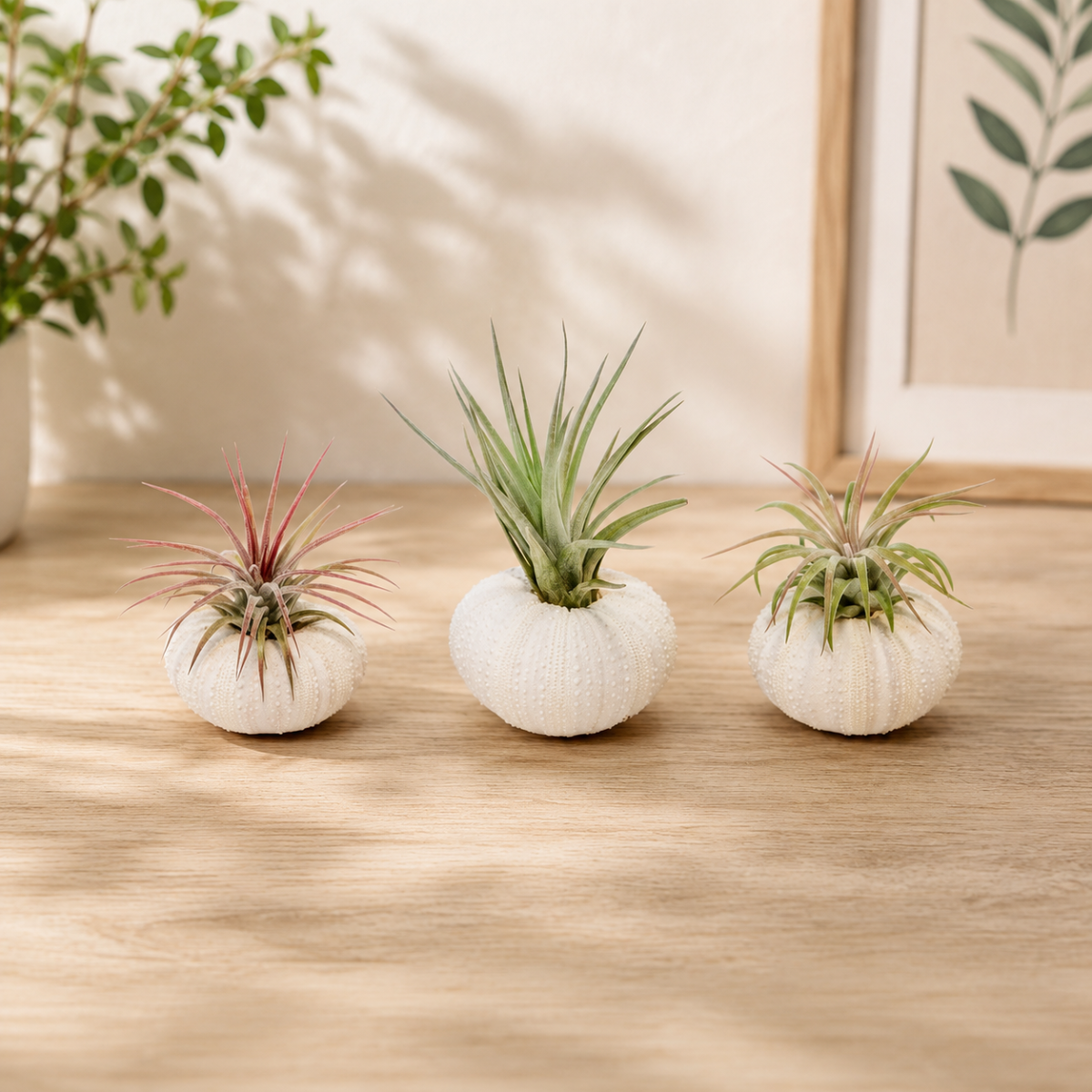
succulent air plant White Urchin with Tillandsia Air Plant, No Soil Needed, Easy Care by Succulents Box

Sale price$20.89 Regular price$23.21
Save 10%

Pay in installments of $5.80 with ShopPay, AfterPay and Klarna

Shipping Estimate
USA
  • USA
  • CAN

Ships within 48 hours · Estimated delivery Jul 31 - Aug 5

Promo Codes Available:

For Your Every Summer RSVP, with Code: SUMMER15

Description

succulent air plant White Urchin with Tillandsia Air Plant, No Soil Needed, Easy Care by Succulents BoxDescription Light Soil Water Hardiness The White Urchin with Tillandsia Air Plant is a creative pairing of a natural sea urchin shell and a living Tillandsia, a genus of epiphytic plants in the bromeliad family native to Central and South America and the southern United States. Tillandsias are commonly called air plants because they require no soil to grow, drawing moisture and nutrients directly from the air around them. This combination turns an

  • The White Urchin with Tillandsia Air Plant is a creative pairing of a natural sea urchin shell and a living Tillandsia, a genus of epiphytic plants in the bromeliad family native to Central and South America and the southern United States. Tillandsias are commonly called air plants because they require no soil to grow, drawing moisture and nutrients directly from the air around them. This combination turns an organic coastal keepsake into a miniature living display.

    The white sea urchin shell serves as a natural vessel, its rounded, textured form contrasting beautifully with the soft, arching green to silvery-green leaves of the Tillandsia nestled inside. The spiky, rosette-shaped air plant typically stays compact, reaching just a few inches in width, making it ideal for small shelves, windowsills, terrariums, or as a standalone accent piece on a desk or tabletop.

    This arrangement makes a charming gift and fits effortlessly into coastal, bohemian, or minimalist home decor. Because it needs no soil or pot, it is wonderfully versatile and easy to move around the home. This plant is best placed away from curious cats and dogs, and kept out of reach of young children to protect the delicate shell and plant.
  • Tillandsia air plants thrive in bright, indirect light. Place yours near a sunny window where it receives several hours of filtered light each day. Avoid prolonged direct afternoon sun, which can scorch the delicate leaves. Fluorescent or full-spectrum grow lights also work well if natural light is limited in your space.

    Water by misting the leaves thoroughly two to three times per week, or by gently removing the plant from the shell and soaking it in room-temperature water for 20 to 30 minutes once a week. After soaking, shake off any excess water and allow the plant to dry completely within four hours before returning it to the shell. Standing water trapped in the base of the leaves can cause rot, so good airflow after watering is essential.

    No soil is needed for Tillandsia air plants. They absorb water and nutrients through tiny structures on their leaves called trichomes. The sea urchin shell simply acts as a decorative holder. If you ever want to display the plant differently, it can rest on any clean, dry surface or be placed in a terrarium, on driftwood, or mounted with safe adhesive.

    Tillandsias prefer temperatures between 50 and 90 degrees Fahrenheit (10 to 32 degrees Celsius). They appreciate good air circulation, so avoid placing them in sealed containers or stuffy corners. Keep them away from heating or air conditioning vents, which create dry, harsh airflow that can stress the plant. Normal household humidity levels are generally sufficient, though occasional misting helps in drier climates.

    Feed your Tillandsia once a month using a bromeliad or air plant fertilizer diluted to one quarter of the recommended strength. Apply it by misting the leaves directly with the diluted solution. Fertilizing is optional but encourages healthier growth and can prompt the plant to produce its colorful bloom when it reaches maturity.
  • USDA Hardiness Zones 9-11 | Minimum temperature: 25°F (-4°C)

    In zones 9 through 11, Tillandsia air plants can be displayed outdoors in a sheltered spot with bright, filtered light and good airflow during warm months. Bring them indoors when temperatures drop below 50 degrees Fahrenheit (10 degrees Celsius), as they are sensitive to cold and cannot tolerate frost. In cooler zones, they are best grown year-round as indoor plants near a bright window.

Shipping Notes
  • Free Standard Shipping on $100+ Orders to the USA.
  • Except Preorder products are shipped in 48 hours.
  • Delivery to the USA:
  1. Standard Shipping : 3-10 business days
  • If time is of the essence, please consider selecting expedited delivery for faster service.
Exchange/Return Notes
  • We offer a 30-day return/exchange service after receiving.
  • Final sale items are not eligible for returns or exchanges.
  • To process your return/exchange, please contact us at [email protected]
  • Please click here for more details>>> Return & Exchange Policy
SKU: 4594488279

Discover Niche Categories That Outsell succulent air plant

Top-Converting Item to Boost Your Average Order

4.7 ★★★★★
Based on 9 reviews
Sort
Highest Rating
Newest First
Oldest First
Product Reviews
A
Verified Purchase
Amazon Customer
Draper, US
★★★★★ 5
Inspiring and well-written
This is a very interesting book written by some Harvard profs. They did a large national survey of innovative businesses and their leaders. The book posits that innovative people follow five skills: associating, questioning, observing, networking, and experimenting. These skills can be found at the individual or organizational level. The idea is that most people have these skills in their DNA and can bring them out with some practice. There are a lot of interesting and inspiring examples like Steve Jobs and Jeff Bezos. Although this book seems like a self-help type book with a lot of hype, it has an academic underpinning. Any organization that is interested in promoting innovation could benefit from encouraging these 5 skills. If you are interested in innovation or creativity in business or any organization that produces something, you will like this book. The books is a little distracting to read because it has sidebars all through it giving interesting examples that break up reading concentration. Aside from that, it is a well-written book that is easy and enjoyable to read. I enjoyed the book greatly and found it to be inspiring.
WAS THIS REVIEW HELPFUL?YesReportShare
Reviewed in the United States on December 5, 2015
S
Verified Purchase
Stephen Collins
Grantham, US
★★★★★ 4
Great read and research. But what about daily application for regular people?
The research piece behind this book might be the next thing I read, as I'm intrigued by the academic rigor applied. The reveal and living examples of the five skills - questioning, networking, experimenting, observing and associating - are tangible and approachable given their articulation through well-known and highly visible entrepreneurs running innovative companies. There's much to be gleaned by looking at the way these people behave and, even through simple emulation, enhancing one's own skills. My only real disappointment with the book is its limited approach to practical, daily application for those not yet at the top of the tree. It's rather a different kettle of fish for the innovation-minded, but stuck in bureaucracy, worker who wants to make things better, is still motivated, and hasn't been crushed by the machine. How does that person actively innovate? And, in some cases, get away with it? This book (or an accompanying volume) focussing on daily, in-work, innovation would be useful.
WAS THIS REVIEW HELPFUL?YesReportShare
Reviewed in the United States on May 23, 2013
A
Verified Purchase
Annette
Carnegie, US
★★★★★ 5
A Favorite Book on Innovation
Format: Hardcover
Very well written and enough stories to help the true content stick. This is a favorite book of mine and has lead to interesting conversations to boot.
WAS THIS REVIEW HELPFUL?YesReportShare
Reviewed in the United States on September 29, 2025
K
Verified Purchase
Kurt Manwaring
Birmingham, US
★★★★★ 5
An exceptional five stars out of five
Few qualities separate inordinately successful entrepreneurs from the rest of the pack than the ability to innovate. Many have debated whether individuals are born with this quality or whether it can be nurtured. In The Innovator's DNA, Jeff Dyer, Hal Gregersen and Clayton Christensen explain that while genetics play a role, innovation is most certainly a skill that can be learned. In particular, the authors introduce and expound upon five "discovery skills" found in the leaders of some of the most innovative companies in the world: (1) associating, (2) questioning, (3) observing, (4) networking and (5) experimenting. Each discovery skill is accompanied by real-world examples and pragmatic exercises that make the book unusually valuable in an age where copious books on change, leadership and innovation overwhelm the already-overwhelmed executive. I give The Innovator's DNA an exceptional five stars out of five. The authors present a very readable book and provide concrete exercises for developing innovative skills. Using the principles provided in the book, I created a folder on my computer that I call my "Innovation Room." I use this to track progress as I work through various exercises and as I take time to ponder about how to apply innovative solutions to extant problems in Utah. This book was and will continue to be useful to me, and is recommended as a must-read for those interested in adding rare innovative attributes to their arsenal of problem-solving and decision-making skills. *NOTE: The preceding text is taken verbatim from my short book review printed in the June 2012 edition of Utah Business.
WAS THIS REVIEW HELPFUL?YesReportShare
Reviewed in the United States on March 22, 2013
K
Verified Purchase
Kocese
Fort Morgan, US
★★★★★ 3
It's Ok
It's an ok book and it definitely has some interesting things going on it, but it also has those "ask yourself" these questions if you can be an innovator which is where every human being ponders and talks themselves into having the type of characterisitic the question asks if they have and that makes that human being feel the best about themselves. Bottom line the book has some good info, is it better than say reading the biography of each innovator that they cover (if one is available)....I can't say that it is.
WAS THIS REVIEW HELPFUL?YesReportShare
Reviewed in the United States on May 2, 2013

recommand products