Pay in installments of $7.21 with
 ,
,
 and
and

Shipping Estimate
USA
- USA
- CAN
- USA
- CAN
Ships within 48 hours · Estimated delivery Sep 23 - Sep 28
 Promo Codes Available:
For Your Every Summer RSVP, with Code: SUMMER15
Description
castor oil seed plant Red Castor Bean – UJAMAA SEEDSRicinus communis Contains ~ 15 seeds per packet Germination 94% March 2026 Packed for 2026 Red castor bean has no culinary use as a food plant and should never be grown or handled as an edible crop. All parts of the plant are poisonous if ingested, especially the seeds. Origins, Migration, and HistoryRed castor bean (Ricinus communis) is a dramatic ornamental form of the castor oil plant, a species probably native to tropical Africa, with Kew listing
Ricinus communis
Contains ~ 15 seeds per packet
Germination 94% March 2026 Packed for 2026
Red castor bean has no culinary use as a food plant and should never be grown or handled as an edible crop. All parts of the plant are poisonous if ingested, especially the seeds.
Origins, Migration, and History
Red castor bean (Ricinus communis) is a dramatic ornamental form of the castor-oil plant, a species probably native to tropical Africa, with Kew listing its native range more specifically as northeastern tropical Africa. Over time, the plant spread widely through warm regions of Africa, the Middle East, Asia, and the Americas, becoming naturalized in many tropical and subtropical areas. Historically, Ricinus communis has long been valued for castor oil, which has been used in medicine, industry, and manufacturing, while the plant itself also became popular in ornamental gardening because of its huge tropical-looking leaves and striking seed pods. “Red castor bean” usually refers to red- or bronze-leaved ornamental forms rather than one single fixed heirloom cultivar, though older garden strains and selections such as red-stemmed and bronze-red forms have circulated for generations.
Our Red Castor Bean seeds were grown out by our friend Susana Lein of Salamander Springs Farm in Clear Creek, Rockcastle County, near Berea, Kentucky.
Appearance and Characteristics
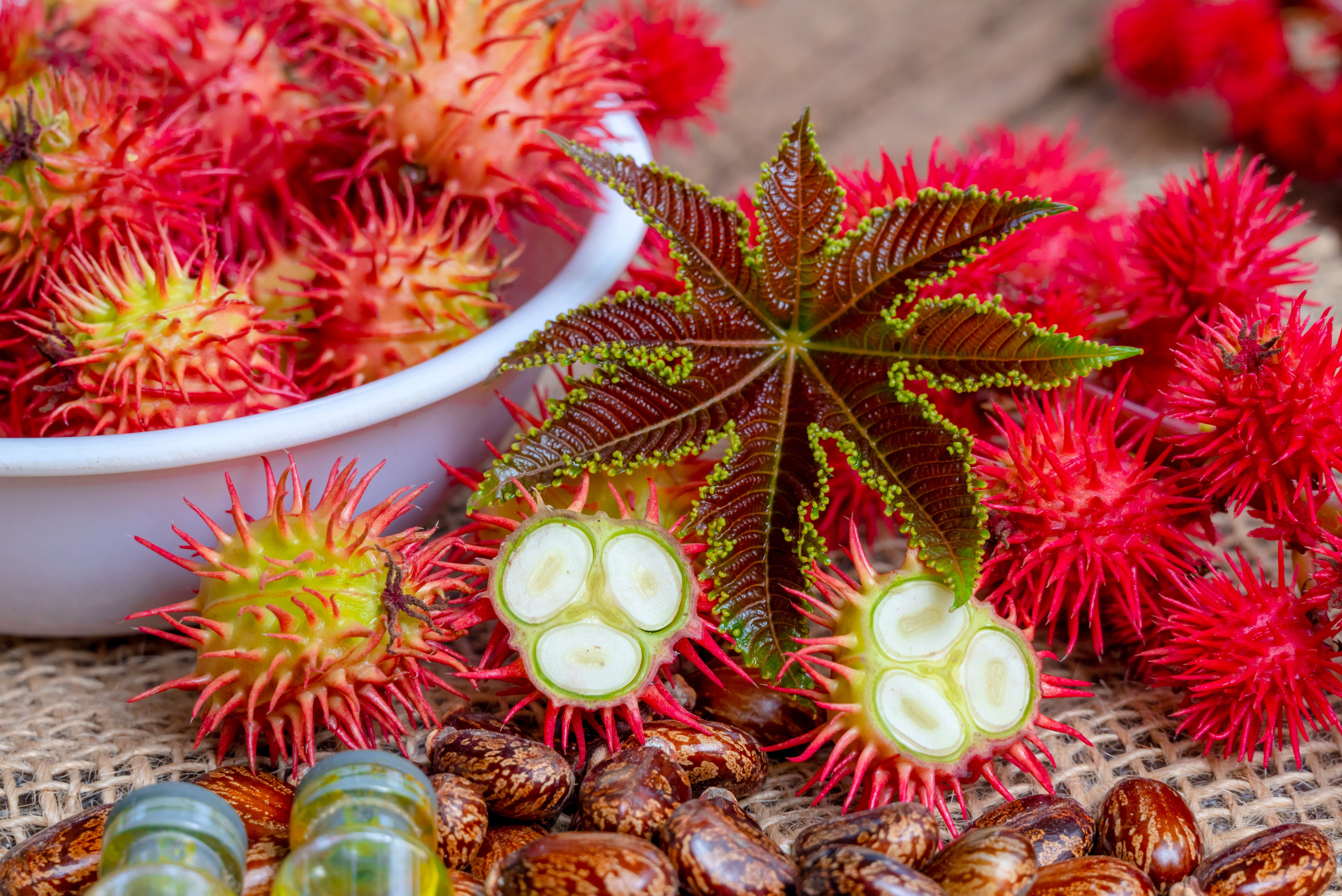
Red castor bean is a fast-growing, bold foliage plant that may be grown as a warm-season annual in cooler climates or as a perennial shrub in USDA Zones 9–11. It is prized for its large, glossy, palmately lobed leaves, which may be deep red, bronze, burgundy, or red-flushed depending on the strain. The stems are often red to purple, and the flower spikes carry small yellowish-green flowers, followed by showy spiny seed capsules that may be bright red, reddish-brown, purple, or green. In one growing season it can quickly reach roughly 6 to 10 feet tall under good conditions, making it useful as a specimen plant, tropical-style accent, or dramatic container feature.
Culinary Uses
Red castor bean has no culinary use as a food plant and should never be grown or handled as an edible crop. All parts of the plant are poisonous if ingested, especially the seeds, which contain ricin. Although processed castor oil has industrial and pharmaceutical uses and is described by botanical sources as non-toxic after extraction and processing, the home gardener should treat the plant strictly as an ornamental and not as a kitchen, tea, or medicinal herb.
Growing Tips
Grow red castor bean in full sun for the strongest color and best height. It performs best in rich, moist, well-drained soil, though established plants tolerate some drought better than young ones. In colder regions it is commonly started indoors about 6–8 weeks before the last frost or direct-sown once the soil has warmed and frost danger has passed. Because it grows rapidly and can become top-heavy, it benefits from a sheltered site protected from strong winds, and taller plants may need staking. Some sources also note that the plant can self-seed aggressively in warm climates, and it is considered invasive or weedy in some areas, so it should be planted thoughtfully and monitored carefully. Wear gloves when handling it, since foliage and sap may irritate skin.
Sow Depth
Sow seeds about 1 to 1½ inches deep in warm soil. For improved germination, many horticultural guides recommend nicking or lightly scarifying the seed coat or soaking seeds overnight before planting. Germination commonly occurs in about 1–3 weeks under warm conditions.
Harvesting Guidance
Red castor bean is generally grown for ornamental display rather than harvest. If you are saving seed, wait until the spiny capsules mature and begin drying on the plant, then collect them very carefully with gloves and store them securely away from children, pets, and food areas. Because the seeds are the most dangerous part of the plant, many botanical gardens and extension sources recommend pinching off the seed capsules while still small if safety is a concern. For most home landscapes, the best “harvest” guidance is simply to enjoy the foliage and remove seed heads before full maturity, especially in gardens used by children or animals.
Important Safety Note
Red castor bean is an exceptionally toxic ornamental. Do not plant it where children, pets, or livestock may have access to the seeds or plant parts, and always handle it with care.
Shipping Notes
- Free Standard Shipping on $100+ Orders to the USA.
- Except Preorder products are shipped in 48 hours.
- Delivery to the USA:
- Standard Shipping : 3-10 business days
- If time is of the essence, please consider selecting expedited delivery for faster service.
Exchange/Return Notes
- We offer a 30-day return/exchange service after receiving.
- Final sale items are not eligible for returns or exchanges.
- To process your return/exchange, please contact us at [email protected]
- Please click here for more details>>> Return & Exchange Policy