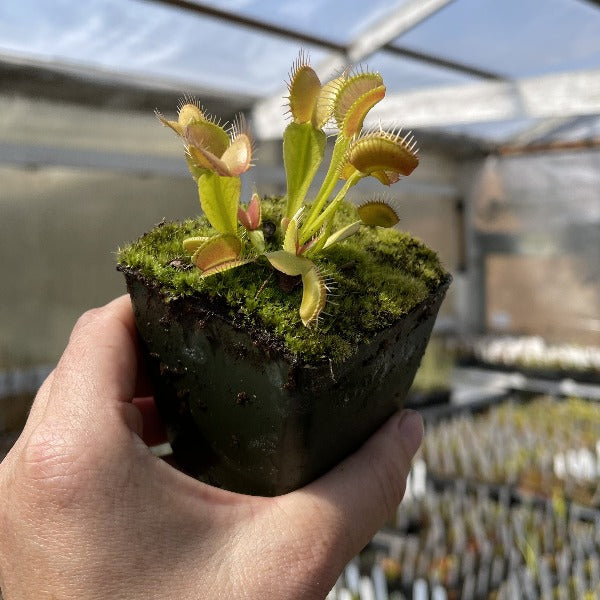
SKU: 49793063804
planting venus fly trap seeds

planting venus fly trap seeds Dionaea m. seed-grown Potted

Sale price$24.88 Regular price$27.64
Save 10%

Pay in installments of $6.91 with ShopPay, AfterPay and Klarna

Shipping Estimate
USA
  • USA
  • CAN

Ships within 48 hours · Estimated delivery Oct 3 - Oct 8

Promo Codes Available:

For Your Every Summer RSVP, with Code: SUMMER15

Description

planting venus fly trap seeds Dionaea m. seed-grown PottedThese are exceptional plants that we are very excited about! They are mature, seed grown flytraps from numerous cultivars and each one is unique and fun. Many are quite large, with huge traps and they vary from plant to plant in color, petioles length and cilia type! Each one is amazing though and theyre a really fun way to add some genetic diversity to your collection. We are shipping small plants. The second to last photo shows their size. These

These are exceptional plants that we are very excited about! They are mature, seed-grown flytraps from numerous cultivars and each one is unique and fun. Many are quite large, with huge traps and they vary from plant to plant in color, petioles length and cilia type! Each one is amazing though and they’re a really fun way to add some genetic diversity to your collection.

We are shipping small plants. The second-to-last photo shows their size. These small plants will grow rapidly in summer!

PLEASE NOTE VENUS FLYTRAPS GO DORMANT SEASONALLY, STARTING AS EARLY AS OCTOBER AND LASTING AS LATE AS MARCH, DEPENDING ON THE CONDITIONS. During this time, they appear relatively small and grow a few traps; please see the final photo to see how flytraps look when dormant. They will begin to grow vigorously again in Spring when photoperiods lengthen and temperatures increase.

Care Instructions:

Growth Habit: Venus flytraps are low-growing bog plants native to North and South Carolina. These plants grow their traps, modified leaves, from a rhizome that spreads over time. The traps will die back frequently all year, have high leaf turnover, and many new traps will grow throughout the spring and summer. In spring, the traps grow, often low to the ground and small. In summer, they grow their best traps, taller and more prominent. As Fall comes on, the traps start to die back, growing lower to the ground and smaller, and by winter, the plant will be dormant, with many or all of the traps gone, but the rhizome remains healthy and intact throughout winter dormancy even if you cannot see any traps growing. Venus flytraps have black roots, and not generally not many of them.

Sun: Full sun. Venus flytraps require lots of direct sun to grow and produce traps. In many areas, they can be grown outdoors in full sun. If you live in a very hot AND very dry place like Arizona or Sacramento, for example, you will want to grow your plants in full morning sun with protection from the afternoon sun or under 30% shade cloth. It is common for several traps/leaves to "burn" and die back when you first place your plant into the sun; your plant is acclimating to your conditions, and in most cases, new leaves will soon grow and be fully acclimated. Venus flytraps can be grown indoors, on extremely sunny windowsills, that receive all-day sun, but they will require a grow light in most circumstances due to the amount of light the plant needs. Grow lights should be 6-12” from the plant, depending on the light, and on a 10-12 hour day length. Venus flytraps generally are not a good candidate for a terrarium as they need intense light and good airflow. Grow outdoors if possible for best results.

Water: Always keep them in a saucer with a few inches of distilled, rainwater, or reverse osmosis water. Never let them dry out, especially in the hot summer months. Venus flytraps are bog plants that prefer water-logged conditions unless you live somewhere both very hot AND extremely humid, like Alabama. In that case, let the water tray dry out for a day or two between refills. Always use distilled, reverse osmosis, or rainwater only. These plants are especially sensitive to their water quality, and giving them mineral and salt-free water is very important. In winter, when the plants are dormant, you can let them dry out a bit between rain storms, but do not let the soil get so dry that it pulls away from the edges of the pots. Be sure to supplement water as needed in between rains in winter.

Temperature and Dormancy: These are warm-temperate plants, meaning they need warm summers and chilly winters. They should be grown outdoors year-round in areas with mild winters. They thrive in temperatures ranging from 20 degrees - 90F degrees and can take a brief freeze or high-temperature spike up to 105F degrees for a short period. If nighttime temps drop below 20 but rise again during the day above 40, your plant will be fine outside.

If you live in an area with very cold winters, where nighttime temperatures drop below 20 degrees for sustained periods, you have three options for providing them with winter dormancy: the garage method, mulching in, or the fridge method. Dormancy is triggered by a combination of exposure to shorter photo-periods and cooler temperatures in the 40-60's F. While you can skip a dormancy period once or twice, in the long term, your plant will begin to do poorly and will eventually die if you skip this crucial period.

The garage method: Bring your plant indoors to a sunny windowsill in an unheated room or garage, where the nighttime temperatures will dip down to 50-60F. Keep it well watered during this period, do not let it dry out, and put it outside again when the outside nighttime temperatures increase consistently above 20F.

The mulch method: Mulch them in very, very well outdoors. Pack at least four inches of mulch on top of the plants and all around the sides to prevent winds from chilling them and freezing the roots. You can also dig the pots into the ground and then mulch heavily on top.

The fridge method: remove the plants from pots, gently clean the roots of soil, wrap the roots in a bit of damp long-fibered New Zealand sphagnum moss, place the plants in a resealable bag, and put the bag into the refrigerator. Leave them in the fridge from October to February, periodically checking on them to ensure they are still moist and not growing mold or fungus. Pot them back up in February. You can vary the timing to align with your outside nighttime temperatures so that your plants can come out of dormancy when it is safe to place them back outside. You can leave them in the fridge for an extended period if you have very long winters.

Soil and Repotting: We prefer a mix of four-part fertilizer-free peat moss to one-part perlite. You can add our pre-made mix to your order here. You do not need to repot your plant when you receive it from us for at least a year, and we recommend against it during the spring-summer months. Repot Venus flytraps every 1-3 years in January or winter. Avoid placing in excessively larger pots; size up only a few inches at a time. They do well in tall pots. Soil can also develop a swampy smell, especially right after shipping when the plant is wrapped in plastic and sealed. This is normal; these plants grow naturally in bogs and swampy conditions, and peat moss can develop a bit of an anaerobic smell, but this does not indicate a problem with the soil. 

Feeding and Fertilizer: Venus flytraps will catch plenty of food when grown outdoors. When grown indoors, they will significantly benefit from fertilizing, a foliar fertilizer, and feeding the traps. Plants grown outdoors will appreciate a foliar feed as well. Apply MaxSea fertilizer once per month to the foliage only. Dilute 1/4 teaspoon of MaxSea into one gallon of water and then apply to the traps with a mister bottle. If you would like to feed the traps of your flytrap, it is recommended that you use live prey, as the traps usually require continued movement from their food to stimulate the complete absorption process. They will often open too soon if fed inert foods and do not absorb nutrients. We recommend live mealworms, which are available from any pet store. After digestion, Venus flytraps open back up, leaving the exoskeleton of their prey. They have liquified and absorbed the contents of the insect, but the exoskeleton remains. This does not need to be removed. Traps often die back after a big meal; new ones will grow, and the plant benefits greatly from the nutrients!

More Information: For further information on dormancy, repotting, dividing, and more, check out our website, Venus Flytrap Care, or our YouTube channel.

Shipping Notes
  • Free Standard Shipping on $100+ Orders to the USA.
  • Except Preorder products are shipped in 48 hours.
  • Delivery to the USA:
  1. Standard Shipping : 3-10 business days
  • If time is of the essence, please consider selecting expedited delivery for faster service.
Exchange/Return Notes
  • We offer a 30-day return/exchange service after receiving.
  • Final sale items are not eligible for returns or exchanges.
  • To process your return/exchange, please contact us at [email protected]
  • Please click here for more details>>> Return & Exchange Policy
SKU: 49793063804

Discover Niche Categories That Outsell planting venus fly trap seeds

Top-Converting Item to Boost Your Average Order

4.0 ★★★★★
Based on 15 reviews
Sort
Highest Rating
Newest First
Oldest First
Product Reviews
M
Verified Purchase
Mrs. Mcginty
New York, US
★★★★★ 4
Great idea
Color: Blue, Size: 28" x 34"
This is a great product mainly because it holds down the pads and if anyone has tried to do the inside to outside training that was a huge plus to have it not blowing away constantly the only reason. For the 4 star and not 5 is the middle tends to have a lump of bunch up cause it does not have a section to cover but only way to make this better is to have the top be completely seperate but either way better then most I have tried
WAS THIS REVIEW HELPFUL?YesReportShare
Reviewed in the United States on January 31, 2026
C
Verified Purchase
C. G.
New York, US
★★★★★ 5
Great investment! It'll save your floors and help train your pup by giving him/her a specific area to pee/potty in the house!!
Color: Blue, Size: 17" x 23", Color: Blue, Size: 17" x 23"
Though my pup sometimes like to pee right at the edge of this puppy pad holder, when he does, he usually just hits the lip of holder. He's a beagle/dachshund mix, and will probably end up around 20lb - he's around 15-ishlb now - so not a tiny dog, but is still a small dog. And with him being "not" tiny/toy, and him being a male, he tends to not aim so well sometimes when he uses it. This made using the PP holder a learning curve for me. I started out using the regular size pads in it , which fit amazing well; however, with Morty's - ahem! - mishaps with aiming, I tried doubling-up on the training pads - would put two of the reg size pads on the holder - and that left just enough pad "hanging" outside of the holder to meet Morty's mishaps in aiming. I was even able to still fasten the holder through the pad, which is awesome! However, using double to pads to cure Mort's lack of ability to aim for the center every time was costly, so I decided to shop around to see if I could find a solution to our aiming whoes. That's when I stumbled upon these pads at Walmart for just under $10 before tax, but they are available to purchase here at Amazon, & it occurred to me that perhaps one XL pad would give Morty that extra allowance he needed, and it could be more affordable to me - it worked! . These particular pads have been working out wonderfully because I continue to use just one pad and still get the overage protection - I'm pretty sure Morty intentionally pees on the edge sometimes - but since they're quite absorbent, it's very rare that he misses so much that he pees "through the pad." [The time he pees through the pad are the times he literally barely even hits the holder/pad at all because like I said, I'm pretty sure he aims for the edge on purpose most of the time.] Since Morty is a beagle/dachshund mix, he is a scent hound, which means that I can never just "let him outside" - I always walk him outside with a leash - because scent hounds follow their noses [pretty sure his nose is more Beagle than Dachshund lol]. And with it being extremely hot out now, I allow him to pee indoors at least 50% of the time; I am absolutely thrilled that he has taken to his wee-wee pad like a pro. All and all I'm very satisfied with this purchase because it has allowed us to have a clearly defined, and mostly contained space within out home for our pup Morty, to go potty in the house, and without ruining our hard floors. Moreover, since the holder itself is plastic, cleaning it up is a breeze! I just spray a bit of Clorox Clean-up on the holder, wipe it and voilà - odor-free home! As an aside; the holder mentions being skid proof, and though I don't doubt the validity in that claim since the feet, which are on the four corners, do have rubber on the bottom, Morty is still a 7-month-old puppy, and sometimes, he can be a bit ornery and play with his pee-pad - which is always fastened inside the holder. And that subsequently allows him to move the holder from it's original spot because he "pulls" it since he's trying to "pull" the pee-pad off. Also, when my daughter and her friends play fetch with him, sometimes they'll throw his tow toward the same area that his holder sits. When that happens, he tends to run across the pad/pad holder and cause it to move. I'm attaching a video to illustrate what I mean. On this particular day Morty was playing by himself with an empty two liter bottle - he loves bottles! On this occasion, his pad/holder is not in it's normal spot - he's actually moved it into the kitchen. Toward the end you can here him baying out the door at someone/thing. I believe it may have been the neighbor lol :) But since the times that Morty is able to move the holder are during times in which his doing it intentionally, I still wouldn't dock it for "not" being skid proof because it clearly is. I just wanted to point this out in case you furry family member is anything like mine, and is full of energy - I don't think there much of anything in my house Morty can move when he has high-energy like that. Also in the video, you can see how the XL pads fit onto the regular size holder, and the extra overage it provides - should you have a dog like Morty who needs a little extra overhang because of his aiming woes. I've also included photos of my pup, Morty. He'd climbed up on the chair for no reason really, but it's another example of his high-energy :)
WAS THIS REVIEW HELPFUL?YesReportShare
Reviewed in the United States on July 22, 2017
E
Verified Purchase
Emily
Omaha, US
★★★★★ 5
Does what it says
Color: Dark Gray, Size: 22" x 22"
I was using just a puppy pee pad on the floor, but when my puppy started to become rambunctious....she'd quickly grab it and play with it...shred it and try to eat it. I also noticed that she tended to only want to use the edges of the pee pad majority of the time....so I typically ended up with it on the pee pad and then a puddle next to it. I had to do something. On Amazon I go like always and I found this. Didn't even know this existed. Works beautifully. I've had this for around 2 months now. Fits standard pee pads perfectly. It cleans easily. It doesn't hold in any odor. This does not completely keep my puppy from peeing on the floor. This is not the products fault, she aims towards the edges for whatever reason. If anything, it's helped keep more of it in. The raised edges do seem to encourage her to stay inside of it. We rarely have "accidents" now and no more shredding pee pads. See below. *On another note- she has scratched at the pee pads, like she's digging in the dirt for gold as well as chewed on the plastic a fews times. I was worried I'd have to find another solution. She gets redirected with her chew toys and gets a treat every time she uses it correctly (no chewing or digging). At this time it doesn't seem like it will be an issue that I need to address. She hasn't done it since. So if your dog is determined this will NOT stop them. This product is not indestructible, please know this! It can be chewed on and if determined they can still get to the pee pad. I don't understand why some people rate it poorly when the product is doing what it's "intended" to do. You just have to know your situation and find the best solution you can live with. A dog is going to be a dog. Please address why they are doing what they're doing to begin with. I realized that my pup (*puppies will chew) wasn't getting enough mental stimulation, she's an Aussie. She had physical but not enough mental stimulation. Combine that with making sure we only encourage the wanted behavior and simply dismiss the unwanted behavior. I'm not saying I'm a pro, far from it... nor is everyone's situation the same....I'm just saying don't expect a product to do your job, expect what it says it's intended use is for. :)
WAS THIS REVIEW HELPFUL?YesReportShare
Reviewed in the United States on August 27, 2024
A
Verified Purchase
A. Iacono
Massapequa, US
★★★★★ 1
NO GO!
Color: Dark Gray, Size: 22" x 22"
I was really hoping this would work, but it did not. The minute I put the tray down with puppy pad secured, my puppy managed to chew and dig at the edges ripping the pad away from the side of the tray and making a huge mess! I am not returning it bc this company makes you take it to UPS which is not convenient for me, so maybe I will donate it. If your puppy is massive chewer this may not be the thing for you.
WAS THIS REVIEW HELPFUL?YesReportShare
Reviewed in the United States on May 2, 2026
T
Verified Purchase
T.H
Lexington, US
★★★★★ 3
Great idea.
Color: Dark Gray, Size: 22" x 22"
Great concept! Unfortunately, the plastic area underneath the pad area isn’t very thick and flexes. When my dog used it the first time the plastic flexing up and down under her feet frightened her a little bit. I placed a rubber mat between the pee pad and the flimsy plastic and that stopped the plastic from flexing but since it scared my dog from the first use she won’t go back on it.
WAS THIS REVIEW HELPFUL?YesReportShare
Reviewed in the United States on March 17, 2026

recommand products