SKU: 50898501651
sustrato anthurium

sustrato anthurium Comprar sustrato para Anthurium? ✓ Alta calidad – Sybotanica

Sale price$25.70 Regular price$28.55
Save 10%

Pay in installments of $7.14 with ShopPay, AfterPay and Klarna

Shipping Estimate
USA
  • USA
  • CAN

Ships within 48 hours · Estimated delivery Oct 3 - Oct 8

Promo Codes Available:

For Your Every Summer RSVP, with Code: SUMMER15

Description

sustrato anthurium Comprar sustrato para Anthurium? ✓ Alta calidad – SybotanicaEsta mezcla SYBASoil puede contener gusanos vivos! Cmo usar la mezcla de suelo para Anthurium Usar la mezcla es fcil! Comienza quitando la mayor cantidad posible de tierra vieja. Aprieta suavemente la maceta mientras la sostienes de lado para aflojar la planta. Pasa las races bajo agua tibia del grifo para eliminar los ltimos restos. Adems, elimina cualquier follaje muerto que an pueda estar en la planta usando tijeras. Ahora tu planta est lista para

¡Esta mezcla SYBASoil puede contener gusanos vivos!

Cómo usar la mezcla de suelo para Anthurium

¡Usar la mezcla es fácil! Comienza quitando la mayor cantidad posible de tierra vieja. Aprieta suavemente la maceta mientras la sostienes de lado para aflojar la planta. Pasa las raíces bajo agua tibia del grifo para eliminar los últimos restos.

Además, elimina cualquier follaje muerto que aún pueda estar en la planta usando tijeras. Ahora tu planta está lista para su nueva tierra de Anthurium. Agrega una pequeña capa de mezcla de Anthurium en el fondo de la maceta.

Coloca la planta en la maceta y añade lentamente tierra de Anthurium a los lados para llenarla. Asegúrate de que el punto donde las raíces se encuentran con la planta esté justo enterrado bajo la tierra de Anthurium.

Presiona ligeramente la mezcla de Anthurium en la maceta. Asegúrate de regar bien la mezcla de Anthurium después de trasplantar, ya que esto ayuda a asentar la mezcla y las raíces.

Por qué funciona la mezcla de Anthurium

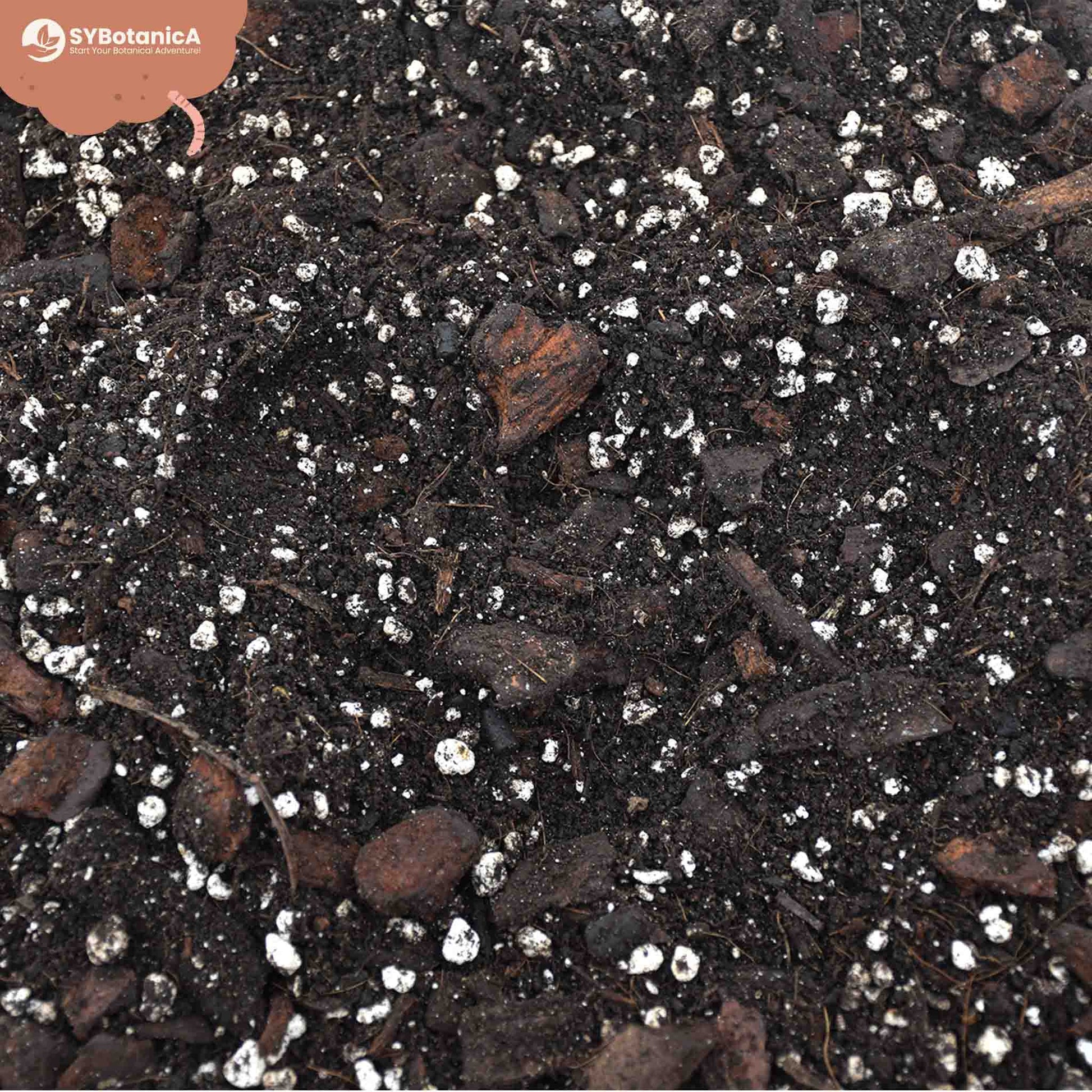
Como los Anthuriums son epífitos y generalmente tienen raíces más grandes, hay muchos chips de coco y corteza para permitir espacio para eso. Los Anthuriums son propensos a la pudrición, por lo que con el carbón activado y la perlita añadidos, se produce una combinación de aireación y purificación en el suelo en todo momento. Esto combate en gran medida el riesgo de pudrición de las raíces. ¡La mezcla perfecta para Anthurium!

    El hábitat original de las plantas de Anthurium

    El Anthurium es una planta de crecimiento lento que prefiere condiciones húmedas, generalmente se encuentra en bosques tropicales de América Central y del Sur. La mayoría de las especies de Anthurium son plantas trepadoras y tienen raíces gruesas y epífitas. Requieren una mezcla con grava y trozos más gruesos para soportar estas raíces.

    Cómo cuidar las plantas de Anthurium

    Como son nativas de selvas tropicales, prefieren mayor humedad y riego regular. A diferencia de la alocasia, debes dejar que los primeros centímetros de la tierra se sequen antes de volver a regar. Rocía regularmente tu anthurium si vives en un ambiente seco.

    Los Anthuriums prefieren luz brillante indirecta, la luz más brillante ayuda a producir flores grandes y saludables. No lo mantengas a pleno sol ya que las hojas se quemarán.

      Shipping Notes
      • Free Standard Shipping on $100+ Orders to the USA.
      • Except Preorder products are shipped in 48 hours.
      • Delivery to the USA:
      1. Standard Shipping : 3-10 business days
      • If time is of the essence, please consider selecting expedited delivery for faster service.
      Exchange/Return Notes
      • We offer a 30-day return/exchange service after receiving.
      • Final sale items are not eligible for returns or exchanges.
      • To process your return/exchange, please contact us at [email protected]
      • Please click here for more details>>> Return & Exchange Policy
      SKU: 50898501651

      Discover Niche Categories That Outsell sustrato anthurium

      Top-Converting Item to Boost Your Average Order

      4.7 ★★★★★
      Based on 10 reviews
      Sort
      Highest Rating
      Newest First
      Oldest First
      Product Reviews
      A
      Verified Purchase
      allison
      Draper, US
      ★★★★★ 5
      A great reference for Biblical factual archeology
      Format: Paperback
      I just received this book and I am so excited. It is a great tool and reference for Biblical studies. Each artifact has a great photograph next to the quick eye catching dates, discovery, period, keywords and Biblical passage. Then a brief but to the point description. It is simple and effective. Very easy to refer when reading your Bible or if you are just interested in archeology. Each artifact is about 2 pages and nothing more which is perfect for references. What a great book!
      WAS THIS REVIEW HELPFUL?YesReportShare
      Reviewed in the United States on March 1, 2025
      S
      Verified Purchase
      sandyrouse
      New York, US
      ★★★★★ 5
      Excellent and in-depth archeologic finds that authenticate Bible history.
      Format: Paperback
      Archeology is proving much of the Bible's history as true. This book really delves into various sites and provides a lot of detail. My type of reading.
      WAS THIS REVIEW HELPFUL?YesReportShare
      Reviewed in the United States on February 21, 2026
      A
      Verified Purchase
      Angie Criss
      Carnegie, US
      ★★★★★ 5
      Great information and pictures
      Format: Paperback
      Great information on Biblical sites, beautiful pictures, and a pretty book as well. I gave several of these to my family for Christmas. Everyone seemed to love them. The only thing I will caution you about is that the book is small.
      WAS THIS REVIEW HELPFUL?YesReportShare
      Reviewed in the United States on January 22, 2026
      M
      Verified Purchase
      Mareadas
      Charlottesville, US
      ★★★★★ 4
      Knowledgeable and delectable book.
      Format: Paperback
      This book shows an excellent archaeological evidence of the Bible accuracy of places, names, events, etc. and proving for the Christians that the Bible is a historical document as well as the inspired inerrant word of God. The majority of the book is interesting and delectable, I mean, the pages where the author presents archaeological facts such as the artifacts and their correlation with people, places times, events and practices recorded in the Bible. But I do not like when the author make personal assumptions and do not present any proof of that. He says: it probably be…. it may be… Here I show three cases of this conjectures;: 1.The author seems to affirm that the triumphal entry of Jesus into Jerusalem, or at least, the name of this event, was derived from the Roman triumph celebration. He says (page 231), regarding to the Roman Empire and the life of Jesus: “By the time of Jesus, the requirements and meaning of a triumphal entry had shifted slightly from its earlier roots associating it with a conquering hero, as it became even more significant and representative of kingship and divinity”. He continues to say: “In ancient Roman culture, a triumphant victor, known as vir triumphalis (“man of triumph”) would enter the city in a celebration parade wearing the laurel wreath and a purple garment, which identified him with the royal and the divine, while riding in a chariot pulled by four horses, alluding to Sol the sun god”.  But if we compare the Roman triumph celebration with the entry of Jesus into Jerusalem described in the Bible, it is not derived from the Roman culture but is the exact fulfillment of the prophesy of Zechariah 9:9. I do not see any correlation between the two celebration; Jesus did not ride a horse but a donkey to signify peace, meekness and humility. It was not a pompous entrance of a conquering hero or king wearing a expensive garment and royal crown. 2.Even though, it is not possible to identify the location of the tomb of Jesus with absolute certainty; the author states (page 199) that the tomb of Jesus is located at the Church of the Holy Sepulchre possible based on “the restoration work to the edicule and an arcosolium tomb from the Roman period found in the church of the Holy Sepulchre”. The author also affirms without giving any proof that: “Christians in Jerusalem then passed down a continuous memory of the location of the tomb (of Jesus) from the time of the burial and resurrection in AD33 until construction of the Church of the Holy Sepulchre was started in about AD326”. But where are the records of that time? The author probably based his statement on Eusebius who lived in the 3rd and 4th centuries AD. According to the history , the Church of the Holy Sepulchre was built by the Roman Emperor Constantine around 326 AD, when her mother the Queen Helena, wanted to replace the pagan temples with Christian churches; she met the Bishop Macarious of Jerusalem who determined the location where Jesus had been buried at the place where was a temple to the Greek goddess Venus. At the beginning of the construction of the church, a rock-cut tomb was found there and an edicule was built to protect the site. But later the edicule was destroyed and rebuild. More tombs has been found under this church. How to be sure or verify that this rock-cut tomb was the one where Jesus was buried? 3.The author is biased with respect to the Masoretic Text, he make a statement but does not support it with any evidence in this regard. Writing about the Dead Sea Scrolls (Page 173) he states: “And certain passages in the Masoretic text seem to have been intentionally modified to match ideas and theology of medieval Judaism.” it is a bad accusation.
      WAS THIS REVIEW HELPFUL?YesReportShare
      Reviewed in the United States on April 23, 2021
      H
      Verified Purchase
      Harold Lau
      Lowell, US
      ★★★★★ 5
      Great Worth
      Format: Paperback
      The Book That Must Be Read!
      WAS THIS REVIEW HELPFUL?YesReportShare
      Reviewed in the United States on April 18, 2026

      recommand products