SKU: 51714338681
where can i buy yucca plants near me

where can i buy yucca plants near me Buy Banana Yucca Phoenix, AZ | Yucca baccata

Sale price$18.32 Regular price$20.35
Save 10%

Pay in installments of $5.09 with ShopPay, AfterPay and Klarna

Shipping Estimate
USA
  • USA
  • CAN

Ships within 48 hours · Estimated delivery Oct 2 - Oct 7

Promo Codes Available:

For Your Every Summer RSVP, with Code: SUMMER15

Description

where can i buy yucca plants near me Buy Banana Yucca Phoenix, AZ | Yucca baccataArizona's Best Native Desert Accent Plant for Bold, Low Water Landscapes Banana Yucca (Yucca baccata) is one of the Southwest's most striking native perennials a sculptural rosette of bluish green, sword shaped leaves that commands attention in any desert garden. Incredibly drought tolerant once established, it laughs off Phoenix summer heat, reflected warmth from block walls, and caliche soil without missing a beat. Whether you're designing a

Arizona's Best Native Desert Accent Plant for Bold, Low-Water Landscapes

Banana Yucca (Yucca baccata) is one of the Southwest's most striking native perennials — a sculptural rosette of bluish-green, sword-shaped leaves that commands attention in any desert garden. Incredibly drought-tolerant once established, it laughs off Phoenix summer heat, reflected warmth from block walls, and caliche soil without missing a beat. Whether you're designing a xeriscape in Scottsdale, building a rock garden in Mesa, or adding native drama to a Chandler front yard — Banana Yucca delivers bold form with almost zero maintenance.

Banana Yucca Plant Details

Attribute Detail
Scientific Name Yucca baccata
Common Names Banana Yucca, Datil Yucca, Blue Yucca
Mature Height 2–3 feet
Mature Width 2–3 feet
Growth Rate Slow — 3–6 inches per year in Phoenix
Sun Full sun (6+ hrs). Handles reflected heat from walls and pavement.
Water Very low once established. Extremely drought-tolerant.
USDA Zones 5–11 (Phoenix is Zone 9b–10a)
Soil Well-draining. Thrives in rocky, sandy, and Arizona caliche soils.
Foliage Evergreen — bluish-green sword-shaped rosette year-round
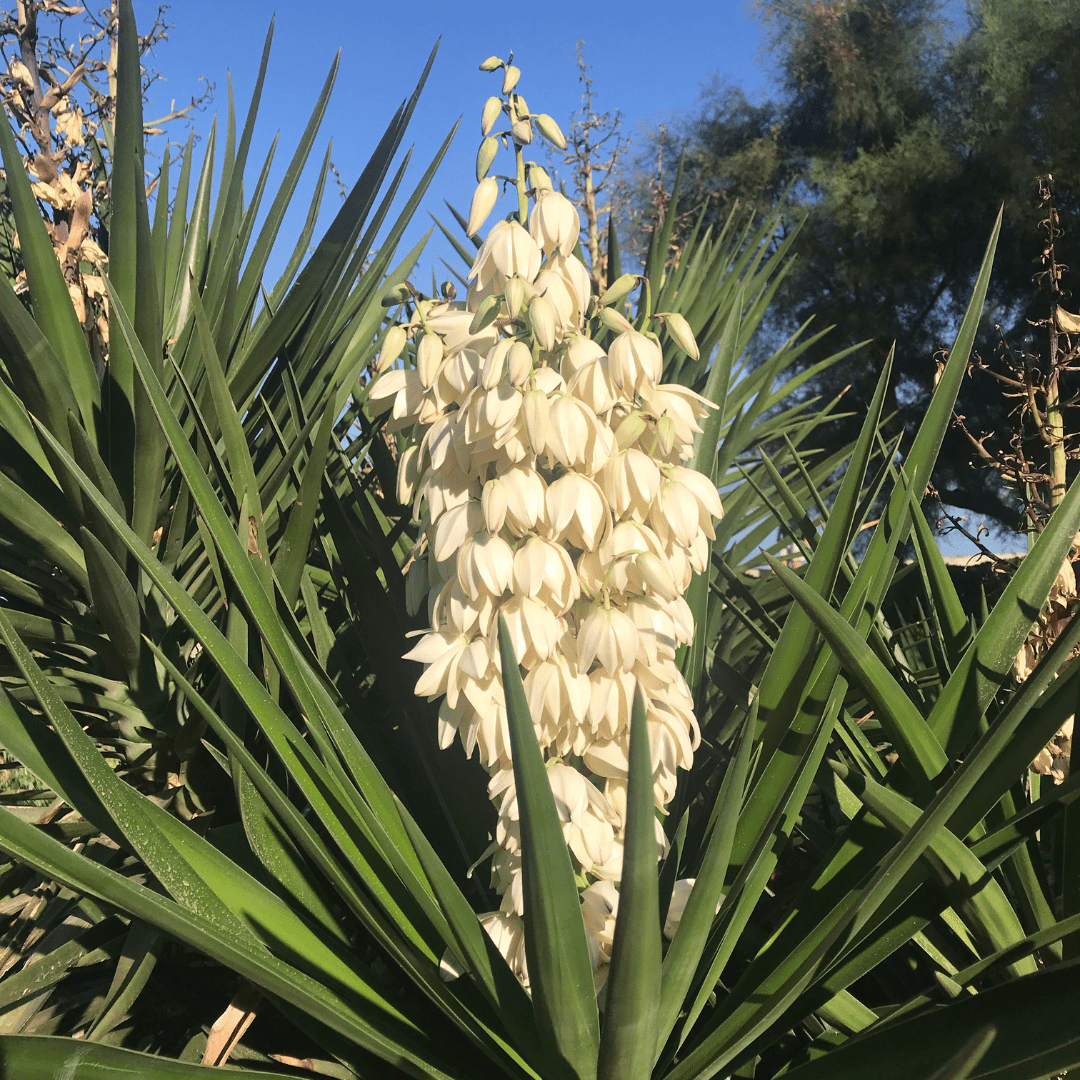
Bloom Color Creamy white to pale green, often tinged purple — spring/early summer
Fruit Banana-shaped, edible — sweet and fleshy
Native Status Native to the southwestern United States and northern Mexico

Banana Yucca Uses in Phoenix Landscapes

Sculptural Desert Accent

Banana Yucca's bold rosette form and blue-toned foliage make it a natural focal point in any desert-themed garden. Plant it among boulders, decomposed granite, or alongside barrel cacti for a striking, low-water composition that looks designer-level without the irrigation bill.

Rock Gardens & Xeriscape Beds

This plant was made for xeriscaping. Its compact 2–3 foot profile fits perfectly in rock gardens, gravel beds, and hellstrip plantings. Pair it with Desert Spoon, Agave, or Red Yucca for a layered, textural desert palette. Spacing: 3–4 feet apart for groupings.

Native & Edible Landscaping

The banana-shaped fruit is sweet and edible — a unique feature for homeowners interested in native food plants. Combine Banana Yucca with Desert Milkweed, Chuparosa, and Penstemon to create a native pollinator garden that also provides harvestable fruit.

Modern Desert Design

Banana Yucca's architectural silhouette pairs beautifully with clean lines, concrete planters, and modern hardscaping. Use it as a repeating element along walkways or as a single specimen in a courtyard planter for contemporary Scottsdale and Tempe homes.

Best Time to Plant Banana Yucca in Phoenix

Fall (October–November) is the ideal planting window. Soil stays warm enough for root growth while cooler air temperatures reduce transplant stress. Your Banana Yucca gets 6–8 months of root establishment before its first Phoenix summer. Spring (February–April) is the second-best window. Avoid planting in peak summer if possible.

How to Plant Banana Yucca

  1. Dig wide, not deep — 2–3x the root ball width, same depth as the container.
  2. Check for caliche — break through any hardpan layer so water can drain freely.
  3. Backfill with native soil — Banana Yucca prefers lean, unamended soil. A light 20% sand mix is fine if your native soil is heavy clay.
  4. Spacing — 3–4 feet apart for grouped plantings; 5+ feet for standalone specimens.
  5. Water basin — build a 3–4 inch ring of soil around the planting hole to direct water to roots.
  6. Mulch — 2–3 inches of gravel or decomposed granite. Avoid organic bark mulch close to the crown to prevent rot.

Watering Banana Yucca in Phoenix

First Year Watering Schedule

  • Weeks 1–2: Every 2–3 days, deep and slow (15–20 min drip)
  • Month 1–2: Every 5–7 days
  • Month 3–6: Every 10–14 days (7–10 days in peak summer)
  • After Year 1: Every 3–4 weeks in summer; little to no supplemental water in winter

Drip Irrigation

Place one 1-GPH emitter 12–18 inches from the base. Banana Yucca is extremely drought-tolerant once established — overwatering is the most common mistake. Established plants in the ground rarely need supplemental irrigation outside of extreme drought.

How fast does Banana Yucca grow in Phoenix?
Banana Yucca is a slow grower — expect 3–6 inches of height per year. The trade-off is an incredibly tough, long-lived plant that needs almost no care once established.

Is Banana Yucca drought tolerant?
Extremely. Once established (about 1 year in the ground), Banana Yucca can survive on rainfall alone in most Phoenix Valley locations. It's one of the most water-efficient accent plants available.

Are the fruits really edible?
Yes. The banana-shaped fruits are sweet and fleshy when ripe. They've been harvested and eaten by indigenous peoples of the Southwest for centuries. They can be eaten fresh, roasted, or dried.

Can Banana Yucca handle full reflected heat?
Absolutely. It thrives against south- and west-facing walls where reflected heat would stress most plants. It's native to some of the hottest, driest landscapes in North America.

What's the difference between Banana Yucca and other Yuccas?
Banana Yucca stays compact (2–3 ft) compared to taller species like Beaked Yucca. Its unique edible fruit and bluish foliage set it apart. The curly fibers along its leaf edges are another distinguishing feature.

You May Also Like

  • Beaked Yucca — A taller, trunking yucca that adds dramatic height to desert gardens.
  • Desert Spoon — Another sculptural rosette that pairs beautifully with Banana Yucca in xeriscape beds.
  • Red Yucca — Not a true yucca, but a perfect companion with coral-red flower spikes and similar water needs.
  • Adam's Needle — A cold-hardy yucca variety with striking white flower stalks.
  • Agave Americana — Bold blue rosettes that complement Banana Yucca's form in desert groupings.

How Many Banana Yucca Do I Need?

At a mature width of 2 to 3 feet, Banana Yucca works as a single specimen or in repeating groups. Space plants about 3 feet on center for a grouping, or give standalone specimens 5 feet of clearance. Use this guide:

Planting Goal Spacing & Count
Single accent 1 plant, 5 ft clearance
Rock-garden cluster Odd-numbered group of 3 to 5 at 3 ft centers
Repeating walkway rhythm About 1 plant every 3 ft along the run

Set the stiff, sharp-tipped rosettes at least 2 feet back from walkways and seating areas.

Banana Yucca Season-by-Season in Phoenix

  • Spring (Feb–Apr): Tall creamy, purple-tinged flower stalks rise in spring to early summer, drawing pollinating yucca moths. A strong second planting window.
  • Summer (May–Sep): Thrives in extreme and reflected heat against south and west walls. Edible banana-shaped fruit ripens through the warm season. Needs little water.
  • Fall (Oct–Nov): The prime planting season, giving roots months to settle before summer. Slow steady growth continues.
  • Winter (Dec–Jan): Fully evergreen and very cold-hardy (USDA Zone 5). No frost protection is needed anywhere in the Valley. The blue rosette holds its form year-round.

At a Glance

✔ Arizona Native   ✔ Heat-Loving (Reflected-Heat Tolerant)   ✔ Drought-Tolerant   ✔ Evergreen   ✔ Low-Maintenance   ✔ Pollinator-Friendly   ✔ Edible   ✔ Deer & Rabbit-Resistant   ✔ Cold-Hardy to -10°F

Plant It With

  • Beaked Yucca: a taller trunking yucca that adds height behind the compact rosette.
  • Desert Spoon: a silver sculptural rosette that echoes the form in a xeriscape bed.
  • Red Yucca: coral flower spikes and matching water needs for a layered grouping.
  • Adam's Needle: a white-flowering yucca with curly leaf filaments for textural contrast.

Is Banana Yucca Right for Your Yard?

Banana Yucca thrives in full sun and reflected heat, needs sharply draining soil (break through caliche), and survives on rainfall once established. As an Arizona native it is cold-hardy, edible, and essentially maintenance-free. Not a fit right along a busy walkway or play area, where the stiff, sharp leaf tips are better set back into a bed.

Shipping Notes
  • Free Standard Shipping on $100+ Orders to the USA.
  • Except Preorder products are shipped in 48 hours.
  • Delivery to the USA:
  1. Standard Shipping : 3-10 business days
  • If time is of the essence, please consider selecting expedited delivery for faster service.
Exchange/Return Notes
  • We offer a 30-day return/exchange service after receiving.
  • Final sale items are not eligible for returns or exchanges.
  • To process your return/exchange, please contact us at [email protected]
  • Please click here for more details>>> Return & Exchange Policy
SKU: 51714338681

Discover Niche Categories That Outsell where can i buy yucca plants near me

Top-Converting Item to Boost Your Average Order

4.5 ★★★★★
Based on 26 reviews
Sort
Highest Rating
Newest First
Oldest First
Product Reviews
W
Verified Purchase
WU.
Birmingham, US
★★★★★ 4
Good overview of the leading Agentic Framework. Will become outdated quickly.
Format: Paperback
3.5 Stars rounded up. Not a bad place to start if you need to get up to speed fast with Claude Code, understand its vast feature set, how it works under the hood, best practices, and the various agent primitives and how to get the most out of them. Agentic frameworks (Claude Code in particular) are quickly becoming table stakes for anyone working in tech, so it's best to start now. I appreciated the author's ability to flesh out areas where Anthropic's documentation is lacking in depth and nuance, and for some not already working with Claude in their own repos, the fact that he provides "toy" repos where one can experiment with the tools without fear of consequence. Where the book falls short is that most of the stuff in here is already covered pretty well already in Anthropic's docs, or even better so in their free "Skilljar" courses. What's more, some areas are given a bit of a shallow treatment, while others are a bit better done. So it's a bit inconsistent in that sense. Also, I can see how this book will quickly lose its currency in a few months at the pace things are going. Ultimately, for me, the price of this book was a bit rich for my liking given the criticisms above. Still, I feel like I got valuable info that rounded up what I already knew from working with this agentic framework. Recommended.
WAS THIS REVIEW HELPFUL?YesReportShare
Reviewed in the United States on May 28, 2026
B
Brahmananda Reddy
Alexandria, US
★★★★★ 5
Practical AI Engineering Beyond Prompts — One of the Better Books on Agentic Coding
Format: Paperback
This book is not another “AI coding hype” book. A lot of books talk about agents at a very high level. This one actually explains how things work when you try to use them inside real development workflows. That was the biggest difference for me. What I liked most was the focus on context engineering, memory, MCP, hooks, subagents, and workflow orchestration instead of just “prompt better.” The author spends time explaining why long-running agent systems fail, how context grows over time, and why most AI coding setups become messy without structure. The examples also feel practical — The HookHub project, Next.js setup, GitHub workflows, Claude memory files, and MCP integrations make it easier to connect theory with actual implementation. From my retail domain experience perspective, I could immediately connect this to forecasting and pricing workflows. For example: * agents helping analysts generate specs before model development * automated code review for promo forecasting pipelines * isolated subagents for pricing, promotions, assortment * persistent memory for business rules across teams * MCP integrations to pull context from internal systems safely The section around context isolation and subagents especially stood out because that is very similar to how enterprise forecasting teams already operate in reality. Different teams own different decision spaces. One thing I appreciated: the author does not oversell AI. There is a strong focus on constraints, context pollution, hallucinations, performance degradation, and workflow reliability. That makes the book feel grounded instead of marketing-heavy. This is not for complete beginners though. If someone has never worked with Git, APIs, coding agents, or LLM workflows, parts of the book may feel overwhelming early on. The author clearly says this is not beginner-level content. Overall, probably one of the more practical books I have read recently on agentic coding systems. Good for: * software engineers * AI engineers * enterprise architecture teams * technical product teams * analytics leaders trying to operationalize AI development workflows Especially useful if your organization is trying to move from “AI demos” into actual production workflows.
WAS THIS REVIEW HELPFUL?YesReportShare
Reviewed in the United States on May 20, 2026
U
UA
Waukegan, US
★★★★★ 5
A Good Reality Check on How AI Agents Actually Work in Enterprise Systems
Format: Paperback
Most AI books stop at prompts. This one goes deeper into how agent systems actually behave once you try to use them inside large workflows with memory, tools, permissions, automation, and multiple agents working together. That part felt very relevant for healthcare and enterprise environments. The book does a good job explaining why context engineering matters and how poor context handling creates hallucinations, inconsistent outputs, and degraded performance over time. Honestly, that is one of the biggest problems organizations underestimate right now. In healthcare workflows, context matters a lot: * prior interactions * business rules * auditability * escalation logic * safety constraints * tool permissions * workflow boundaries The sections on persistent memory, scoped context, subagents, and structured workflows connected strongly to that reality. I work in enterprise analytics, and while reading this book I kept thinking about use cases like: * pharmacy workflow automation * prior authorization support systems * coding assistants for healthcare engineering teams * AI copilots for operational analytics * agent-based escalation systems * claims and workflow orchestration The MCP chapters were also useful because they explain integration challenges clearly instead of treating tooling as magic. What made this book stand out for me was the balance between implementation and architecture. The author explains: * why long contexts fail * how context poisoning happens * why isolation matters * when parallel agents help * when they actually create more complexity That level of honesty is missing in many AI books right now. Another thing: the examples are not overly academic — The Next.js project setup, GitHub automation, Claude desktop workflows, memory systems, hooks, and subagents make the learning process feel practical and hands-on. One limitation: this book assumes technical background. Someone completely new to coding agents, LLMs, Git, or development workflows may struggle in the first few chapters. But for engineers, AI teams, enterprise architects, and technical leaders trying to understand where agentic coding is actually going, this book is worth reading. Especially for organizations trying to operationalize AI safely instead of just experimenting with chatbots.
WAS THIS REVIEW HELPFUL?YesReportShare
Reviewed in the United States on May 20, 2026
C
Christopher West
Omaha, US
★★★★★ 5
Great book! Practical and for developers that already use AI!
Format: Paperback
I purchased "Agentic Coding" by Claude Code due to my desire for an alternative to generic "Prompt Template" type resources related to AI-based development. This book accomplishes just that. As opposed to merely viewing Claude Code as a "magic box", the author has explained how to utilize it in conjunction with other actual development processes. The authors' emphasis on "context engineering" (i.e., structuring data/information; managing knowledge in a project; guiding an AI agent to produce consistent results vs. producing random/unknown results) represents the strongest component of the book. It should be noted that the book appears to be intended primarily for experienced developers with prior experience in software development and/or familiarity with AI-based development tools. Should you be familiar with Git, the command-line interface, and/or modern development processes, you may find this resource very helpful. Conversely, I did appreciate the fact that there were no novice-oriented descriptions provided throughout the book. The aspect of the book that I found most valuable, however, is the extremely pragmatic nature of the material contained within. The examples illustrated through developing/maintaining CLAUDE.md files; utilizing Claude Code in combination with GitHub Workflows; employing MCP Servers; and creating multi-agent or sub-agent workflows all seemed to reflect a clear focus on "real world usage" rather than theoretical constructs. In addition, each chapter builds upon previous chapters in such a manner as to provide a logical progression through which the reader can easily understand and ultimately implement the concepts learned. I also appreciated that the author included guidance on responsible utilization of the tool(s), as well as maintaining control over what changes are made by the agent. While numerous books regarding AI focus solely on what AI tools can accomplish, this book addresses both how to utilize these tools effectively in a real codebase, as well as responsibility and safety considerations. In summary, this is not a book for individuals completely inexperienced in either programming or generative AI. However, if you are currently experimenting with tools such as Claude, Cursor, GitHub Actions, or MCP, this is likely one of the more useful and practical books available on the subject. Recommended for software engineers seeking to transition from simply "prompting an AI" into establishing a repeatable/professional workflow process surrounding agentic coding.
WAS THIS REVIEW HELPFUL?YesReportShare
Reviewed in the United States on April 11, 2026
P
Paul Pollock
Grantham, US
★★★★★ 4
⭐⭐⭐⭐ (so far)
Format: Paperback
I'm maybe a third of the way through this and already rethinking how I talk to coding agents. The reframe from "prompt engineering" to "context engineering" sounds like semantics until Marco walks you through why context poisoning, context clash, the Goldilocks zone for system prompts. That chapter alone reorganized something in my head. I keep going back to the line about garbage in, garbage out being the real reason agentic systems underperform. The hands-on stuff lands well too. Building the HookHub project from scratch, wiring up Playwright MCP, watching Claude generate a CLAUDE.md file and then not automatically loading a memory file you just created — that moment where you expect magic and get silence instead? That's the kind of honest teaching I appreciate. It made the "why" behind memory hierarchies click.
WAS THIS REVIEW HELPFUL?YesReportShare
Reviewed in the United States on May 12, 2026

recommand products