SKU: 52104242459
do spider lilies bloom every year

do spider lilies bloom every year Peppermint Spider Lily (Lycoris incarnata)

Sale price$26.49 Regular price$29.43
Save 10%

Pay in installments of $7.36 with ShopPay, AfterPay and Klarna

Shipping Estimate
USA
  • USA
  • CAN

Ships within 48 hours · Estimated delivery Oct 3 - Oct 8

Promo Codes Available:

For Your Every Summer RSVP, with Code: SUMMER15

Description

do spider lilies bloom every year Peppermint Spider Lily (Lycoris incarnata)The Lycoris incarnata is often called "Peppermint Spider Lily." As soon as you see the bloom, you know why. The blooms look like peppermint sticks where a deep pink stripe runs down the middle of each white petal. These lovely blooms are fascinating and unique. They work best in zones 5b 8a. How they bloom: Lycoris incarnata "Peppermint Spider Lily" bulbs bloom differently than most flowers. Now is a perfect time to plant these bulbs. These bulbs need

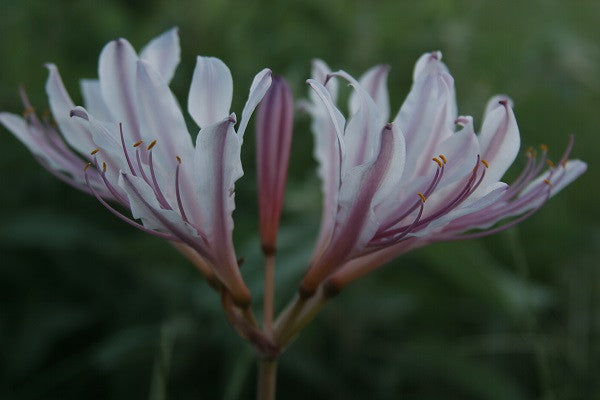
The Lycoris incarnata is often called "Peppermint Spider Lily." As soon as you see the bloom, you know why. The blooms look like peppermint sticks where a deep pink stripe runs down the middle of each white petal. These lovely blooms are fascinating and unique. They work best in zones 5b-8a.

How they bloom: Lycoris incarnata "Peppermint Spider Lily" bulbs bloom differently than most flowers. Now is a perfect time to plant these bulbs. These bulbs need 1-2 years after they are planted before presenting blooms. Your bulbs are developing a strong root system right now to support future foliage and eventually blooms. You might see the foliage this February - May, but don't be concerned if you don't. Most people still expect to see something growing during the summer months. You won't see anything. These bulbs are dormant in the summer. After 1-2 years, the flowers suddenly appear with the first later summer and early fall rains. One day there is nothing growing and then suddenly you have a surprise, a fully blooming flower! This bulb acts very similarly to red spider lilies, yellow spider lilies, and schoolhouse lilies. Simply put, they bloom in the fall and then have foliage for the winter.

Foliage: Let's talk foliage for a moment. The "Peppermint Spider Lily" foliage is a lovely green, and will look great by itself in the spring or mixed in with spring blooms. We know that we all want to see the beautiful unusual blooms in the late summer, but the foliage is very important. The foliage is what allows the bulb to grow and multiply. Many people get very concerned if they don't see the bloom the first year that they plant it and believe that maybe the bulb isn't any good. A good rule for perennial bulbs....if the bulb is firm when you plant it, it is healthy and will eventually come up. The foliage is what you watch for since the bulbs aren't going to bloom for 1-2 years. The foliage will grow during the winter months, February - May, so be sure to plant the bulbs where they will receive at least 6+ hours of winter sun. Even if the foliage gets hit by a winter cold snap, it will have taken in nutrients for months! Always allow the foliage to die down naturally and don't cut it off. If you cut it, you are killing the bulb. Once the foliage is completely dead which is usually around the beginning of May, this area can be mowed. Remember, it takes a lot of energy for the bulb to push that bloom up out of the ground and open wide. The more time the bulbs can take in nutrients, the more energy they will have for that fall bloom.

Just a thought...if it looks like you are going to have a cold snap and want to protect your foliage, you might consider covering it with a bucket and then removing the bucket once the daytime temperatures warm up.

Blooms: When talking about color, these unique blooms have been compared to the crinum "Milk and Wine" blooms. Each petal is white with a dark pink stripe running down the center. The blooms will appear late August or early September on a naked stalk like the other Lycoris. In late summer, each bulb sends up an 16-20 inch stem that holds several blooms. Each stalk will hold 6-8 frilly-edged blooms. It may take 1-2 years before the blooms appear, but the show it produces in late summer is spectacular. Once established in your garden they are there for a lifetime! These blooms need water to bloom. They respond to the late summer rains well, but if there is a hard drought, be sure to begin watering the area around the beginning of August to help the bulbs have enough energy to bloom. A naked stalk will rise quickly and a few days later peppermint-colored blooms will appear.

Plant: Don't plant the bulb too deep. You will plant the bulbs 2-3 times deep the height of the bulb (so if your bulb is 1" tall, then you will plant it 2-3 inches deep). Because they bloom on a naked stalk, they look better when planted in groups. You can plant the bulbs close together (2-4 inches apart) to make the blooms look more natural or spread the bulbs out and allow 6-8 inches in between each bulb. The area will look sparse the first couple of years that the blooms come up, but the bulbs will multiply and fill in several years after that.

Lycoris bulbs really do well in any type of soil except full clay. They thrive in soil that has plenty of organic material mixed in but they do not require fertilizer. Newly planted bulbs would actually be harmed by exposure to fertilizer, so if you are going to apply nutrients, limit the application to established plants when the plants are producing their green leafy foliage during the winter. After planting the bulbs, water the soil thoroughly. Damp soil is ok, as long as the bulbs are in a spot where they will receive plenty of winter sun and the foliage is allowed to die down naturally in the spring. Standing water is not good. Once the summer season starts these bulbs will do best in soil that dries out a bit, as this facilitates its entry into the dormant stage when the leaves die back. This period is followed by its blooming season when it will reward daily watering with long-lasting blooms. Too much moisture in the soil will lead to the bulbs rotting.

**The following picture is of Lycoris squamigera, Naked Ladies, which are in the same family, but it gives you ideas on how you can plant them.

Sun Requirements: The single most important thing about landscaping with Lycoris is the sun. They need at least 6+hours of WINTER sun. That means about 6-8 hours of sunlight during the winter months - they do great with full winter sun. Because they are dormant during the summer, the amount of summer sun doesn't matter; however, Lycoris incarnata blooms will last a little longer and tend to appear a little earlier when they bloom in the summer shade. They fade more quickly when in full hot summer sun.

The Lycoris all have the same requirements of the sun. If you look at the photo above of the Lycoris squamigera "Naked Lady" blooms, you will see that they are in the shade of the trees. You can be sure that most, if not all, of those trees, will lose their leaves in the winter when the greenery needs sunlight. Lycoris put on their foliage during the winter (February - April) and that is when it takes in the nutrients it needs to produce the blooms in September. The winter foliage soaks up sun energy during winter as it prepares for summer dormancy. The foliage normally completely dies down around May.

Bulbs to use with Lycoris: There are an assortment of perennial flower bulbs that go well with Lycoris blooms. When the bloom appears in late August or early September, it will look great with rain lilies and other spider lilies. The foliage makes a great backdrop for spring bloomers like Narcissus Jonquils, campernelles, twin sisters, and snowflakes.

Shipping Notes
  • Free Standard Shipping on $100+ Orders to the USA.
  • Except Preorder products are shipped in 48 hours.
  • Delivery to the USA:
  1. Standard Shipping : 3-10 business days
  • If time is of the essence, please consider selecting expedited delivery for faster service.
Exchange/Return Notes
  • We offer a 30-day return/exchange service after receiving.
  • Final sale items are not eligible for returns or exchanges.
  • To process your return/exchange, please contact us at [email protected]
  • Please click here for more details>>> Return & Exchange Policy
SKU: 52104242459

Discover Niche Categories That Outsell do spider lilies bloom every year

Top-Converting Item to Boost Your Average Order

4.7 ★★★★★
Based on 13 reviews
Sort
Highest Rating
Newest First
Oldest First
Product Reviews
A
Verified Purchase
Alex McLeod
Birmingham, US
★★★★★ 5
Great for vitamin D levels
Size: 60 Count (Pack of 1)
Easy to swallow, small size. Decent taste. Wonderful quality. Vitamin D needs fats for the body to help absorb it and this product has that. I used this when raising my vitamin D levels. Ingredients are clean and it's not hard on my stomach. I definitely recommend
WAS THIS REVIEW HELPFUL?YesReportShare
Reviewed in the United States on August 12, 2025
A
Verified Purchase
Aisha S. Tiller
Grantham, US
★★★★★ 5
Quality
Size: 60 Count (Pack of 1)
Vitamins are the best vegan option available at this time, which is not made with coconut oil.
WAS THIS REVIEW HELPFUL?YesReportShare
Reviewed in the United States on May 13, 2026
T
Verified Purchase
TommyC
Charlottesville, US
★★★★★ 5
Really effective supplement combo I trust
Size: 60 Count (Pack of 1)
I've been very happy with this vitamin D3 and K2. The plant-based D3 and vegan K2 are great for my health. Max absorption with organic olive oil makes a difference. I feel better overall, and my bones and heart seem healthier. The 60 softgels pack is convenient. Overall, a high-quality product I recommend.
WAS THIS REVIEW HELPFUL?YesReportShare
Reviewed in the United States on August 11, 2025
S
Verified Purchase
Sophia Bezirganian
Los Angeles, US
★★★★★ 5
Most Illuminating Psych Book I've Read
Format: Hardcover
As a psychiatrist, I have yet to read a more illuminating book on how mental illnesses can develop, and how to help patients' to become free of them. Existential Psychotherapy presents a theory of the existential forces that drive all human beings--knowledge of death, of our aloneness in the world, and of "meaninglessness" (the utter inconsequence of our one life in the entirety of the universe). It shows how these forces are powerful influences in shaping human mental health and illness. Other reviewers here point out that the basic existential issues Yalom presents are well-known to academics and to many literate people who are exposed to them in that good, broad, liberal arts education we (still?) get in college. But what Yalom achieves in this book, has not to my knowledge been accomplished before (nor since): a presentation of these ideas to an audience of clinicians in a lucid, beautifully written, way that is salient to the daily practice of psychotherapy. Yalom is a rare psychiatrist who is not only a master of the art of teaching and practicing psychiatry, but for this book, ventured into philosophy, literature, history, and sociology, and then integrated the wisdom each brings to the study of human nature, into a clear and cohesive whole, a beautifully written theory of the existential dimension of men's fears, drives, and actions, and how this dimension creates mental illness or health, depending on how each person handles it. What is amazing is how such a book is now buried in the archives of (relative) obscurity, while others, recycling the same old tired ideas, reign on. So what do these lofty insights in Yalom's book contribute that is unique and powerful to us lowly practitioners toiling daily in our offices in the (seemingly more banal) task of helping patients with daily crises, complaints, resistance to change, and painful repetitions of self-destructive life choices? One very important tool: a true understanding of the power of existential concerns, not only in creating mental illness and self-destructive life paths, but, by shining a light on them-- capturing that elusive force of change: MOTIVATION. This force, and how to harness it to help patients overcome their suffering, has for me been one of my greatest challenges as a doctor. And one for which most books on psychotherapy have fallen short in helping me tackle. In the sections "death" and "will", (two of the four main sections in the book), Yalom forges a path that I could follow, to help my patients free themselves of the fears that block motivation for change. In short, Yalom shows how the anxiety about, (and thus avoidance of) awareness of our death and aloneness, can cripple us into denial, and resistance to changing those of our behaviors that shield us from these truths. But, these very fears, when faced and reframed--as the awareness of one's finite limits, and of the freedom that comes along with one's aloneness, become extremely potent engines for change. Other peoples' judgements, and fear of failure, lead us to believe that the human "judges" are the most important threat in our lives. But in Yalom's world, these feared judgements pale in comparison to the the consequences of inaction. When we live with acute awareness that we waste our only life when we are beholden to judges who are after all, mortal and alone just like us, this can shake us up to MOVE and LIVE, in this finite life, in a way other insights cannot. This example of how avoidance of existential fears leads to anxiety, low self-worth, and depression, is but one vignette in this book. Yalom applies his theory to the gamut of mental illness, and includes discussion of how narcissism, perversions, obssessions, masochism, sadism, ...the list goes on, are fueled by existential concerns. Yalom argues that they all boil down to one of two main strategies we humans employ to "forget" Death, Aloneness, and Meaninglessness: Either we escape too much into the protective cover of the GROUP, and become mindless group robots who drone through life until illness, or loss forces us to suddenly face our mortality, at which point many of us panic, or become depressed, OR, we get sucked into this defiant delusion : "I am SPECIAL"...smarter, more rebellious, unfettered by the social conventions of meek men, thus free of death's jaws". This reaction then can lead to reckless, impulsive, pseudo "powerful" behaviors that are often the fuel of many "acting out" mental problems: addiction, sociopathy, sadism, and narcissism. Enough of my words-read and feel the power of Yalom's words in this great book.
WAS THIS REVIEW HELPFUL?YesReportShare
Reviewed in the United States on April 4, 2006
S
Verified Purchase
Searching the Stars
Battle Creek, US
★★★★★ 5
A Great Work on the Dynamics of the Human Condition
Format: Hardcover
Irvin Yalom, Professor Emeritus at Standford in psychiatry, has written a masterful book on the human condition (published in 1980). "Existential Psychotherapy" is singularly one of the best books I have ever read. Why? Yalom has combined 1) his intellectual insights in psychology with 2) his practical observations in therapy with 3) existential thought. He seeks to show that much of the anxiety we face as human beings, and seek comfort for in psychotherapy (or religion), originates from the existential facts of being a mortal, free being. He focuses on four main areas: death (our inner structure will go to nothing), freedom (we are forced to make momentous decisions without full information), isolation (we are alone in many fundamental ways) and meaninglessness (we don't have a clear picture of what it really means). From literature, psychology, philosophy and some theology (Tillich), Yalom has created a definitive text on what it means to open our eyes fully to our existential situation. It is not a depressive text, as the goal is to come to terms with our condition. And ironically, facing the truth of death, for example, makes life richer. This is much more than a self-help book, it is a philosophical-psychological masterpiece. I have a Ph.D. in the philosophy of religion and have published several articles in leading journals and don't give out the kind of praise I am giving here easily. It is one of the best books I have ever read, and I think a wide range of people would profit from it. Yet it's a difficult book, not an easy self-help read. But Yalom is such a clear writer that most readers could follow it. When he uses technical psychological or philosophical terms, he usually explains them. Otherwise, the dictionary must be used. This text would be helpful for people in the helping professions in giving an existential aspect to their work. Religious thinkers and those interested in philosophy should pick it up at any cost. Any educated person could profit from it greatly. It's a long text, and I had to break it up by carefully reading some from each of the main four parts simultaneously to get a view of the whole. It's a bit dry at times, but thoughtful, perceptive, educational in many fields, --it's ....wisdom literature....I can't think of a higher compliment.
WAS THIS REVIEW HELPFUL?YesReportShare
Reviewed in the United States on March 19, 2013

recommand products