Pay in installments of $7.02 with
 ,
,
 and
and

Shipping Estimate
USA
- USA
- CAN
- USA
- CAN
Ships within 48 hours · Estimated delivery Oct 3 - Oct 8
 Promo Codes Available:
For Your Every Summer RSVP, with Code: SUMMER15
Description
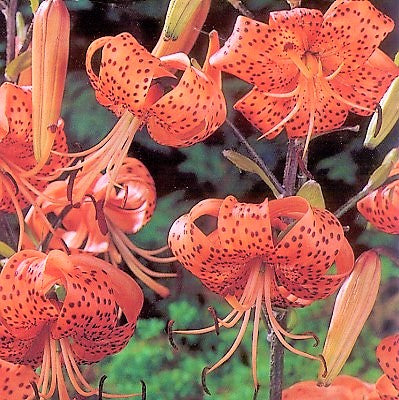
different types of tiger lilies Tiger Lily Species LilyLilium Tigrinum (lancifolium) is an heirloom favorite, quite properly known as the "Tiger Lily" of "Grandma's garden" fame. It has large unscented pendant orange flowers with black spots and recurved tips. It is a notoriously vigorous grower and naturalizes easily, producing a big crop of stem "bulblets" every year and aerial bulbils (resembling black beads thickly arranged along the stem). Once they develop rootlets, these bulbils can be easily
Lilium Tigrinum (lancifolium) is an heirloom favorite, quite properly known as the "Tiger Lily" of "Grandma's garden" fame. It has large unscented pendant orange flowers with black spots and recurved tips. It is a notoriously vigorous grower and naturalizes easily, producing a big crop of stem "bulblets" every year and aerial bulbils (resembling black beads thickly arranged along the stem).
Once they develop rootlets, these bulbils can be easily raised to blooming size, in fact will plant themselves if allowed to drop to the ground. If you seek a rapidly-propagating lily, this one's FOR YOU! In the Orient this species is raised for its edible bulbs (delicious in veggie stir-fry dishes. Very enduring and virus-resistant. We barely keep up with the revival of demand for this hard-to-get species. 16-18 cm bulb size. Choose between 1 bulb or a 3-pack.
Once they develop rootlets, these bulbils can be easily raised to blooming size, in fact will plant themselves if allowed to drop to the ground. If you seek a rapidly-propagating lily, this one's FOR YOU! In the Orient this species is raised for its edible bulbs (delicious in veggie stir-fry dishes. Very enduring and virus-resistant. We barely keep up with the revival of demand for this hard-to-get species. 16-18 cm bulb size. Choose between 1 bulb or a 3-pack.
Botanical name: Lilium lancifolium 'Splendens'
Form: Perennial
Hardiness Zone: 3-9
Flower Color: Orange/black spots
Foliage Type: Linear, green leaves arranged in whorls or spirals up the stems
Bloom time: July-August
Height: 3-4 ft
Spread: 12 inches
Light requirements: Full or partial sun
Plant depth: 6 inches of soil over top of bulb
See "Growing Tips" for more detailed instructions
Form: Perennial
Hardiness Zone: 3-9
Flower Color: Orange/black spots
Foliage Type: Linear, green leaves arranged in whorls or spirals up the stems
Bloom time: July-August
Height: 3-4 ft
Spread: 12 inches
Light requirements: Full or partial sun
Plant depth: 6 inches of soil over top of bulb
See "Growing Tips" for more detailed instructions
Tips and Growing Instructions
Visit our How-To Cultivation Library for more growing tips.
Species lilies, also known as Tiger Lilies, are wild lilies, native to North America, Europe, and Asia. Delicate and full of charm, there are 80 - 100 accredited Species. Most species lilies do not require specialized care and will naturalize themselves very well. They are very adaptable to most soil conditions and environmental conditions, and they do quite well in warm, moist climates with fertile soil. Tiger Lily bulbs for the most part are smaller than hybrid varieties, but will produce good quality stems and a lot of blooms. Their delicate, beautiful flowers are quite showy and most will bloom for long periods compared to other lilies.
Lilies are incredibly easy to grow and few garden pests trouble them. The most natural location for lilies is on sloping ground with excellent drainage. Lilies prefer to have their blooms in the sun and their roots in the shade. Try planting them among annuals or perennials that will keep their roots cool.
The general rule of thumb for planting spring bulbs is to plant two to three times as deep as the bulb is tall. This means that some of our larger Bulb-Zilla lily bulbs will need to be planted 6-8 inches deeps. Plant with the roots downward and the scales upward. After planting, water well two or three times. Lilies are most effective when planted in groups of three or more. Space them about a foot apart – they will spread and fill this space in no time!
Always allow the leaves on the stalk to turn yellow and fall off as part of the lily’s natural growth process. This ensures that the bulbous underground part of the plant has gotten enough nourishment and will mean greater growth next year. Each year watch their beauty increase as they multiply!
Visit our How-To Cultivation Library for more growing tips.
Species lilies, also known as Tiger Lilies, are wild lilies, native to North America, Europe, and Asia. Delicate and full of charm, there are 80 - 100 accredited Species. Most species lilies do not require specialized care and will naturalize themselves very well. They are very adaptable to most soil conditions and environmental conditions, and they do quite well in warm, moist climates with fertile soil. Tiger Lily bulbs for the most part are smaller than hybrid varieties, but will produce good quality stems and a lot of blooms. Their delicate, beautiful flowers are quite showy and most will bloom for long periods compared to other lilies.
Lilies are incredibly easy to grow and few garden pests trouble them. The most natural location for lilies is on sloping ground with excellent drainage. Lilies prefer to have their blooms in the sun and their roots in the shade. Try planting them among annuals or perennials that will keep their roots cool.
The general rule of thumb for planting spring bulbs is to plant two to three times as deep as the bulb is tall. This means that some of our larger Bulb-Zilla lily bulbs will need to be planted 6-8 inches deeps. Plant with the roots downward and the scales upward. After planting, water well two or three times. Lilies are most effective when planted in groups of three or more. Space them about a foot apart – they will spread and fill this space in no time!
Always allow the leaves on the stalk to turn yellow and fall off as part of the lily’s natural growth process. This ensures that the bulbous underground part of the plant has gotten enough nourishment and will mean greater growth next year. Each year watch their beauty increase as they multiply!
Shipping
Sorry, we do not ship outside the U.S. or to Hawaii due to agricultural restrictions.
We guarantee safe arrival of healthy bulbs, that varieties will be true-to-name, and will grow if planted as instructed, subject to the limitations described in our Shipping and Returns Policy.
We begin shipping our bulbs in mid-February through Spring. Despite what you may have heard, Spring planting of bulbs is not a bad thing, and in fact, there are many advantages to planting in Spring. Visit our Spring Planting page to learn more. Upon arriving, your bulbs and most of your perennials may show signs of growth such as green leaves and sprouts - this is okay and transportation during this time should not harm the plants.
All bulbs and perennials should be planted in your garden as soon as possible to ensure the best success. If you must delay planting, open the bags to permit air circulation and place them out of direct sunlight in a cool, well-ventilated room. Do not place the bulbs where they can freeze. If you have the space, storing the bulbs in the refrigerator is another excellent way to “hold them” prior to planting. If you choose this method of storing your bulbs, be sure not to store fruit with them, as this is detrimental to bulbs.
Plant outdoors when the ground is no longer frozen and the conditions have improved for your zone.
If you have any questions or concerns our customer service team would be glad to help you at any time. Please use our contact form, email us at [email protected], or call us at 541-671-3196.
Shipping Notes
- Free Standard Shipping on $100+ Orders to the USA.
- Except Preorder products are shipped in 48 hours.
- Delivery to the USA:
- Standard Shipping : 3-10 business days
- If time is of the essence, please consider selecting expedited delivery for faster service.
Exchange/Return Notes
- We offer a 30-day return/exchange service after receiving.
- Final sale items are not eligible for returns or exchanges.
- To process your return/exchange, please contact us at [email protected]
- Please click here for more details>>> Return & Exchange Policy
4.1 ★★★★★
Based on 20 reviews
Sort
Product Reviews
★★★★★ 4
Textbook
Format: Paperback
There was plenty of work put into this book and a lot of research. The reason why I did not give the fifth star is due to the reading of the book. To me I felt like I was back in school reading a textbook which after a time became tedious. It started to get to the point of reading too fast just to get the pages to go by. I probably missed some information as I found the book boring at times. The advice that I would give somebody is to read the book slowly and not to read too many pages and then put it down to pick it up another day. This way you can absorb the information better.
WAS THIS REVIEW HELPFUL?YesReportShare
Reviewed in the United States on March 3, 2026
★★★★★ 5
The Unalterable Truth
Format: Paperback
The publisher's description of this book claims that there would be a severe reaction within American society due to the facts Professor Stannard brought to light. There was, unfortunately yet not unexpectedly, not much of a response to the horrifying truths revealed in his compelling narrative on the fate of the Western Hemisphere's indigenous people. Most Americans simply do not seem to care whether their nation's history, from the moment Columbus set foot in "The New World" and claimed that the people he encountered would make good slaves to the immediate present, is bathed in copious amounts of indigenous people's blood. The European's behavior when they were unleashed upon the unsuspecting Native Americans reveals not only their homicidal nature and destructive approach to a relatively pristine world; but their unfathomably horrid and continuous attempts to keep the destruction and death going. Extermination was the name of the game and even a cursory glance at the American newspapers of the nineteenth century reveals a national psychology which leaves one in a vast and endless state of confusion and disbelief. But it's all true. The phrase, "The Final Solution" was coined by nineteenth century Americans, not Hitler's Germany. Tens of millions perished, an eternal food source, the buffalo herds, were almost rendered extinct and while all this was occurring the people of Africa were chained to their masters' bidding. The people of Iraq understand. So do the Vietnamese and now the Syrians and many, many, many more. Of course, on publication Dr. Stannard was labeled a crank for mostly revealing that American "exceptionalism" is merely a high falootin' excuse for mass death and destruction.
WAS THIS REVIEW HELPFUL?YesReportShare
Reviewed in the United States on August 27, 2017
★★★★★ 5
Horrifying but it is a must read
Format: Paperback
This book should be required reading for all high-school students rather than the friendly history books that treat Columbus as a hero. This man was a murderous psychopath. Strong words but after reading this powerful text you will agree. I am ashamed at what these monsters from Spain, and England and elsewhere did soon after Columbus "discovered" the Americas. And all of the sacred knowledge lost. Everything the Mayans wrote down was burned. Knowledge from prehistory--all gone. All of the knowledge from prehistory the Indians in the Amazon basin held, all of the technology on agriculture, building, medicine, sacred knowledge, and much more gone. And for what?
I cannot tell you how powerful this book is. I cannot get it out of my head. If you think black lives matter well, sorry folks indigenous Indians of the New World MATTER MORE. They should be rioting for compensation from Spain and England. Oh, I forgot, nobody's left to riot.
It was a complete deliberate genocide killing perhaps 80 million paleo-indians from the 15th century on. And they are still killing the rest of them in Mesoamerica and esp. the Amazon where oil and mineral companies are murdering the remainder. And nobody seems to care! Read this book and learn the truth finally.
WAS THIS REVIEW HELPFUL?YesReportShare
Reviewed in the United States on September 19, 2020
★★★★★ 5
In 600yrs. , life itself, is elusive
Format: Paperback
American Holocaust or books related to the Native American should be required reading. The carnage or genocide, on the inflicted erased thousands of years of culture. We have lost so much which makes us, all less. Hispaniola, had a population of 8,000,00, in 1496. By 1535 they were extinct. Equivalent to N.Y. city today. Spanish and British. One looking for gold, the latter imposing European values, to steal land. But what was most fascinating, the religious hypocrisy. To kill, enslave, torture in the name of God. Who snatches babies from their mother, and feeds them to dogs, hanging natives from a gibber, and burned alive, brand enslaved women's faces every time they are resold ? The British and Spanish were the "Very ministers of Hell".
WAS THIS REVIEW HELPFUL?YesReportShare
Reviewed in the United States on November 19, 2023
★★★★★ 5
Academic / Thought-Provoking
Format: Paperback
They Were Her Property: White Women as Slave Owners in the American South is a powerful, eye-opening work that challenges long-held assumptions about slavery and gender in American history. Stephanie E. Jones-Rogers thoroughly dismantles the myth that white women were passive or marginal participants in the institution of slavery. Through meticulous research and extensive use of primary sources, including legal records, letters, and testimonies from formerly enslaved people—the book reveals that many white women were active, knowledgeable, and often brutal slave owners in their own right.
What makes this book especially compelling is how it centers the voices and experiences of enslaved people to expose the economic, legal, and physical power white women wielded. Jones-Rogers shows that white women not only benefited from slavery but also enforced it, defended it, and used it to build wealth and social status. The writing is clear, authoritative, and accessible, making complex historical arguments understandable without oversimplifying them.
This book is an essential read for anyone studying American history, slavery, race, or gender. It forces readers to confront uncomfortable truths and rethink narratives that have long softened or excused the role of white women in slavery. They Were Her Property is both academically rigorous and deeply impactful—a necessary contribution to honest historical understanding.
WAS THIS REVIEW HELPFUL?YesReportShare
Reviewed in the United States on December 16, 2025