SKU: 54155523690
dracaena trifasciata seeds

dracaena trifasciata seeds African Spear Plant 'Sansevieria cylindrica'

Sale price$22.19 Regular price$24.66
Save 10%

Pay in installments of $6.17 with ShopPay, AfterPay and Klarna

Shipping Estimate
USA
  • USA
  • CAN

Ships within 48 hours · Estimated delivery Aug 4 - Aug 9

Promo Codes Available:

For Your Every Summer RSVP, with Code: SUMMER15

Description

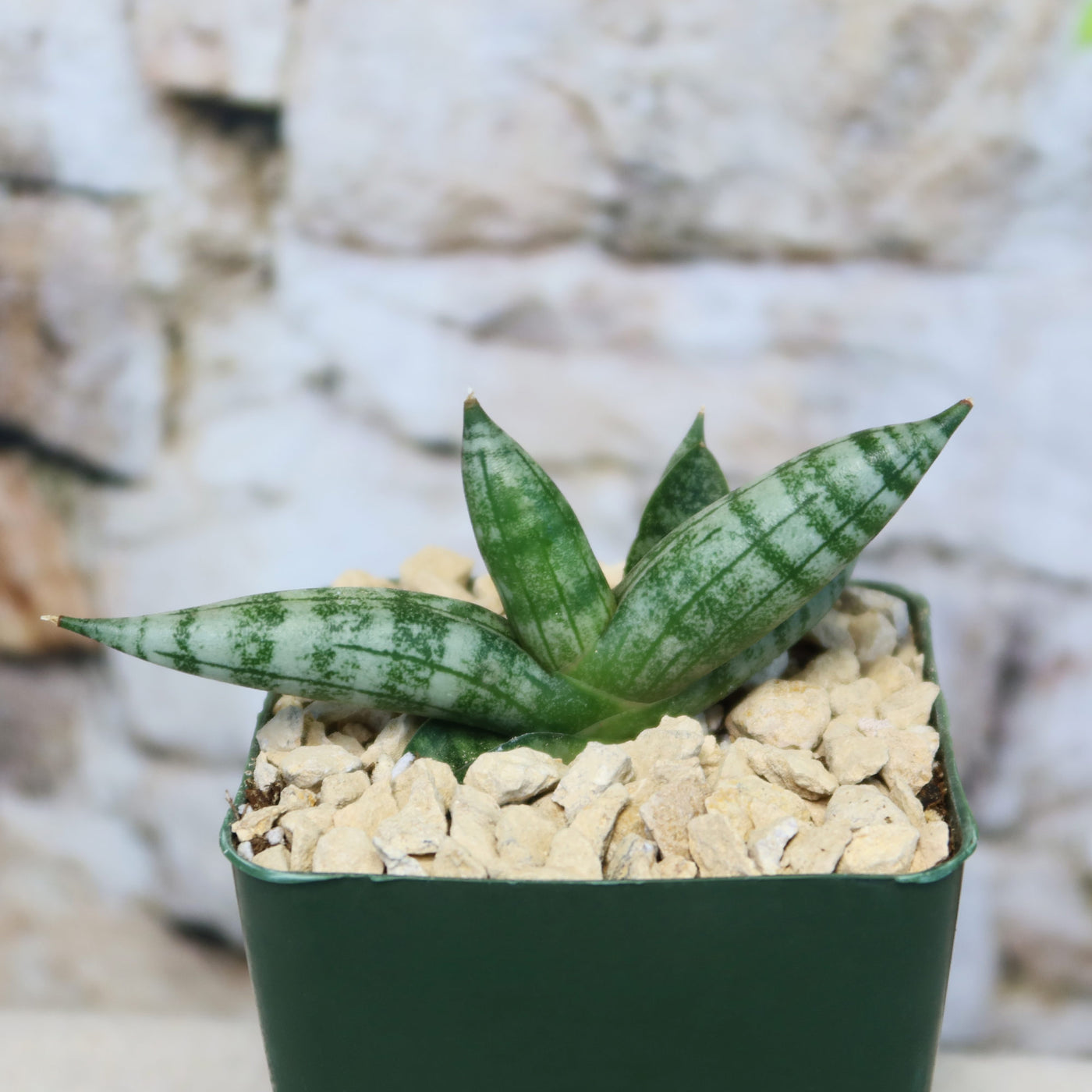
dracaena trifasciata seeds African Spear Plant 'Sansevieria cylindrica'Get ready to be amazed by the African Spear plant, also known as Sansevieria cylindrica (Dracaena angolensis), one of the snake plant varieties and a vibrant member of the Sansevieria genus! It has many other common names, including cylindrical sansevieria, the cylindrical snake plant, the Starfish sansevieria, the bow string hemp, dragon fingers, and pencil Sansevieria. This snake plant does not have ordinary upright, dark green leaves; they are

Get ready to be amazed by the African Spear plant, also known as Sansevieria cylindrica (Dracaena angolensis), one of the snake plant varieties and a vibrant member of the Sansevieria genus! It has many other common names, including cylindrical sansevieria, the cylindrical snake plant, the Starfish sansevieria, the bow-string hemp, dragon fingers, and pencil Sansevieria. 

This snake plant does not have ordinary upright, dark-green leaves; they are horizontally striped and have an extraordinary cylindrical fan shape that tapers to a fine point at its tips.The single leaf of this spear sansevieria can grow up to 7 feet tall and up to 1.4 inches wide. 

In the right conditions, these extraordinary Sansevieria plants might surprise you with a small creamy-white flower spike shooting up from their center. While the cylindrical snake plant flower is not the largest or most colorful among its succulent family, it does have a distinct, sweet-smelling, and pleasing fragrance. These delicate white blooms dance in the air like tiny fairies spreading joy and enchantment everywhere they go. It's simply magical! 

Remember, these cylindrical snake plants are mildly toxic for humans and pets, so, it's important to keep them away from children and pets. It is the simplest way to multiply and propagate Sansevieria cylindrica plants. You can either adopt the division or the leaf-cuttings method of Sansevieria cylindrica propagation. While this slow-growing succulent is known to live longer than most other succulents provided it is kept in a warm and well-lit position. 

Watering Needs 

Native to Africa, the African spear succulent plant doesn't need much water to thrive. In fact, it's best to water the Sansevieria cylindrica plant only when the soil is completely dry, which can be once every two to three weeks. When you do water your Sansevieria plants, be sure to do so thoroughly, allowing the water to soak into the soil. Be careful not to overwater it, as this can cause root rot, which can be fatal to the plant. 

But come wintertime (dormant period), you can cut back to every two weeks or less. And get this - any type of water (except hard water) will work just fine! So, whether you use tap or filtered, or even rainwater, your cylindrical snake plant will thrive in no time. Just remember to avoid hard water since this African spear plant doesn't like lime very much. 

Light Requirements 

The African spear plant, or Sansevieria cylindrica survives in bright full sunlight but can also tolerate low light conditions. It's best to avoid direct afternoon sunlight, as this can burn the leaves. 

If you're growing the African spear indoors, place it near a north-facing window that gets plenty of bright, indirect light. If you're growing it outdoors, be sure to provide it with some shade during the hottest part of the day. Without enough light, photosynthesis rates drop, leaves become thin, colors appear dull, there is an unhealthy look to the plant, and growth is stunted. 

Optimal Soil Needs 

The Sansevieria cylindrica prefers soil that's well-drained and rich in organic matter. A good potting mix for this African spear should be a combination of peat moss, perlite, and sand. You can also add some compost or aged manure to the soil to provide additional nutrients. Planet Desert has got your back with our specialized succulent potting mix that includes 5 natural substrates with organic mycorrhizae perfect for promoting healthy roots and happy plants. 

When it comes to fertilizing this Sansevieria, it's best to use a slow-release fertilizer that's high in nitrogen. You can fertilize the plant once a year during the growing season, which is typically from spring to fall. Avoid over-fertilization as it can lead to the death of your stunning succulent. 

Hardiness Zone & More 

Typically grown in hot, arid desert regions, the Sansevieria cylindrica thrives indoors in warm, dry surroundings. If you live in USDA regions 9 to 11, you can also grow these Sansevieria plants outdoors year-round, but they are not cold- or frost-tolerant, so you should plant them indoors or put them in a pot and move them indoors during the winter if you live outside of these regions. 

Keep your African spear plants away from cold, drafty windows and air vents if you are growing them indoors in a cold climate. 

We think you will love this Sansevieria plant order your very own Sansevieria cylindrica - African spear or cylindrical snake plant today and start enjoying its beauty in no time! 

Shipping Notes
  • Free Standard Shipping on $100+ Orders to the USA.
  • Except Preorder products are shipped in 48 hours.
  • Delivery to the USA:
  1. Standard Shipping : 3-10 business days
  • If time is of the essence, please consider selecting expedited delivery for faster service.
Exchange/Return Notes
  • We offer a 30-day return/exchange service after receiving.
  • Final sale items are not eligible for returns or exchanges.
  • To process your return/exchange, please contact us at [email protected]
  • Please click here for more details>>> Return & Exchange Policy
SKU: 54155523690

Discover Niche Categories That Outsell dracaena trifasciata seeds

Top-Converting Item to Boost Your Average Order

4.3 ★★★★★
Based on 25 reviews
Sort
Highest Rating
Newest First
Oldest First
Product Reviews
A
Verified Purchase
A. Kassahun
Phoenix, US
★★★★★ 5
Must read book on African colonial sociology and politics
Fanon describes the character of (European) colonialists, the colonised Africans (the "masses" - rural and urban, the elites, the nationalists, the tribalists) wonderfully. The book is wonderfully written - Fanon must have been a good writer. Fanon is a psychiatrist, and worked in Algeria as psychiatrist, but he many have travelled other African countries too. His book shows his deep knowledge of both African and European sociology, psychology and politics. The book is still relevant; his analysis as to what will happen after the liberation of African countries is amazingly valid. He is in a way one of the most important African (though he is born in Latin America) sociologist and political scientist. Fanon's book starts on "violence", he doesn't shy away from prescribing violence in the struggle for liberation. Some find Fanon advocating violence, but that is not the case. He puts in perspective the violence perpetrated by colonists against the resulting reaction that culminates in the violence of the colonised. His clear analysis demystifies the violence that still grips Africa. Unfortunately Fanon seems to put all European in Africa as colonists. Many cases from South Africa show that that should not be the case. But his views may be due to the brutal repression he has to witness and experience in Algeria by the French government and French citizens there.
WAS THIS REVIEW HELPFUL?YesReportShare
Reviewed in the United States on March 13, 2010
R
Verified Purchase
Roman P.
Lake Worth, US
★★★★★ 5
Colonialism not dead yet
This is a review of the 2004 Grove paperback edition of Frantz Fanon’s The Wretched of the Earth The Wretched of the Earth is the most famous work of Algerian revolutionary Franz Fanon (1925-1961) finished and published shortly before his death (he died of leukemia). Fanon is known above all as a theorist of revolutionary violence and a champion of its therapeutic good for the oppressed. However, this book is not about armed struggle only; it covers many other topics: theory of class conflict in colonies, revolutionary process and subjects of social change in the Third World, the future of new independent states (former colonies), strategies of building Third World—First World relations in a right way, the relationship between the struggle for national culture and national liberation struggles, consequences of colonialism for both the colonizer and the colonized, etc. It’s a book of an angry man; the author's revolutionary pathos and standing with the oppressed (‘the wretched of the earth’) are noticeable. Though Fanon wrote his book drawing on the experience of the Africa of the 1950s an acute reader can easily notice similarities and parallels with what’s going on in the underdeveloped countries all over the world. The book can be of particular use for anthropologists, historians, philosophers, sociologists, as well as for those interested in cultural studies. I prefer Richard Philcox’s translation to the one published in 1963. Citizens of the global South can skip Jean-Paul Sartre’s preface; let the author speak for himself.
WAS THIS REVIEW HELPFUL?YesReportShare
Reviewed in the United States on September 17, 2019
R
Verified Purchase
R. Schwenk
Natrona Heights, US
★★★★★ 4
Influential and Insightful
Frantz Fanon's The Wretched of the Earth is an important document in the history of imperialism capturing the state of the Algerian revolution and the struggle for independence in the Third World at a crucial time. The year was 1961, and the book was published just before Fanon's premature death. Algeria was a year away from independence. The Congo had just achieved a travesty of independence. The Cuban revolution was still fresh. Fanon was born in Martinique but was fully committed to the Algerian cause by the end of his life. His insights into the pitfalls threatening newly-independent nations have proved to be uncannily accurate. His voice is of his time and ahead of his time. I would recommend this book to those wanting to learn more about the Algerian War and to those curious about the huge effect of this book on the leftists of the 1960s.
WAS THIS REVIEW HELPFUL?YesReportShare
Reviewed in the United States on September 28, 2013
P
Verified Purchase
padre viejo
Port Orchard, US
★★★★★ 5
A SIXTIES CLASSIC WE HAVE MOVED ON FROM OR BACK OF/
Format: Paperback
i am 90 years old. i was a student in the 60s but i had already served in the military so i was already in my 30s. Which meant with a wife and twins i was more concerned with earning a living and finishing my doctorate than participating BUT it was a time when we swung one way as a nation and we were part of the post war swing of the world. The world had developed empires, WW1 began their downfall, ww2 pretty much finished the rest BUT it opened the door for new imperialism. On one hand colonialism melted away. The greatest empire ever, the British faded to legend and an island itself breaking up. American imperialism sprouted along with Soviet. And now China and Russia. One old model, Russia, one new model China. But the world i cyclical not progressive so China may become another imperial power. Fanon is an antidote as are other writers of the 60s so good to see new editions. Many rebels are now out of print. History is always ignored but it is always present.
WAS THIS REVIEW HELPFUL?YesReportShare
Reviewed in the United States on July 12, 2022
R
Verified Purchase
Ra Shemsu Heru Drakes
Charlottesville, US
★★★★★ 5
An Important Text for All Those Engaged in The Struggle
Format: Paperback
The type of text that can bring about a breakthrough in consciousness, it places world affairs in perspective for the seeker of an authentic African consciousness.
WAS THIS REVIEW HELPFUL?YesReportShare
Reviewed in the United States on May 19, 2025

recommand products