SKU: 55792000444
century plant indoors

century plant indoors Variegated Century Plant

Sale price$26.16 Regular price$29.07
Save 10%

Pay in installments of $7.27 with ShopPay, AfterPay and Klarna

Shipping Estimate
USA
  • USA
  • CAN

Ships within 48 hours · Estimated delivery Oct 3 - Oct 8

Promo Codes Available:

For Your Every Summer RSVP, with Code: SUMMER15

Description

century plant indoors Variegated Century PlantIntroducing the variegated century plant, also known as Agave americana 'Variegata or Agave americana 'Marginata', a stunning variety of Agave americana. Agave americana is commonly referred to as a century plant because it was once believed that it took 100 years for the plant to bloom. However, this is a common misconception. The variegated century plant blooms light green yellow flowers once in its lifetime after it has reached maturity. This can

Introducing the variegated century plant, also known as Agave americana 'Variegata or Agave americana 'Marginata', a stunning variety of Agave americana. Agave americana is commonly referred to as a century plant because it was once believed that it took 100 years for the plant to bloom. However, this is a common misconception.

The variegated century plant blooms light-green yellow flowers once in its lifetime after it has reached maturity. This can take anywhere from 10 to 30 years, depending on light, temperature, and humidity. Being monocarpic, the mother plant dies after blooming.


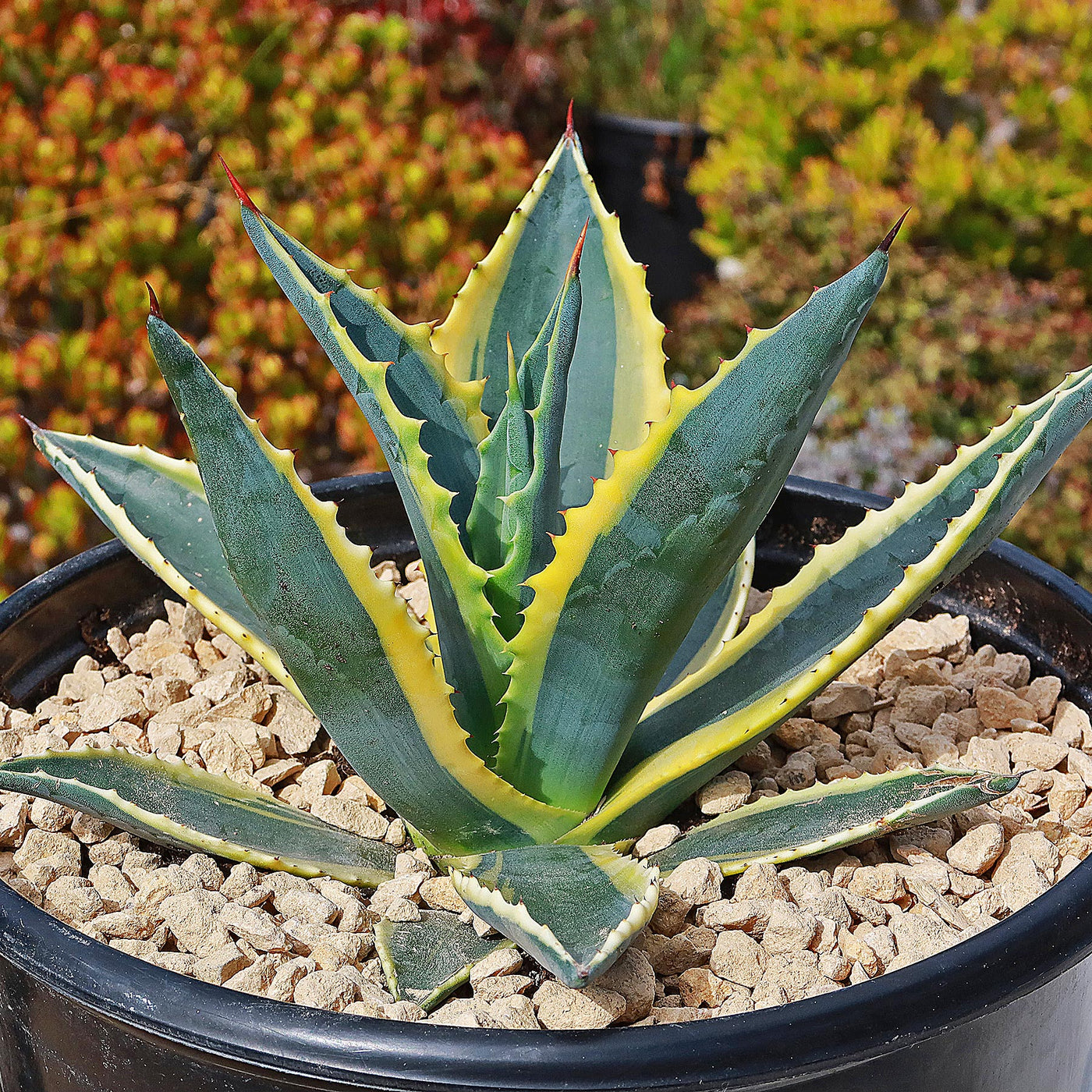
The twisted, silvery-green leaves of this variegated century plant form a large rosette, and the leaf margins have bright yellow stripes that resemble a striped ribbon.

Its stiff, rosette-shaped, sword-like leaves grow upright, and the mature plant can reach a height of 6 feet and 10 feet wide. Each leaf has a pointed, spiny tip and is armed with tiny brown hooks.

This variegated century plant will grow a bit smaller than other Agave Americans but is still bigger than the one with white stripes.

Native to Mexico, there are numerous variegated forms of Agave americana,Go to agave americana, each with distinctive names and leaf types.

This stunning variegated century plant is sure to stand out in any garden, adding a touch of exotic beauty to your outdoor oasis.

This variegated Century plant is incredibly low-maintenance, requiring low water and very little attention from you. Whether you're an experienced gardener or just starting out, this variegated century plant is perfect for anyone who wants a gorgeous addition to their collection without all the fuss.

Watering Needs 

This variegated century plant, like other succulents, is drought-tolerant by nature, and its fleshy, water-storing leaves can hold a lot of water.  However, their root structure is easily susceptible to overwatering, so make sure that you don't overwater, as it can lead to root rot and fungal infections. 

When this variegated Americana agave is dormant in the winter, reduce watering to once every 4–6 weeks, soaking it completely.  During the growing season in summer, water the agave century plant once every 2–3 weeks.

In spite of the right watering frequency, variegated century-plant succulent roots can be damaged if the soil is not fast-draining.  Allow the pot and soil to dry out thoroughly between waterings. 

Light Requirements 

When grown indoors, place your variegated century plant in the sunniest place in your house. This variegated agave century plant may benefit from shade in consistently hot climates. It is ideal to grow this variegated century plant in a west- or south-facing window. 

For outdoor cultivation, ensure that your Agave americana variegata thrives, provide it with 8–10 hours of direct light and a minimum of 5–6 hours of survivable bright light; the variegation of creamy yellow margins will be more pronounced in brighter light.

Remember, these variegated century plants thrive best in bright, sunny environments. It cannot tolerate full shade or low light. So, the variegated agave americana should be planted in full sun outdoors. 

Optimal Soil & Fertilizer Needs 

Are you ready to take your Agave Americana Variegata game to the next level?  When it comes to choosing the right soil and fertilizer for your adorable agave plants, you need to be extra cautious and use the right kind of sandy soil.  Moisture can be a real killer, leading to root and stem rot in no time flat. But fear not my fellow green thumbs! Planet Desert has got your back with our specialized succulent potting mix that includes organic mycorrhizae, perfect for promoting healthy roots and happy variegated century plants. 

When it comes to fertilizing your variegated agave americana, it only needs a small amount of fertilizer applied once a year in the spring. Variegated Century plants prefer a fertilizer with lower doses of NPK, with a maximum ratio of 5-10-5 that is higher in phosphorus than nitrogen. 

Hardiness Zones & More 

When growing indoors, your variegated century plants thrive best in temperatures between 65-75 degrees Fahrenheit. It is important to avoid extreme temperature fluctuations to prevent stress on the plant.

For outdoor cultivation, this variegated century plant can tolerate mild frost but does best in sunny, warm climates. The Agave Americana variegata is not entirely cold-hardy, though.  Generally, these can be grown in the garden in USDA zones 8–11 and can tolerate temperatures down to 20 F, but your variegated century plants may suffer damage if exposed to prolonged periods of freezing temperatures.

So, if you live in an area with cold winters, it's best to protect these variegated century plants by covering them with a frost cloth or moving them indoors during the coldest months. 

Final Thoughts

Overall, this variegated century plant, Agave americana 'Variegata' is quite a hardy succulent plant that is suitable for beginners to grow in the garden and as houseplants. Their growth rate is slow, and they tend to last for many years. For variegated plant care, it prefers planting in well-draining soil, providing ample sunlight, and watering sparingly. Additionally, fertilizing with a balanced liquid fertilizer during the growing season can help promote healthy growth and vibrant foliage.

We think you will love this plant – order your very own Agave Americana variegata for sale today and start enjoying its beauty in no time!

Shipping Notes
  • Free Standard Shipping on $100+ Orders to the USA.
  • Except Preorder products are shipped in 48 hours.
  • Delivery to the USA:
  1. Standard Shipping : 3-10 business days
  • If time is of the essence, please consider selecting expedited delivery for faster service.
Exchange/Return Notes
  • We offer a 30-day return/exchange service after receiving.
  • Final sale items are not eligible for returns or exchanges.
  • To process your return/exchange, please contact us at [email protected]
  • Please click here for more details>>> Return & Exchange Policy
SKU: 55792000444

Discover Niche Categories That Outsell century plant indoors

Top-Converting Item to Boost Your Average Order

4.6 ★★★★★
Based on 7 reviews
Sort
Highest Rating
Newest First
Oldest First
Product Reviews
E
Verified Purchase
evelyn
Chelsea, US
★★★★★ 5
Purse companion
Size: 27 Count (Pack of 1)
I carry these lozenges in my purse. It tastes good, and truly helps with dry mouth!
WAS THIS REVIEW HELPFUL?YesReportShare
Reviewed in the United States on May 22, 2026
S
Verified Purchase
Sher
Cuba, US
★★★★★ 5
Great lozenge! Tastes very good.
Size: 27 Count (Pack of 1)
Very effective and tastes good. I will continue using it after my chemo treatment is finished.
WAS THIS REVIEW HELPFUL?YesReportShare
Reviewed in the United States on May 1, 2026
S
Verified Purchase
Shop Queen
Whiting, US
★★★★★ 3
Dry mouth is miserable.
Size: 27 Count (Pack of 1)
The mouth lozenges for dry mouth were excellent at first, but I have dry mouth all day, and they started upsetting my stomach. I guess I was taking too many. Since I switched to the spry, I don't have a problem. I keep the a small bottle of the spray in my pocketbook, because I need it sporadically. It is probably different with each individual.
WAS THIS REVIEW HELPFUL?YesReportShare
Reviewed in the United States on April 11, 2026
R
Verified Purchase
Rusky
Lake Worth, US
★★★★★ 5
Well researched, solidly faithful; undoes the harm of decades of scholars' attempts to debunk the Gospels
Format: Hardcover
Lots of reviewers have written great reviews, so this one will be fairly brief. Brant Pitre's books, this one included, are an example of what is best in the new scriptural studies emerging today. His research is solid and meticulous - no sloppiness here! - and he writes with a refreshingly strong Catholic faith. This book carefully and effectively undoes the harm of decades of scholars' attempts to debunk the Gospels. He very effectively rebuts 20th century scholars' claims that we don't know who wrote the Gospels, and that they were written so long time after Jesus' time on earth that they lack credibility as eyewitness, historical accounts. Step by step, with each chapter building on the next, Pitre shows the opposite to be true. Christians who have been disturbed by the debunkers will be strengthened, confirmed, and given much joy by this book. I've just purchased three more copies to give to friends - one of them a Catholic high school teacher and two, Catholic priests. But I think Christians of any denomination will welcome this book. Pitre's writing style is a joy to read: lucid, clear, and very easy to understand (even when I'm tired at the end of the day), without being annoyingly clever (as some popularizers can be) or pushy (as some apologists are). (I see Pitre as neither a popularizer nor an apologist; he is a scripture scholar who also is a fantastic communicator.) Without any attempt on his part to be "entertaining," Pitre has written a cliff-hanger - I couldn't put the book down! His insights - and now I'm speaking of the insights in all three of his books that I've read so far - Jesus and the Jewish Roots of the Eucharist, Jesus the Bridegroom, and this book, The Case for Jesus - are profound and deeply enriching spiritually. Although I've questioned a few of his insights, most of them have moved me profoundly, with a sense of wonder, and deep love and gratitude to Our Lord. Reading his books is, for me, a real form of prayer. I am looking forward to reading Jesus and the Last Supper (borrowed from the library to see whether I'll want to buy my own copy); this last book, per its reviewers, is aimed at a scholarly audience and different in tone from the three very accessible books I named above, but I'm expecting this book to be a treasure, too. In all of his books, Brant Pitre's lucid writing style, coupled with his solid scholarship, deep faith, and beautiful love for Our Lord, makes for a very special reading experience. I appreciate his respect for and great knowledge of Judaism, and the way he helps us to see the rich continuity between the Jewish and Christian faiths. Brant Pitre’s books are a real gift to us all.
WAS THIS REVIEW HELPFUL?YesReportShare
Reviewed in the United States on January 27, 2017
M
Verified Purchase
M. L. Asselin
Chelsea, US
★★★★★ 5
Who is Jesus: A Case for Jesus’ Divinity
Format: Hardcover
I thoroughly enjoyed reading Brant Pitre’s “The Case for Jesus.” The New Testament scholar’s contribution to Catholic popular literature on the identity of Jesus stands well above much of the plethora of material available to Christian readers today. Pitre (mostly) convincingly builds his case through careful, fact-based argumentation--even if one could draw different conclusions from the same evidence. What case is Pitre trying to make? In effect, he makes several cases leading up to his central point of who Jesus was and is. In the first part of this slim volume, he treats the authorship of the Gospels. In this matter, as in most of the book, his principle foil seems to be Bart Ehrman, a former Fundamentalist Christian-turned-apostate scholar whose popular works attempt to undermine the validity of the Gospels as meaningful historical documents and specifically the claim that Jesus is the Son of God. Contrary to Ehrman, Pitre argues for the traditional authorship of the Gospels. As two significant pieces of evidence, Pitre points out that even the earliest Gospel manuscripts and secondary references to the Gospels include the writers’ names by which we know them. The Gospels, then, were never really “anonymous.” This leads Pitre to challenge the scholarly consensus on the dating of the Gospels, and the more controversial hypothesis that Matthew and Luke were based in part on a hypothetical, now lost (and, as Pitre points out, never referenced) book of Jesus sayings denoted by scholars as the “Q” source. As for the so-called lost or apocryphal gospels, Pitre shows that they were never really lost, that most of them were known by early Christian writers, who regarded them as forgeries. In the case of the apocryphal gospels, then, even though the internal evidence suggests that they were written by the apostles to whom they were ascribed, the attributions were never accepted. Ehrman has argued that the apocryphal gospels were not accepted by mainstream or orthodox Christianity, but were embraced by the communities, such as the Gnostics, for whom they were written. In a way, Pitre and Ehrman aren’t in contradiction here, but they just interpret the data differently. In other words, if you accept that the Church Fathers are espousing the correct version of Christianity, then Pitre’s point stands; if you hold on to the view that the Church Fathers represented one view of Christianity among many, all to be regarded equally, then the criticism of the (orthodox) Church Fathers matters less. Pitre, while not dismissing the validity of literary criticism, argues for the historical value of the Gospels. He wants to treat the Gospels as biographies of Jesus. Their inconsistencies and apparent contradictions stem not, as Ehrman would have it, from a “telephone game”-like process of accretions and alterations over time, or even so much from the requirements of the communities for which they were written, as from the different perspectives and life experiences of their writers. Pitre notes the similarities between the Gospels and ancient Greco-Roman biographies in countering the ideas of Ehrman and before him, Rudolf Bultmann, in thinking of the Gospels as akin to folktales, fairy stories, and myths. Pitre stands for the literal truth of the Gospels as far as they will allow in part because two of the four Gospels tell us that they are true (Lk 1:1-4; Jn 19:35, 21:24-25). There’s a bit of circularity in that argument. The main case for Jesus that Pitre wants to make is for His divinity. The Gospels, as Luke Timothy Johnson and other scholars have explained, try to answer, however obliquely, the question Jesus himself poses to Peter: “But who do you say that I am?” (Mk 8:29). Pitre makes the case that the Gospels--even the synoptic Gospels--speak to Jesus’ being God. Pitre makes a lively, even entertaining, argument, using some passages, e.g., the reference to the sign of Jonah, in ways I certainly hadn’t thought of before. Even though as a Catholic I accept Jesus’ divinity, I am willing to allow that others may look at Pitre’s argument and reasonably come to different conclusions. One train of thinking might be this: Pitre notes that Jesus speaks in parables and riddles, and so His claims to divinity are indirect. Moreover, an outright and indeed blasphemous claim to His divinity might have put an even earlier end to Jesus’ three years of ministry. But the Gospel writers should not have been constrained by either Jesus’ particular application of rhetoric or his need to be circumspect; why did the Gospel writers not forthrightly declare that Jesus was God? I think the proper response to this is that Matthew, Mark, Luke and John wanted the person encountering the Gospels to answer for themselves who Jesus was and is. In other words, by transmitting the way Jesus conveyed who He was to His disciples perhaps they, too, would draw in and win over later followers of Christ. It’s much more efficacious to engage the potential convert that way than simply to assert that Jesus is God. Brad Pitre has written a wonderful and engaging book. Even if you don’t agree with all of his conclusions, you will appreciate his logical and engaging discussion. This book is meant for the general reader, although it does have a scholarly apparatus by way of careful notes. An index would have been nice but this is a short book of a couple hundred pages. If you’re on a long flight, this book would be the perfect company.
WAS THIS REVIEW HELPFUL?YesReportShare
Reviewed in the United States on October 28, 2016

recommand products