SKU: 5799071171
indoor plants with variegated leaves

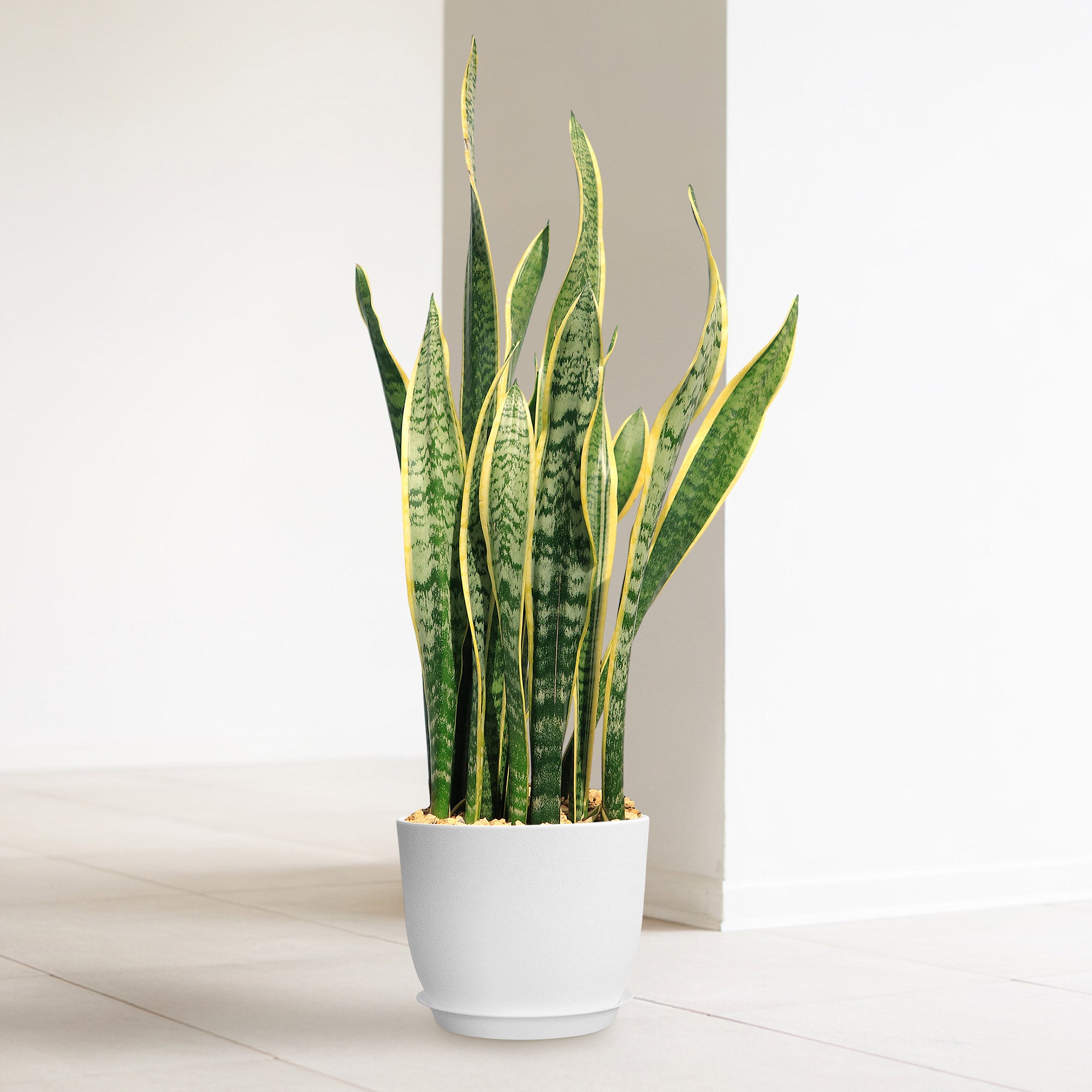
indoor plants with variegated leaves Variegated Snake Plant

Sale price$25.71 Regular price$28.57
Save 10%

Pay in installments of $7.14 with ShopPay, AfterPay and Klarna

Shipping Estimate
USA
  • USA
  • CAN

Ships within 48 hours · Estimated delivery Sep 23 - Sep 28

Promo Codes Available:

For Your Every Summer RSVP, with Code: SUMMER15

Description

indoor plants with variegated leaves Variegated Snake PlantIntroducing the Sansevieria laurentii, known as the variegated snake plant, is one of the most popular snake plant varieties. Native to Tropical West Africa, the Sansevieria laurentii has several other common names, such as snake plant laurentii, variegated mother in law's tongue plant, Sansevieria trifasciata laurentii, or striped snake plant. The Sansevieria laurentii differs from the other main type of snake plant, Sansevieria zeylanica because of

Introducing the Sansevieria laurentii, known as the variegated snake plant, is one of the most popular snake plant varieties. Native to Tropical West Africa, the Sansevieria laurentii has several other common names, such as snake plant laurentii, variegated mother-in-law's tongue plant, Sansevieria trifasciata laurentii, or striped snake plant.


The Sansevieria laurentii differs from the other main type of snake plant, Sansevieria zeylanica because of its green leaves with yellow striped edges and larger size.

The plant has tall, rigid sword-like leaves that grow upright and can reach up to 8 feet tall.

Its leaves provide a striking contrast between their dark green color and the dazzling gold variegation around the edges. 

The flowers of this variegated snake plant are creamy white, pale green, and bloom from late winter through early spring, making it a true showstopper in any garden. This perennial Sansevieria laurentii succulent is perfect for those looking for a low-maintenance addition to their garden or indoor space.  

Sansevieria is part of our clean air plant collection, which filters airborne toxins. The Laurentii snake plant is a popular plant that can be grown in both rock gardens and landscaping, as well as in decorative pots indoors. It's a versatile plant that adds beauty to outdoor spaces and brings a touch of greenery to indoor environments. 

However, because this snake plant laurentii grows slowly, large plants can be expensive

When and How to Water Your Variegated Snake Plant 

The Variegated Snake Plant is a drought-tolerant succulent that should be watered every 2–3 weeks during spring and summer and only once every 4–5 weeks during fall and winter, allowing the soil to dry completely between waterings.

From March to August, during the growing season, water your Sansevieria laurentii every 2 to 3 weeks, giving just enough water to moisten the root zone. This is when the plant is actively photosynthesizing and may absorb water more quickly, especially in warm, bright indoor conditions. Always ensure excess water drains out fully and never let the pot sit in water.

From September to February, during the dormant season, reduce watering to once every 4 to 5 weeks, or only when the soil is bone dry. The plant’s growth slows down significantly during cooler months, and its water needs decrease accordingly. Overwatering in winter can easily lead to soft, rotting roots or fungal issues.

Thanks to CAM photosynthesis, this snake plant opens its stomata at night, conserving water efficiently throughout the day. This adaptation, along with its thick, moisture-retentive leaves, means it’s better to underwater than overwater. Wrinkling or slight leaf shriveling are early signs it’s time to water, while mushy or yellowing leaves indicate excess moisture and possible root rot.

Light Requirements - Where to Place Your Variegated Snake Plant

If growing indoors, place your Sansevieria succulents directly in front of a west- or south-facing window, where it gets 4-6 hours of bright, indirect light.

If Sansevieria laurentii don't receive enough bright light, their dark green leaves with yellow variegated edges may grow leggy, become paler, and shorten.

So, make your succulent happy and give your variegated snake plant plenty of brighter light.

When growing outdoors, this Sansevieria laurentii prefers full sun to partial shade for at least 4-6 hours but can also tolerate low light conditions, making it a great choice for rooms with limited natural light. Direct sunlight should be avoided because it can burn your variegated snake plant leaves.

Remember, it's important to gradually acclimate it to the outdoor environment to prevent sunburn. Start by placing it in a shaded area and gradually move it to a spot with more sunlight over a few weeks. This will help the plant adjust to the increased light levels.

Optimal Soil & Fertilizer Needs 

The Sansevieria laurentii snake plant thrives in well-drained soil and should be fertilized once a year in spring. Moisture can be a real killer, leading to root and stem rot in no time. But fear not, my fellow green thumbs! Planet Desert has got your back with our specialized succulents potting mix that includes organic mycorrhizae – perfect for promoting healthy roots and happy Sansevieria laurentii. 

When it comes to fertilizing your variegated snake plant, it only needs a small amount of fertilizer applied once a year in the spring. Succulents prefer a fertilizer with lower doses of NPK, with a maximum ratio of 5-10-5 that is higher in phosphorus than nitrogen. 

Hardiness Zones & More 

In the United States, this is mostly an indoor plant, but if you live in southern Florida or Hawaii, then you can cultivate it outdoors in USDA zones 9-11. 

This plant thrives in dry, semi-tropical conditions, but it goes dormant when temperatures dip, slowing its growth significantly.

If exposed to prolonged cold or frost, especially below 50°F, the leaves may suffer scarring, mushiness, or collapse.

Even in zones where outdoor cultivation is possible, it’s best to grow them in containers so they can be easily relocated when temperatures become unfavorable.

How to Grow Variegated Snake Plant Best Indoors

To grow your Variegated Snake Plant successfully indoors, maintain a warm, stable environment with temperatures between 65°F and 75°F, which closely mimics its native tropical climate. This plant does not tolerate frost or cold drafts, so it should always be kept away from open windows in winter or air conditioning vents. High humidity can also be problematic, as it increases the risk of rot, so aim for dry, well-ventilated indoor conditions. Its upright, sword-shaped leaves not only make it a great vertical accent in tight spaces but also help purify indoor air, making it both a functional and decorative choice for homes and offices.

Wildlife - Variegated Snake Plant Attracts the Following Friendly Pollinators

The variegated snake plant produces small, fragrant flowers that attract a variety of friendly pollinators such as bees, butterflies, and hummingbirds. These pollinators are essential for the plant's reproduction and play a crucial role in maintaining biodiversity in the ecosystem.

Butterflies
Bees
Hummingbirds
Lady Bugs
Multi Pollinators
Other Birds

According to ASPCA, the variegated snake plant is mildly toxic to humans and pets if ingested. The entire plant contains saponins, which can cause gastrointestinal issues like nausea, vomiting, and diarrhea. However, it is safe to touch and handle, making it a popular choice for indoor decoration in homes with pets or children.

How to Propagate Your Sanseveria laurentii

The Sansevieria laurentii can be propagated through division or leaf cuttings. To propagate through division, carefully separate the plant into smaller sections with roots attached and replant them in fresh soil. For leaf cuttings, simply cut a healthy leaf into smaller sections and plant them in soil to root.

Key Takeaways

  1. The variegated snake plant stores water in its thick, upright leaves, making it extremely drought-tolerant and perfect for forgetful waterers or low-maintenance homes.
  2. Its striking vertical foliage is edged with golden-yellow margins, giving it a bold, architectural look that stands out in any modern interior.
  3. This plant improves indoor air quality by filtering toxins like formaldehyde and benzene, making it both beautiful and functional for home or office spaces.
  4. Thanks to CAM (Crassulacean Acid Metabolism) photosynthesis, it absorbs carbon dioxide at night, making it one of the few houseplants ideal for bedroom air purification.
  5. It’s nearly indestructible in the right pot, tolerating low light, dry air, and minimal care, yet leaf damage can occur if temperatures drop below 50°F.

Final Thoughts

Overall, the Sansevieria Laurentii (snake plant laurentii) is a beautiful and resilient plant suitable for indoor spaces due to its ability to tolerate various conditions. Its upright leaves and variegated pattern add elegance to any room. It is low-maintenance, thrives in well-draining soil, and prefers bright, indirect light. Watering should be minimal to prevent overwatering. It can withstand neglect and drought periods. Sansevieria Laurentii's air-purifying qualities make it an excellent choice for improving indoor air quality.  

With the easy-to-care-for variegated snake plant - Sansevieria laurentii, you'll start to spend less time maintaining your garden and more time taking in its beauty! 

You may also like the other popular snake plant varieties, including the moonshine snake plant, the mother-in-laws snake plant, the Cylindrical snake plant, and the Zeylanica snake plant.

Shipping Notes
  • Free Standard Shipping on $100+ Orders to the USA.
  • Except Preorder products are shipped in 48 hours.
  • Delivery to the USA:
  1. Standard Shipping : 3-10 business days
  • If time is of the essence, please consider selecting expedited delivery for faster service.
Exchange/Return Notes
  • We offer a 30-day return/exchange service after receiving.
  • Final sale items are not eligible for returns or exchanges.
  • To process your return/exchange, please contact us at [email protected]
  • Please click here for more details>>> Return & Exchange Policy
SKU: 5799071171

Discover Niche Categories That Outsell indoor plants with variegated leaves

Top-Converting Item to Boost Your Average Order

4.2 ★★★★★
Based on 21 reviews
Sort
Highest Rating
Newest First
Oldest First
Product Reviews
R
Verified Purchase
Richard Reese (author of Understanding Sustainability)
Omaha, US
★★★★★ 5
A short book loaded with sharp insights
Every year, Canadians eagerly huddle around their radios to listen to the Massey Lectures, broadcast by the CBC. For the 2004 season, Ronald Wright was the honored speaker. He presented a series of five lectures, titled A Short History of Progress. In 2005, Wright's presentation was published as a short book, and it became a bestseller. Martin Scorsese's movie, Surviving Progress, was based on the book. It was an amazing success for a story contrary to our most holy cultural myths. Wright believed that the benefits of progress were highly overrated, because of their huge costs. Indeed, progress was approaching the point of becoming a serious threat to the existence of humankind. "This new century will not grow very old before we enter an age of chaos and collapse that will dwarf all the dark ages in our past." He pointed out that the world was dotted with the ruins of ancient crash sites, civilizations that self-destructed. At each of these wrecks, modern science can, in essence, retrieve the "black box," and discover why the mighty society crashed and burned. There is a clear pattern. Each one crashed because it destroyed what it depended on for its survival. Wright takes us on a quick tour of the collapse of Sumer, Easter Island, the Roman Empire, and the Mayans. He explains why the two oddballs, China and Egypt, are taking longer than average to self-destruct. The fatal defects of agriculture and civilization are old news for the folks who have been paying attention. It has become customary for these folks to believe that "The Fall" took place when humans began to domesticate plants and animals. Wright thinks the truth is more complicated. What makes this book unique and provocative is his notion of progress traps. The benefits of innovation often encourage society to live in a new way, while burning the bridges behind them as they advance. Society can find itself trapped in an unsustainable way of living, and it's no longer possible to just turn around and painlessly return to a simpler mode. Like today, we know that the temporary bubble of cheap energy is about over, and our entire way of life is dependent on cheap energy. We're trapped. Some types of progress do not disrupt the balance of the ecosystem, like using a rock to crack nuts. But our ability to stand upright freed our hands for working with tools and weapons, which launched a million year process of experimentation and innovation that gradually snowballed over time. We tend to assume that during the long era of hunting and gathering our ancestors were as mindful as the few hunting cultures that managed to survive on the fringes into the twentieth century. But in earlier eras, when big game was abundant, wise stewardship was not mandatory. Sloppy tribes could survive -- for a while. Before they got horses, Indians of the American west would drive herds of buffalo off cliffs, killing many at a time. They took what they needed, and left the rest for legions of scavengers. One site in Colorado contained the carcasses of 152 buffalo. A trader in the northern Rockies witnessed about 250 buffalo being killed at one time. Wright mentioned two Upper Paleolithic sites I had not heard of -- 1,000 mammoth skeletons were found at Piedmont in the Czech Republic, and the remains of over 100,000 horses were found at Solutré in France. Over time, progress perfected our hunting systems. Our supply of high-quality food seemed to be infinite. It was our first experience of prosperity and leisure. Folks had time to take their paint sets into caves and do gorgeous portraits of the animals they lived with, venerated, killed, and ate. Naturally, our population grew. More babies grew up to be hunters, and the availability of game eventually decreased. The grand era of cave painting ended, and we began hunting rabbits. We depleted species after species, unconsciously gliding into our first serious progress trap. Some groups scrambled to find alternatives, foraging around beaches, estuaries, wetlands, and bogs. Some learned how to reap the tiny seeds of wild grasses. By and by, the end of the hunting way of life came into view, about 10,000 years ago. "They lived high for a while, then starved." Having destroyed the abundant game, it was impossible to return to simpler living. This was a progress trap, and it led directly into a far more dangerous progress trap, the domestication of plants and animals. Agriculture and civilization were accidents, and they threw open the gateway to 10,000 years of monotony, drudgery, misery, and ecocide. Wright says that civilization is a pyramid scheme; we live today at the expense of those who come after us. For most of human history, the rate of progress was so slow that it was usually invisible. But the last six or seven generations have been blindsided by a typhoon of explosive change. Progress had a habit of giving birth to problems that could only be solved by more progress. Progress was the most diabolically wicked curse that you could ever imagine. Maybe we should turn it into an insulting obscenity: "progress you!" Climate scientists have created models showing weather trends over the last 250,000 years, based on ice cores. Agriculture probably didn't start earlier because climate trends were unstable. Big swings could take place over the course of decades. In the last 10,000 years, the climate has been unusually stable. A return to instability will make civilization impossible. Joseph Tainter studied how civilizations collapse, and he described three highways to disaster: the Runaway Train (out-of-control problems), the Dinosaur (indifference to dangers), and the House of Cards (irreversible disintegration). He predicted that the next collapse would be global in scale. Finally, the solution: "The reform that is needed is... simply the transition from short-term thinking to long-term." Can we do it? We are quite clever, but seldom wise, according to Wright. Ordinary animals, like our ancestors, had no need for long-term thinking, because life was always lived in the here and now. "Free Beer Tomorrow" reads the flashing neon sign on the tavern, but we never exist in tomorrow. The great news is that we now possess a mountain of black boxes. For the first time in the human journey, a growing number of people comprehend our great mistakes, and are capable of envisioning a new path that eventually abandons our embarrassing boo-boos forever. All the old barriers to wisdom and healing have been swept away (in theory). Everywhere you look these days; people are stumbling around staring at tiny screens and furiously typing -- eagerly communicating with world experts, engaging in profound discussions, watching videos rich with illuminating information, and reading the works of green visionaries. It's a magnificent sight to behold -- the best is yet to come! Richard Adrian Reese Author of What Is Sustainable
WAS THIS REVIEW HELPFUL?YesReportShare
Reviewed in the United States on January 20, 2013
R
Verified Purchase
Richard Clark
Lake Worth, US
★★★★★ 5
Wright is right
The fact Wright attacks popular concepts of progress is enough to merit five stars. Until 1955, when I was 25, I naively believed progress was inevitable, natural, and simply a part of human nature and society. I attended the Earl Lectures that year. Swiss Theologian Emil Brunner presented three addresses on "Faith, Hope, and Love" at Berkeley, California. Westminster Press published his series in a book given the same title. I shall quote a few remarks. Brunner traced the burgioning faith in progress to the nineteenth century, when "Darwin's theory of evolution seemed so to support and enlarge this optimistic evaluation of progress as to see it in a cosmic perspective." But the doctrine of progress is not the same as evolution. "Although this idea of progress had a success for which the word 'triumph' is hardly an exaggeration, there were warning voices raised against it, voices of men of weight and importance who were not willng to accept the new doctrine," he said. "It was a new doctrine because it was not known to antiquity, it was not known in the time of the Reformation, it was unknown in all Asiatic culture. It was a new thing! The idea of progress became an axiomatic conviction which needed no proof and could not be disproved." At one point, Brunner said, "Since Hiroshima the world does not believe in progress anymore." The end of WWII was still fresh in our memories, and I suppose that's why he said it. We know, today, that it didn't take long for much of the world to revive and renew its faith in progress. And now it's stronger--and more dangerous--than ever. I'm not opposed to every aspect of progress. Progress, when it moves in wholesome and healthy directions, is a blessing. I'm glad my dentist is able to fill--and save--my teeth without pain. And when it came time for my doctor to pull my cataracts and replace them with implanted lenses, I marveled at the miracle. It was a quick and painless operation, and now I have wonderful vision. It's that dogmatic idea of progress based on greed and cold indifference to global warming that concerns me. It's that ongoing waste of limited resources, whether they be animal, vegetable or mineral, that concerns me. We are pulling the carpet from beneath our feet, and the king is pulling hardest of all. And who is the king? Ignorance! Ignorance is king!
WAS THIS REVIEW HELPFUL?YesReportShare
Reviewed in the United States on September 21, 2008
K
Verified Purchase
Kevin S. Grail
West Palm Beach, US
★★★★★ 5
My favorite book, in any genre
Ronald Wright is an amazing scholar and writer. His style is fun and easy to read while delivering impeccable historical research. I have listed to this book several times over the years and I appreciate it more each time. I recommend the audio version more than the print version because of the compelling way Mr. Wright delivers this 4-Part lecture series to his audience (now in book form). Note to Amazon: Please make this book available on Audible, CDs are cumbersome.
WAS THIS REVIEW HELPFUL?YesReportShare
Reviewed in the United States on July 3, 2018
J
Verified Purchase
J. Edgar
Belleville, US
★★★★★ 4
How many trees do we have left?
In this book, the author takes a look at the downfall of civilizations. Yes, that's plural. There are several models of how civilization is progressing. One is that we're getting better and better as time goes by. Another, less popular one states that we are actually in decline, going down from some sort of golden age. You'll find many of these proponents in the old age homes and such. For them, the only disagreement is when we are declining from. Wright takes a look at the cyclical nature of the rise and fall of civilizations, taking examples from several once- prospering civilizations. This book stands as a call to action that something must be done to grow smartly and be careful on how we allocate the scant resources we have left. While he doesn't hit an anything new, this book's strength is its concise nature. The several examples are familiar and in that have more impact. The strongest example is one he visits several times to show an analogy of current times: Easter Island. This isolated speck in the Pacific was once a thriving mini-civilization with culture and art. And a lot of trees. These trees helped the islanders fish and raise their ceremonial head sculptures. However, these trees also were a poorly cultivated resource. Someone not too long ago cut down the last tree, and the island is now a wasteland and anthropological curiosity. We are doing the same thing. How many trees do we have left to cut?
WAS THIS REVIEW HELPFUL?YesReportShare
Reviewed in the United States on October 14, 2009
W
Verified Purchase
W Lorraine Watkins
Port Orchard, US
★★★★★ 3
Good on Review Short on Direct Experience
It is an extensive review of the literature on rise and fall of civilizations with observations on our's. Extremely well footnoted and referenced it however suffers from the author appearing to have little direct primary experience in the study of his topic. Nonetheless there is good information here and substantiation of the notion that cultures come and go, frequently going as a result of the lack of capacity necessary to change group behavior in response to certain challenges. He presents compelling evidence that those overwhelming challenges often revolve around irrational and compulsive exploitation of natural resources. Sadly I share the author's pessimism in regard to our global culture being likely to respond adequately to the ongoing destruction of our livable earthly environment. I fear the planet is headed for a massive kill off in the disturbingly near future.
WAS THIS REVIEW HELPFUL?YesReportShare
Reviewed in the United States on April 13, 2013

recommand products