SKU: 58204047773
heirloom flower seed

heirloom flower seed Edible Wildflower Seed Collection – Seed Needs LLC

Sale price$20.46 Regular price$22.73
Save 10%

Pay in installments of $5.68 with ShopPay, AfterPay and Klarna

Shipping Estimate
USA
  • USA
  • CAN

Ships within 48 hours · Estimated delivery Aug 4 - Aug 9

Promo Codes Available:

For Your Every Summer RSVP, with Code: SUMMER15

Description

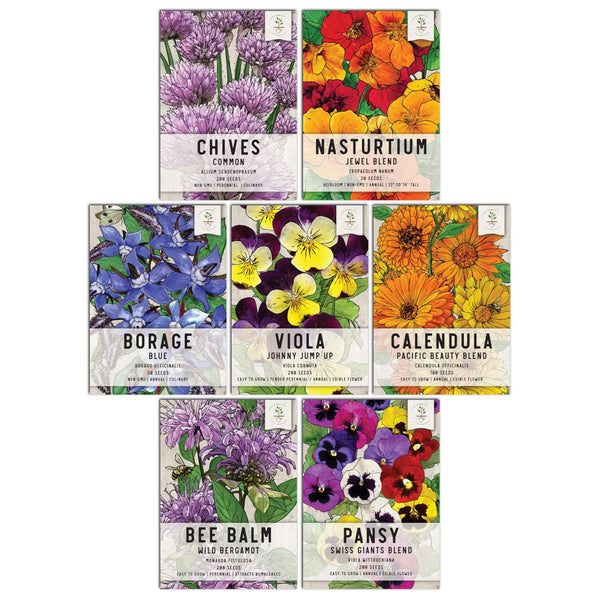
heirloom flower seed Edible Wildflower Seed Collection – Seed Needs LLCOur Edible Wildflower Collection contains plants that are both interesting and delicious! Believe it or not the flowers in this collection can be added to salads and other dishes as a garnish. Some popular favorites include Blue Borage, Calendula, Chives, Wild Bee Balm, Marigold, Pansies, Johnny Jump Ups and Nasturtium. The packages are 3. 25" wide by 4. 50" tall and come complete with a beautiful illustration on the front side, as well as detailed

Our Edible Wildflower Collection contains plants that are both interesting and delicious! Believe it or not the flowers in this collection can be added to salads and other dishes as a garnish. Some popular favorites include Blue Borage, Calendula, Chives, Wild Bee Balm, Marigold, Pansies, Johnny Jump Ups and Nasturtium.

The packages are 3.25" wide by 4.50" tall and come complete with a beautiful illustration on the front side, as well as detailed sowing information on the reverse. Each packet also includes a QR code that leads to additional information on the corresponding plant variety. Each packet contains a different amount of seeds, with Nasturtium being the lowest seed count of 25, and the majority of the others measuring roughly 200 seeds each.

Nasturtium, Jewel Mixture

(25 Seeds)

Nasturtium Jewel Mixture will produce unique flowers, in an assortment of warm colors, such as red, yellow, gold and orange. The flowers themselves open up to a diameter of roughly 2 or 3 inches wide, forming 3 petals on the bottom and 2 on the top. The plants will reach a mature height of roughly 12 to 18 inches tall, and spread a good 12 inches wide.

Categorized as an annual flowering plant, Nasturtium, Jewel Mixture will grow quickly from freshly harvested seeds. The plants will then bloom profusely through the summer months, later wilting with the first frost. Nasturtium seeds can be harvested at the end of the season, to regrow fresh plants the following year. The plants can often drop their seeds to the bare ground beneath, allowing new plant life to establish naturally, after the harsh temperatures of winter have passed.

Nasturtium, Jewel Mixture is not only a beautiful flower in the garden, but it is also a colorful addition to many garnishes, salads and other culinary dishes. The seeds, stems, leaves and flower heads are all edible, providing you with a sweet, yet spicy flavoring. The leaves and stems have a hot, peppery taste, while the seeds can be a substitute for capers. The flowers have a more mild flavor and are a perfect addition to omelettes & salads.

Nasturtium plants, such as the Jewel Mixture will attract all sorts of butterflies to the garden. Their leaves are often eaten by caterpillars, and other insects. However, be aware that these plants can attract some pesky insects, such as slugs and aphids. You'll be surprised to learn that they will cling to the leaves, like a moth to a flame. But keep in mind that this can be a good thing if you grow cabbage, or other crops. Many gardeners will use Nasturtium plants as a sacrificial magnet for these insects, so that their main crops can flourish.

Wild Bee Balm

(200 Seeds)

Wild Bee Balm, also known as Wild Bergamot, will produce gorgeous, lilac-pink colored blooms through the Spring and Summer months. The plants themselves will reach a mature height of roughly 36 to 48 inches tall and will produce 2 inch flowers. The leaves of this stunning plant are aromatic, and the nectar will attract all sorts of beneficial insects to the garden, such as hummingbirds, honeybees, bumblebees, butterflies and more. Several plants can easily spread out, forming mounds of color in many areas of the garden. These plants are popularly chosen for borders, along fences and paths, or directly in the garden. Wild Bee Balm is also seen in many public parks, zoos, butterfly gardens and insectaries as well.

Grown as a perennial flowering plant, Wild Bee Balm will establish a deep root system, which will allow the plants to remain dormant in the cold temperatures of the winter season. The plants can then reestablish themselves the following year, after all danger of frost has passed. When the blooms of your Wild Bee Balm plants become old and start to wilt, simply pop the heads off to replace them with new flowers. Powdery mildew can be a major issue for not only Wild Bee Balm, but most other Monarda plants as well. To prevent powdery mildew, we suggest cutting back thicker foliage, allowing air to circulate through the plants more efficiently. You can also water the plants directly at the root to avoid mildew as well.

Johnny Jump Up

(200 Seeds)

Johnny Jump Up is a delightful low growing, flowering plant that is sure to bring joy to onlookers and insects alike. It’s colorful little blooms are a mixture of beautiful violet and yellow. They are known to attract an array of beneficial insects from butterflies, bumblebees, lady bugs and even hummingbirds. Viola cornuta will grow to a graceful height of only 6 to 12 inches tall and do not require much attention once established. Each flower is roughly 1 inch in diameter and don’t mind a bit of mild crowding.

The Johnny Jump Up is not only a decorative plant, but can also be seen in salads as the flowers are in fact edible. Grown as a tender perennial in warmer regions, but often as an annual in the northern states. They will grow quickly, bloom profusely and then later die with the first frost. Viola cornuta seeds can be collected at the end of the growing season to resow the following year, or you can allow the Viola flower seeds to drop to the bare ground beneath to regrow naturally.

Johnny Jump Up is best grown in masses and can be seen in a variety of settings. Often used in pots & containers, but can be grown in flower beds or used as a border plant as well. If you are a fan of Johnny Jump Up flowers, you might also want to check out our other varieties of Viola, including “Bowles Black” & “Arkwright Ruby”. We also offer a number of colorful pansies as well.


Common Chives

(200 Seeds)

Common Chives will produce shoots that grow to a mature height of roughly 18 inches tall. Popularly used to flavor potatoes and salads, Chives are not only tasty, but are also attractive as well. Each plant displays fluffy, purple colored flowers atop slender stems / shoots. The shoots, once cut will add a slight onion flavor to any dish that they are added to. The flowers also add a mild onion flavor and can be used as a garnish.

Categorized as a perennial herb plant, common chives will establish a deep root system, later wilting on the surface with the first frost. The plants will then return the following year after all danger of frost passes. The plants can be harvested soon after they reach a few inches tall. Chives not only look great, smell great and taste great, but they also drive away pesky insects as well. Grow Common chives near any vegetables or herbs that are being tormented by unwanted insects to instantly drive them away.

Calendula, Pacific Beauty Mixture

(125 Seeds)

Featuring showy, four-inch single and double blooms in vivid shades of orange and yellow, the Calendula Pacific Beauty will provide gorgeous color all summer in the right conditions. With its four-inch flowers and full, green foliage, the Calendula Pacific Beauty makes an eye-catching addition, as it also reaches up to 24 inches in height and spreads once established in the ground.

Whether you are wanting to add bright color to a flower bed or a container garden, the Calendula Pacific Beauty does well in either setting. Expect to see lots of butterflies and bees surrounding it, as the Calendula Pacific Beauty is attractive to pollinators. Due to its height and hardiness, this makes a good cut flower, adding pleasant fragrance and color to any arrangement. It can even be dried for a long-lasting floral display.  

From decoration to medicine, the Calendula Pacific Beauty is a great addition to your garden plan.

Blue Borage

(50 Seeds)

Borage is an attractive herb that is often grown for it’s deep blue, star shaped blooms. It reaches a mature height of about 12 to 24 inches tall. Borage is not only sought after for it’s beauty, but also it’s cucumber flavored leaves and attractive flowers. Both of which are often used in salads, to add flavor and color. Grown as an annual herb, Borage will grow quickly, bloom profusely and then die soon after with the first frost. Plants can return the following year if seeds drop to the earth under it, or if they are collected for resowing.

Borage herb plants will attract an array of bumblebees and are also great to grow near vegetable gardens. It is recommended to harvest the leaves of Borage herb early as they will be much more flavorful. Matured leaves begin to get tough and hairy. The flowers of Borage however can be harvested at any time. Try cutting the plants to use in a decorative vase as well!

Swiss Giants Pansy

(200 Seeds)

Swiss Giants is comprised of gorgeous, 3 inch paper like flowers in shades of red, rose, yellow, blue, purple and white. The plants reach a mature height of about 6 to 8 inches tall, making it a great flower for beds, pots, containers, window boxes and baskets.

Swiss Giants is a pretty hardy plant, grown to bloom in cooler temperatures of fall and winter. It is grown as an annual flowering plant that establishes quickly from flower seeds, blooms profusely, then later dies with very harsh temperatures. Sought after as an edible flower, the colorful blooms are often added to salads and used as a garnish.

Shipping Notes
  • Free Standard Shipping on $100+ Orders to the USA.
  • Except Preorder products are shipped in 48 hours.
  • Delivery to the USA:
  1. Standard Shipping : 3-10 business days
  • If time is of the essence, please consider selecting expedited delivery for faster service.
Exchange/Return Notes
  • We offer a 30-day return/exchange service after receiving.
  • Final sale items are not eligible for returns or exchanges.
  • To process your return/exchange, please contact us at [email protected]
  • Please click here for more details>>> Return & Exchange Policy
SKU: 58204047773

Discover Niche Categories That Outsell heirloom flower seed

Top-Converting Item to Boost Your Average Order

4.2 ★★★★★
Based on 7 reviews
Sort
Highest Rating
Newest First
Oldest First
Product Reviews
T
Verified Purchase
Terry Anne
New York, US
★★★★★ 3
Only holds towels in place when it is full or 1/2 full
Color: 01-silver
If you are buying this for the feature of holding the paper towels in place so you can just rip one, I think you will be disappointed. Once the roll becomes smaller (and I tried changing the arm) the arm does not touch the towels. I do like the firm grip on the counter. My other dissatisfaction is the base gets water spots. Being near the sink this happens frequently. It does its job and is attractive.
WAS THIS REVIEW HELPFUL?YesReportShare
Reviewed in the United States on May 21, 2026
J
Verified Purchase
Jay
Fort Morgan, US
★★★★★ 5
Stylish
Color: 01-silver
Good sturdy stand for paper towels. Has small suction cups on bottom for stability. Good finish and good fit under the counter. Heavy base and not flimsy feeling. Brushed aluminum matched other appliances well.
WAS THIS REVIEW HELPFUL?YesReportShare
Reviewed in the United States on January 6, 2026
T
Verified Purchase
The product comes in multiple colors, but the function is terrible
Los Angeles, US
★★★★★ 5
Goodbye for the value
Color: 02-black
Great value looks wonderful very adorable
WAS THIS REVIEW HELPFUL?YesReportShare
Reviewed in the United States on May 31, 2026
J
Verified Purchase
Jonathan Bailey
Cuba, US
★★★★★ 5
Required Reading for Egyptologists
Format: Paperback
To say the very least, this book is an enlightening read. The author attempts to design a new chronology of Egypt based on a number of archaeological observations he made which pointed to certain anomolies in the standard chronology of the Third Intermediate Period of Egyptian history. The TIP is one of those points in history where information is scanty and there is much room for error in interpreting existing archaeological evidence. Rohl posits that the 21st and 22nd pharaonic dynasties were at least partly contemprary in a period of balkanization of Egypt, contrary to the conventional chronology's view that they were successive. He therefore shifts the entire preceding dynastic histories downward from 200 to 300 years. That is, what we previously though to occur at 1250 BC actually happened at 1000 BC according to Rohl. In so doing Rohl has done much to synchronize Egyptian chronology with the chronology of the bible. Rohl claims that the Amarna letters were not to be compared to Joshua's conquest of Canaan, a period where they clearly do not fit, but rather tell the tale of Saul's and David's claiming of Israel from Phillistine Egyptian vassals. He synchonizes Ramesses II's conquests of Asia Minor with the biblical invasion of Shishak. Also, he identifies the Egyptian 'Hyksos' with the Amalekites of the book of Exodus. There are many other enlightening points of connection with the bible that Rohl makes, but my point here is not to explain them all. The true value of this book for any egyptologist, student of biblical history, or any student of the ancient world at all, is this book's popular presentation of the field of archaeology and ancient history. So rare are books that actually connect a lay reader with the methodologies and evidence upon which researchers base their works. In order to show a need for a revision of Egyptian chronology, Rohl shows how the entirety of Egyptian chronology depends on all but of a handful of archaeological finds, many of them of dubious reliability. Even if Rohl's opponents find more pieces of evidence supporting the standard chronology, the number will still be very small and they will quite likely be as subject to interpretation, as are the ones that Rohl has pointed out. Rohl goes to great lengths to show the history of the observations that scholarship has made, thereby showing us where they may have gone wrong. (As a popular book, I must confess that parts of Rohl's historical narratives depict events in which one expects to find Indiana Jones) Next, when building his own chronology, Rohl puts us close to the texts and archaeological evidence upon which he bases his theories. Rohl's conclusions are in many cases impressive, but in some cases I had to shake my head and come to the conclusion that he was grasping at straws. For instance, I believe that his work in astronomical retrocalulations to find the dates of eclipses recorded in ancient texts is pretty shaky. I even doubt that the text that he is talking about is even mentioning an eclipse. This information has proved to be incredibly valuable to me, however, as I now know that astronomy based chronology, something I though would give absolute and undisputable dates, is as foggy an area of research as any. I do not know if I will eventually embrace Rohl's ideas or not, or if partially. I do know that reading this book has shown me the types of reasoning and observations that old world historians make, and can now make an informed decision about how firm our grip on dating events of the past is. My conclusion: if somebody tells you some biblical event did not happen because the dates don't line up with scientific knowledge, don't be disheartened. We have a LONG way to go before we can truly be confident about such statements, if indeed we will ever arrive at that sort of knowledge. This uncertainty that I have gained from Rohl's book is corroberated by the "Oxford History of Ancient Egypt" which provides wonderful information on Egyptian chronology. Everyone who wants to study ancient history, whether it be Egyptian, biblical, Middle Eastern, or even Chinese for that matter, should read this book, so the next time they read somewhere that 'such and such happened at 3200 BC', they will know to take that statement with a grain of salt. Whether Rohl is right or not, I am forever indebted to him for showing me how chronologists operate. Lastly, I would like to say, after all this talk about archaeology and methodology of Egyptologists, that this book is very readable and comprehensible to the lay reader. Though a smattering of knowledge of biblical and/or Egyptian history will make the book more interesting to the reader, no such knowledge is required in order to understand the book or find value in it. It is truly a popular book intended for the average interested person. I recommend it to all.
WAS THIS REVIEW HELPFUL?YesReportShare
Reviewed in the United States on February 10, 2001
S
Verified Purchase
Stone Dog
Waukegan, US
★★★★★ 5
Exciting reinterpretation of ancient history.
Format: Paperback
In "Pharoahs And Kings", author David Rohl offers the reader a stunning new interpretation of the events of the ancient world in Egypt and the Levant. In doing so, he ties in Biblical events to their proper place in history. This is a stunning reordering of events and personalities and brings both Egyptian and Biblical history to a much closer synchronization. The book begins in Egypt where Rohl lays out his evidence for condensing the chronology of Egypt. Though we use AD/BC as a method of numbering our years, the ancients did not do so and used regnal dates ("In the third year of Pharoah So-And-So's reign, something happened."). By counting all Pharoahs and their reign lengths, historians felt they had a handle on when, according to our dating system, things happened. When they did so, they discovered the events portrayed in the Bible didn't match. When they date Solomon's reign in Israel to the Iron Age, for example, they find economic development to be poor - a far cry from the Biblical accounts of Solomon's reign as a flowering of culture and rich in trade. Likewise, Jericho's walls did not fall in the time period most historians would place the Exodus and entrance into the Levant of the Hebrews. Therefore, the Biblical accounts are simply myth, nothing more. David Rohl is a historian, not a religious believer and his point of view is as a historian. His focus is to find a more accurate timeline for the events in the ancient Middle East. He begins in Egypt because that is his area of expertise and he gives convincing arguements for re-ordering the events of Egypt. The clincher, for me, was the tombs of Tanis (among other inconsistencies in the conventional dating such as the number of Apis Bulls) in which the tomb of Psusennes I cuts into the tomb of King Oskoron II and was obviously built after the tomb of Oskoron II. The problem? Oskoron II was from the 22nd dynasty while Psusennes was from the 21st! It is quite obviously reversed! Rohl's conclusion is that two dynasties were contemporary and that about 140 years needs to be removed from the timeline of Egypt. When this is done, events in the Levant match the events in the Old Testament very closely. In the New Chronology, Jericho falls just when the Hebrews are entering Canaan according to the Bible. Solomon's Israel is now placed in the Late Bronze Age where there is evidence of prosperous cities and flourishing trade. There is evidence of mentions of both Saul and David in the Amarna Letters. This was a page turner and Rohl's work, although controversial, is backed up by fact and evidence. There is less evidence for some of his conclusions than others (in my mind), but it is well researched and never strays from a scholarly interpretation of the evidence written and on the ground. I actually enjoyed this book! David Rohl writes in a very engaging fashion, often using humor. His writing skill keeps subjects that may seem dull very frsh and exciting. He often uses humor and engages the reader, challenges the reader and forces the reader to think. This is not the usual dry tome on archeology that puts you to sleep! He assists the reader with many and high quality photos and drawings of the evidence and includes "side bars" with definitions and explanations in the margins to help the layman navigate the technical aspects of history and archeology without getting bogged down and overwhelmed. This is a fine book and more than deserving of five stars. It's a very eye-opening and interesting read that doesn't seem like a college textbook. Instead, he challenges the reader while entertaining at the same time. I recommend this book with five stars!
WAS THIS REVIEW HELPFUL?YesReportShare
Reviewed in the United States on September 29, 2012

recommand products