SKU: 6199405151
buy juniper bonsai tree online

buy juniper bonsai tree online Shimpaku Juniper – Magic Valley Gardens

Sale price$22.26 Regular price$24.73
Save 10%

Pay in installments of $6.18 with ShopPay, AfterPay and Klarna

Shipping Estimate
USA
  • USA
  • CAN

Ships within 48 hours · Estimated delivery Oct 2 - Oct 7

Promo Codes Available:

For Your Every Summer RSVP, with Code: SUMMER15

Description

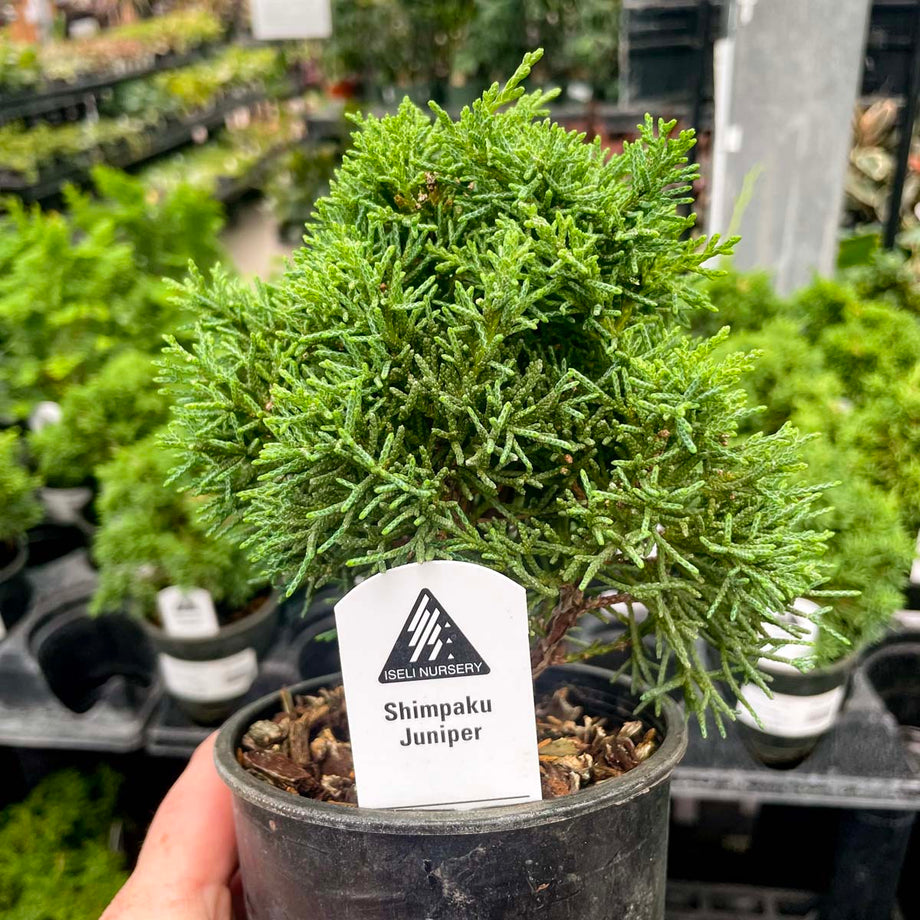
buy juniper bonsai tree online Shimpaku Juniper – Magic Valley GardensJuniperus chinensis Shimpaku This versatile, vase shaped Shimpaku develops upright, fountain like branches that are covered in robust, green, awl shaped foliage. Appreciated by bonsai enthusiasts for an irregular form and exposed, peeling bark, it also makes an interesting addition to container arrangements and garden beds. Garden Size: 3H x 6W Dwarf: 3 6 year Habit: Spreading Hardiness: Zone 4 Exposure: Full Sun Many perennials and bonsai plants will

Juniperus chinensis ‘Shimpaku’ 

This versatile, vase-shaped
 ‘Shimpaku’ develops upright, fountain-like branches that are covered in robust, green, awl-shaped foliage. Appreciated by bonsai enthusiasts for an irregular form and exposed, peeling bark, it also makes an interesting addition to container arrangements and garden beds.

  • Garden Size: 3’H x 6’W
  • Dwarf: 3-6″/year
  • Habit:  Spreading
  • Hardiness:  Zone 4
  • Exposure:  Full Sun

Many perennials and bonsai plants will have a ‘winter look’ that differs from how they look when actively growing.  Colder temperatures and short days alter the appearance of these plants as they go thru seasonal changes.  Some plants require this reboot to bloom and/or perform at their best during the growing season.  Plants may remain semi-dormant until early spring.  Rest assured that these cosmetic changes do not adversely affect the health of your plant. 

Bonsai Basic Care: Hard

Watering: Bonsais require careful watering. The frequency depends on the species and the climate, but generally, the soil should be kept slightly moist. Check the soil daily, and water thoroughly when the top layer feels dry.

Light: Most bonsai trees prefer bright, indirect light. A few hours of direct sunlight early in the morning or late in the afternoon is beneficial, but a direct midday sun can be harmful, especially in hotter climates.

Soil/Drainage: To prevent water retention and root rot, use a well-draining bonsai-specific soil mix.

Temperature/Humidity: Depending on the species, bonsai trees can be kept indoors or outdoors. Indoor bonsais generally prefer temperatures between 60-75°F and benefit from increased humidity, which can be achieved through daily misting or humidity trays.

Feeding: Fertilize your bonsai regularly during the growing season. Use a balanced, water-soluble fertilizer every few weeks or as recommended for the specific type of tree.

Pruning/Training: Pruning is essential to maintaining the shape and health of a bonsai. Regular pruning of the roots and canopy is necessary. Training with wires can also shape branches and direct growth.

Repotting: Most bonsai trees require repotting every 2-5 years to prevent root crowding and replenish nutrients in the soil. This is best done in the spring.

General Tips: Regularly inspect for pests and diseases. Bonsai trees are susceptible to insect infestations and fungal infections, which should be treated promptly to keep the tree healthy.

Order & Shipping Info:
-Plants ship in a grower's pot, fully rooted.
-We ship every Monday and Tuesday (excluding holidays) to avoid weekend delays.
-Our photos show what you can expect, but each plant is unique and may look slightly different upon arrival.
-Minor damage during shipping is entirely normal and should be expected, especially in extreme summer or winter temperatures. Don’t worry—damaged foliage can be trimmed away and will not affect the plant's root system or overall health.
-Hold off on watering if the soil is still moist, and wait 2-4 weeks before repotting or fertilizing. This patience will help your plant adjust smoothly without going into shock.

Important:

  • Report any order issues the day they arrive by messaging us on Etsy or emailing [email protected] with a photo. After 24 hours, no refunds, returns, or exchanges—no exceptions.
  • We guarantee plants arrive alive but can’t promise long-term success due to plant nature.
  • Refunds are case-by-case. Many plants recover with proper care, so refunds may not be needed.
Shipping Notes
  • Free Standard Shipping on $100+ Orders to the USA.
  • Except Preorder products are shipped in 48 hours.
  • Delivery to the USA:
  1. Standard Shipping : 3-10 business days
  • If time is of the essence, please consider selecting expedited delivery for faster service.
Exchange/Return Notes
  • We offer a 30-day return/exchange service after receiving.
  • Final sale items are not eligible for returns or exchanges.
  • To process your return/exchange, please contact us at [email protected]
  • Please click here for more details>>> Return & Exchange Policy
SKU: 6199405151

Discover Niche Categories That Outsell buy juniper bonsai tree online

Top-Converting Item to Boost Your Average Order

4.8 ★★★★★
Based on 20 reviews
Sort
Highest Rating
Newest First
Oldest First
Product Reviews
D
Verified Purchase
David Lemberg
Bozeman, US
★★★★★ 5
Five Stars
Format: Paperback
Professor Cornford's translation with running commentary is definitive.
WAS THIS REVIEW HELPFUL?YesReportShare
Reviewed in the United States on November 5, 2015
J
Jordan Bell
Lake Worth, US
★★★★★ 5
Plato's dialogue about the physical world
Format: Paperback
The two biggest topics in the Timaeus are astronomy and the elements of bodies, which are constructed using triangles and the tetrahedron, octahedron, icosahedron, and cube. I would like to see a translation of the Timaeus that uses it as a way to introduce all the astronomy that appears in the dialogue. Introducing the astronomy does not mean just talking in words about spheres or the zodiac or the ecliptic, but actually explaining how these were used by astronomers. Cornford has much to say, but to someone who has not learned any Greek astronomy his commentary will be opaque and hard to use. I didn't know the astronomy well enough to readily understand Cornford's explanations. I plan to learn more classical Greek astronomy, perhaps using Evans' , and then read Waterfield's translation of the Timaeus . Before reading this you should have read the Republic and know some classical Greek natural philosophy, mathematics, and astronomy. Although Cornford's commentary makes the dialogue staccato, I am glad for it because I wouldn't otherwise have understood much of what Plato says. The Timaeus and the Parmenides are the two dialogues of Plato that one needs commentary to understand; the Parmenides demands the commentary because so much of what is happening depends on the original language, and the Timaeus demands the commentary because of all the things the reader is supposed to be familiar with. The following is a list of topics I kept while reading the dialogue: theory of Forms 27d-28a, 51a-52a; harmonics 35b-36b; time 37c-38e, 39b-e; vision 45b-46c, 67c-68d; space 52b; surfaces 53c; weight 62d-63e; sound 67a-67c; physiology 70c-79e, 80d-86a; antiperistasis 79e-80c.
WAS THIS REVIEW HELPFUL?YesReportShare
Reviewed in the United States on December 12, 2015
S
Steve Lookner
Cuba, US
★★★★★ 4
Helpful, but Waterfield is better for an intro
Format: Paperback
This is basically a scholarly paragraph-by-paragraph commentary on the Timaeus. It's really good for what it is, but I don't recommend it as your first introduction to the Timaeus -- rather, I recommend Waterfield: http://www.amazon.com/Timaeus-Critias-Oxford-Worlds-Classics-ebook/dp/B006NTMD16 A problem with using Cornford as an introduction is that he comments on everything, and it's hard to figure out what the main themes are. I tried reading Cornford as an intro and gave it up, but once I'd read Waterfield I found Cornford extremely helpful both in elucidating passages further than Waterfield does, and in interpreting passages Waterfield doesn't cover. So if you're looking to learn about the Timaeus, I'd suggest Waterfield first and Cornford second (or Cornford alongside Waterfield).
WAS THIS REVIEW HELPFUL?YesReportShare
Reviewed in the United States on February 24, 2014
B
Brian Chrzastek
Bozeman, US
★★★★★ 5
Cornford's running commentary is arguably the best suited to fulfill this desire
Readers of any of Plato's works are bound to feel they might profit from various commentaries. His Timaeus, in particular, may be said to elicit such a hope because of number and intricacy of its details. Cornford's running commentary is arguably the best suited to fulfill this desire: it helps make clear the integrity of the dialogue as a whole and illumines the specific points along the way. Although this work is certainly dated, originally published in 1937, it is certainly one of the best full commentaries on the Timaeus.
WAS THIS REVIEW HELPFUL?YesReportShare
Reviewed in the United States on November 4, 2014
R
Roberto V. Novaes
San Leandro, US
★★★★★ 5
Plato's view of the creation of the world
Format: Paperback
A cosmology is a narrative concerning the creation of the universe. Many ancient philosophers have written or elaborated this kind of work. The Platonic dialogue Timeus is an account of the work of the creator god (called the demiurge - or artisan) sculpting the chaotic material world in accordance with the immaterial model of the Ideas. But the text was written in a very hermetic and symbolic language, making its interpretation difficult or even impossible without the knowledge of the references and symbols used by Plato. This book is a complete translation of the text followed by a comprehensive commentary explaining in detail every passage. Francis MacDonald Cornford is one of the most important ancient philosophy scholars, and this work reveals his deep knowledge of Platonic and Greek thought. It is a must have for anyone interested in greek and Platonic philosophy.
WAS THIS REVIEW HELPFUL?YesReportShare
Reviewed in the United States on February 13, 2008

recommand products