SKU: 62779423702
dubian philodendron

dubian philodendron Monstera Dubia on Eco Mosspole House Plant – Plants For All Seasons

Sale price$19.44 Regular price$21.60
Save 10%

Pay in installments of $5.40 with ShopPay, AfterPay and Klarna

Shipping Estimate
USA
  • USA
  • CAN

Ships within 48 hours · Estimated delivery Aug 25 - Aug 30

Promo Codes Available:

For Your Every Summer RSVP, with Code: SUMMER15

Description

dubian philodendron Monstera Dubia on Eco Mosspole House Plant – Plants For All SeasonsMonstera dubia is a rare and fascinating climbing aroid prized for its shingling growth habit and remarkable leaf transformation. Native to the tropical rainforests of Central and South America, this species showcases one of the most striking developmental changes in the Monstera genus from small, flat, patterned juvenile leaves to large, fenestrated adult foliage that rivals Monstera deliciosa in beauty. In its juvenile stage, Monstera dubia produces

Monstera dubia is a rare and fascinating climbing aroid prized for its shingling growth habit and remarkable leaf transformation. Native to the tropical rainforests of Central and South America, this species showcases one of the most striking developmental changes in the Monstera genus — from small, flat, patterned juvenile leaves to large, fenestrated adult foliage that rivals Monstera deliciosa in beauty.

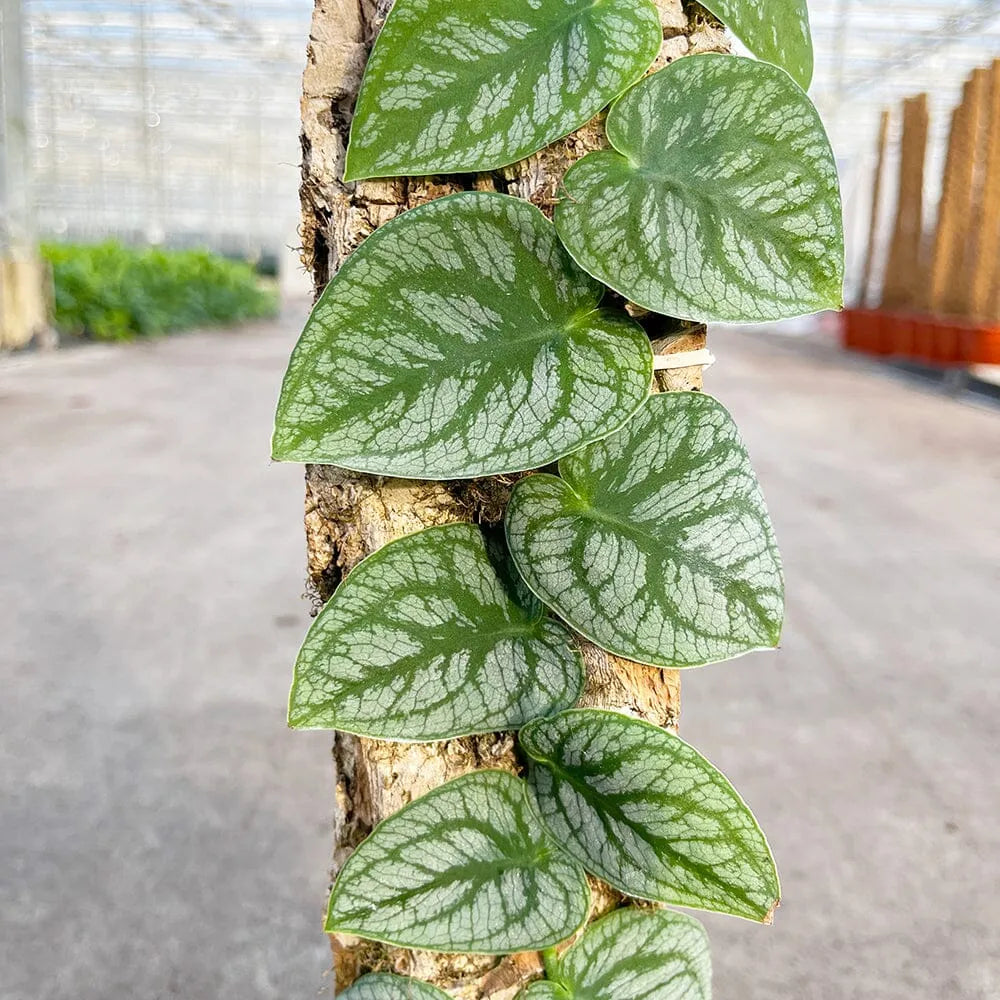
In its juvenile stage, Monstera dubia produces delicate, heart-shaped leaves that lie flat against tree trunks or climbing boards, each one marked with a silvery-green mosaic pattern over deep emerald veins. As the plant matures and climbs toward brighter light, the leaves grow larger, lose their variegation, and develop dramatic splits and holes characteristic of mature Monsteras.

Unique, elegant, and endlessly intriguing, Monstera dubia is the perfect addition for collectors seeking a living example of tropical evolution — a plant that tells a visual story as it grows.


Monstera dubia – Care Guide

Light

Thrives in bright, indirect light. In its juvenile shingling form, it prefers lower light similar to a forest understory, while mature plants climbing toward light can tolerate slightly brighter conditions. Avoid harsh direct sunlight, which can burn the delicate silver-patterned leaves.

Watering

Keep the soil lightly moist but never soggy. Water when the top 2–3 cm of soil feels dry to the touch. Monstera dubia enjoys consistent moisture but is sensitive to overwatering, especially when young. In winter, reduce watering frequency while keeping humidity high.

Temperature and Humidity

  • Temperature: Prefers warmth between 20–30 °C; avoid cold draughts and temperatures below 16 °C.

  • Humidity: Requires high humidity (70–90%) to thrive. Mist regularly, use a humidifier, or grow in a greenhouse cabinet to replicate its native rainforest environment.

Soil and Potting

Use a loose, airy, well-draining aroid mix — a blend of compost, orchid bark, perlite, and coco coir provides the perfect structure. The plant prefers a substrate that stays slightly damp but never compacted. Repot every 1–2 years in spring to refresh the mix and accommodate root growth.

Feeding

Feed every 4–6 weeks during spring and summer with a diluted, balanced fertiliser or one formulated for aroids. Avoid heavy feeding, as Monstera dubia is a moderate grower with delicate roots. Suspend fertilising during autumn and winter.

Pruning and Maintenance

Trim back leggy vines or remove any yellowing leaves to encourage dense, compact growth. Wipe leaves gently with a soft, damp cloth to remove dust and highlight their natural sheen. Provide a climbing board, moss pole, or tree bark slab to support the shingling growth pattern.

Growth and Maturity

A moderate grower, Monstera dubia can reach up to 1.5–2 metres in height indoors when given proper support. Juvenile leaves stay flat and decorative, while mature plants transition into large, fenestrated foliage when they reach higher light and humidity levels. This transformation is one of the plant world’s most captivating natural displays.

Common Issues

  • Yellowing leaves: Overwatering or poor drainage.

  • Faded colour: Too much direct sunlight or insufficient humidity.

  • Drooping: Cold temperatures or dry soil.

  • Pests: Occasionally spider mites or thrips; treat promptly with neem oil or insecticidal soap.


Background and Benefits

Monstera dubia is native to tropical forests across Costa Rica, Panama, and Ecuador, where it grows as a shingling epiphyte, adhering closely to tree trunks in its juvenile form. The species epithet dubia means “doubtful” in Latin, originally referencing confusion in early botanical classification — though today, it is recognised as one of the most distinctive and fascinating Monsteras.

In cultivation, it thrives in warm, humid environments and rewards growers with an evolving display of form and texture. Beyond its visual intrigue, it also helps purify the air, filtering toxins while adding a serene, tropical presence to indoor spaces.


Quick Care Summary

Light: Bright, indirect light; avoid direct sun
Water: Keep soil lightly moist; allow top 2–3 cm to dry before watering
Temperature: 20–30 °C; avoid below 16 °C
Humidity: High (70–90%)
Soil: Airy, well-draining mix – compost, bark, perlite, coco coir
Feed: Every 4–6 weeks in spring/summer
Growth: Climbing, shingling habit; juvenile silver-patterned leaves maturing into large fenestrated foliage, 1.5–2 m tall

⚠️ Toxicity note: Contains calcium oxalate crystals and is toxic if ingested. Keep out of reach of pets and children.


Styling Tip

Display Monstera dubia on a wooden climbing board, cork slab, or moss pole to showcase its unique shingling growth pattern. Its silvery juvenile leaves pair beautifully with darker foliage such as Philodendron micans or Anthurium luxurians, while its eventual fenestrated maturity complements larger tropicals like Monstera deliciosa. Perfect for glass cabinets, terrariums, or humid bright corners, it’s a living artwork that evolves gracefully over time.

Shipping Notes
  • Free Standard Shipping on $100+ Orders to the USA.
  • Except Preorder products are shipped in 48 hours.
  • Delivery to the USA:
  1. Standard Shipping : 3-10 business days
  • If time is of the essence, please consider selecting expedited delivery for faster service.
Exchange/Return Notes
  • We offer a 30-day return/exchange service after receiving.
  • Final sale items are not eligible for returns or exchanges.
  • To process your return/exchange, please contact us at [email protected]
  • Please click here for more details>>> Return & Exchange Policy
SKU: 62779423702

Discover Niche Categories That Outsell dubian philodendron

Top-Converting Item to Boost Your Average Order

4.2 ★★★★★
Based on 19 reviews
Sort
Highest Rating
Newest First
Oldest First
Product Reviews
E
Verified Purchase
erika
Charlottesville, US
★★★★★ 4
They are good
They were really good with nice flavor just not sour
WAS THIS REVIEW HELPFUL?YesReportShare
Reviewed in the United States on September 20, 2023
P
Verified Purchase
paige alexander
Lexington, US
★★★★★ 5
Tasty
Yummy.
WAS THIS REVIEW HELPFUL?YesReportShare
Reviewed in the United States on May 7, 2026
S
Verified Purchase
slimwriter
Fort Morgan, US
★★★★★ 2
Not sour
Not really sour at all so it’s a pretty disappointing candy.
WAS THIS REVIEW HELPFUL?YesReportShare
Reviewed in the United States on May 6, 2026
M
Verified Purchase
Moon Riley
Los Angeles, US
★★★★★ 5
Sugar free
Tastes great
WAS THIS REVIEW HELPFUL?YesReportShare
Reviewed in the United States on April 21, 2026
M
Verified Purchase
Mr. Paul A. Ackermann
Houston, US
★★★★★ 5
Dude, it's not just a horror novel
Format: Paperback
This is to the previous reviewer (C. Scanlan). If this is just a horror novel, it failed miserably. It is not exactly a blood ’n gore thriller. Compared to Stephen King, it is pretty tame. What puts the horror in this book is that it is social commentary. Mary Shelly is not just trying to scare us. It is more than just a “Friday the 13th” movie. Mary Shelly is delivering a message. It seems that everyone understands this except this reviewer. There have been several different interpretations of the novel (see [...] for 10 different meanings of the novel). ICE takes the interpretation that Shelly is saying science can go too far. This is a perfectly valid interpretation. One can disagree with this interpretation but let’s not resort to name calling and personal attacks – that those who hold such an interpretation are doing a “low level attempt to cash in on home schooling Christian paranoia and fear of health care” or believe that “AIDS [is] the fruit of sin”. My wife and I are Catholic parents and we sent our children to public schools He mocks the idea of a secular fundamentalist but then demonstrates what that is. A religious fundamentalist sees anyone who disagrees with him as being of the devil. A secular fundamentalist sees anyone who disagrees with him as guilty of “brainwashing” others. In both cases, true dialogue is impossible. Another thing that a fundamentalist does is that he sees things in opposite extremes. If you are warning of the dangers of trusting too much in science then you must be against science. There is no middle ground for the fundamentalist. If you see that science can sometimes go too far then that means you are against health care. But this is a non-sequitur. Nielson writes “Frankenstein’s placing of the creation of life within the scientific method first destroys the unrepeatability and systematically eliminates the other elements [of hope, love, beauty, creativity and sacrifice]”. Nielson is not criticizing the scientific method in total. He is only criticizing it in the creation of life. The reviewer writes “He thereby easily and explicitly condemns the whole process and philosophy of the scientific method”. But Nielson is not condemning the whole process of the scientific method. He is only condemning it in the creation of life. The reviewer then mocks the credentials of the critics in the book - “So who are these essayists superior to Norton's and Oxfords and free of deconstructionist feminist secular fundamentalism, experts so august Ignatius should want them mentioned on their product page yet are nowhere to be seen?” But this game can be played both ways. What are the credentials of this reviewer? Is this reviewer so august as to challenge these essayists? Again, this is merely an ad-hominem attack. I really do not care who has the best credentials. What matters is who makes sense. Sometimes intellectuals can make the dumbest claims. Read Paul Johnson’s book, “Intellectuals” (http://www.amazon.com/Intellectuals-Marx-Tolstoy-Sartre-Chomsky/dp/0061253170/ref=sr_1_1?ie=UTF8&qid=1421862888&sr=8-1&keywords=intellectuals). He compares the essayists unfavorably to “good solid Roman Catholic moral theology” from the likes of Richard A. McCormick S.J., who “is the renowned leader of Roman Catholic Moral Theology in the field of bioethics in the USA.” He overlooks the fact that A. McCormick S.J. has dissented from teachings of the Popes Paul VI, John Paul II, and Benedict XVI over contraception. The “renowned leader” in the Catholic Church in morality is first and foremost the pope. Since Richard A. McCormick has contradicted the popes, he cannot be a good solid Catholic theologian. Mary Shelly lived right after the Enlightenment – man is the measure of all things. She lived at a time when people believed that science will solve all our problems. This is called scientism. ICE contends that Shelly is saying that we may be expecting too much from science. It does not mean that Shelly was saying that we should reject science. And it does not mean that Shelly believes that we should go back to the Catholic faith. In fact, ICE acknowledges that Shelly was an anti-Catholic. But the Church believes that the kernel of truth can be found in others, even in anti-Catholics. This is part of the Catholic tradition. St Augustine learned from Plato and St Aquinas learned from Aristotle. ICE would take that kernel of truth and expound that with the fullness of the Catholic faith. You may disagree with the Catholic faith, or with ICE looking at Shelly’s book from a Catholic perspective. But this is at least as a legitimate an interpretation as any other. In fact, this interpretation seems closer to the truth than the others. This interpretation is the traditional interpretation, which means that it goes back further to Shelly’s time than the modern interpretations, and is therefore less likely to be in error. BTW, the reviewer wrote that “Opus Dei right wing publishing (or reprint) house is selling this novel is to milk the home school market and to support its own bizarre bio-ethical ideology”. This is factually wrong. The company that publishes Opus Dei’s books is Sceptre. But the publisher of ICE is Ignatius Press.
WAS THIS REVIEW HELPFUL?YesReportShare
Reviewed in the United States on January 22, 2015

recommand products