SKU: 6288747357
blue grow lights for plants

blue grow lights for plants FGI UV LED Grow Light Set. 340-400 nm Extended Spectrum Bars

Sale price$19.91 Regular price$22.12
Save 10%

Pay in installments of $5.53 with ShopPay, AfterPay and Klarna

Shipping Estimate
USA
  • USA
  • CAN

Ships within 48 hours · Estimated delivery Sep 29 - Oct 4

Promo Codes Available:

For Your Every Summer RSVP, with Code: SUMMER15

Description

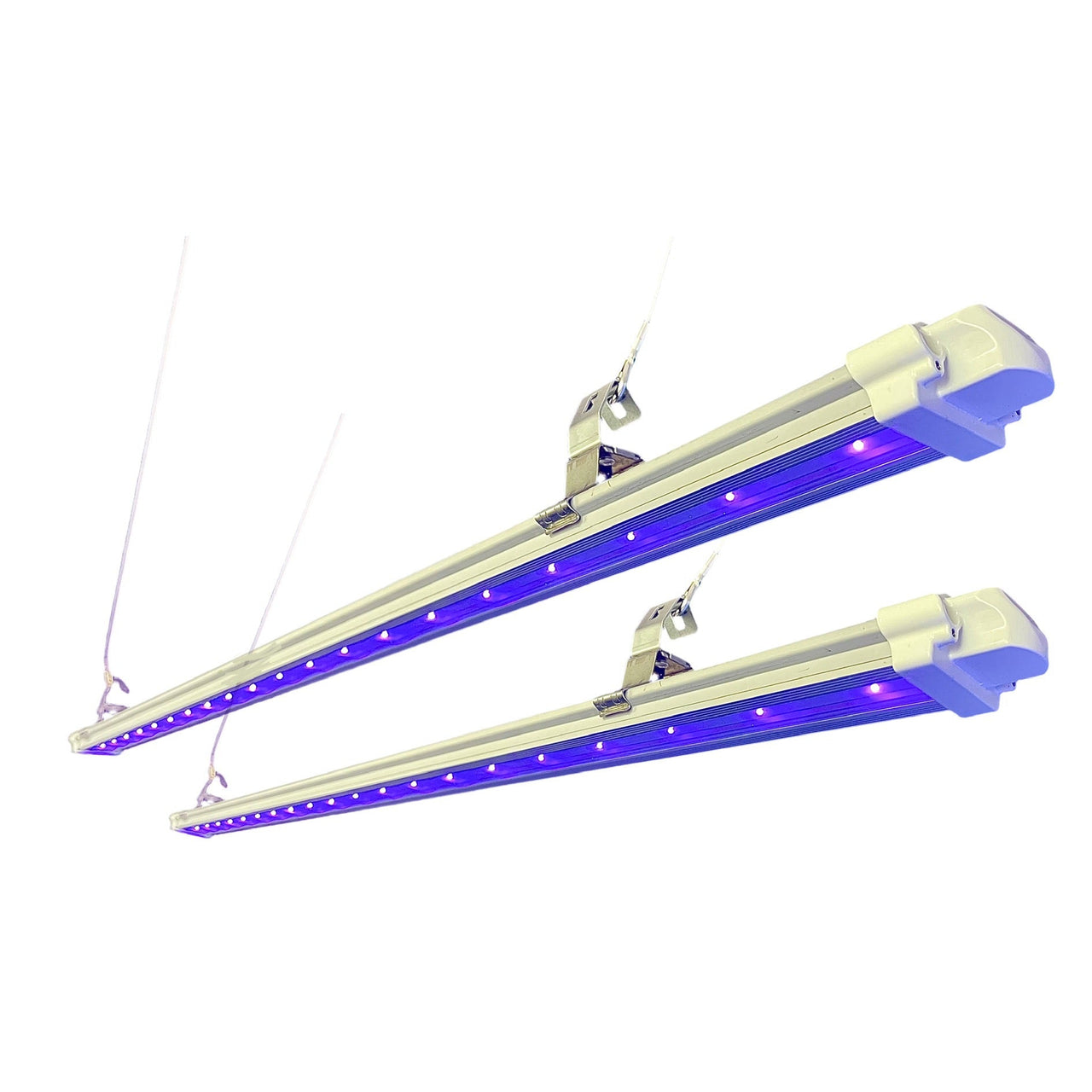
blue grow lights for plants FGI UV LED Grow Light Set. 340-400 nm Extended Spectrum BarsCommercial 385nm UVA LED light bar for supplemental UV in grow rooms, coral systems, and controlled environments. Quick Specs: Type: UVA LED Light Bar Wavelength: 385nm (single band) Length: 44 in (4 ft) Power: 30W Voltage: 100277V AC Waterproof: IP68 Housing: Sealed aluminum + glass lens Applications: CEA, coral, mycology Bundle: 2 units Why 385nm UVA? How This Compares: Standard UV lights: 395405nm (visible violet) FGI: true 385nm UVA Standard:

Commercial 385nm UVA LED light bar for supplemental UV in grow rooms, coral systems, and controlled environments.

Quick Specs:

  • Type: UVA LED Light Bar
  • Wavelength: 385nm (single-band)
  • Length: 44 in (4 ft)
  • Power: 30W
  • Voltage: 100–277V AC
  • Waterproof: IP68
  • Housing: Sealed aluminum + glass lens
  • Applications: CEA, coral, mycology
  • Bundle: 2 units

Why 385nm UVA?

How This Compares:

  • Standard UV lights: 395–405nm (visible violet)
  • FGI: true 385nm UVA
  • Standard: blended spectrum
  • FGI: single-band precision
  • Standard: IP65 or lower
  • FGI: IP68 fully sealed

 Most grow lights stop at 400nm. Natural sunlight does not.

  • UVA range (380–400nm) exists in sunlight but is typically absent in LED systems
  • This wavelength range influences plant morphology and secondary responses
  • Allows growers to fine-tune spectrum beyond traditional PAR lighting

This is not a broad-spectrum “blue boost.”
This is precision UVA supplementation.

Science + E-PAR Context

Research from Utah State University and others has expanded the usable light range for plants:

  • E-PAR: 380–740nm
  • Extends beyond traditional PAR (400–700nm)
  • Includes UVA at the edge of biologically active light

Adding 385nm helps create a closer spectral match to natural sunlight conditions—something standard LED fixtures lack.

Bundle Advantage (2 Units)

  • Wider canopy or rack coverage
  • More uniform UVA distribution
  • Flexible placement across grow zones or systems

Commercial Build Quality

  • IP68 Waterproof – fully sealed for wet, humid, washdown environments
  • Sealed Aluminum Housing + Glass Lens – durable, corrosion-resistant
  • 100–277V Input – plug into commercial power without modification
  • 4’ Linear Format (44”) – ideal for rows, vertical racks, or coral systems

Applications

  • Indoor commercial cultivation (CEA)
  • Supplemental UV strategies for flowering or morphology
  • Coral fluorescence and reef systems
  • Mycology and controlled environments
  • Research and spectral testing


Sunlight Levels of 380NM UV

Natural sunlight provides plants 1.22 umols of 380nm blue energy. 

Natural Sunlight Spectrum Blue Energy 1.2234 umols

Typical Full Spectrum LED Lack 380NM UV

Full spectrum LEDs have limited blue spectrum which peak at 460nm.  

Full Spectrum LED 460nm Blue Energy Levels .0514 umols

Full Spectrum LED with Supplemental 380NM UV 

Adding supplemental 385NM UV creates a secondary peak of blue energy at 1.5047 umols at 12" from the canopy, roughly equaling natural sunlight. 

Supplemental UV Spectrum plus Full Spectrum Blue Energy 1.5047 umols (3x greater) 

Build Quality

These are high quality units with a crystal glass lens cover to protect the diodes and allow for cleaning. The all aluminum frame dissipates what little heat the bar creates. At 30 watts the Lightbar sips energy too. 

Spectrum Theory 

Blue energy is scientifically known to help form more compact plants. More lush leaf growth, stronger and larger stems and tighter internodal spacing.

We gave a prominent researcher one of our UV-A LEDs and he said: 

"Your UVA lights arrived and we have confirmed their 385 nm peak. This looks like a high quality fixture." He went on to say: "Elevated exposure to UV photons is known to enhance the synthesis of UV blocking compounds in the leaves of many species and it is reasonable to think that UV photons can increase the synthesis of secondary metabolites in plants." And further, "I expect we will find value in dosing of CSativa plants with UV photons, but not surprisingly, the effects will likely interact with UV wavelength, intensity, timing of delivery, and growth stage."

The UVA Lightbar fits neatly inside the frame of our Uniformity Pro LEDs as well as many other multi-bar style full spectrum LEDs.

Use

We recommend two of our UV-A LEDs over each 4'x4' area. The slim design allows them to be hung inside the frame of most 6 and 8 bar LEDs. Mounting height should be at the same level to avoid creating shadowing. 

Control

A basic digital 110V wall timer can be used, or if using the TrolMaster Hydro X we recommend the DSP-1 module for 110V or DSP-2 for 120V power connection and multiple on/off timer programming.

Technical Specifications

  • Power: 30W (±5%)
  • Diodes: 20 UVA LEDs
  • Input: 100–277V AC, 50/60Hz
  • Thermal Output: 102.3 BTU
  • Rating: IP68 waterproof
  • Dimensions: 44.88” × 2.24” × 1.53”
  • Weight: 4.4 lbs


Photometric File Download

Product Warranty (see our warranty here)

3 year warranty

Shipping Notes
  • Free Standard Shipping on $100+ Orders to the USA.
  • Except Preorder products are shipped in 48 hours.
  • Delivery to the USA:
  1. Standard Shipping : 3-10 business days
  • If time is of the essence, please consider selecting expedited delivery for faster service.
Exchange/Return Notes
  • We offer a 30-day return/exchange service after receiving.
  • Final sale items are not eligible for returns or exchanges.
  • To process your return/exchange, please contact us at [email protected]
  • Please click here for more details>>> Return & Exchange Policy
SKU: 6288747357

Discover Niche Categories That Outsell blue grow lights for plants

Top-Converting Item to Boost Your Average Order

4.5 ★★★★★
Based on 25 reviews
Sort
Highest Rating
Newest First
Oldest First
Product Reviews
D
Verified Purchase
David R. Papke
Bozeman, US
★★★★★ 5
Recommended for All Lawyers
Format: Paperback
Meyer proves his initial point that much of what lawyers do is storytelling, and he achieves his goal of providing a primer on narrative theory for lawyer-storytellers. The book is sophisticated but written in an engaging way using non-technical language. Examples from legal and literary works abound, and they range from courtroom arguments and appellate briefs on the one hand to an essay by Joan Didion and Vonnegut's "Slaughterhouse Five" on the other. Meyer's favorite stories are found in Hollywood movies, and although he seems unaware of the accomplishment,Meyer provides fresh interpretations of such movies as "HIgh Noon" and"Jaws." I strongly recommend "Storytelling for Lawyers" for all law students, lawyers, and judges.
WAS THIS REVIEW HELPFUL?YesReportShare
Reviewed in the United States on May 7, 2014
D
Verified Purchase
DoubtfulReader
Massapequa, US
★★★★★ 3
Notes on Legal Style by a Law Professor and Experienced Lawyer.
Format: Kindle
BOOK REVIEW: MEYER, Philip N., Storytelling for Lawyers ISBN: 978-0-19-5396638 Read June, 13th-27th, 2017. This book discusses storytelling tools by presenting a series of examples of good storytelling, both in legal settings and in literary works and movies. If theoretical explanations are sometimes a bit dry, the frequent quoting of practical examples conveys fluidity and speed to the book. After an introduction presenting lawyers as storytellers, it deals with the roles played in storytelling by Plots (chapters 2 and 3); Character (4 and 5); Voice, Perspective, Details and Images, and Rhytm and Speed (which relate to Scene and Summary) (chapter 6); Place or Story Environment (chapter 7) and Narrative Time. Focusing maybe too narrowly on legal storytelling before American juries, plot is almost equated with melodrama. Films like Jaws and High Noon are extensively discussed, as Gerry Spence’s Closing Argument on Behalf of Karen Silkwood. The chapters on character offer interesting insights on character classification (“round” characters, with psychological depth, prone to suffer transformation as the story evolves, vs. “flat” ones), while discussing the tools for telling how a character is, as opposed to simply showing the psychological nature of each character’s character through dialogue or the actions the character performs. Examples include Tobias Wolff’s This Boy’s Life and Jeremiah Donovan’s Closing Arguments on Behalf of Louis Failla, in a 13-week trial the Author could scrupulously attend in person. Discussions on Voice, Perspective, Details and Images, Scene and Summary, criticize the basic assumptions of the neutrality of lawyers’ voices, exemplifies how to manage details to suggest ideas and emotions, draw on the distinction between showing and telling, and offers interesting insights into the narrative theory’s concept of stretch (the slowing of the narrative rhythm in relation to the narrated story’s). Environment depiction storytelling tools deals with Joan Didion’s The White Album and the Judicial Opinion in a Rape Case, quoting also from W. G. Sebald’s The Emigrants and the Petition Briefs in Reck v. Ragen and Miranda v. Arizona. Further examples are Kathryn Harrison’s While They Slept and the Petitioner’s Brief in Eddings v. Oklahoma. Finally, the chapter on Narrative Time draws on Kurt Vonnegut’s Slaughterhouse Five and explores time, rhythm or speed, discussing more deeply stretch and the relation of time of the narrative itself with the time of the facts dealt with in the narrative. Chronology is discussed and criticized; Analepsis or Flashback is didactically explained and exemplified, both in general storytelling theory and in its legal use; the same holds for Prolepsis (Flash-forward) and Ellipsis (the intentional omission of a part of the narrative, often with the purpose of emphasizing the omitted event. Pacing and Rhythm are discussed in more lenght, with the caveat - repeated somewhat throughout the book - that legal stories are often left unfinished by the lawyer, in order to allow the jurors or judges fill the end with their decision. The Author remarks his purpose was to suggest possible tools and ways of dealing with problems which arise in legal storytelling, and he delivers what he promises.
WAS THIS REVIEW HELPFUL?YesReportShare
Reviewed in the United States on June 27, 2017
M
Verified Purchase
Matt M.
Alexandria, US
★★★★★ 5
Great book and great professor
Format: Paperback
Professor Meyer is a great writer. I had took his death penalty case at Vermont Law School. He writes for numerous magazines including the ABA. I would highly recommend this book and all of his writings.
WAS THIS REVIEW HELPFUL?YesReportShare
Reviewed in the United States on January 19, 2021
J
Verified Purchase
J. Christian
Los Angeles, US
★★★★★ 4
Interesting book
Format: Paperback
I am not a lawyer, nor a writer, but rather a reader. I found the correlation of legal storytelling with sceenplay, literary narrative quite interesting. Legal trials are theater.
WAS THIS REVIEW HELPFUL?YesReportShare
Reviewed in the United States on March 20, 2014
C
Verified Purchase
Classics professor
Port Orchard, US
★★★★★ 5
Highly recommended -- not just for lawyers!
Format: Paperback
I'm not a lawyer but a Classics professor looking for modern parallels to (and contrasts with) Cicero's persuasive strategies in Roman courts. This book was just what I was looking for: lucid, informative, smart, and as a bonus, well versed in narrative theory, which Meyer handles as an experienced teacher -- avoiding jargon and needless complication, illustrating the key ideas with well-known cinematic examples.
WAS THIS REVIEW HELPFUL?YesReportShare
Reviewed in the United States on April 20, 2017

recommand products