Pay in installments of $5.00 with
 ,
,
 and
and

Shipping Estimate
USA
- USA
- CAN
- USA
- CAN
Ships within 48 hours · Estimated delivery Aug 30 - Sep 4
 Promo Codes Available:
For Your Every Summer RSVP, with Code: SUMMER15
Description
succulent plant native to southern africa Carrion Plant 'Stapelia gigantea'The Carrion plant, known as Stapelia gigantea, is known for having the largest flowers of almost any succulent in the world. Native to South Africa, the Stapelia gigantea has several other common names, such as carrion flowers, starfish plant, starfish flower, toad plant, and zulu giant plant. The term "carrion" is used to describe the unpleasant, foul odor associated with decaying flesh. This Stapelia gigantea gets its common name because its flowers
The Carrion plant, known as Stapelia gigantea, is known for having the largest flowers of almost any succulent in the world. Native to South Africa, the Stapelia gigantea has several other common names, such as carrion flowers, starfish plant, starfish flower, toad plant, and zulu giant plant.
The term "carrion" is used to describe the unpleasant, foul odor associated with decaying flesh. This Stapelia gigantea gets its common name because its flowers emit a strong, unpleasant, carrion-like smell, which resembles rotting meat. The odor is what attracts flies and other pollinators in their natural habitat.
Stapelia gigantea is a spineless stem succulent that resembles a cactus; it can grow up to 2 feet tall and may form big clumps when growing up to 3 feet wide. These thick, fleshy stems are ribbed and have a green coloration, with some variations in shades.
The Carrion has Huge Flowers
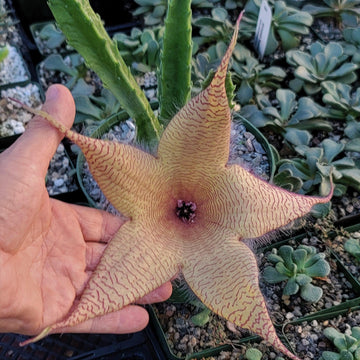
The flowers of the Stapelia gigantea are large, about 15 inches, and star-shaped; they bloom during the fall.
They have pale yellow to reddish brown hues adorned with intricate patterns and markings. The petals are thick and fleshy, and they curve backward, giving the flowers a star-like appearance.
The carrion flowers smell like rotten flesh; although this sounds disgusting, it helps attract flies and other pollinators to the Stapelia gigantea.
Interestingly, it also looks like drying flesh peeling from the bone, and also fringes of soft white hairs on the corolla segments superficially resembling a layer of mold growing on rotting matter.
The cluster of flowers arises near the base of a branch; on this carrion plant, the inflorescence had two buds with scale-like leaves at the base of the petioles.
Despite their unusual smell, the flowers of the Stapelia gigantea can be quite beautiful and captivating. They are a testament to the diversity and uniqueness of nature. If you ever come across these flowers, be sure to take a moment to appreciate their intricate beauty, even if the smell might not be to everyone's liking!
When and How to Water Your Carrion Plant
The Carrion Plant is a highly drought-tolerant succulent, meaning it can store water in its thick stems and survive long dry spells. Overwatering is one of the most common mistakes with this plant, so it’s important to mimic its natural dry habitat by keeping watering minimal. The carrion plant prefers watering once every 2-3 weeks in the growing season, and once in 4-6 weeks during the dormant season.
In spring and fall, during the growing season, the carrion flower plant prefers watering once every 2–3 weeks is sufficient, but frequency should be adjusted depending on your conditions, such as temperature, humidity, and soil drainage. Using the soak and dry method, water thoroughly until excess drains out of the pot, then wait until the soil has completely dried before watering again.
In winter, during the dormant season, the Carrion plant slows down its growth to watering once every 4–6 weeks, or even less, is usually enough. During this period, allow the soil to stay dry for extended periods, watering only when the stems show signs of dehydration, like slight wrinkling. Providing too much water in dormancy can lead to root rot, so it’s best to keep it on the drier side.
Light Requirements - Where to Place Your Carrion Plant
When growing your Stapelia gigantea indoors, it thrives in bright, indirect light for 4-6 hours a day. Avoid placing it in direct sunlight, as the intense rays can scorch the leaves and cause damage to the carrion plant. If you notice that the stems are stretching or leaning toward the light source, it's a sign that it needs more light. In that case, you can consider supplementing with artificial grow lights to provide the necessary brightness.
When growing outdoors, it works best in full sun to partial shade. It can tolerate some direct sunlight, especially during the morning or late afternoon, but it's best to avoid the scorching midday sun. A location with dappled sunlight or a spot under a tree that provides filtered light can be ideal for the carrion plant. Just make sure it still gets enough brightness to thrive.
Remember, finding the right balance of light is crucial for the health of the Stapelia gigantea. Too much direct sunlight can cause sunburn and damage the plant, while insufficient light can lead to weak growth and poor blooming.
Optimal Soil & Fertilizer Needs
The Carrion plant prefers a well-draining soil mix and should be fertilized once a year in spring. You can create a suitable blend by combining equal parts of potting soil, perlite, and coarse sand. Instead, make or buy a well-draining potting mix, or ideally, use our specialized succulent potting mix, opens in a new tab: Soil cactus mix blend 1 gal 4 qt cacti succulent dirt compost growing media that contains 5 natural substrates and mycorrhizae to promote the development of a strong root system that helps your succulent to thrive.
The Stapelia gigantea carrion plant doesn't require frequent fertilization, but it can benefit from light feeding during the growing season. Fertilize once a year during the growing season in the spring with a balanced NPK fertilizer of about 5-10-5. Be cautious not to over-fertilize, as this can result in excessive growth with fewer blooms. This provides a slow-release source of nutrients and helps improve the overall soil structure.
Hardiness Zone & More
In the United States, this is mostly an indoor plant, but if you live in southern Florida or Hawaii, then you can cultivate it outdoors in USDA zones 10-12.
It can tolerate higher temperatures, but it's essential to provide some protection from the intense midday sun, especially in hotter climates.
In terms of humidity, the Stapelia gigantea can handle a range of humidity levels, but it appreciates moderate to high humidity.
Remember to acclimate your Stapelia gigantea gradually when transitioning it from indoor to outdoor or vice versa. Sudden changes in temperature or light can stress your carrion plant. Take care to protect the plant from extreme weather conditions like frost or excessive heat.
How to Grow the Best Carrion Plant Indoors
The Stapelia gigantea is native to warm, tropical regions, so it thrives in indoor environments where temperatures are consistently between 60°F and 80°F. It prefers bright, indirect light, so placing it near a window with filtered sunlight works well. In terms of humidity, this plant can tolerate average indoor humidity levels, but it appreciates a slightly higher humidity level. You can increase humidity by placing a tray of water near the plant or by using a humidifier.
Wildlife - Carrion Flowers Attracts the Following Friendly Pollinators
Carrion flowers attract flies, such as blow flies, flesh flies, and house flies, along with some beetles and even mosquitoes. These pollinators are drawn to the flowers' foul smell, mimicking the scent of decaying flesh.
According to the ASPCA, the Carrion Plant (Stapelia gigantea) is mildly toxic to humans and animals if ingested, and its sap can cause skin irritation, so it should be handled with care and kept out of reach of children and pets.
How to Propagate Your Stapelia gigantea
To propagate your Stapelia gigantea, you can easily do so by taking stem cuttings from a healthy plant. Make sure the cutting has calloused over before planting it in well-draining soil, and keep it in a warm, bright location to encourage root growth. Water sparingly until roots have established, and soon you will have a new plant ready to thrive in your collection.
Key Takeaways
- The Carrion Plant produces some of the largest flowers in the succulent world, often reaching up to 12 inches across.
- Its blooms release a distinct carrion-like odor, which attracts flies for pollination—an unusual but fascinating survival strategy.
- The flowers are hairy, star-shaped, and leathery, making them look almost unreal, like something from another world.
- As a drought-tolerant succulent, it thrives on neglect and prefers the “soak and dry” method of watering.
- Instead of bees or butterflies, this Carrion plant relies mostly on flies and beetles to pollinate its massive blooms.
The Bottom Line
Overall, the Stapelia gigantea (Carrion plant) is unique and captivating, with its large, star-shaped flowers that have a distinctive carrion-like scent, hence known as carrion flowers. It is a low-maintenance succulent plant that thrives in bright, indirect light and well-draining soil. The Stapelia gigantea is also known for its ability to attract pollinators like flies, making it a great addition to any garden or indoor collection.
So, if you're looking for a striking and low-maintenance succulent for your rock gardens, the Carrion Plant Stapelia gigantea is definitely worth considering!
Shipping Notes
- Free Standard Shipping on $100+ Orders to the USA.
- Except Preorder products are shipped in 48 hours.
- Delivery to the USA:
- Standard Shipping : 3-10 business days
- If time is of the essence, please consider selecting expedited delivery for faster service.
Exchange/Return Notes
- We offer a 30-day return/exchange service after receiving.
- Final sale items are not eligible for returns or exchanges.
- To process your return/exchange, please contact us at [email protected]
- Please click here for more details>>> Return & Exchange Policy