SKU: 65196001257
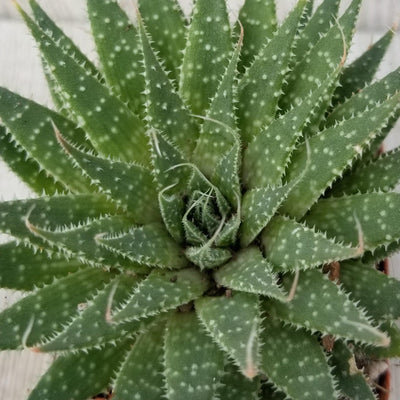
aloe vera looking plant with white spots

aloe vera looking plant with white spots Buy 'Lace Aloe - Aloe Aristata' Care and Growing Guide

Sale price$18.05 Regular price$20.06
Save 10%

Pay in installments of $5.01 with ShopPay, AfterPay and Klarna

Shipping Estimate
USA
  • USA
  • CAN

Ships within 48 hours · Estimated delivery Sep 22 - Sep 27

Promo Codes Available:

For Your Every Summer RSVP, with Code: SUMMER15

Description

aloe vera looking plant with white spots Buy 'Lace Aloe - Aloe Aristata' Care and Growing GuideIntroducing the Lace Aloe, known as Aloe aristata (or Aristaloe aristata) which is vibrant among the aloe genus! The Lace Aloe gets its name from the intricate, lacy patterns on its leaves. The Aloe aristata of this low growing perennial succulent. The specific epithet aristata means "bearing bristles or a beard." It is sometimes also known as torch plant, spider aloe, and Guinea fowl Aloe. This lace aloe is not just any ordinary houseplant; it's a

Introducing the Lace Aloe, known as Aloe aristata (or Aristaloe aristata) which is vibrant among the aloe genus! The Lace Aloe gets its name from the intricate, lacy patterns on its leaves.

The Aloe aristata of this low-growing perennial succulent. The specific epithet aristata means "bearing bristles or a beard." It is sometimes also known as torch plant, spider aloe, and Guinea-fowl Aloe.


This lace aloe is not just any ordinary houseplant; it's a compact, hardy succulent that has recently undergone reclassification.

The lace aloe is grown primarily for its attractive succulent rosettes with yellow spots and white bumps on dark green leaves with lacy edges and soft white spines.

Hailing all the way from South Africa, the Aloe aristata can grow up to 8 inches tall and 6 inches wide. From wide bottoms to sharper points at the top, these leaves are pure perfection. 

This sun-loving Aloe aristata plant thrives on warmth and dryness; it's like having your very own sunshine-filled oasis indoors or outdoors in xeriscape landscapes. This frost-hardy wonder boasts leaves that mimic the elegance of Haworthia plants and grows at an astonishing pace.  

When it comes to flowering, these pollinator-friendly lace aloe plants bloom with tubular orange-red lace aloe flowers during the sizzling summer months, that attract both bees and hummingbirds alike  talk about being irresistible to nature's most delightful creatures! 

When and How to Water Your Lace Aloe

The Lace Aloe has moderate watering needs. It is a succulent plant that prefers to be underwatered rather than overwatered. Its large, fleshy succulent stems and lanceolate leaves store water for use during times of drought. It's pretty risky to feed it too much water because it doesn't require it because of this adaptation. 

When watering, make sure to thoroughly saturate the soil and then allow it to completely dry before watering again. This Aloe plant is drought-tolerant and can withstand periods of dryness, so it's better to err on the side of underwatering. 

 In the spring and summer, during the active growing season, you can water the Lace Aloe every two to three weeks. However, in the fall and winter, during the dormant period, watering should be reduced to once a month or even less, as the lace aloe plant requires less moisture during this time. It's always a good idea to check the moisture level of the soil before watering to ensure it is dry.

Light Requirements - Where to Place Your Lace Aloe

When growing indoors, the Aloe Aristata prefers bright, indirect light. It thrives in a location with plenty of natural sunlight, such as a south-facing window.  If your home doesn't receive much natural light, you can also use artificial grow lights to provide the necessary light for the plant's growth. Just make sure to position the lights a few feet away from the plant to prevent heat damage. 

For outdoor cultivation, the lace aloe can thrive in full sun and partial shade for at least 4-6 hours per day. It's important to protect the aloe aristata from prolonged, direct sunlight, as it can cause the leaves to become scorched. If you notice the leaves turning brown or yellow, it may be a sign that the aloe aristata plant is receiving too much light.

Remember, finding the right balance of light is crucial for the health of the Lace Aloe.

  1. If the aristata lace aloe isn't receiving enough light, it may become leggy, and its growth may slow down.
  2. On the other hand, too much light can cause the leaves to become discolored or sunburned.

Observing the Aloe aristata response to its current light conditions and making adjustments as needed will help ensure its well-being.

Optimal Soil & Fertilizer Needs

The Lace Aloe thrives in well-drained soil that mimics its natural habitat. A coarse sand or gritty soil mix is ideal for this succulent plant, as it allows excess water to drain away quickly and prevents the roots from sitting in soggy soil. Instead, simply mix garden soil or buy a well-draining potting mix, or ideally use our specialized succulent potting mix that contains 5 natural substrates and mycorrhizae to promote the development of a strong root system that helps your succulent to thrive.

When it comes to fertilizer, the aristaloe aristata Lace Aloe is not a heavy feeder. It can thrive in nutrient-poor soil, so you don't need to fertilize it frequently. During the growing season, which is typically in spring, you can apply a balanced natural fertilizer once a year.

However, it's important to note that succulents like the Lace Aloe are more prone to damage from overfertilization than underfertilization. Excessive fertilizer can lead to burnt roots and other issues. So, it's best to err on the side of caution and fertilize sparingly. Always observe the plant's response and adjust your fertilization routine accordingly. 

Hardiness Zone & More

If you're growing the Lace Aloe indoors, it prefers temperatures between 50-80°F and can tolerate slightly cooler temperatures at night. Avoid placing them near drafts or heating vents, as sudden temperature changes can stress the plant.

You can place it in a well-ventilated area or use a fan to improve air circulation.   It is strongly advised that plants be shielded from cold, wet soil conditions in areas that experience a lot of winter and spring moisture (especially rain).  

For outdoor cultivation, the Lace Aloe is a cold-hardy plant and can tolerate mild frost in USDA zones 7-12. If you live in a colder climate, you should put them in a pot, and they can then be kept outdoors during the summer and brought in as the temperature drops. 

In terms of humidity, the Lace Aloe is adaptable and can tolerate a wide range of humidity levels, but it generally prefers drier conditions. It's important to provide good airflow around the plant to prevent excessive humidity and reduce the risk of fungal diseases. 

How to Propagate Your Lace Aloe?

You can easily propagate your lace aloe by removing offsets that grow around the base of the plant. These offsets can be gently separated from the main plant and planted in their own pots with well-draining soil to encourage root growth. Additionally, you can also propagate lace aloe through leaf cuttings by allowing the cut ends to callous over before planting them in soil.

Wildlife - Lace Aloe Attracts the Following Friendly Pollinators

The Lace Aloe attracts pollinators such as bees, hummingbirds, and butterflies with their tubular orange flowers. These succulents are also known for their ability to thrive in low-water conditions, making them a popular choice for drought-tolerant gardens.

Butterflies
Bees
Hummingbirds
Lady Bugs
Multi Pollinators
Other Birds

Toxicity: The Lace Aloe is completely safe for humans and pets. It is a popular choice for indoor succulent gardens due to its low maintenance requirements and attractive appearance.

Key Takeaways

  1. The Lace Aloe forms a compact rosette of dark green, fleshy leaves adorned with white, lace-like spots and soft spines along the edges, giving it a unique, ornamental appearance.
  2. Also known as Spider Aloe, this name reflects its spiky, delicate leaves that resemble spider legs, adding an intriguing visual element to small gardens and indoor spaces.
  3. When in bloom, Lace Aloe produces tall stalks topped with tubular, orange-red flowers that attract hummingbirds and bees, adding vibrant color to your garden in late summer and fall.
  4. This aloe is highly drought-tolerant, requiring minimal watering once established, making it an excellent choice for xeriscaping or low-maintenance indoor and outdoor gardens.

The Bottom Line

Overall, the Lace Aloe (Aloe aristata) is a striking, compact succulent known for its unique rosette of dark green leaves adorned with white, lace-like markings and soft spines. Its ability to tolerate cooler temperatures and mild frost makes it more versatile than many other aloe species, especially in outdoor gardens. With its low water requirements, Lace Aloe is a perfect addition to drought-tolerant landscapes or as a low-maintenance indoor plant. During its bloom period, it produces vibrant orange-red flowers that attract pollinators, adding seasonal interest. For best care, place it in well-draining soil with plenty of sunlight, water sparingly, and protect it from extreme cold.

Shipping Notes
  • Free Standard Shipping on $100+ Orders to the USA.
  • Except Preorder products are shipped in 48 hours.
  • Delivery to the USA:
  1. Standard Shipping : 3-10 business days
  • If time is of the essence, please consider selecting expedited delivery for faster service.
Exchange/Return Notes
  • We offer a 30-day return/exchange service after receiving.
  • Final sale items are not eligible for returns or exchanges.
  • To process your return/exchange, please contact us at [email protected]
  • Please click here for more details>>> Return & Exchange Policy
SKU: 65196001257

Discover Niche Categories That Outsell aloe vera looking plant with white spots

Top-Converting Item to Boost Your Average Order

4.0 ★★★★★
Based on 21 reviews
Sort
Highest Rating
Newest First
Oldest First
Product Reviews
E
Erik D. Curren
Dallas, US
★★★★★ 5
We can all be wise men bearing gifts to Jesus
Format: Hardcover
Faith, hope, and charity are not just virtues that we can develop to bring ourselves closer to God and our fellow person but they are also gifts that we can bring to God, writes this household preacher to two Popes. Cardinal Cantalamessa writes on serious topics with an accessible and joyful style that welcomes the reader to see him or herself as one of the Magi bringing precious and deeply meaningful gifts to Christ.
WAS THIS REVIEW HELPFUL?YesReportShare
Reviewed in the United States on November 14, 2024
R
Rocco
New York, US
★★★★★ 5
Cardinal Cantalamessa is a Saint!
Format: Hardcover
This book has the wisdom of the fathers infused with the gentle Grace of the Holy Spirit, written for modern day Christian readers.
WAS THIS REVIEW HELPFUL?YesReportShare
Reviewed in the United States on December 20, 2024
J
jpmath
Massapequa, US
★★★★★ 4
Beautiful and profound, albeit flawed
Format: Hardcover
What I'd really like to rate this is 4 1/2 stars, because it isn't perfect, but it's better than a 4. I just can't bear to give it a 5, for reasons described below. The book has three main parts, each named for a theological virtue of the title. Altogether there are 40 chapters: 14 dedicated to faith, 10 to hope, and 16 to charity. A couple of "Bonus" chapters called "Excursus" take up some interesting theological questions that are related but don't quite fall under any one topic: did Jesus possess the theological virtues? and From God as Love to the Filioque. The book is deeply learned and cites theologians through the centuries, including a few I'd never heard of despite a lot of formal and informal theological study. Of course you meet the usual suspects such as Origen, pseudo-Dionysius, Augustine, Thomas Aquinas, Catherine of Siena, John of the Cross, Mother Teresa, and others; but: have YOU heard of St. Zeno of Verona before? If not, you're in for a treat! The text has more of an Augustinian flavor than a Scholastic one. (I should qualify that claim by admitting that I am at best an armchair theologian, so don't quote me on that.) But, for example: Chapter 39 discusses Beauty, uses the idea of God's eternal Beauty to explain the Trinity, and concludes with St. Augustine's "recipe" for becoming beautiful. Indeed, an in-depth discussion of the Trinity doesn't appear at all until Part 3 on Charity, rather than in the chapter on Faith! An important distinction that Fr. Cantalamessa draws is between "objective" aspects of a theological virtue and the "subjective" aspects of the same. The "objective" aspects refer to the object of the virtue, such as God Himself; the "subjective" aspects refer to how we experience them. He points out that, historically, the "objective" view tended to predominate in theological discussion, whereas the "subjective" view tends to dominate more recently, almost to the exclusion of the objective. It will probably not surprise the reader that Fr. Cantalamessa, former Preacher to the Papal Hosuehold, comes down squarely in the Catholic approach of "both/and", and he elaborates on this. A very appealing aspect of this book is the occasional use of parable and analogy to explain difficult subjects: a parable on trying to justify ourselves by our works (Ch. 7), analogies for "the hint that God exists" (ch. 5), the analogy of the seed (ch. 14), an analogy that hope needs difficulties and tribulations (ch. 22), the Trinity (ch. 29), God's love for us is erotic (ch. 34), and how we might hope that even Nietzsche can be saved (ch. 37). Many analogies, though not all, are drawn from ordinary family life: a mother's love for a child, a child's temper tantrum before collapsing in tears on a parent. These are powerful and effective. Unfortunately, I can't rate it 5 stars, because the text seems to consider its audience to be the average educated lay Catholic, but there are two serious weaknesses both for the theological newbie and even for the theological adolescent. One is the use of many unfamiliar terms, some of them merely transliterated from Greek, and no definition given anywhere -- often, not even a hint of what the word may mean. In some cases this can make it difficult to follow the discussion. For instance, the text dedicates two entire chapters to the question of justification, which makes sense given that it's an important topic in the realm of faith, and it's important to take it seriously. But the book never once provides a definition, which suggests the reader should be familiar with the term already. I guarantee you most people don't know what the word means. But even if you think that a definition of "justification" will indeed come tripping off the average reader's tongue, I challenge you to make a case for terms like ontological, parousia, and parenesis. I've been reading Catholic theology for 30 years and parenesis is a new one even to me. Sure, the reader might could look them up, and I'm glad to expand my vocabulary, but who's the audience here? If the text is meant only for seminarians, then never mind, but given how Word on Fire is marketing this I really don't think that is the case. The second major weakness is all the more disappointing, as it is so common to contemporary works of theology: when newer developments seem to contradict past dogma or even Scripture itself, pretend the dogma and Scripture doesn't exist. This happens at least twice: 1) Surely Fr. Cantalamessa is not unaware that Scripture both Old and New is replete with references to Christ "ransoming" us from God's wrath. Yet there he is in Chapter 31, not merely acting as if it doesn't exist, but contemptuously dismissive of the notion! Grant the Scholastics this much: at least they took Matthew 20.28, Romans 1.18, Romans 2.5-8, 1 Timothy 2.6, 1 Peter 1.18-19, and Revelation 19.15 seriously enough to wrestle with them. 2) Similarly, the Council of Florence made certain pronouncements on "those existing outside the Catholic Church" and "the souls of those who depart this life in actual mortal sin, or in original sin alone." Chapter 14 acts as if they do not exist. I do not for a moment mean to advocate for the "glass half-empty" interpretation of these pronouncements that predominated theological discourse for centuries, let alone for Feeneyism, but we ignore them at our peril, if only because ignoring them leaves a great big breach in the apologetic wall that will come under assault both from those who do reject the Second Vatican Council and from hostile Protestants more knowledgeable of Catholic theological history than the average Catholic and, one half-wonders, the average Catholic theologian. Those drawbacks, while severe enough in my eyes to warrant mention and deduct a star, do not for a moment take away from the beauty and profundity of the rest of this work. I am very glad to have had the chance to read it; it has challenged me both intellectually and spiritually, and I have given it to my (late teenage) children to read and discuss with me. It is absolutely worth reading, and you WILL get a lot out of it. Just be ready for the challenge.
WAS THIS REVIEW HELPFUL?YesReportShare
Reviewed in the United States on July 25, 2025
S
Verified Purchase
shelly turco
Omaha, US
★★★★★ 5
OPEN YOUR EYES
Format: Paperback
Great book! Open your eyes sheep..... there is much more to this world that we know of. Authority figures have lied to us long enough..... do your own research. This book is a great example of what we were not taught in school! Well written.
WAS THIS REVIEW HELPFUL?YesReportShare
Reviewed in the United States on February 14, 2021
S
Verified Purchase
Sailorman
Belleville, US
★★★★★ 4
Great speculation from the "Alternative Camp"
Format: Paperback
According to John Anthony West it was not until the second half of the twentieth century that "guerilla scholarship" became a noticeable, if uncoordinated force in modern science. Guerilla scholarship of course, refers to the alternative camp or those that challenge orthodox views in science, archeology, anthropology, etc. If this book doesn't fall into the guerilla scholarship or alternative camp category it comes really close. Author Dr. Robert Schoch is of course the archeologist who some years ago, along with John Anthony West, shocked the scientific community and infuriated Dr. Zahi Hawass, Egypt's Director of Antiquity, by claiming that the Sphinx's construction predated Khufu, its alleged builder, by 3,000 years or more. While the controversy surrounding those claims has resulted in numerous books, both, pro and con, with no real accepted conclusions, in this book Schoch tries to develop the hypothesis that all of the pyramids constructed around the world have a common origin in Sundaland, which was inundated under 250 feet of water after the last ice age. If somebody could come across a pyramid or two (2), that predated the great pyramid, under that 250 feet of water it would certainly help Schoch's case, but be that as it may, Schoch, while not proving his hypothesis, does present a pretty convincing argument in support of his speculation. Schoch begins with a discussion in review of the theories for the age of Giza and other pyramid type structures around the world. He then provides very convincing evidence for his claim that humans traversed both the Atlantic and Pacific oceans eons before Columbus's 1492 voyage, which is the orthodox view of the first contact with the new world. He discusses how early humans might have accomplished this as well as their possible motives for doing so. Schoch concludes with where they came from, arriving at the common roots in Sundaland 10,000 years ago. This book probably has some of the longest, impossible to pronounce names, of people and places of any book that I have ever read; and a few maps of various parts of the world, particularly Europe, the Middle and Far East, and South America, would have helped a great deal in developing a mental picture of what was being related. All that aside, the book challenges the mind and causes one to think. I was particularly intrigued by Schoch's explanation as to how Moses was able to convince the pharaoh to allow him and his followers to leave Egypt, as well as Schoch's perfectly plausible explanation of what parted the waters of the Red Sea and subsequently drowned the pharaoh's army when the waters rushed back in. While maybe not as convincing as Schoch's earlier work, "Voices of the Rocks", Schoch presents convincing arguments and if you are a "guerilla scholar" you're going to love this book.
WAS THIS REVIEW HELPFUL?YesReportShare
Reviewed in the United States on February 24, 2008

recommand products