SKU: 68170496386
abundant edge herbicide

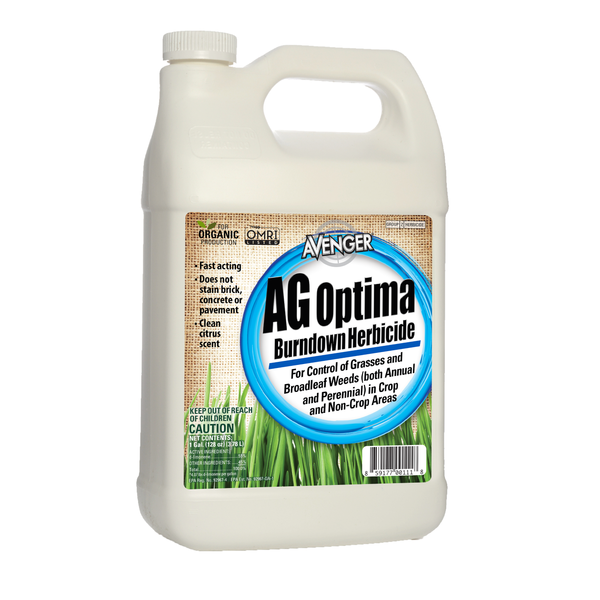
abundant edge herbicide Avenger® | AG Optima Burndown Herbicide | Concentrate

Sale price$20.68 Regular price$22.98
Save 10%

Pay in installments of $5.75 with ShopPay, AfterPay and Klarna

Shipping Estimate
USA
  • USA
  • CAN

Ships within 48 hours · Estimated delivery Jul 29 - Aug 3

Promo Codes Available:

For Your Every Summer RSVP, with Code: SUMMER15

Description

abundant edge herbicide Avenger® | AG Optima Burndown Herbicide | ConcentrateAvenger AG Optima Burndown Herbicide Concentrate 1 gal. Item # AVGR OPTC1G 04 View SDS Avenger AG Optima is an excellent botanical alternative to synthetic, toxic herbicides when you need to use in areas where children and pets are present. Its intended for both agricultural and non agricultural use and has a more economical dilution ratio versus competitors. Using a natural citrus oil base, this is a non selective herbicide that kills a broad

Avenger® | AG Optima Burndown Herbicide | Concentrate | 1 gal.
Item # AVGR-OPTC1G-04 - View SDS

Avenger® AG Optima is an excellent botanical alternative to synthetic, toxic herbicides when you need to use in areas where children and pets are present. It’s intended for both agricultural and non-agricultural use and has a more economical dilution ratio versus competitors.  Using a natural citrus oil base, this is a non-selective herbicide that kills a broad spectrum of weeds and unwanted grasses naturally and quickly. Its main ingredient is d-Limonene and it is for use in organic production around both food crop and non-crop areas. Always follow label directions.

  • Environment: Outdoors, Crops, Orchards & Vineyards, Nursery
  • Active Ingredients: d-Limonene (citrus oil)
  • Shelf Life: 2 years from manufacture date
  • Toxicity: No toxicity known
  • Certifications: EPA, USDA NOP
  • Storage: Store in original container

 How to Use: 

Mix this product in clean water and apply to the foliage of vegetation to be controlled. Spray until weeds are thoroughly wet. Because the underside of the weed leaf may be more susceptible, side sprays are recommended.

Environmental Conditions:

Avenger® AG Optima is effective over a wide range of environmental conditions. Cool weather may slow the activity of the product. For best results, spray when ambient high temperatures are expected above 50°F and lows above freezing. On cooler days, spray during the warm part of the day. Allow heavy dew to evaporate prior to Avenger® AG Optima applications. Do not apply if windy conditions exist or rain is expected within 2 hours.

 Mixing of Avenger® AG Optima:

 Fill the spray tank ½ full with clean water. Add Avenger® AG Optima while agitating. Then fill remainder with water.

 Tank Mixing of Avenger® AG Optima:

 Fill the spray tank ½ full with clean water. Add any dry formulations and then liquid formulations to the tank. Add Avenger® AG Optima while agitating. Then fill remainder with water.

 Restrictions:

 Do NOT exceed 5 gallons of Avenger® AG Optima (20.4 lbs. d-limonene) per acre per application. Do NOT exceed a total of 16 gallons of Avenger® AG Optima (65.1 lbs. d-limonene; Table 1) per acre per year. Determine the final desired finished spray volume according to the appropriate dilution as describe in Table 1. Irrigation and Aerial

Applications: Do not apply this product through any type of irrigation system or by aerial application.

 Spray Drift Management:

 Follow directions for minimizing spray drift. Do not allow the herbicide solution to contact desirable vegetation as small amounts can cause severe damage to crops and other desirable plants. AVOID CONTACT WITH CROP – Intentional or accidental contact (including drift) of Avenger® AG Optima with the crop may result in severe damage or loss of the crop.

 Application Rate:

Four types of applications are described below: Broadcast, Banded, Spot and Pre-Harvest Desiccation. Mixing volumes for two dilution rates are found in Table 1. Apply Avenger® AG Optima at a 7-10% mixture depending on the size of the weeds. For smaller, young, actively growing weeds and grasses, apply the lower 7% mixture. For controlling larger, tough to kill weeds, use the higher 10% mixture. Use the lowest mixture whenever possible to control weeds and grass.

  • Broadcast Applications: Broadcast treatments are used for burndown of unwanted weeds and grass across a field or a plot or apply to burndown winter foliage. Apply Avenger® AG Optima at pre-emergence or at planting. Applications must be made before seedling emergence to avoid severe injury. Allow at least 2 days between application and transplanting. Spray until weeds and grass are thoroughly wet.
  • Banded Applications: Control or suppression of emerged weeds and grasses in row middles and between vines and trees. Apply Avenger® AG Optima at a 7-10% mixture depending on the size of the weeds. Only use the 10% mixture when absolutely necessary to control difficult weeds. Apply by directing spray between the rows and using hooded sprayers to prevent spray contact with crop plants. Keep hoods adjusted to ensure adequate contact with weeds and grass while shielding the crop from the herbicide. To minimize drift, do not use nozzles or nozzle configurations that produce fine droplets (mist).
  • Spot Applications: In cool situations or for tough to kill weeds, a more concentrated spray of d-limonene may be needed. In such situations, a 10% mixture of Avenger® AG Optima (1:10 mixture) may be used up to one (1) week before harvest (see Table 1).
  • Pre-Harvest Desiccation of Vegetable Vines: Apply Avenger® AG Optima at a 7 or 10% mixture to aid in the desiccation of vegetable vines prior to harvest operations. A second application may be necessary to obtain sufficient desiccation.

Table 1. Mixing Directions of Avenger® AG Optima

Desired Spray volume (gallons)

7%

10%

1

9 fl. Oz

13 fl. Oz

60

4.2 gal

6 gal

100

7 gal

10 gal

160

11.2 gal

16 gal

228

16 gal

N/A

Shipping Notes
  • Free Standard Shipping on $100+ Orders to the USA.
  • Except Preorder products are shipped in 48 hours.
  • Delivery to the USA:
  1. Standard Shipping : 3-10 business days
  • If time is of the essence, please consider selecting expedited delivery for faster service.
Exchange/Return Notes
  • We offer a 30-day return/exchange service after receiving.
  • Final sale items are not eligible for returns or exchanges.
  • To process your return/exchange, please contact us at [email protected]
  • Please click here for more details>>> Return & Exchange Policy
SKU: 68170496386

Discover Niche Categories That Outsell abundant edge herbicide

Top-Converting Item to Boost Your Average Order

4.2 ★★★★★
Based on 30 reviews
Sort
Highest Rating
Newest First
Oldest First
Product Reviews
I
Verified Purchase
Immer
Belleville, US
★★★★★ 4
As A Dominant Species, We Dance On The Razor’s Edge
Format: Hardcover
Under A White Sky Elizabeth Kolbert’s claim to fame is her book The Sixth Extinction. In comparison Kolbert’s under A White Sky is rather short and disorganized, yet her coverage of those working on solutions to Climate Change is pretty darn interesting.  In her conclusion, she writes, “This has been a book about people trying to solve problems created by people trying to solve problems.” Putting this sentence at the book’s beginning rather than buried at its end would have provided a reader a compass to help determine where Kolbert was going with her dialogue. As she wades through the reversed direction of the Chicago river; Asian carp; Cane toads; forced and accelerated evolution in regard to coral, in particular in regard to the Great Barrier Reef (without discussing the importance of the worlds reefs; the continual flooding of New Orleans both despite and because of the actions of The Army Corps of engineers, one begins to ponder a general connection that might exist, while the book itself is headed toward a two star rating. Then, Kolbert got to Global Warming and Climate science. The book’s last sixty pages are worth the complete price of admission. The chapter begins with carbon sequestration, the pros and cons of how it can be done, and does it also contribute to the growing problem. The stoppered bathtub” analogy is perhaps the best analogy I’ve heard in regard to the anthropocentric carbon dioxide problem on the Earth. The tub is full of water/ the sky’s CO2 level; the tubs stoppered, so the water isn’t going anywhere, and the atmosphere’s increased CO2 level won’t drop in the near future either; and even if the water flow to the tub is reduced, it will still accumulate until over flowing, as will reduced emissions continue to amass in the atmosphere. In a sense, we are already beyond the tipping point in terms of global temperature increase. Harvard University Center for the Environment director Dan Schrag says, “I’m a scientist. My job is not to tell people the good news. My job is to describe the world as accurately as possible.” He predicts, due to the fact that the oceans must equilibriate. “If we were to stop CO2 emissions tomorrow, which of course isn’t possible, it’s still going to warm for centuries. That’s just basic physics.” Thus enters the topic of geoengineering, and the connection with people trying to solve problems created by people trying to solve problems truly comes into focus. Kolbert , in a rather clandestine way connects the dots of her past “local problems”, but now the problem fix, if it doesn’t work could create problems beyond solving. She hits the nail on the head with this. Humans have been around 35-50 thousand years, but only the last ten thousand or so have they thrived, largely due to agriculture and differentiation of what one can do because of agriculture. But ag has only been able to thrive because of the rather consistent global weather of the past ten thousand years, due to glacial retreat. This has been presented in great detail by Jared Diamond in his book Guns, Germs, and Steel. The CO2 we’ve put into the atmosphere isn’t going anywhere, as we continue to pour more into the mix. Her interviews with climate scientists do not bode well for our species, as everything they think of to combat the CO2 conundrum brings more as the bathtub continues to fill. One could say humans have become victims of their own success as a species. Ultimately, one gets the feeling from Kolbert and her interviews, that the enormous fluctuations in the Earth’s climate over geological time, and those yet to come, render whatever we do as humans as a moot point. The Earth will shake is off as a dog rids itself of fleas. She also brings to the argument, when the blank really hits the fan, as it will despite, or because of any preventative efforts by man, the resulting population displacements will be staggering. A sobering, informative book as we, as a species, dance on the razor’s edge.
WAS THIS REVIEW HELPFUL?YesReportShare
Reviewed in the United States on September 24, 2021
C
Verified Purchase
Christine Liu
Draper, US
★★★★★ 5
fascinating and compellingly written
Format: Hardcover
Elizabeth Kolbert is one of my favorite nonfiction authors. She has such a knack for writing in a clear, compelling way that makes you think and marvel and ask questions you've never considered before. In her previous book, The Sixth Extinction, she catalogs all the ways in which humans have drastically changed the natural world, ushering the new age of the Anthropocene. Under a White Sky is an exploration of the ways scientists around the world are trying to undo those changes. There are people engineering unique solutions to combat a variety of environmental threats: invasive carp in the Chicago River and cane toads in Australia, Louisiana's rapidly disappearing Mississippi River delta, rare species that now depend entirely on human conservation for their continued survival, and, perhaps most pressingly, the problem of rising carbon emissions and global climate change. That there are brilliant minds working innovatively to solve these problems inspires optimism. But these sobering portraits really highlight the extreme human measures it takes to keep at bay the problems caused by humans interfering with nature in the first place. We've already transformed the planet; how much more will it be transformed by these interventions, and in what ways?
WAS THIS REVIEW HELPFUL?YesReportShare
Reviewed in the United States on March 11, 2021
C
Verified Purchase
Carlos
Waukegan, US
★★★★★ 5
Exactly what I ordered
Format: Paperback
As described the book was in great condition and ut was delivered with care
WAS THIS REVIEW HELPFUL?YesReportShare
Reviewed in the United States on August 12, 2025
W
Verified Purchase
Wayne C. Solomon
Natrona Heights, US
★★★★★ 5
Five Stars
Format: Paperback
Look no further. This work is the Rosetta Stone of storytelling.
WAS THIS REVIEW HELPFUL?YesReportShare
Reviewed in the United States on May 24, 2017
D
D. Christofferson
Bozeman, US
★★★★★ 2
It's good for storytelling but has content in stories that's inappropriate in this century
Format: Audiobook
Well modulated interesting and excellent storytelling ability, and skills to teach us of the same. However. I get to the 2nd lesson, it's a book of fiction for the story premise. She describes a woman in her family who can't get pregnant (in the old days), knowing her husband really wants children,and gets happy, as she turns to her "maid" and exclaims that this is alright, he can have a child with their maid! Then the storytelling author, laughs, jokes, about pleasing him and when she says the audience is laughing too, that maybe he can get a 2nd maid pregnant too. Laughing and joking I. The man's eyes as she tells it, about men and their sex drives. I'm not reading g a Victorian romance novel or of the plantation owners in the south, I'm reading a book of lessons on good story telling. This turned me off 500%, and I am done with this author and this book. Is this told by an FDLS polygamist, or ...what? What would make this story in 2013, OK to teach in a college course, or in this book? I don't care if she even made it up for a family old story.
WAS THIS REVIEW HELPFUL?YesReportShare
Reviewed in the United States on January 14, 2025

recommand products