SKU: 68327645023
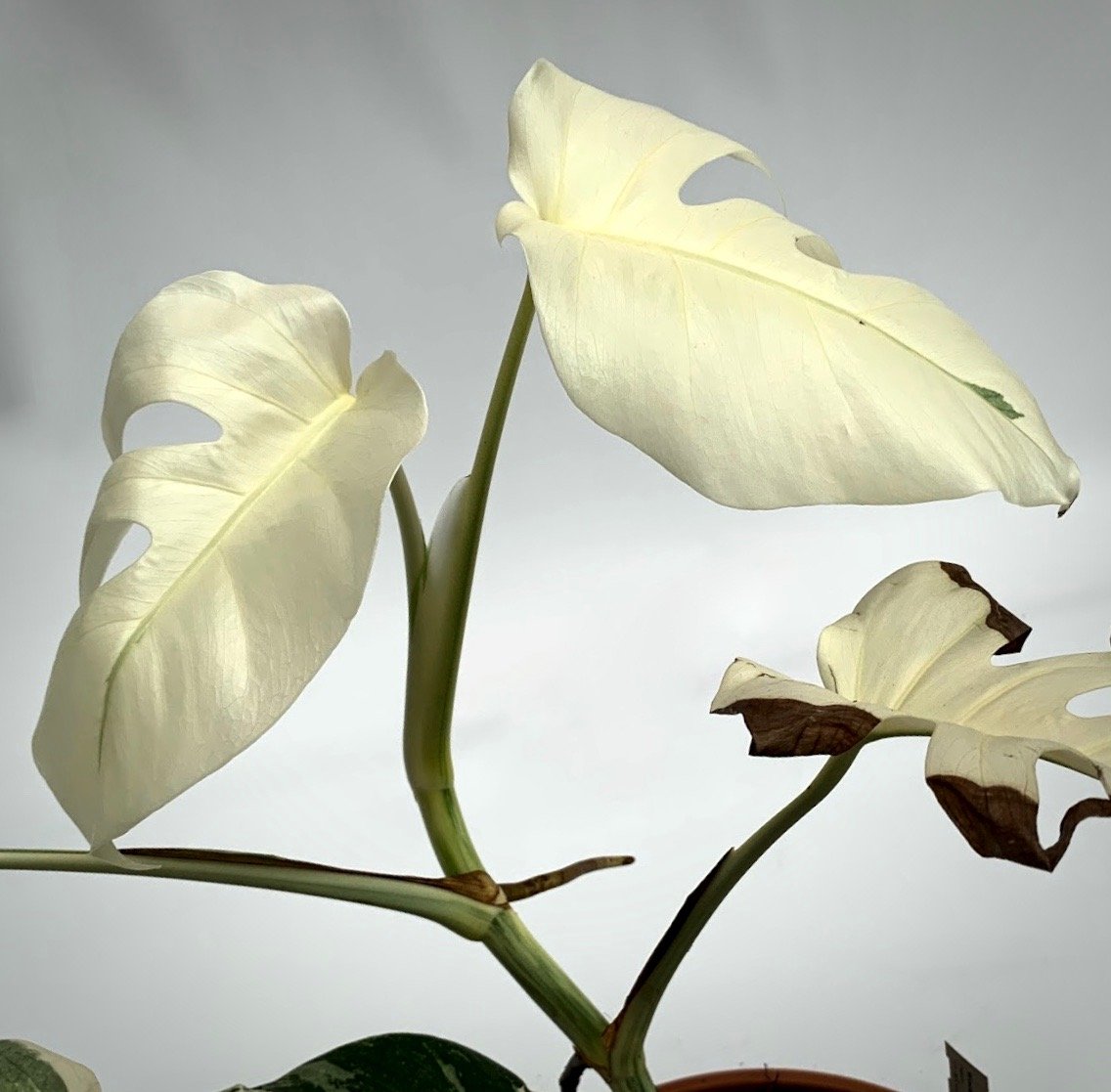
monstera albo leaf

monstera albo leaf Monstera deliciosa Variegata albo (Special White Edition)

Sale price$24.46 Regular price$27.18
Save 10%

Pay in installments of $6.79 with ShopPay, AfterPay and Klarna

Shipping Estimate
USA
  • USA
  • CAN

Ships within 48 hours · Estimated delivery Aug 5 - Aug 10

Promo Codes Available:

For Your Every Summer RSVP, with Code: SUMMER15

Description

monstera albo leaf Monstera deliciosa Variegata albo (Special White Edition)The Monstera deliciosa variegata albo is a very special plant that is still wildly popular. Each leaf has a different pattern, giving each plant a unique appearance. Over the years, this houseplant has gained a lot of fans because of the way it continues to surprise with each new growth. In the wild, the green version can reach a height of 20 feet by climbing up trees. Using a moss pole will also help its growth, as it is a plant that likes to climb.

The Monstera deliciosa variegata albo is a very special plant that is still wildly popular. Each leaf has a different pattern, giving each plant a unique appearance. Over the years, this houseplant has gained a lot of fans because of the way it continues to surprise with each new growth. In the wild, the green version can reach a height of 20 feet by climbing up trees. Using a moss pole will also help its growth, as it is a plant that likes to climb. Allowing it to climb also increases the chances of this plant making large leaves. In addition, it is then easier to grow the plant into the desired shape.

Mean and variegated spots

Monstera means 'monstrous' or 'abnormal' and deliciosa means 'deliciousness,' because of the beautiful large leaves this plant can get. 'Albo' stands for the white spots in the leaves, which this species has acquired due to a mutation in its DNA. Because of this mutation, this plant produces less to no chloroplasts locally, which gives the leaves lighter spots there. In the absence of chloroplasts, the leaves become white.

Special White Edition

What this means is that this plant has a lot of white in the leaves and in the stems. However, the pattern of the variegata is still a surprise.

Care

Beginner plant

The Monstera deliciosa variegata albo is a hole plant with white spots that is relatively easy to care for despite the spots in the leaves. Therefore, it is a suitable beginner plant for people who already have some experience with easy tropical plants.

Leaf chlorophyll and sunlight

Nevertheless, the variegata in the leaves does make the plant a bit more sensitive than the green variety. Because chloroplasts take care of photosynthesis (converting solar energy and carbon dioxide into nutrients for the plant), the local lack of these cell organelles means that the plant here may have trouble getting enough energy to grow well and stay healthy. But the white part of the leaf is also more susceptible to burning. Therefore, it is important that you put the plant in a place where there is plenty of sunlight during the day, but that this light is well filtered through window coverings, for example.

Watering

The Monstera deliciosa variegated albo likes clean water (preferably rainwater at room temperature). In doing so, the plant may dry out slightly before another watering. However, make sure the substrate does not stay wet for too long, as this houseplant does not like wet feet. During the growing season, a small amount of houseplant food may be added.

Care in the living room

Humidity

In addition, the Monstera deliciosa variegata albo is an excellent plant to be kept in the living room, because it can also grow well at fairly normal humidity (50%-75%). Just be sure to avoid drafts and air conditioning with the plant. Air conditioning can dry out the air too much for a plant. A fan, on the other hand, can actually promote growth.

Temperature

What makes this plant even more suitable for the living room is the fact that they can stand well in 17-25 degrees Celcius. A few degrees cooler is also possible, but then you will see that growth will stagnate and the plant will have a little more trouble maintaining resistance.

Monstera borsigiana variegata albo?

In addition, there have been rumors that the Monstera deliciosa variegata albo also has a borsigiana version, which has a slightly different growth habit. However, there is no genetic difference between them. It is the same kind of plant, but in different circumstances it will have a different growth habit. When the plant is in a bright room with lots of indirect light and a good climate, it will tend to get nice, large leaves with lots of holes and compact leaves. So if the plant is growing with long stems and small leaves and instead you want to get large leaves, then it is time to look at its care.

Repot

This plant may be repotted when the roots completely fill out the pot. Then it is best to go for a Potsize of 3-4 cm larger. Because this plant roots very easily. In terms of potting soil, it is best to choose a well-draining mix of perlite, peat and coconut fiber. Usually repotting once every 1 or 2 years will be sufficient. The growing season is best for this. If a lot of mineral-rich substrate is used, extra feeding can be stopped for a few months to prevent accumulation of minerals in the potting soil. Too much minerals can cause damage to the roots and unsightly spots in the leaves. A Monstera deliciosa variegata albo does not need much houseplant nutrition to do well.

Shipping Notes
  • Free Standard Shipping on $100+ Orders to the USA.
  • Except Preorder products are shipped in 48 hours.
  • Delivery to the USA:
  1. Standard Shipping : 3-10 business days
  • If time is of the essence, please consider selecting expedited delivery for faster service.
Exchange/Return Notes
  • We offer a 30-day return/exchange service after receiving.
  • Final sale items are not eligible for returns or exchanges.
  • To process your return/exchange, please contact us at [email protected]
  • Please click here for more details>>> Return & Exchange Policy
SKU: 68327645023

Discover Niche Categories That Outsell monstera albo leaf

Top-Converting Item to Boost Your Average Order

4.1 ★★★★★
Based on 7 reviews
Sort
Highest Rating
Newest First
Oldest First
Product Reviews
P
Verified Purchase
Paul Frandano
Dallas, US
★★★★★ 5
A Dyadic Review: Baffling, Brilliant
Difficult. Rewarding. Serious. Hilarious. Wise. Faux-wise. Scholarly. Mock-scholarly. Observant. Absurdly, obsessively observant. Sharp characterizations. Ridiculous characters. Devout. Bawdy. Endearing. Frustrating. Genius. Barking mad. Narratively incoherent. Stream-of-consciousness associative. Consistently provincial. Profoundly universal. Mired in the 18th century. Harbinger of 20th century literary Modernism. Baffling. Brilliant Not for every taste. For my taste. And while I'm at it, let me give a shout-out for the out-of-print Norton critical edition, which provides many helps, essay avenues of understanding, and a clever chapter summary/table of contents. For so many years - since reading Moby Dick in grad school with the help of a Norton critical - this publication line has been my go-to for great texts: useful annotations, contemporary reviews, later scholarly articles, and more. And also let me give a shout-out to Anton Lesser, who narrated the complete novel for Naxos. I have never, ever experienced an audiobook as masterfully produced and narrated as Naxos' Tristram Shandy. No, it is simply not a book one can listen to and fully comprehend as heard. But one might read while listening, or listen while reading, with - if you have the riight software - the narration sped up closer to one's own reading speed, and experience the full majesty of Lesser's absolute preparation, with Latin, Greek, French, and German - as well as regional English - beautifully and humorously intoned, character voices carefully differentiated, tone and mood captured, etc. Or, as I do, go for a walk and listen as you walk, and afterward slip into a comfy chair, crack the novel open, and continue from where you left off, or backtrack if necessary to sort out the characters. In any event, and particularly for devotees of audio books, do find Anton Lesser's note-perfect reading, a veritable radio serial, perhaps the last book you'd expect anyone to attempt single-handedly, with My Father, My Uncle Toby, Corporal Trim, Parson Yorick, Doctor Slop, Widow Wadman, and all the rest of the supporting characters beautifully, consistently interpreted. Lesser is, in a galaxy of fine narrators, the greatest I've heard: an absolutely peerless voice actor in a most demanding work.
WAS THIS REVIEW HELPFUL?YesReportShare
Reviewed in the United States on June 13, 2016
R
Verified Purchase
Ritesh Laud
Bozeman, US
★★★★★ 5
Brilliant stream of consciousness style, *extremely* humorous
"The Life and Opinions..." is perhaps impossible to really classify. It purports to be a biography of the fictional Tristram Shandy, but I don't think you can call something a biography when it only covers a year or so of the subject's life! I would say that more than half of the novel actually falls into the "Opinions" referred to in the title. The rest consists of short stories on Tristram's father, uncle, and a couple other minor characters. I have never in my life read so many digressions from the topic at hand, most of which were utterly irrelevant but the charm of it is that Sterne *knows* they're irrelevant, but mockingly expresses his license of authorship in forcing the reader to go off on these sidetracks. His attitude is: "If you can't wait a chapter or two to get back to the story, well, go take a flying leap, I'm the author." Sometimes the digressions are exasperating. Very unlike Victor Hugo's signature habit of digressing, say when a certain main character in Notre Dame decides to enter the Paris sewers, Hugo takes thirty or more pages to give a history of the design and construction of the Paris sewer system. At least Hugo's digressions have *something* to do with the story. Well, maybe that's the problem. There isn't a main story in this novel. It's not a storybook. There are many short stories nested within the main framework, but there is no real protagonist or overarching theme of any sort. Indeed, the end comes abruptly and there is absolutely no resolution of any conflict. It's not trying to teach anything, really. So what is it? I'm not sure. More a comedy than anything else. Right up there with Dickens' "Pickwick Papers" in terms of humor, but lacking the story. Maybe funnier than Dickens and just as clever. I was rolling in the aisles so many times I lost count. I read the Penguin edition, edited by Melvyn & Joan New. The back cover does a better job than I could ever do in providing a sense of what you're getting into when you pick this one up: "No one description will fit this strange, eccentric, endlessly complex masterpiece. It is a fiction about fiction-writing in which the invented world is as much infused with wit and genius as the theme of inventing it. It is a joyful celebration of the infinite possibilities of the art of fiction, and a wry demonstration of its limitations." It's a large work, it will take a while to work through. It's worth it. There are passages I want to go back to and make copies of to tape to the walls, they're that brilliant.
WAS THIS REVIEW HELPFUL?YesReportShare
Reviewed in the United States on July 31, 2005
D
Verified Purchase
Diogenes
Port Orchard, US
★★★★★ 3
Interesting read, but takes some getting used to
I heard about this book on a blog, and figured I'd check it out. It's the rambling tale of a man determined to give you every last detail of everything that might be important to the narrative of his life. Unfortunately, he goes on tangets so often that he doesn't even get to his birth for several chapters, let alone the story of the rest of his life. Along the way, you're introduced to lots of random characters who are (at best) loosely related to the protagonist, but as often as not these tangents are fairly amusing. The writing is pretty dense, and this along with the tangents had me putting the book down fairly often. It's probably ideal for a commuting book, but I never wanted to just sit down and blitz through big chunks of it. Overall it's a very different kind of experience than a novel reader typically gets. It's worth a read for a change of pace, but I can't say it's a life-altering read.
WAS THIS REVIEW HELPFUL?YesReportShare
Reviewed in the United States on March 21, 2013
J
Verified Purchase
J. W. Kennedy
Pawtucket, US
★★★★★ 4
Mixed Bag
Everyone should know, first off, that the Dover thrift edition is NOT a graphic adaptation. For some reason, Amazon has attached editorial reviews from the hardcover edition of the graphic novel version to this page. Now, the book itself offers a range of experiences from delightfully hilarious to annoyingly tedious. Lots of the "funny" parts depend on an understanding of 18th-century social mores. I'm sure some of it went over my head but I'm enough of a nerd to have enjoyed most of the drollery. I think... The story is whimsical, told all out of order by a scatterbrained, easily-distracted narrator. Tristram Shandy himself is hardly in the novel at all; aside from narrating it, he only appears momentarily as a newborn infant and then as a boy about 6 years old - and his role in both incidents seems peripheral to the carryings-on of the other characters. Each turn in the story reminds the author of something else, and he turns aside to tell stories inside of stories, each of which are necessary to give the reader some vital "background information" .. with the result that the main story hardly moves forward at all. It takes nearly 200 pages just for Tristram to be born! and even then the reader isn't quite sure it has happened since the conversations and minute actions of the other characters are magnified to such an importance that the narrator's own birth is hardly observed. For the most part this rambling comes across as "quirky and delightful" and the novel flows along quite pleasingly in spite (or perhaps because) of it. The digressions add layers to the story. Except when they don't. The "chapter upon noses" which is a translation of a fictitious(?) Latin work by the great Slwakenbergius, has little bearing on the story. Like most of the book, it builds up to a climax and then stops short of resolution, leaving you to wonder what was the point. It leads nowhere, but at least it was interesting. The same cannot be said of Book VII, which is a sort of travel diary of Tristram (in the novel's "present" time) touring France by post-chaise. Although this is the only significant appearance of Tristram himself as a character in the book, it has absolutely nothing to do with the story/stories he was telling, and it is neither very interesting nor very funny. It serves as nothing but a pointless interruption, delaying the reader for 50 pages before getting to the part we were waiting for: Toby's courtship of the widow Wadman. This last section goes along nicely for a while, and then the book stops. It doesn't end; it just stops right in the middle of a conversation, with the courtship unresolved and most of the reader's questions unanswered. This is perfectly in keeping with the spirit of the entire novel, but I have to admit it's frustrating. I had trouble deciding whether to give this book 3 or 4 stars but I think it entertained me more than it exasperated me, so I'll give it the benefit of the doubt ... and round up from 3.5. It's worth reading once, just for the experience - there's no other book quite like it - and the price of the Dover Thrift Edition can't be beat.
WAS THIS REVIEW HELPFUL?YesReportShare
Reviewed in the United States on September 23, 2010
L
Verified Purchase
Lawrentius Verifer
Waukegan, US
★★★★★ 5
An extraordinary tale of an 18th Century family
Have you wanted to read a book where the author decides to "rip out" one of the chapters, or leaves a blank page for you to 'draw' one of the characters? Would you enjoy a story which takes many chapters before the hero manages to be born? This 18th-Century tale is touchingly told. The characters are real, and fascinating. It's not their fault that their story is frequently and impishly interrupted by outlandish "digressions" on the part of an author so creative that his modern descendants are considered to be Joyce and Beckett, as well as many others. Would you enjoy a chapter on Chapters? About buttonholes? About whether parents and their children are kin to each other? A chapter on curses? Poor Laurence Sterne has so much trouble getting two of his characters down the stairs that he finally calls in a "critic" to help! Advice on reading such an unusual, even unique, book: read the first several chapters, then stop and reread them. Continue that process and soon the book will feel quite familiar, and that's when the fun really starts. The Oxford World's Classics edition follows the first edition of the book, and is preferred. Amazon also offers the fully-annotated edition, the "Florida" edition, in three volumes. A caution about the Everyman hardcover edition: they reprinted a later edition which groups Tristram Shandy into three volumes, not nine. And then they renumbered all the chapters! That's OK unless you read secondary sources that refer you to Book VII, Chap 4: good luck ever finding it.
WAS THIS REVIEW HELPFUL?YesReportShare
Reviewed in the United States on June 4, 2000

recommand products