SKU: 69110073518
pink panther plant indoor

pink panther plant indoor Shop 'Pink Panther Plant - Tradescantia Callisia repens Pink Panther' Care and Info

Sale price$23.45 Regular price$26.05
Save 10%

Pay in installments of $6.51 with ShopPay, AfterPay and Klarna

Shipping Estimate
USA
  • USA
  • CAN

Ships within 48 hours · Estimated delivery Jul 31 - Aug 5

Promo Codes Available:

For Your Every Summer RSVP, with Code: SUMMER15

Description

pink panther plant indoor Shop 'Pink Panther Plant - Tradescantia Callisia repens Pink Panther' Care and InfoIntroducing the low maintenance trailing pink panther plant also known as Callisia repens' Pink panther', is sure to turn heads. This pink panther plant was previously categorized under the genus Tradescantia; it's possible that some websites are using the name "Tradescantia Callisia repens." The correct scientific name for the plant is Callisia repens pink panther, because it has since been reclassified under the genus CallisiaGo to Callisia. The

Introducing the low-maintenance trailing pink panther plant– also known as Callisia repens' Pink panther', is sure to turn heads. This pink panther plant was previously categorized under the genus Tradescantia; it's possible that some websites are using the name "Tradescantia Callisia repens." The correct scientific name for the plant is Callisia repens pink panther, because it has since been reclassified under the genus CallisiaGo to Callisia.  

The Pink Panther plant is named after the famous Pink Panther cartoon character, which resembles the pink stripes on its green leaves. It also has several other common names, such as pink lady turtle vine, tradescantia pink panther, pink turtle vine, Callisia pink panther, or Callisia tricolor. 

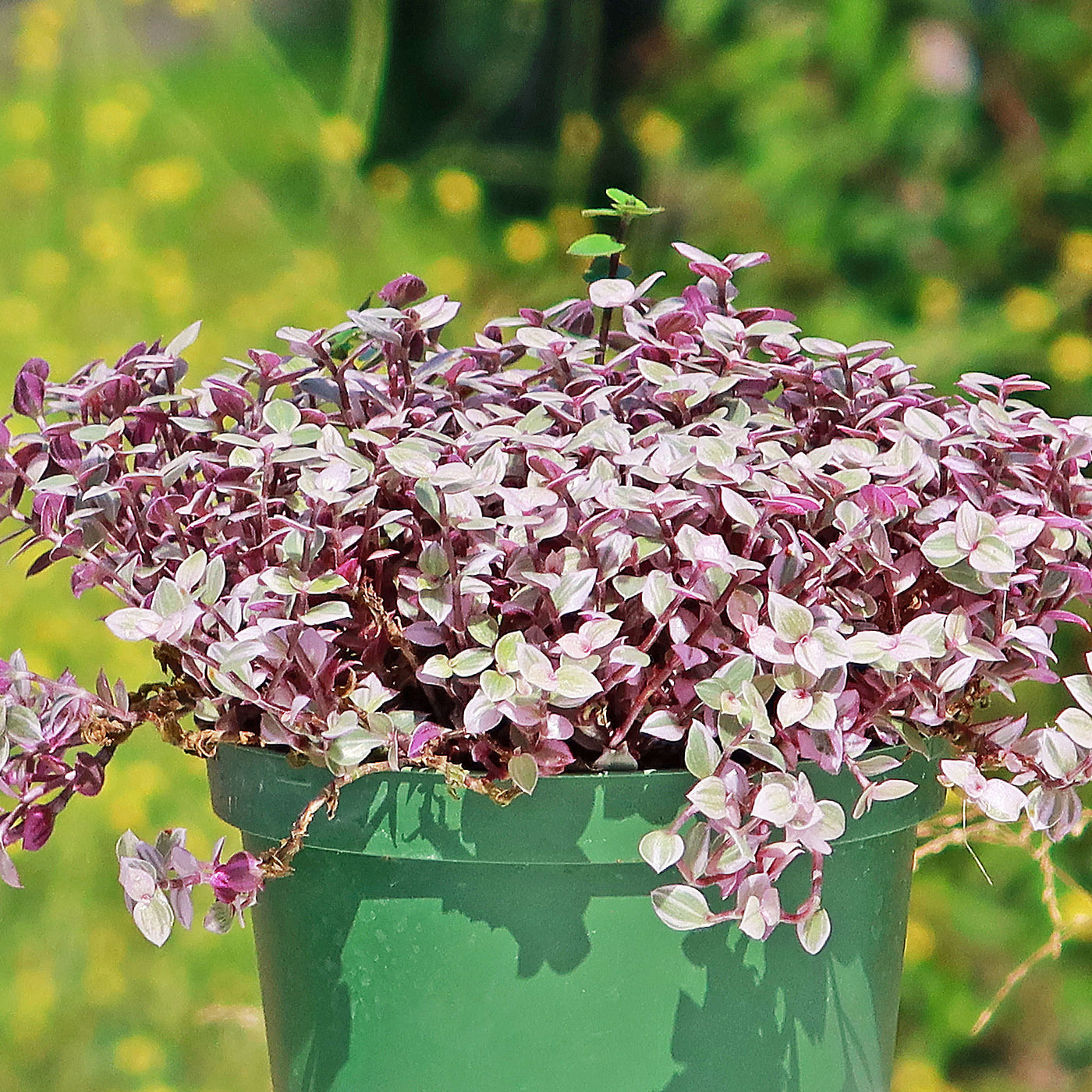
The image features the Pink Panther Plant with its variegated pink, purple, and green foliage, cascading gracefully over the pot in a soft, trailing form.

The cool part is its vibrant pink leaves with a mix of pink, green, and white stripes, making the pink panther plant a popular choice among indoor plant enthusiasts for its unique appearance and ease of care.

It's perfect for tiny spaces like your home, office, or even your desk.

This tropical houseplant is like a burst of joy with its stunning, small lavender-green leaves that turn bright pink and variegate in bright sunlight, with a velvety texture that adds to their appeal.

The foliage is densely packed along the stems, creating a lush and cascading effect when grown in hanging baskets or allowed to trail down from shelves or tabletops.

Your pink panther plant, with its reddish stems, can grow up to 12 inches tall and 24 inches wide. Its delicate but vibrant leaves puff out and shoot off consistently, giving your space a lush and beautiful touch in no time. 

The flowers of the pink panther plant bloom during the summer, with tiny white flowers. However, it's worth noting that the Pink Panther plant is primarily grown for its striking foliage rather than its blooms.

The Callisia repens pink panther plant is distinguished by the striking golden leaves of Callisia repens GoldGo to Callisia repens gold turtle vine and a unique combination of pink and green variegated leaves of the Pink Lady Callisia repens variegated.

When and How to Water Your Pink Panther Plant 

The Pink Panther plant is drought-tolerant, which means it can go for extended periods without water once established. However, to keep it thriving, especially in containers, it’s best to follow the “soak and dry” method: give the plant a deep, thorough watering, then allow the soil to completely dry out before watering again. The trailing pink panther prefers watering once every 2-3 weeks and once a month in the dormant season.

In spring and summer, during the growing season, water once every 2-3 weeks, or whenever the top inch of soil feels dry. Use a water meter or your finger to test moisture levels. Always ensure the plant is in porous, well-draining soil and placed in a container with drainage holes to prevent standing water and root rot.

In fall and winter, during dormant period, the plant enters a dormant period and requires watering once a month. If kept outdoors, withhold watering during rainy spells or cold snaps. Indoors, reduce watering to only when the soil is completely dry. Overwatering during dormancy is one of the most common causes of root rot.

Light Requirements - Where to Place Your Pink Panther Plant

When grown indoors, the pink panther plant also requires brighter, indirect light for at least 6-8 hours a day.

Placing it near a north or east-facing window is usually ideal. Avoid exposing the plant to direct, intense sunlight as it can scorch the leaves.

If you don't have access to ample natural light, you can also use artificial grow lights, such as fluorescent or LED lights, to provide the necessary light for the Callisia repens pink panther plant's growth.

When grown outdoors, the Pink Panther plant enjoys partial shade or dappled sunlight. These plants require at least 4-6 hours of strong light each day to survive, although partial shade in the afternoon is often preferable - especially in hotter climates where the plant might become stressed by the intense heat of the afternoon sun.  

In bright light, its lavender-green leaves turn pink and variegated, making it a true showstopper. It's crucial to place your pink panther succulents away from any areas with constant direct sunlight, as doing so could result in burned foliage.

If the pink panther plant is not getting enough light, it may become leggy, which means that the stems will become long and thin, and the leaves may lose their variegated color. To prevent this, it's important to keep the plant in a location where it can receive plenty of light, but not direct sunlight. 

Optimal Soil & Fertilizer Needs 

Callisia requires a fast-draining potting mix that dries completely between waterings, and should be fertilized once a year in spring. The pink panther likes very airy, porous, nutrient-rich soil with a pH of 5.6- 6.5. Your soil must have a sandy texture and a low water-holding capacity, just like desert soil. Ideally, you want to use our specialized succulent potting mix that contains 5 natural substrates and organic mycorrhizae to promote the development of a strong root system that helps your succulent to thrive.   

When it comes to fertilizer, a small amount of water-soluble fertilizer with lower doses of NPK (5-10-5) applied once a year in the springtime encourages branching and nutrient absorption. Remember, never fertilize your pink panther if it has recently been replanted or if it is experiencing problems, as it is not a medicine. Analyze the plant and make adjustments as needed. 

Hardiness Zones & More 

In the United States, your Callisia repens Pink Panther is mostly an indoor plant, but if you live in southern Florida or Hawaii, then you can cultivate it outdoors in USDA zones 10-12.

They are not cold- or frost-tolerant, so you should plant them indoors or put them in a pot and move them indoors during the winter if you live outside of these regions.  

The Pink Panther plant appreciates moderate to high humidity levels, similar to its tropical origins. Aim for a humidity range of 50% to 60% for optimal growth. If the air in your home is dry, especially during winter months when indoor heating is used, you can increase humidity by placing a tray of water near the plant or using a humidifier. Misting the foliage occasionally can also help provide some moisture.

Remember, frost can damage the leaves, causing them to turn brown and lose their vibrant pink color.  It's important to protect the plant pink panther from further damage by keeping it in a warm place away from cold, drafty windows and air vents if you are growing it indoors in a cold climate.

How to Grow the Best Pink Panthers Plant Indoors 

When grown indoors, the ideal temperature range for your Pink Panther is between 64°F and 72°F. It prefers a warm and cozy environment, so try to avoid exposing it to extreme temperature fluctuations or drafts. It should be fine even if the temperature drops to 50°F at night.

Wildlife - Pink Panther Plant Attracts the Following Friendly Pollinators

The Pink Panther Plant is known to attract a variety of friendly pollinators, including butterflies, bees, and hummingbirds. These pollinators play a crucial role in the plant's reproduction process by transferring pollen from one flower to another, ultimately helping the plant to produce seeds and fruit.

Butterflies
Bees
Hummingbirds
Lady Bugs
Multi Pollinators
Other Birds

According to ASPCA, the Pink Panther plant is considered mildly toxic to pets and humans if consumed. However, it is safe to touch and handle, making it a popular choice for indoor houseplants.

How to Propagate Your Pink Panther Plant

The Pink Panther plant can be propagated through stem cuttings. Take healthy stem cuttings, ensuring they have a few nodes, and remove the lower leaves. Place the cuttings in water or moist soil, providing them with indirect light and regular moisture. Over time, roots will develop, and you can transplant the cuttings into their own pots or a larger container.

Key Takeaways

  1. The Pink Panther plant is ideal for hanging baskets, with trailing stems that spill gracefully over the edges, making it a decorative choice for shelves, windows, or patio planters.
  2. The foliage of Callisia repens 'Pink Panther' is what gives it its name—soft pastel leaves in pink, green, and silver tones that resemble the color palette of the classic Pink Panther cartoon.
  3. The Pink Panther plant is drought-tolerant, needing only occasional watering once established, especially when grown using the "soak and dry" method in well-draining soil.
  4. This compact succulent stays under 6 inches tall but spreads or trails quickly, making it a beautiful indoor accent or a creeping ground cover in warmer climates.
  5. The Pink Panther thrives in bright, indirect light, and under the right conditions, it can produce tiny star-shaped flowers, adding a delicate detail to its already striking appearance.

Final Thoughts

Overall, the Pink Panther plant (Callisia repens Pink Panther) is a delightful and popular choice for indoor gardening enthusiasts. With its vibrant pink and green foliage, it adds a touch of beauty to any space. This trailing plant thrives in average room temperatures between 64°F and 72°F and appreciates moderate humidity levels. When it comes to light, it prefers bright, indirect light indoors and partial shade or dappled sunlight outdoors. Whether you choose to grow it indoors or outdoors, providing the right conditions will ensure the Pink Panther plant's healthy growth and stunning appearance. 

Don't miss out on adding the Callisia repens pink panther to your garden! Order now and enjoy its beauty for years to come. 

Shipping Notes
  • Free Standard Shipping on $100+ Orders to the USA.
  • Except Preorder products are shipped in 48 hours.
  • Delivery to the USA:
  1. Standard Shipping : 3-10 business days
  • If time is of the essence, please consider selecting expedited delivery for faster service.
Exchange/Return Notes
  • We offer a 30-day return/exchange service after receiving.
  • Final sale items are not eligible for returns or exchanges.
  • To process your return/exchange, please contact us at [email protected]
  • Please click here for more details>>> Return & Exchange Policy
SKU: 69110073518

Discover Niche Categories That Outsell pink panther plant indoor

Top-Converting Item to Boost Your Average Order

4.1 ★★★★★
Based on 12 reviews
Sort
Highest Rating
Newest First
Oldest First
Product Reviews
B
Verified Purchase
billy
Belleville, US
★★★★★ 5
My dog is a toy destroyer
Color: Consuela the Cactus - Large, Size: Large Dog, Color: Consuela the Cactus - Large, Size: Large Dog
I’ve had a hard time trying to find toys that my dog, Zara loves because she’s actually very picky. Ive gotten plenty of Kong toys that are well known to be indestructible but she wants nothing to do with them. Then I got her ropes and that seemed to be good for a while until she was getting sick in the middle of the night from eating all of the string. Stuffed toys aren’t good because she’ll rip them within seconds and eat all of the stuffing. I felt like I’ll never score the perfect toy for her. I found the three layered cactus toy and decided to give it a go. It’s clearly designed to be ripped and destroyed to get the ball in the middle which is actually really cute and fun to see all of the layers. The cactus arms have stuffing and of course that’s the first thing she went for and ate. I had to watch her and make sure I took the stuffing away before she ate it. And before I knew it, she ate half of the first layer fabric lol once she got through the first layer, all she’s been doing is walking around the house with the toy in her mouth. But now she’s tired and passed out on the couch from all of the fun. This toy won’t last long with a toy destroyer but it sure does give them something to do and it’s a cute toy. I do recommend!!
WAS THIS REVIEW HELPFUL?YesReportShare
Reviewed in the United States on July 26, 2024
M
Verified Purchase
26.2 Man
Houston, US
★★★★★ 5
My Dogs' Absolute Favorite Chew: Tough, Flavorful, and a Lifesaver for Boredom!
What sets the Benebone Wishbone apart isn't just its durability—though that's impressive enough—it's the thoughtful design that caters to how dogs actually play and chew. Crafted from super-tough nylon infused with real bacon flavor (not some artificial nonsense that fades after one gnaw), this wishbone-shaped toy is ergonomically curved for easy gripping with paws or mouth, making it perfect for aggressive chewers who like to toss, carry, and battle it around. The three prongs give them multiple angles to attack, which keeps them engaged for hours without getting bored. For my Goldendoodles and Golden Retriever, who are all large-breed goofballs with endless energy, the large size (about 7.5 inches long) is spot-on—not too big to intimidate, but substantial enough to withstand their enthusiastic chomping. We've had ours for over two months now, and while it's showing some honorable battle scars (tiny grooves from their teeth, which actually make it easier for them to grip), it's nowhere near splintering or breaking. Compare that to the Nylabones we've tried, which either splintered too quickly or lacked any real appeal—these Benebones win hands down every time.Flavor is where this toy really shines, though. That real bacon infusion isn't just a gimmick; it's embedded throughout the nylon, so even as they chew deeper, the savory scent and taste keep coming. The more food-motivated Goldendoodle goes absolutely feral for it—drool flying as he parades it around the living room like a trophy, grumbling possessively if the others get too close. The female Goldendoodle prefers a more playful approach, flinging it across the room before pouncing back in for wrestling matches that leave her curls even more disheveled, while the Golden Retriever settles on the rug for long, focused sessions that help him unwind after fetch marathons. It's hilarious to watch them "fight" over it (in the gentlest, most sibling-rivalry way), but what's even better is how it redirects their energy. No more shredded couch cushions or nipped at ankles during zoomies—these bones have cut down on destructive behavior by at least 80%, giving me more time to relax and less time playing fetch with toy remnants.Safety and quality are top-notch too, which is crucial when you're dealing with heavy chewers. Made in the USA with non-toxic materials, it's free from BPA, phthalates, and all that sketchy stuff you worry about with imported plastics. The company even encourages responsible use: supervise play, especially for puppies or super-aggressive types, and replace when the ends wear down (though ours are still going strong). At this price point for a toy that lasts weeks instead of days, it's an absolute steal—I've already ordered backups in peanut butter flavor to rotate in and keep things fresh.If your dogs are anything like mine—energetic, mouthy, and in constant need of occupation—this Benebone Wishbone will be a game-changer. It's not just a chew toy; it's a boredom buster, a dental helper (those ridges get the tartar going), and a source of pure joy for your furry family members. My dogs love these bones more than their walks some days, and that's saying something! Five stars all the way—highly recommend grabbing one (or three) before your next Amazon order. Your sanity (and your furniture) will thank you.
WAS THIS REVIEW HELPFUL?YesReportShare
Reviewed in the United States on October 20, 2025
M
Verified Purchase
M. PHILLIPS
Natrona Heights, US
★★★★★ 5
Truly Durable - No Joke, These Actually Last
I purchase these for the rescue I support, and they live up to their “durable” claim - no joke, these truly last. Durability: These are genuinely built for aggressive chewers. While the edges do eventually get rough with heavy use, the fact that they last a while with determined chewers is impressive. Most toys don’t make it that far. Design: The wishbone shape gives dogs multiple angles to chew from, which keeps them engaged longer. The ergonomic design works well for powerful chewers. Made in USA: Knowing these are made in the USA gives me confidence in their quality and safety, whether for rescue dogs or personal use. Flavor: The real bacon flavor keeps dogs interested and coming back to the toy repeatedly. Pros: ∙ Truly durable - actually lasts ∙ Made in USA ∙ Real bacon flavor dogs love ∙ Wishbone shape for multiple grip points ∙ Perfect for aggressive chewers ∙ Edges get rough eventually but toy holds up ∙ Rescue regularly uses these ∙ Better longevity than most chew toys Bottom Line: When a chew toy genuinely lasts with aggressive chewers, that’s noteworthy. Yes, the edges get rough with extensive use, but the toy itself holds together far longer than most. Excellent for rescues, shelters, or anyone with power-chewing dogs. Highly recommended!
WAS THIS REVIEW HELPFUL?YesReportShare
Reviewed in the United States on December 19, 2025
F
Verified Purchase
faith
Pawtucket, US
★★★★★ 5
Great Bone for aggressive chewers but watch the wear & tear
I’m extremely happy I found Benebone Bacon Flavor Large Wishbone for my puppy who is an aggressive chewer. As the packaging reads this is a durable nylon. My puppy chewed the bone down to what you see in the picture within 3 days. It’s easy for him to handle. He loves the bacon flavor. He immediately took to it as soon as I gave it to him & off he went to work. I did check with my Veterinarian first to inquire if this was a safe bone & she assured me it was. She did advise to be aware of the wear & tear on the bone & toss when I felt it was time. I honestly wouldn’t of known when. I’m happy I took the time to read the inside of the packaging this bone came in. It referred me to the benebone website which showed pictures of bones-which I attached- that reflect the wear & tear & when it’s time to toss. There are the 3 categories of “Light Wear,” Moderate Wear“ & “Heavy Wear.” You’ll see the written description next to each. This I found very helpful, therefore I wanted to include it in my review, in hope of helping you. By the looks of my current bone it’s in between moderate & heavy wear. The large is costly, I feel, but it 100% occupies my puppy. It’s his favorite “toy.” I’ve only had small shavings come off since he’s chewed it. Nothing major to clean off the couch where he lays. Stuffed toys are a thing of the past now. I’ll continue to buy once it’s time to toss this bone because he loves it so much. I also love that Benebone is Made in the U.S.A.! I definitely recommend! A heads up! If you click on their store on the main page of this bone you’ll find other shapes of the nylon bone as this one. This Benebone won’t disappoint. Take the time to read the packaging. It’s informative & cool!
WAS THIS REVIEW HELPFUL?YesReportShare
Reviewed in the United States on February 7, 2023
S
Verified Purchase
Sandy B
Draper, US
★★★★★ 5
Very durable and long-lasting, great for strong chewers, gets rid of plaque in older dogs
I have a seven-year-old golden retriever who was never a strong chewer, she liked gnawing on toys and dental “bones” and destroyed shoes and a carpet when she was a puppy but it was never her favorite activity. Then I adopted two puppies of indeterminate breed, but likely Plott Hound and Lab, and they are aggressive chewers and want to chew on everything. I tried all kinds of teething things, as teething seemed to bother them more than any of the other four dogs I’ve had, and all were destroyed quickly, like they were treats instead of supposedly “long-lasting” chew bones. I tried these bones after I happened upon them on Amazon, and I could not be happier. My dogs contentedly gnaw on these for extended periods of time, obviously in heaven as they do so, and sometimes it’s the only way I have time to get anything done. When they were teething these definitely helped them with teething pain, and now they still want to chew on them every day. They can hold them easily and sometimes the puppies even share a bone due to the unique shape. My Golden had lots of plaque and nasty buildup on her teeth and was headed for needing dental cleanings under anesthesia, but now her teeth are sparkling white without a speck of plaque thanks to these. The bones have worn down over the course of eight weeks, but very gradually and not ever in pieces. Yes, the ends become prickly and are definitely not fun to step on, but I don’t let them chew on them outside to reduce them collecting dirt and rinse them every few days to get rid of whatever is on there. I have watched carefully for any signs of irritation in my dogs’ mouths or teeth issues, and have never seen any blood on the bones even after my dogs have determinedly chewed on them for an hour. They LOVE them, and because they are the only bones I have found that last longer than five minutes for my aggressive chewers, hold their attention for an extended period of time, and get rid of all the plaque on my older dog’s teeth, I HIGHLY recommend them.
WAS THIS REVIEW HELPFUL?YesReportShare
Reviewed in the United States on January 26, 2021

recommand products