SKU: 725181280
elephant succulent

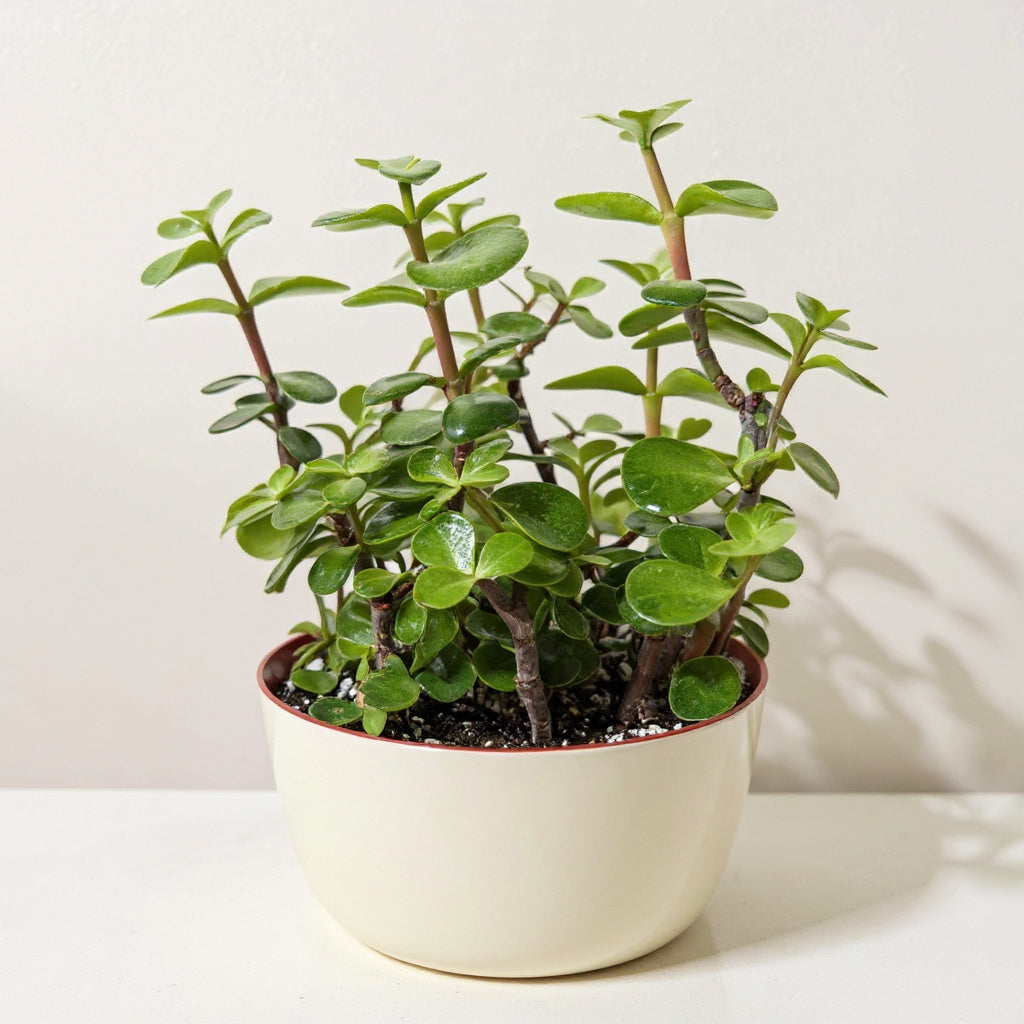
elephant succulent Succulent 'Elephant Bush' 4" Pot

Sale price$19.18 Regular price$21.31
Save 10%

Pay in installments of $5.33 with ShopPay, AfterPay and Klarna

Shipping Estimate
USA
  • USA
  • CAN

Ships within 48 hours · Estimated delivery Oct 1 - Oct 6

Promo Codes Available:

For Your Every Summer RSVP, with Code: SUMMER15

Description

elephant succulent Succulent 'Elephant Bush' 4" PotBotanical Name: Portulacaria afra Common Names: Elephant Bush Dwarf Jade Porkbush Spekboom Mini Jade Plant The Portulacaria afra 'Elephant Bush' delights with its vibrant green, perfectly round succulent leaves that create a lush, tree like appearance while requiring virtually no care to thrive. This charming South African native features thick, glossy jade green leaves densely packed along sturdy brown stems, creating an adorable miniature tree

Botanical Name: Portulacaria afra

Common Names: Elephant Bush • Dwarf Jade • Porkbush • Spekboom • Mini Jade Plant

The Portulacaria afra 'Elephant Bush' delights with its vibrant green, perfectly round succulent leaves that create a lush, tree-like appearance while requiring virtually no care to thrive. This charming South African native features thick, glossy jade-green leaves densely packed along sturdy brown stems, creating an adorable miniature tree effect that brings year-round greenery and natural sculptural beauty to any indoor space with remarkable drought tolerance.

This exceptional drought-tolerant beauty combines vibrant green elegance with unmatched low-maintenance care, making it perfect for busy plant lovers, beginners, frequent travelers, or anyone seeking a resilient plant that thrives on neglect. Enjoy year-round lush green foliage that stores water efficiently while maintaining its charming tree-like form - all with complete confidence around your beloved pets and family members.

Complete Care Guide

Light Requirements ▼
  • Bright, indirect light promotes healthy, vibrant green growth
  • South or west-facing windows provide ideal growing conditions
  • Tolerates direct sunlight and adapts to various light levels
  • Some direct sun enhances the glossy green leaf color
  • Extremely adaptable to lower light conditions indoors
Watering Instructions ▼
  • Water deeply but infrequently - allow soil to dry completely
  • Extremely drought-tolerant and thrives on neglect
  • Can survive weeks without water once established
  • Overwatering is the only real threat to this hardy succulent
  • Water even less frequently in winter months
Humidity & Temperature ▼
  • Low humidity: 30-50% - thrives in dry conditions
  • Temperature range: 65-85°F (18-29°C) with excellent heat tolerance
  • Tolerates dry indoor air exceptionally well
  • No special humidity requirements needed
  • Avoid temperatures below 50°F (10°C)
Potting & Fertilizing ▼
  • Use well-draining cactus/succulent potting mix
  • Ensure excellent drainage with pots that have drainage holes
  • Feed sparingly - monthly during growing season only
  • Prefers to be slightly root-bound for best growth
  • Repot only when severely overcrowded, every 3-4 years
Propagation & Maintenance ▼
  • Incredibly easy to propagate from stem or leaf cuttings
  • Cuttings root quickly in dry soil or even just sitting on top
  • Can be pruned and shaped like a bonsai tree
  • Remove any dead or yellowing leaves as needed
  • Fast-growing and extremely forgiving of mistakes

Styling Ideas for Your Elephant Bush

Bonsai Styling
Perfect for pruning and shaping into miniature trees
Succulent Gardens
Beautiful centerpiece for drought-tolerant collections
Bright Windowsills
Thrives in sunny spots where other plants struggle
Low-Water Displays
Perfect for busy lifestyles and frequent travelers

Shipping & Potting Information

Your plant ships in its current nursery pot and will need to be repotted into a decorative container of your choice. The beautiful ceramic pot shown in the product images is for styling inspiration only and is not included with your purchase. This allows you to select the perfect decorative pot that matches your home's unique style and décor.

Frequently Asked Questions

How is Elephant Bush different from Jade Plant?
While they look similar, Elephant Bush has smaller, rounder leaves and grows faster than traditional Jade plants. It's also more drought-tolerant and easier to care for, making it perfect for beginners who want the jade plant look with even less maintenance.
Can I really neglect this plant?
Yes! Elephant Bush is one of the most forgiving plants you can own. It actually prefers to be forgotten about and can survive weeks without water. The biggest mistake people make is overwatering - this plant thrives on neglect.
Can I shape it like a bonsai tree?
Absolutely! Elephant Bush is excellent for bonsai-style pruning and shaping. It responds well to trimming and can be trained into beautiful miniature tree forms. Regular pruning encourages bushier growth and maintains the desired shape.
Is this plant safe around pets and children?
Yes! Portulacaria afra is completely non-toxic to cats, dogs, and humans, making it a perfect worry-free choice for families who want to enjoy its vibrant green foliage and low-maintenance beauty safely throughout their home.
How fast does Elephant Bush grow?
Elephant Bush is a relatively fast-growing succulent that can develop into a substantial plant within a year or two with proper care. Its quick growth makes it very satisfying for beginners who want to see results relatively quickly.


Shipping Notes
  • Free Standard Shipping on $100+ Orders to the USA.
  • Except Preorder products are shipped in 48 hours.
  • Delivery to the USA:
  1. Standard Shipping : 3-10 business days
  • If time is of the essence, please consider selecting expedited delivery for faster service.
Exchange/Return Notes
  • We offer a 30-day return/exchange service after receiving.
  • Final sale items are not eligible for returns or exchanges.
  • To process your return/exchange, please contact us at [email protected]
  • Please click here for more details>>> Return & Exchange Policy
SKU: 725181280

Discover Niche Categories That Outsell elephant succulent

Top-Converting Item to Boost Your Average Order

4.2 ★★★★★
Based on 6 reviews
Sort
Highest Rating
Newest First
Oldest First
Product Reviews
J
Verified Purchase
James Ferguson
Lake Worth, US
★★★★★ 4
A Brave New World
Format: Hardcover
It wasn't quite what I expected, but Charles Mann leads the reader on a fascinating journey in the wake of Columbus, focusing mostly on the environmental impact of his "discovery" of the New World. Mann literally spans the globe, as the establishment of Spanish colonies in the Americas would have far reaching consequences. Most interesting to me was how silver came to be the currency of exchange, allow Spain to trade with China, when it established its trading outpost in the modern-day Philippines. Along with silver, came corn, rubber and potatoes which would radically alter the landscape of the world. Mann discusses how corn came to replace rice for many Chinese, and how rubber trees would be transplanted to Indochina, bringing with them unsuspected pests that would wreak havoc on ecosystems. In this sense, the book has similarities with Jared Diamond's but explores different terrain. One of the most interesting chapters was on the highly profitable mining of bird guano and how the British cornered the market in this new fertilizer. Mann describes how the shift to mono-cultures had a tremendous impact on agriculture. At first, these new crops seemed to solve much of the world's food shortages, but then as the Irish famine made all too painfully aware, putting all your "eggs in one basket" can lead to devastating consequences as an unforeseen blight wiped out much of Ireland's food supply. Mann also offers a long study on how slavery evolved and re-shaped the ethnic identity of many countries, particularly those in Central and South America. The miscegenation that took place, with particular focus on Brazil, reshaped cultural patterns and changed the political dynamics in these countries. He offers a number of intriguing case studies, and discussed the long term impact of this human cross-pollination. 1493 is a fascinating study and meditation on life after Columbus. We don't fully realize how rapidly the world changed after this fateful "discovery," and how continents became so interdependent, where before they had been relatively isolated from each other.
WAS THIS REVIEW HELPFUL?YesReportShare
Reviewed in the United States on April 30, 2012
R
Verified Purchase
Russell C.
Grantham, US
★★★★★ 5
Great History book
Format: Paperback
This book was a gift for husband. He loves it. He is a slow reader, but he can’t put book down. New and interesting history facts and stories.
WAS THIS REVIEW HELPFUL?YesReportShare
Reviewed in the United States on February 6, 2026
J
Verified Purchase
John D. Cofield
Waukegan, US
★★★★★ 5
Consequence After Consequence
Format: Hardcover
"In Fourteen Hundred Ninety Two, Columbus Sailed The Deep Blue Sea" is a ditty sung by generations of school children. Most of those students learned and believed that Columbus was the only man in Europe who believed the world was round and proved it by sailing three ships west to find the East. In 1493, Charles C. Mann dismisses these legends and goes on to demonstrate that Columbus (or as he refers to him, Colon) and the other Europeans who sailed across the Atlantic in the 1400s and 1500s did far more than just discover a New World, they helped create a planet wide system in which people, plants, animals, and diseases travelled further and were linked in more ways than had ever before been possible. In other words, 1493 was the beginning point of a new age of globalization. This is not a new theory. Alfred W. Crosby developed the term Columbian Exchange back in the 1970s to describe the changes that took place after 1492. Jared Diamond's Guns, Germs, and Steel and Collapse also detailed some of the consequences of the European "discovery" of the Americas. What makes Mann's new book so appealing is his ability to tell an engrossing story that ably explains how one consequence led to another, fundamentally changing society after society and helping to creat our modern world. This is global history at its best, jumping from Ming and Qing China's opulent but troubled societies to the fast growing but still relatively backwards European states to the myriad African and Native American cultures, all of them to be affected by the transfer of peoples, plants, diseases, and ideas. Mann has a keen eye for an appealing and informative anecdote which really details the consequences of seemingly small decisions, such as how the introduction of the sweet potato to China led to deforestation, or how the Little Ice Age was affected by the abandonment of the Native American practice of burning off underbrush in North American forests. Its books like 1493, as well as Mann's earlier and equally excellent 1491, which make studying history so fascinating. I taught Advanced Placement World History to high school students for many years before retiring, and I regularly amused them (at least I hope I did) with many references to Jared Diamond and Alfred Crosby's ideas. With 1493 Charles C. Mann deserves equal recognition by global historians.
WAS THIS REVIEW HELPFUL?YesReportShare
Reviewed in the United States on August 19, 2011
V
Verified Purchase
Victor Vögel
Birmingham, US
★★★★★ 5
Mesmerizing; shows the butterfly effect in action
Format: Paperback
Charles Mann’s “1493” is about globalization and the Homogenocene epoch. Unlike the plenitude of other recent books about globalization, however, “1493” is about biological globalization rather than economic globalization. The book traces the results of the Columbian Exchange, with chapters devoted to tobacco, the earthworm, malaria, silver, potatoes and sweet potatoes, guano and rubber. The book is in four parts, and is written in an accessible, non-academic style. I found the first three parts of the book, which cover the impact of the Columbian Exchange on the Atlantic, the Pacific and Europe, respectively, to be captivating. These parts of the book demonstrated the fascinating interconnectedness of all things in a globalized society (in other words the “butterfly effect”) – for example, how transporting the sweet potato to Western China led to population migrations from Eastern to Western China, deforestation and overflowing of the Yellow River. The general result of such biological globalization is the creation of the Homogenocene epoch, a term which Mann uses to describe the biological homogenization that has replaced biological diversity since the time of Columbus. In the first three parts of the book, Mann demonstrates how history, biology and chemistry are all interrelated, and how today’s world continues to be influenced by the Columbian Exchange. I found the last part of the book to be less impressive than the first three parts. Part Four is called “Africa in the World,” but confusingly it is about South America, not Africa. Parts of it read more like travel writing than history. Still, the book deserves five stars for the first three thrilling parts, which successfully trace the mesmerizing history of various everyday biological substances.
WAS THIS REVIEW HELPFUL?YesReportShare
Reviewed in the United States on December 31, 2017
J
Verified Purchase
Jamie Barnett
Boise, US
★★★★★ 3
There were periods I was on the edge of my seat. There were times I just wanted to the book to end.
Format: Paperback
I recently started reading at 40 years old to make up for a lot of wasted time and missed education. This is a very informative read, but that said, I had a hard time staying focused sometimes. He gets into a lot of the science pertaining to plagues, epidemics etc which is interesting and I am reluctant to list science as a con as I did learn, but frequently found myself scrolling through several pages just to get the main idea behind the historical part. There were periods that I was on the edge of my seat and there were times I just wanted to the book to end. 1491 was similar. Both useful books, but a bit challenging to follow along especially if you are only reading small amounts at at time like on break at work etc. It jumps around from S. America, N America and China all through the book. I would have preferred that each region be separated. I get that he had his reasons. I am glad I read both books, but I probably should have gone with more of an overview vs the more in-depth content in this. I do not regret reading both books however, and recommend if you already have a good knowledge of this subject and are just trying to learn a little more. I found the information about the slave trade, the most interesting and wasn't aware that the majority of slaves shipped over from Africa went to Mesoamerica and the Caribbean. I also did not realize that plague and sickness really enabled use of African slaves as they were not prone to malaria like the Europeans. There is also some good info about ancient China and also sliver and mercury mining with South American Indians which made the book worth it for me.
WAS THIS REVIEW HELPFUL?YesReportShare
Reviewed in the United States on March 7, 2023

recommand products