SKU: 73847604277
anthurium pedatoradiatum mature

anthurium pedatoradiatum mature Anthurium pedatoradiatum 'Fingers' – Deeply Divided Strap Leaves

Sale price$22.25 Regular price$24.72
Save 10%

Pay in installments of $6.18 with ShopPay, AfterPay and Klarna

Shipping Estimate
USA
  • USA
  • CAN

Ships within 48 hours · Estimated delivery Jul 31 - Aug 5

Promo Codes Available:

For Your Every Summer RSVP, with Code: SUMMER15

Description

anthurium pedatoradiatum mature Anthurium pedatoradiatum 'Fingers' – Deeply Divided Strap LeavesAnthurium pedatoradiatum Fingers Anthurium pedatoradiatum Fingers is a divided leaf Anthurium with mature blades that spread into radiating lobes. The botanical species is Anthurium pedatoradiatum; Fingers is a trade nickname for the segmented foliage. Its epiphytic roots need a loose substrate, airflow through the pot and careful watering. As the foliage matures, the lobed blades need side space to expand without tearing or folding against nearby

Anthurium pedatoradiatum ‘Fingers’

Anthurium pedatoradiatum ‘Fingers’ is a divided-leaf Anthurium with mature blades that spread into radiating lobes. The botanical species is Anthurium pedatoradiatum; ‘Fingers’ is a trade nickname for the segmented foliage.

Its epiphytic roots need a loose substrate, airflow through the pot and careful watering. As the foliage matures, the lobed blades need side space to expand without tearing or folding against nearby plants.

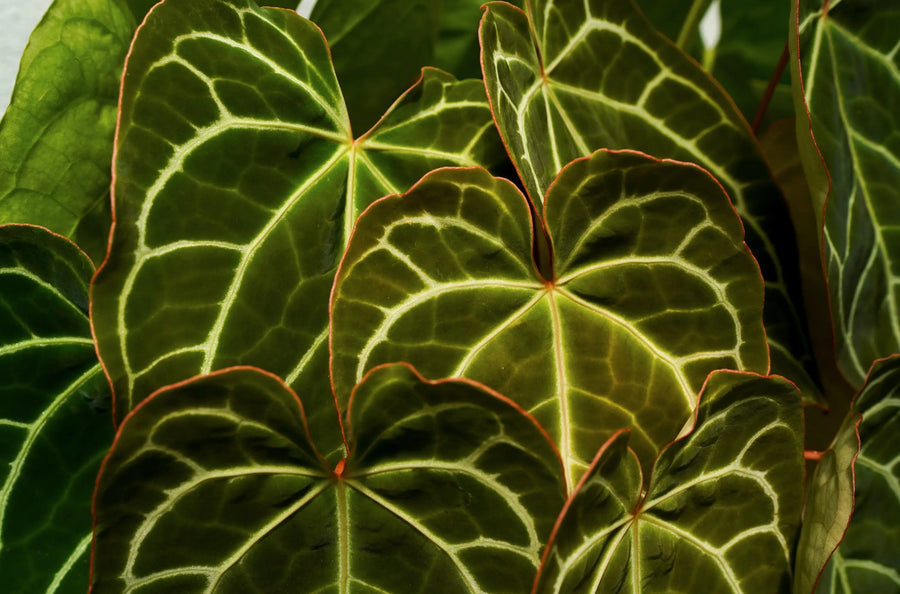
Radiating leaves on Anthurium pedatoradiatum ‘Fingers’

  • Leaf form: Mature leaves divide into narrow lobes arranged around the blade.
  • Leaf spread: The segmented blades need side space as the plant develops.
  • Native range: Anthurium pedatoradiatum is native to southern Mexico.
  • Growth habit: The species grows as an epiphyte, so its roots need an airy substrate.
  • Indoor setup: A loose substrate and careful watering suit its epiphytic root habit.

How Anthurium pedatoradiatum ‘Fingers’ develops

Smaller plants may show less divided leaves before the mature outline becomes stronger. As it sizes up, the blade opens into radiating segments and gives the plant a wider outline.

The divided edges can catch during transport, cleaning or tight shelf placement. Keep the plant where the leaves can expand freely and where the potting mix dries evenly between waterings.

Care for Anthurium pedatoradiatum ‘Fingers’

  • Substrate: Use an open epiphyte-style Anthurium mix with bark, coco chips and porous mineral components.
  • Light: Give bright filtered light. Harsh sun can scorch exposed lobes and new leaves.
  • Water: Let the upper part of the pot dry before watering again, then drain fully.
  • Humidity: Moderate to high humidity reduces tearing and sticking while divided leaves expand.
  • Warmth: Keep it warm and avoid cold, saturated roots.
  • Placement: Leave space around the plant so the lobes are not pressed against neighbouring pots.
  • Feeding: Feed lightly in active growth once the root system is established and the plant is producing leaves.

Problems on Anthurium pedatoradiatum ‘Fingers’

  • Limp or yellow leaves: Check for a potting mix that stays wet too long or lacks air around the roots.
  • Brown tips: Moisture swings, dry air or stressed roots can show first on the divided leaf edges.
  • Torn lobes: Mature leaves can tear when crowded, rubbed or handled roughly.
  • Stretched petioles: Very low light can produce longer, weaker growth.
  • Pests: Inspect petiole bases and the underside of lobed leaves for thrips, mites and mealybugs.

Safety around Anthurium pedatoradiatum ‘Fingers’

Anthurium pedatoradiatum ‘Fingers’ contains calcium oxalate crystals. Keep the plant away from pets and children likely to chew foliage, and wash hands after pruning or root work.

Botanical background for Anthurium pedatoradiatum ‘Fingers’

Anthurium pedatoradiatum Schott was first published in Bonplandia in 1859. The species is native to southern Mexico and grows as an epiphyte in a seasonally dry tropical biome. The epithet pedatoradiatum refers to a pedate, radiating leaf arrangement.

Shipping Notes
  • Free Standard Shipping on $100+ Orders to the USA.
  • Except Preorder products are shipped in 48 hours.
  • Delivery to the USA:
  1. Standard Shipping : 3-10 business days
  • If time is of the essence, please consider selecting expedited delivery for faster service.
Exchange/Return Notes
  • We offer a 30-day return/exchange service after receiving.
  • Final sale items are not eligible for returns or exchanges.
  • To process your return/exchange, please contact us at [email protected]
  • Please click here for more details>>> Return & Exchange Policy
SKU: 73847604277

Discover Niche Categories That Outsell anthurium pedatoradiatum mature

Top-Converting Item to Boost Your Average Order

4.4 ★★★★★
Based on 19 reviews
Sort
Highest Rating
Newest First
Oldest First
Product Reviews
A
Verified Purchase
Amazon Customer
Boise, US
★★★★★ 5
Inspiring and well-written
This is a very interesting book written by some Harvard profs. They did a large national survey of innovative businesses and their leaders. The book posits that innovative people follow five skills: associating, questioning, observing, networking, and experimenting. These skills can be found at the individual or organizational level. The idea is that most people have these skills in their DNA and can bring them out with some practice. There are a lot of interesting and inspiring examples like Steve Jobs and Jeff Bezos. Although this book seems like a self-help type book with a lot of hype, it has an academic underpinning. Any organization that is interested in promoting innovation could benefit from encouraging these 5 skills. If you are interested in innovation or creativity in business or any organization that produces something, you will like this book. The books is a little distracting to read because it has sidebars all through it giving interesting examples that break up reading concentration. Aside from that, it is a well-written book that is easy and enjoyable to read. I enjoyed the book greatly and found it to be inspiring.
WAS THIS REVIEW HELPFUL?YesReportShare
Reviewed in the United States on December 5, 2015
S
Verified Purchase
Stephen Collins
Omaha, US
★★★★★ 4
Great read and research. But what about daily application for regular people?
The research piece behind this book might be the next thing I read, as I'm intrigued by the academic rigor applied. The reveal and living examples of the five skills - questioning, networking, experimenting, observing and associating - are tangible and approachable given their articulation through well-known and highly visible entrepreneurs running innovative companies. There's much to be gleaned by looking at the way these people behave and, even through simple emulation, enhancing one's own skills. My only real disappointment with the book is its limited approach to practical, daily application for those not yet at the top of the tree. It's rather a different kettle of fish for the innovation-minded, but stuck in bureaucracy, worker who wants to make things better, is still motivated, and hasn't been crushed by the machine. How does that person actively innovate? And, in some cases, get away with it? This book (or an accompanying volume) focussing on daily, in-work, innovation would be useful.
WAS THIS REVIEW HELPFUL?YesReportShare
Reviewed in the United States on May 23, 2013
A
Verified Purchase
Annette
Los Angeles, US
★★★★★ 5
A Favorite Book on Innovation
Format: Hardcover
Very well written and enough stories to help the true content stick. This is a favorite book of mine and has lead to interesting conversations to boot.
WAS THIS REVIEW HELPFUL?YesReportShare
Reviewed in the United States on September 29, 2025
K
Verified Purchase
Kurt Manwaring
Whiting, US
★★★★★ 5
An exceptional five stars out of five
Few qualities separate inordinately successful entrepreneurs from the rest of the pack than the ability to innovate. Many have debated whether individuals are born with this quality or whether it can be nurtured. In The Innovator's DNA, Jeff Dyer, Hal Gregersen and Clayton Christensen explain that while genetics play a role, innovation is most certainly a skill that can be learned. In particular, the authors introduce and expound upon five "discovery skills" found in the leaders of some of the most innovative companies in the world: (1) associating, (2) questioning, (3) observing, (4) networking and (5) experimenting. Each discovery skill is accompanied by real-world examples and pragmatic exercises that make the book unusually valuable in an age where copious books on change, leadership and innovation overwhelm the already-overwhelmed executive. I give The Innovator's DNA an exceptional five stars out of five. The authors present a very readable book and provide concrete exercises for developing innovative skills. Using the principles provided in the book, I created a folder on my computer that I call my "Innovation Room." I use this to track progress as I work through various exercises and as I take time to ponder about how to apply innovative solutions to extant problems in Utah. This book was and will continue to be useful to me, and is recommended as a must-read for those interested in adding rare innovative attributes to their arsenal of problem-solving and decision-making skills. *NOTE: The preceding text is taken verbatim from my short book review printed in the June 2012 edition of Utah Business.
WAS THIS REVIEW HELPFUL?YesReportShare
Reviewed in the United States on March 22, 2013
K
Verified Purchase
Kocese
Whiting, US
★★★★★ 3
It's Ok
It's an ok book and it definitely has some interesting things going on it, but it also has those "ask yourself" these questions if you can be an innovator which is where every human being ponders and talks themselves into having the type of characterisitic the question asks if they have and that makes that human being feel the best about themselves. Bottom line the book has some good info, is it better than say reading the biography of each innovator that they cover (if one is available)....I can't say that it is.
WAS THIS REVIEW HELPFUL?YesReportShare
Reviewed in the United States on May 2, 2013

recommand products